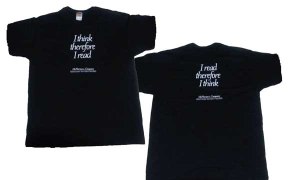
Voices of the Book of the Dead & Vitality

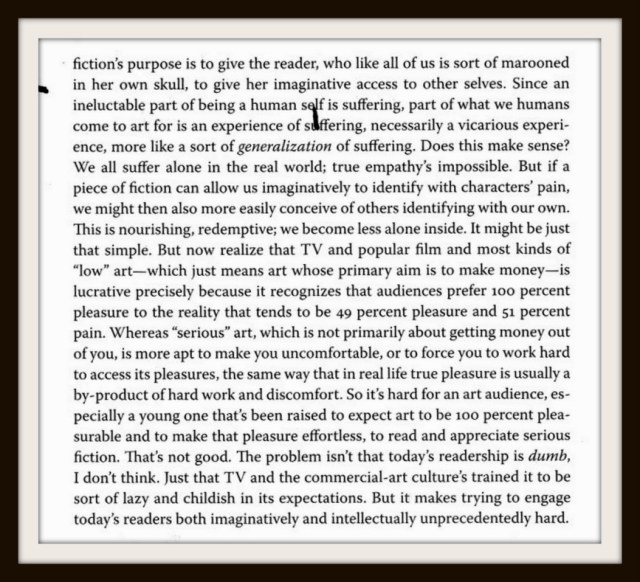
I have to agree that one major thing I have never been able either to tell when talking with others, nor explicate when trying to share – about writing, the activity – is the pleasure.  For me, if I can move my experience of the world into language and there let language create a new experience with world for me, whether I’m miserable or joyous, in tedium or ennervated, things feel alright with the universe.  Sometimes even if I’m just drawing letters onto paper, words or not, phrases or not, discernable meaning or not – I still feel fine.  But then, if there seems like a resonant flow – if the language available and the experience felt engage recursively – there truly IS nothing quite like it in my experience of life.  David Foster Wallace says it this way, and I’ve heard similar attempts come out of my mouth:

“When I discovered writing I discovered a thing that gave me a combination of fulfillment (moral/aesthetic/existential/etc.) and near-genital pleasure I’d not dared to hope for from anything”

that rang exactly true for me….and…

“when i’d sit down and look up and it would be hours later and there’d be this mess of filled-up notebook paper and I just felt wrung out and well-fucked and, well, blessed.”

I probably wouldn’t blog that term (“blessed” or “f*@ked”), but there it is, and again, it does come as close as I can think to that satisfied, dizzying, emptied loose feeling that comes from a safe and open, intense and releasing session of writing.  I am thinking that the words “combination” and “pleasure” and “fulfillment” do the most to describe the process and experience of experimenting and experiencing in language for me.  And it is very similar to sexual intimacy, because once you have moved into the other (in this case, language) – the other has as much to do with, as much control over, as much effective presence in, the beauty and sense of meaning of, content and activity of the process and results or engagement as you – the writer – do.

Making it with the world is one of those weird mysterious ecstasies that are incomparable and indescribable.  I would be deceptive if I said that anything were “better” than it, though it has (in our limited emotional/emotive base) many similarities to being “spent” with one’s spouse, or those rare and profound connections with one’s children – I guess it ought to make some sense that intimacy-with would draw from the same human wells.  There is a quiver of experiences that no one speaks of without a touch of awe, a befuddled amaze, or a glad bafflement, and for me, the activity of reading and writing is one of these.
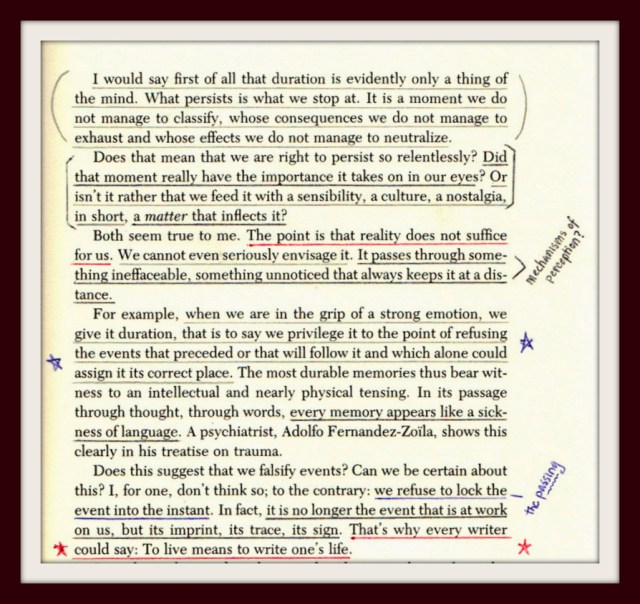
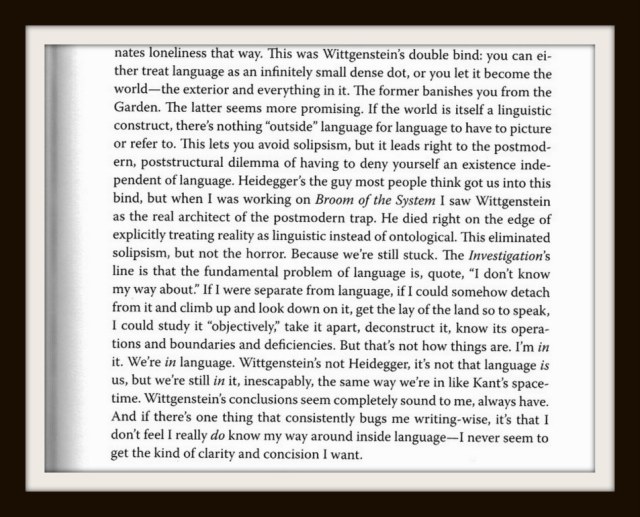
Book of the Dead + commentary, cont’d.

This person makes an enormous difference in my life.

Endnotes: David Foster Wallace (BBC Documentary) – YouTube.

Strange Alchemy

Excerpt from the Book of the Dead – Jabes (replete with traces)

Edmond Jabes - from "The Cut of Time"
Edmond Jabes – from “The Cut of Time”

“Why render that experience through fiction?  First, because we are only fiction.

We are only the idea we have of ourselves.”

-Edmond Jabes-

David Foster Wallace – Salon.com

an interview of interest – worth an attentive read

David Foster Wallace – Salon.com.

Another Fragment…

David Foster Wallace in conversation with Larry McCaffrey

Pieces from the Book of the Dead

David Foster Wallace, from Conversations with David Foster Wallace

“Bless Babel.”

Below I am going to share with you an essay that I promise is worth every hour or two you lend your attention to each paragraph.

It is written by this person:

(Donald Barthelme)

and it is called: Not Knowing

from his collection of the same name.

it contains statements like the following:

“Any work of art depends upon a complex series of interdependences”

“tear a mystery to tatters and you have tatters, not mystery”

“What is magical about the object is that it at once invites and resists interpretation.  Its artistic worth is measurable by the degree to which it remains, after interpretation, vital – no interpretation or cardiopulminary push-pull can exhaust or empty it”

“The combinatory agility of words, the exponential generation of meaning once they’re allowed to go to bed together, allows the writer to surprise himself, makes art possible, reveals how much of Being we haven’t yet encountered.”

“Art is a true account of the activity of mind”

“The aim of meditating about the world is finally to change the world”

and so forth.

Please understand me, if you maintain a blog, take photos, love your children, think about your self or the world you live in, dialogue with books or pictures or animals or people or movements…

take a little time to read this

Thank you.

  Not Knowing


Enough about Writing…


Came across this article…seems to jibe with many blog discussions/posts floating about out there just now…thought I’d like to share it.  It’s a bit dated in places, but the overall concept seems worth your ruminations….

Introduction:
Why Books?
LIBRARIES 2000
Libraries 2000, a seminar to re-examine the function and future
development of libraries in Alberta, was held in 1983. A committee
consisting of representatives of Alberta Culture, the Alberta Library
Board, the Alberta Library Trustees Association, the Library Association
of Alberta and the Learning Resources Council of the Alberta
Teachers Association was set up to look into ways of following
up on the suggestions arising out of the seminar. This is the second
booklet commissioned as a result of these discussions.
Public libraries have long attempted to fulfil many functions and
roles in our society. As financial and human resources have become
harder to obtain, librarians and library trustees have had to give
more attention to examining these roles and assessing their relative
worth. In recent years, there has been increasing discussion of the
public library as an information provider, but less discussion of the
more traditional view of library service.
Sam Neill is a professor at the School of Library and Information
Science at the University of Western Ontario, London, Ontario.
This booklet is based on a speech delivered at the Ontario Library
Association Conference, Ottawa, 1984, entitled “The Role of a
Traditional Library in an Age Bludgeoned by Information.” The
opinions and ideas expressed are those of the author and do not
necessarily represent the view of Albe11a Culture, or the Alberta
Library Board. The assistance of the Alberta Library Board in editing
and printing this booklet is gratefully acknowledged .

Why Books? by Sam Neill

(click for full article, please)

dove-tailing ever-so-nicely with another book I stumbled across in the library (which also contains a fine consideration of David Foster Wallace in one of the chapters), and considers, I think, the same sorts of issues of humaneness and being alive meaninfully:

In Memoriam – to a Master

The Great Fires

Love is apart from all things.
Desire and excitement are nothing beside it.
It is not the body that finds love.
What leads us there is the body.
What is not love provokes it.
What is not love quenches it.
Love lays hold of everything we know.
The passions which are called love
also change everything to a newness
at first. Passion is clearly the path
but does not bring us to love.
It opens the castle of our spirit
so that we might find the love which is
a mystery hidden there.
Love is one of many great fires.
Passion is a fire made of many woods,
each of which gives off its special odor
so we can know the many kinds
that are not love. Passion is the paper
and twigs that kindle the flames
but cannot sustain them. Desire perishes
because it tries to be love.
Love is eaten away by appetite.
Love does not last, but it is different
from the passions that do not last.
Love lasts by not lasting.
Isaiah said each man walks in his own fire
for his sins. Love allows us to walk
in the sweet music of our particular heart.

Jack Gilbert