Here are the beginnings of a sort of alternate telling of the past 6 months of life around these parts….
Invisible Man Narratives
Six months ago, things was different. That’s how he says it, he says “things was different then.” He says about Kansas, he says, “…see ‘cause in Kansas they’s got exemplary seasonal cycles,” he says. He says “in Kansas they depend on them cycles and they is distinct and prominent,” he says. He says “you get yer harsh and bitter subzero Winters replete with blistering blizzards and crackin’ pipes…” he says that – he says “replete” – would you believe it? “And hell-hot dry and blowing Summers with readings oft above 100,” he says, “an’ then ya got yer gradual, colorful clear and moisty Autumns where things fall apart and die, fall apart and die,” he says. “And then them explosive Springs – redolent, verdant and blowin’ up and apart,” he says – and he truly do say “redolent” and “verdant” just you believe me – I’ll be sayin’ to ya just like he says it, that’s my job – I’m just Mr. Dudtnitz’ tangible voice, as you might have it – I listen and repeat it, sometimes askin’ clarification, sometimes just writin’ it down, but always – always – I swear it, just likin’ he says it.
I asks him, I asks – “how was it different six months ago, Mr. Dudtnitz?” I says. And he starts talkin’ ‘bout them seasons and Kansas and how landscapes set up the visible shape of any man’s life and outlook and how all those seasons changing so “drastically” and them all dependin’ on them for “crops and cash, cows and copin’”, and his own life fittin’ right into them seasons: “six months ago I was deep in a drizzlin’ fog, a drizzlin’ fog of grief” he says, “stuck in a rainy Spring and things warmin’ up and me all set to hibernate where I was,” he says, “but that Spring don’t care, them Kansas seasons don’t stop fer shit,” he says, “so here I am,” he says, “hunkerin’ into Spring, delightin’ in a wet and frigid Winter and fixin’ to stay there – lost my love, no work, found myself in foreign lands, failin’ at everything I got goin’- my kids, my marriage, my thinkin’, and it feels real good in a bad way – y’know? Like I’s right where I’s doomed to be – stuck in a drizzling cold, cain’t see fer shit, just swirlin’ like dirty snow, blusterin’ and stickin’ and meltin’ away in some grey fuggy existence.” (He uses them terms, he do, this Mr. Dudtnitz. He’s native Midwestern, but he done a penis-ton of travelin’ and learnin’ and spices up them stories he tells with education he took in around the globe – I swear I never add a term or tale to the things he tell me).
Tell me more about that, I asks him – tell me more about what the seasons – er, y’know – about your seasons the past six months, I says to him, Mr. Dudtnitz.
“Well, hell,” he says, he says “I lost me the love of my life, one I been pinin’ for for near twenty years or more, one I wooed and got to come here to the Midlands from the plush piney Northwest, one full of learnin’ and paintin’ and a whole kitter of arts and sciences, she was,” he says. “I somehow finds her here in the Midlands, the Plains, straight out from mountains and forests and rain,” he says, “and here she is paintin’ on my porch, therapizing myself and my children, learnin’ us emotions and dreams and feelin’s and such,” he says, “and I start back to school to learn some more, to be a scholar, to be ‘of refined mind,’ pursuin’ my philosophy and science, humanities and arts,” he says, “and we set up places in the ol’ home to read and write and paint and study,” he says, “to mix and match, blend and blur all the things it is that we love to do,” he says, “and we drop out and hone in on what we love,” he says, “together we fix ourselves on each other, on learnin’ and makin’ and bein’ and relatin’,” Mr. Dudtnitz explains. “And it was a helluva thing,” he says, “a helluva thing indeed.”
What happened next? I asks Mr. Dudtnitz – a bearded, dusty, unkempt man with smart-looking glasses like from over the sea somewheres, some strange mix of Earthman and Philosopher-Poet with them four kids trailin’ around him wherever he goes – what happens next? I asks him. And he carries on with a tale about love and satisfactions, nerves and energy, landscapes and comfort zones until he gets to the business about when that Nor’wester takes off to visit her kin and writes to him that she ain’t comin’ back, that she don’t like the way he thinks and acts about life and morals, don’t trust him, cain’t trust him, won’t trust him, and lessin’ he alter his ways inside to out, she’s gotta go her own ways. Well Mr. Dudtnitz had been thinkin’ he had altered his ways, altered them a great deal in fact, quittin’ on the bottle, quittin’ on the smokes, quittin’ on seducing whatever caught his imagination, intelligence, antiquities and fancies – Mr. Dudtnitz thought he done about changed whatever a man could change to be alright with a girl, so, as he tells it, the bottoms simply gave out, a “kind of perpetual Fall – falling apart, drifting along, swirling in Winter, in cold, in the way of things dyin’,” he says.
But the seasons ain’t ever over, is the thing, he explained to me. They keep cyclin’ around, circlin’ in a way, but spiralin’ more, he says to me, pushin’ and changin’ and changin’ things in a similar way all around and within. And you don’t even need seasons, Mr. Dudtnitz says, “no, it’s simply the ways of things,” he says, “they change and change and never quit doin’ that,” Dudtnitz says to me. So “all stuck in that grey veil of a cosmos,” trying to keep and raise his kids, trying to find work to find a way to do that, tryin’ to keep up with his learnin’ he was midway on further in to, tryin’ to keep a house, a home, a “self or two” and some sanity, Mr. Dudtnitz plugged ahead, “robotin’ it through the fog,” he says, “just breathin’ and thinkin’ and breathin’ through the thinkin’,” in order to survive one thing or another, is how he tells it to me. And I believes him. I believes him, ‘cause he never say bad about the shit goin’ on, what peoples do, what befalls him, what shakes up the seasons in naturally unnatural ways – he just says what happens the ways he feels it and tries to tell me how them changes and “fluctuations” and “undoings and revisions,” is simply “the way things get along,” the “ways they function to bewilder us,” he says, “the ways they remind us that we ain’t prepared, that they ain’t no way to be prepared, that we just swirlin’ in the seasons like the rest of things,” he says to me, and I believes him, that wily Mr. Dudtnitz with the finaglin’ brain or mind or body, he kinda mixes it all together when he talks to ya, you see, kinda hard to follow, yet strangely compelling and convincing, even when he ain’t tryin’ to convince you of anythin’.
When Mr. Dudtnitz agreed to tell me his story, he said I had to visit Kansas in every season before he would disclose his own personal path. Late July through August, mid to late October, January and the end of March into April were the times he specified. Dudtnitz explained that his narrative wouldn’t make any sense to someone like me unless I had seen Kansas at all times of the year. “There’s times Kansas looks for all the world like it gone completely dead,” Mr. Dudtnitz explained, “and days later smells like it has always been green.” “This is what I’m a-tryin’ to get at,” Dudtnitz carried on, “it took a very long time for me to understand the life in things ain’t in the rain or the sun, not the soil or sky or seed – it’s fixed right into the mix of it all, the changin’ and the this-doing-this-with-that-with-this-and-that-and-the-other all churnin’, stewin’, blendin’ and actin’ with each others,” he says. “I had it in me that my life was tied to the presence or absence of the right season, optimal conditions, fortuity and such,” he says, “but I learnt finally, or maybe some little bit, that the sky, the soil, the season, the man, the woman, the child and animal all got it in ‘em all of the time, it jus’ rises and falls, goes dormant then blooms, burns off, drowns out, sprouts up, all given them activity-conditions of everything ‘round about,” he says.
“So here I was thinkin’ I was done and dead, curlin’ away in a dampy dark cave, face to the stale like a miner goin’ down while coughin’ up blood,” he says. “I determined to give on up on love, on relatin’ intimate-like, on adult partnerships,” he conveys, “and bolstered myself like some old Westward expansion man – a job to do, a body to do it with, a mind to still – like that,” he says. “And I moved on in to Spring tryin’ to calm my kiddos, keep ‘em safe and close, tell ‘em everything’ll be alright, we’ve been through all this before, weepin’ in my bedroom, drivin’ my car, whenever alone with myself, seekin’ professional help, breathin’, breathin’, breathin’, and thinkin’ kinda thoughts like what pays attention to what’s good.”
“I done applies for 362 jobs with all the learnin’ I got,” he says, “and get back nothin’ but a few interviews and a lot of ‘nice to meet ya’s’ and mostly just nuthin’,” Dudtnitz relays. “Then one day I get a job for the U.S. Postal Service – drivin’ mail way out in the countryside to them folk that live miles away from each other tendin’ farms – and I takes it.” “I figger it’ll give me time to think on things, I’m doin’ somethin’ I always thought important and admired, and if’n I can get enough days work, I can make it go on the house and children.” “At near the same time I gets a message that someone wants my mind and language for a project that might even bring in a little cash, and at this point I says yes to everything, anything that might feed the little ones and keep us housed.”
He explains that now we’re talking about late March to April in my calender’d visits. Something swells in the air and land, he says, everything is blowing and stirring, and you better believe it – it won’t be long before something pops real big – change like destruction sweeps the place, he explains to me. “And sure enough,” he says, “I walks into this kitchen on this lovely quiet farm where this artist fellow works, in order to meet the artist lady I’m hired to construct some response to with my mind and language, and I steps nervous-like – this is the first time I’ve willingly stepped out to meet people, be around people since that frozen January to February of the deadening of things, and I peeks my head round the corner into that kitchen and my breath drops like hail, like a punching bag down toward my loins, like the first rain in Spring, like dead land getting plugged in…there’s this young lady, midriff showin’, hesitant smile, long full head of hair, a touch awkward with folks and a helluva lot breathtaking as I attempted to mention before, and I walked right through and outta that house and into the land – a boom had landed in me and was shaking everything up and around – I wasn’t ready to notice anything, to feel anything, to see anything – I high-tailed it to the fields, the ruins, corn rows and dirt roads, high grasses, anything to get away from that twister, danger, tornado of life Spring rips into a Kansas Winter-ravaged destitution.”
At this point I just let Dudtnitz ramble on – no prodding to the story – we was walking out along a creek and Dudtnitz would kick rocks, pick up bugs, point out wildlife and critters, all the while spinning this yarn of seasonal change and landscape taking charge of our bodies and minds, or somesuch similar. Listen on…
“I never spoke with her, though I was wishin’ to,” Dudtnitz says, “I spent a lotta time talkin’ to her beau though, checkin’ out his thinkin’, seein’ how he cared for that beauty walkin’ ‘round with him.” “Turns out she was hired as well to respond to this visiting artist lady, and a week later or so I was sittin’ in to my first period of training for the USPS, when – what the hell!? – this very same breath-mangling lady was comin’ there too!”
And so on….(to be continued)…
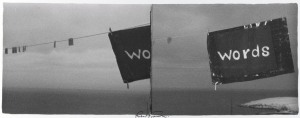


 All my Words are Silent