
Subject to Change

Mail carrier logo

I am become a Rural Carrier Associate for the U.S. Postal Service.

I pursued employment with the USPS thinking it might provide some security of longevity, tradition (over 200 years of continuous service, public benefit, innovation and survival), government benefits and programs…a service and income that might meet the needs my children and I have developed for something like stability and sustenance.

I was wrong about most of those things.

I’m almost guaranteed one day of work a week (or whenever the regular carrier is unable to work) – no benefits, guaranteed abuse and damage to our one essential family vehicle, grave limitations on supplemental work (not supposed to seek employment with anyone that is a client of USPS – in other words, anyone that purchases postage – greatly delimiting the options / NOR taking any work between the hours of 6 AM and 6 PM when I might be needed to fill in) – and, a grand service NOT supported or secured by the US Government since 1970 (no tax dollars toward USPS!).

On the other hand.  It clearly satisfies core ethics and values I have carried through my entire life and its pursuits –  Meaning.  Relationships.  Communication.  Tangible Information.  The Betweens:

Music.  Poetry.  Religion.  Philosophy.  Psychology.  Bookselling (bibliotherapy).  Marriages.  Research and reference.  Parenting.  Writing.  Anthropology.  Semiotics.  Neuroscience.  Embodiment.  Systems Theory.  Language.  Ekphrasis.  Communications.  Information Science…

what (it seems) has fueled them all has been a passion, fascination, curiosity and intense desire to search into, understand, sense

HOW HUMAN BEINGS MAKE AND SHARE MEANING

            NOW:  I’m a tangible link in the chain.  A node or circuit in the web of transmission.


Divorce summons, a lover’s plaint, news of a long-lost classmate or childhood friend, money for a meal, Christmas gifts for grandchildren, links between parents and children, carrier of bills and obligations that alter our lives – invitations to weddings, announcements of deaths, retirements, coupons and births, biological specimens and literary manuscripts, art works, seeds, music, books, clothes and toys…

from here to there, there to here

how often I have rushed to the mailbox,

how often I have posted letters,

how often the holding of a living personal document has made a difference in my life…


These are what I think of as I dig through bins, collocate numbers, sort and file, casing mail, and rattle and drag my way through any weather, mood or condition to securely, confidentially and certainly deliver the mail…

In a great meanwhile…

…after three years working from home like a dream – researching, academics, creative writing and art-making; love with a tremendous spouse, and a generous and flexible availability to my amazing children…

it is now turning into months of spouse-lessness, unemployment, harried by survival efforts, sustenance, hours upon hours of therapy, grief, anger, puzzlement, bewilderment, and wonder…

CHANGE

A sustained period of invaluable interactions and dad-ness will be swallowed up bouncing wash-boarded gravelly roads placing packages and envelopes in sturdy boxes of farms.  Fighting for moments with children, opportunities to claim that I am here for them.  To study.  To write.  To read or rest or be…to grocery and launder, housekeep, to play.

Relocating yet again a sense of home.

            For our part – four kiddos, their mothers (and their partner/spouses) and I (and mine) – we have survived, adapted, adjusted and altered much in the past two decades.  Time/little time, retail/academia/schlepping/poverty/art – proven resilient, pliable, innovative, possible – committed or interdependent on one another and have formed and become, ached and angered, wept and worried, laughed and lost, suffered and rejoiced and survived and thrived…

continued…(“I can’t go on.  I’ll go on.”)

and we’re a pretty wonderful, remarkable, heart-stopping, difficult bunch!


A biological, literate, artistic, psychological, cultural, spiritual, relational, musical, playful, emotional, terrified, successful, wounded, smart, creative, clinical, authentic, unusual, “awkward,” bunch of “weirdies” (kids’ favorite terms)

and I hope and I trust

SURE OF ONE ANOTHER

…ever subject to change…

but together.

USPS logo

In Strange States and Finding Delight : Questions on Being Well and Doing Well

 “Nothing that is complete breathes.”

-Antonio Porchia-

Description:  Flux.  By its very nature, significant change is unsettling, disregulating and life-altering.  Over the past 6-8 weeks I have lost spouse, employment, my personal and relational rhythms and schedule, the savings in my bank account depleted.  I have applied for over 180 jobs, written as many cover letters, tweaked as many resumes, attempted to keep up with my coursework, and take good care of my four amazing children who abide with me.  Each week in therapy (without doubt a literal life-saving engagement) the session will end with something like curiosity at just how uncertain, good, terrifying, significant, painful, frightening, moving, difficult and meaningful the week’s happenings are.  I have felt I am living multiple lifetimes of experience in each 7-day period.  Inherently, overwhelming are experiences that cannot be described, portrayed, understood or explicated.  These are strange statesdevoid of much that could be regulating or structuring, a wild gyre of hope and despair, connection and separation, exhaustion and inspiration.  Strange states.

One of the things that has pestered and picqued me this past week is a growing recognition that most of the people I know – friends, peers, acquaintances, relatives – are people that can DO almost anything well, even exceptionally.  Humans have such an uncanny adaptive ability to (as Kafka says) “wriggle through.”  My people are the sorts of persons who find satisfaction and contentment in being well – the activity of living itself, ever specific to context, is its own contentment and satisfaction, often regardless of what they are doing (it seems).

From early on, many of us were instructed to “follow your passions,” or “use your gifts and talents,” another way, I am thinking, of saying FIND DELIGHT.  Delight, it seems to me, is that tone of experience we incur when both being and doing provide utmost satisfaction and contentment for our individuated and particular “selves.”  Moments such as that first eye contact that seems comprehending, recognizing between the infant you have brought into the world and love so much and yourself.  Moments often termed “flow” – when your ache to express and the form of your expression seem to unite, resonate – in whatever medium you most enjoy – dancing, painting, writing, conversing, thinking, playing, sculpting, calculating, making music, serving others – whatever it is that brings you joy coupling with your own unique history and experience and way of being.

And here’s the rub:  in our authentic relationships, most of us have a good sense between us of what it is that makes our “others” tick, or thrive, their core desires and wishes, delights and strengths.  HOW they like to be WHO they are.  My friends who love to observe and capture beautiful moments, create photographs, artefacts of world/self combined are often selling insurance, teaching classes, running cash registers.  My friends with conceptual strengths and reflective panache – philosophers with ever-evolving ideas and visions of the world and how it functions – are often administering organizations, delivering mail, stocking grocery shelves.  My friends who thrive in drama and play, or sport and music, or math and surfing – end up spending their days repairing roofs or selling shoes, concocting coffee or serving food, mowing lawns or teaching children.  AND THEY ARE EXCEPTIONAL AT WHAT THEY DO!

The rub:  When people are being wellit seems they do well, regardless of whether the task or activity would inherently give them delight.  It is the being that delights them, and they infuse whatever they do with that wonder and wealth.  The query:  is there, when is there, how is there – the possibility of (remember, our lives are brief) – combining our capacities for being well with those things we most enjoy doing well and might that not result in a life characterized by delight ?  Is it possible to insist on?  And is one able to survive?  As I search for work – I realize just how many things I am able to do well – like so many others – and that doing well at things has a certain level of satisfaction because one is being well.  But what joy (remember, our lives are brief) if our lives might be characterized by being well/doing well those things that delight us (nourish our well-being)?  We are social, and because of that our survival depends/inter-depends on one another – and society needs certain things of us – teachers, mail deliverers, food service, grocers, manufacturers, administrators, tax accountants, waste management, shoe repairers, and so on.  We fill these positions FOR one another, for our greater good, making effort to infuse and tweak our responsibilities with as much as we are individually able to also gain some satisfaction and contentment with the ways that we be in those roles.

This question is unclear.  I suppose I am wondering the experience of all of you out there – Is it possible to live a life characterized by delight?  Where we are able to survive being well doing what we most enjoy doing well?  I have yet to fill out the application, sit through the interview for, or see the job posting that asks me to DO WELL WHAT I BE.  Perhaps that is the application of life itself.  Perhaps I will never run across the posting that says – actualize your desire to write – whatever you are compelled to write – and we will make sure you are sustained and healthy.  Any testimonies of conflated being and doing and surviving and thriving out there?

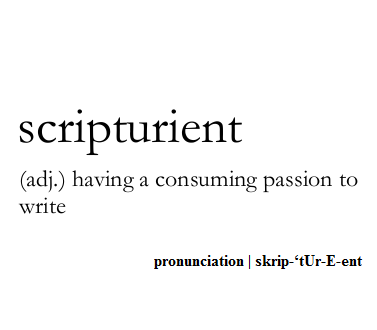
Scripturient“Would there be this eternal seeking if the found existed?”

-Antonio Porchia-

“Determining Gapless Playback”

Might it indeed be we passing through world as world makes its way through us?

In other words, we walk along, and call it “moon,” but once we’ve passed it goes on in its nameless and momentous being?

Likewise “Holly,” “daughter,” “self,” … “being”?

And anything else to which we lend ideas?

If “lending” (for practical purposes)

is not dictation.

.

Incise.  Excise.  Decide. – a definition.

Who of you likes to be told what you are?

Who of us can be?  Even by our (many) selves?


The Idea of Maturity (continued) – “Have a ‘good enough’ day”

“Since early years I have been cursed or blessed with a habit of mind – a character defect it may be – that likes to turn over problems that have no solution, or at least no solution that can be provided outside of thought itself (if there).”

– John Deely, Four Ages of Understanding

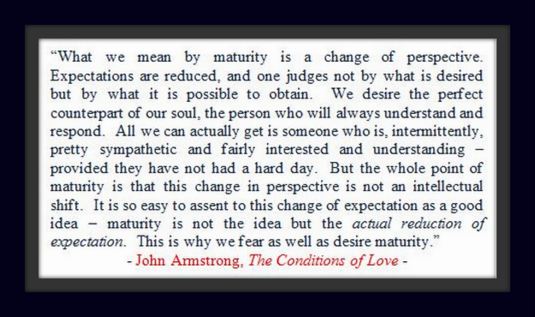
This concept of “maturity” as I encountered it in John Armstrong’s Conditions of Love is caught like a burl in my system.  Maturity as “not the idea, but the actual reduction of expectation.”  Maturity is reductive.  Is that so?  Is the process of human living a progress of delimitation, scoping the range of experience to our actual organismic potentials?  Process, progress, growth not expansive, extending operations, but boundarying and restraining limitations to our hopes?

I take my “problems” to my therapist.  They always come back to me changed.  “And what are the sources of expectation?” he asked.  “Expectation is sourced in the past / oriented toward the future,” he answered.  “If you reduce it – “YOU. ARE. HERE.”

YOU ARE HERE


Whenever I “get” something like that, I noticed I want to take off with it.  Like a skipping stone, I feel inspired and start leaping the surface of things – making connections with this concept and that image, this thinker and that artist, that idea and this experience… activating PATTERNS from my past and projecting POSSIBILITIES toward the future… LEAVING THE PRESENT.

My therapist/guru(?) has been investigating the neuroscience of enlightenment – or being awake to reality / the actual…


…and working with the brain and body to (perhaps) soak or sink there

rather than skip along the surface from PAST toward FUTURE

My helpmeet described this as an interesting and fascinating capacity of brains excited by the ineffable to apply TOP-DOWN (or metacognitive, reflective, intentional attention, interpretive) strategies to BOTTOM-UP (automatic, subconscious, pattern-oriented, limbic or reactionary, survival-based) strategies in order to, in a way, burl them – mesh them – unite them with WHAT IS – the Umwelt – our actual EXPERIENCE of BEING a living organism PRESENTLY.

We NEED both strategies to survive, and thrive.  Much of our life-world is uncertain and unknown to us – much we will never KNOW in any sense like “understand” or “comprehend.”  Life constantly HAPPENS.  We are quite limited, reduced, in our capacity to TAKE-IN, ABSORB, “com-prehend” (apprehend-with) all that our life-bubbles afford us and confront us with each moment… We NEED the emotive, reactive, pattern-based knee-jerk reactions to navigate much that could be life threatening (thought not much IS these days – WHAT IF something IS?)…no time to reflect or discourse or meta-cognize it if a car or snake or fire is about to strike you… but we also NEED the reflective, metacognitive capacities to distinguish between what is ACTUALLY life-threatening and what is ONGOING EXPERIENCE – opportunity – potential to comprehend, learn, understand, adapt, adjust, in-corporate, BE WITH.

That middle-point : tension-place : meeting-space (“like the appropriate tension of a string on a violin” he said) is perhaps where Armstrong’s maturity IS.  Reduced to the present, what’s happening, our actualizing experience – NOT skipping the surface of automated connections drawn from past experience and projected toward possible futures…

In other words (again, in his words)

Lord - Motto

On Change, Perception and the Idea of Maturity

John Armstrong’s The Conditions of Love is obviously far from through with me, and I with it.  My encounter with this writing has challenged me in so many ways.  Principally, I think, in querying my bases of knowledge in neuroscience, literature, philosophy, psychology and art – and struggling what is known (or supposed, or observed) in these disciplines toward our lived experience of love, of loss, of change, of survival.  Our brains, our stories, our bodies are all so very highly attuned to patterns in our world, perception, experience…how does that work itself out in our lives of loving and losing, changing and adapting?  What is difficult, what is beautiful in such behavior and practice?  What do domain-specific, developed human disciplines offer us in our mind/body organismic goings-on?

Maturity - John Armstrong

Enormous changes…you could say…REQUIRE all sorts of perspectival changes.

If only, simply, to adapt to the new WORLDS initiated by the universe-altering adjustments that major life changes (positive, negative, or, usually, BOTH) introduce:  couplings and separations / relocations / employment, vocation, education / grief, loss, birth, reduction, addition / success and failure and so on…

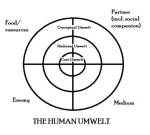
Our experiential/perceptual “worlds” have been aptly described and ascribed as Umwelten (see also – Paul Bains, Primacy of Semiosis).  In drastically simplified form: the concept that we are (each sort of organism) evolved in such a way as to perceive and engage with that in our environments that pertains to our survival and flourishing, our continuance of existence.  Those elements or that structuring and interacting with what we select out of our replete environments and surroundings – including ourselves – constitutes our Umwelt – our little “life-world” – species-specific bubble of “reality” (what is real to us, for us).

The sorts of change(s) that provoke potential for maturity tend (I think) to be changes that evince larger (or larger-scaled) patterns of experience and events (although all the minute alterations ever occurring – to the attentive and aware – also constitute mature adaptations for the human – the meditator recognizes the flux in each moment and works to adapt to this flux with openness and acceptance) – in other words, such things as by their very occurrence create/disrupt/introduce significant and substantial structural alterations – profoundly unavoidable – changes to the content AND context of the individual organisms perceptual/experiential SURROUND.

Changes (like those listed above) that, if NOT adapted or adjusted to, evidence a socially recognizable UNreality – a person clearly maladapted to the realities of their situations.  An example would be CHANGE or DIE; ADAPT or FAIL in some socially undeniable sense.

ADAPTING – in a “to-obvious-Umwelt-alteration-sense” is what I comprehend as an instance of maturity (a la Armstrong).

The loss of a child or spouse or health or limb.  New employment, habitat, geography.  Freshly developed abilities, knowledge, or lost capacities or income.  New love, memory, trauma – and so on – all represent an altered human Umwelt – adaptation to the ever-changing “reality” would be an instance of maturity – while maladaptation/denial/resistance would be a kind of instantiation of insanity – dis- or mis-alignment/-integration/-accordance to the altered Umwelt/environment/world-circumstance/perceivable “reality.”

Maturity then is our relatively accurate adjustment and adaptation to – our expectations and perceptions – to the “realities” of our ALWAYS-changing life-world.

I think Armstrong is right that we have a love/hate relationship to maturity.  It is something I (we?) HATE and HOPE for – the changes in our personal and public worlds so mostly beyond our control – air quality, abandonment, accident, reward, attention, ignor-ance, and so on.  As he puts it: “maturity is not the idea but the actual reduction of expectation.  That is why we fear as well as desire maturity.”  I question whether the adaptation is always “reductive” – in some cases, where we tend to be ruled by “patterns” (our past, our available information, our individual perceptions, our nature/culture development, etc.) maturity would constitute expanding, extending and opening our perceptions to the wider, complex and dynamic possibilities of an ever-changing life-world (I think).

For myself:  I HATE it (the death and loss implied in honest, authentic reductive maturity – mapping my individuality to my actual surroundings and situations) – I often resent and resist the ongoing change – erosion and eruptions – of the world I’m embedded in.  AND I WELCOME it – the reality-check of it, the alteration, breath, fresh potentials of “new worlding” that constant change instigates and offers.

As if our “realities” were 1000 plateaus – layered, indistinct, overlapping, vague and enmeshed.  As if “reality” were only (for me) what is perceivable (to me) and a dramatically altered Umwelt STRIKES into me whole new wild conceptions of what the world might be.  Reduction / Expansion.  Every change offers this.  The death (amputation, loss, etc.) and birth (regeneration, appendices, new growth).  Every vacancy corresponds with potential and unknown occupancy and vice-versa…

Or so I’m thinking…at this moment in this circumstance…

“Questioning places us in relation with what evades every question and exceeds all power of questioning…it seems that we question more than we are able to question”

-Maurice Blanchot-

…and so it goes…

17. Find Beauty – YouTube

Today’s “One Thing…”

17. Find Beauty – YouTube.

Hanson - just one thing

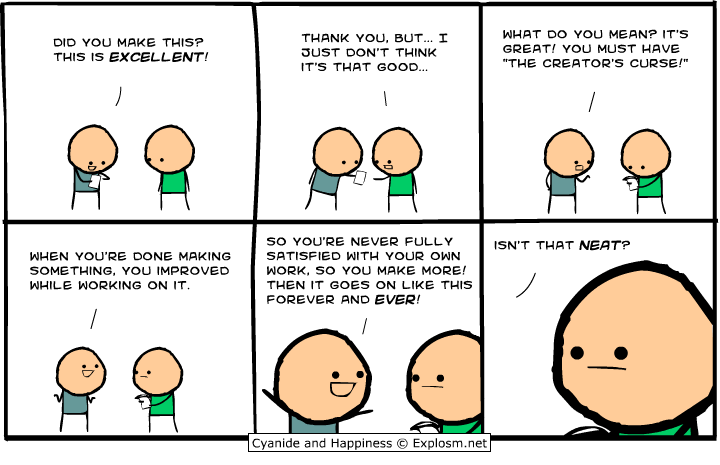
“The Creators Curse” – a raw deal – and everything is practice

When I stood up from the couch I thought.  I’m tired of everything being practice.  Each character sketch, each poetic fragment, each novel attempt, each theory, each relationship, each parenting moment, each breath.  All participated in as if the engagement might provide benefit, as if the pain will promote healing, as if the mistakes will prove corrective, as if fitness might improve health.  “Lifelong learning” – how nice it sounds, how endless.

But learning for what – ?  There’s just more life until… and then it’s probably simply (well, complexly) variantly continued – one situation hardly informs another – for the next now the context has changed, as well the elements, the matter, the flow.

So then I think again – perhaps it’s fear.  That lifelong learning, or anything meta- entails a splitting off – a doing WITH the observation; and thinking WITH  reflection; the subject’s objectification.  A remove.  And so it feels like practice rather than NOW.  

Earlier today (apologies – I’m really just rambling this post – no pre-write, no consideration or filtering) my son shared this with me:

Cyanide Happiness Creators Curse


– The “Creators Curse” from Cyanide & Happiness.  In our making we extend and become in the risking required to attempt…to craft… to work… so it cannot end, for if we grow or move or change (which we will) the work will need to go farther, be finer, account for those fluctuations… ever stepping into new, fresh, dynamic, complex realities… PRACTICE IS IMPOSSIBLE.

But if we turn and try to bring the effort up to speed, in that turning, that editing, that effort, nothing stops.  Nothing stops moving into that next moment, next ream of realities, heart-beat’s context, juggling atoms and muscles and breath…  “Improvement”?  Who knows.  But different for sure.  And even if we reach and stretch toward the work we imagine versus the work we are capable of…it all changes in kind…as change.

In optimistic moments this is cause for hope.  The possibility that something might improve, benefit may come, a temporary health could be achieved.  But not achieved only altered.  And not altered only changing.  I’ve argued before that we must lose our tenses to be honest to living – everything must become verb.

But I don’t want anything to be practice anymore…rather maybe process – doing, making, saying thinking in or with … everything.

I’m very tired of the hesitation, illusory gap, the pretend-vision of seeing our seeing, or feeling our feeling; loving our loving, writing our writing, thinking our thinking our  thinking…

I want to be : living, writing, parenting, loving, doing, making, saying, thinking NOW and HERE as IS.  

From Another Hand – “Folksonomies” & “Controlled Vocabularies”

Here follows a rambling response to a course discussion post relating to social-media-tagging and authority-derived-taxonomies in information resources (pros/cons, advantages/disadvantages, issues, etc.)…from my unedited perspective.  Perhaps it will interest some.

Option 2: Discuss issues surrounding social vs. professionally created metadata, citing examples from the readings. What are the problems and challenges as you see them?

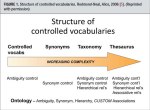
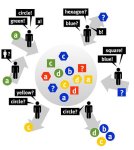
“Naming entities in the world is a tricky business” (Mai, 2011, p. 116).  Socially-created metadata is a fascinating approach and response to the inherent ambiguity, flexibility and complexity of the human use of language and the co-ordination of communicating the range of contextual usages of information resources / objects in contemporary life.  I particularly appreciated Mai’s attention to the plurality and “heterogenous settings” (settings where there are “no unified contexts, goals, or objectives against which objects can be named and ordered…” p. 116) of networked global information resources.  “Naming, indexing, has its limits – it can only be done within a given context” (Mai, p. 116), and as George W. Trow pointed out long ago – we are in the “Context of No Context” once we’ve embarked on a world-wide web engagement.  The stimulating idea is that if you have those who are interacting with the resources “tagging” their meaningful engagement with those resources “in their own terms” – you are replicating the range and breadth and depth of ACTUAL human use and inference and representation of interaction with information.  Now THAT is FASCINATING!

On the other hand.  By now we are all mostly aware of the extreme subjectivity involved in perception, acquisition, attention, selection, and utilization or effecting of data-available-to-us (individually) in the experiences that afford us, expose us, enable us to actuate and in-form whatever available reality that resource represents for us.  This means that each individual organisms experience of a given interaction with an available resource is intensely situation-specific.  Which also implies that their report, account, or “tricky naming” of said interaction is apt to be highly idiosyncratic.  Which (OBVIOUSLY) presents an enormous problem for the stability or repeatability or findability or accessibility of the potential import of said resource for any other organism.  This, it seems to me, is where even collective or massive social input still engenders community-and-individual-sized gaps in findability and usability of digital information resources.

As I see it, the concept of “folksonomy” and social democratic tagging is a practical response to Wittgenstein, Heidegger, Uexkull, et. al.’s realization that any and all conscious human individuals will seek, access, perceive and select elements of their environment FOR THEMSELVES – limited by every aspect of their own physiobiology, neurobiology, social contextualization and environmental situation – if a WHOLE BUNDLE, an aggregate, a swath of humans “tag,” “name,” “label” a resource according to the meaning it gave rise to in them – we might get an approximately adequate representation of the (at least human) RANGE of meaning or import that resource might have for our species – the uses to which it might be put, the ideas it might give rise to, the practical effects it may indeed effect.  HOWEVER – it will by no means have overcome the inherent ambiguity, openness and possibility of said entity/resource/ordination of “information” for any further context / individual / situated need going forward, unknown.  This is where things like mathematical language, artistic form/contents, agreed-upon languages, domain-specific terminologies, “controlled vocabularies” SERVE our species – they give us COMMUNAL resources by which to evaluate and organize our experiences – and COMMUNICATE.  Private languages, really, tell us no more than the barking of a dog.  We infer and intuit, but then, that is OUR language imposing order on someone else’s expression.  Standardized, collectively agreed-upon terminologies and languages allow us to participate, interact and coordinate our experiences and understandings, while “folksonomies,” “tagging” and so forth allow us to nuance and extend or specify aspects of the agreed-upon discourse.  At least these are the uses I find compelling around both Controlled Vocabularies AND individual or privatized labeling.

It’s fascinating because it allows a democratic voicing which accounts for many more human facets to ANY and all resources, while “social” in a “societal” sense – domain-oriented, authoritative and agreed-upon terminologies allow us a way to flesh out, fuel and invigorate COORDINATED meanings – something accessible to us more like our own bodies – a corporate interaction – avoiding both solipsism (isolation) and equivalence (anonymity).  All sources seemed to agree that all things “con-” (con-sensus, co-llaboration, co-rrespondence and so on) are ESSENTIAL for our worlds to be useful and meaningful to us.

We have work to do in finding the dynamic balance in agreed-upon vocabularies as touchstones maybe not necessarily rules and the open source of additive description to equal something perhaps more in accord with human “reality.”  I sense that this is the dream of the Semantic Web…and of all communities worldwide.  I appreciate how the internet re-invigorates this ancient human process.


Groundlessness

Chodron - groundlessness


I seem to be unable to stop digging in and reflecting on When Things Fall Apart.  My memories range over its engagements with this book, most of the circumstances blurred and dissipate, but not the wisdom of the text.  I was trying to explain to my teens the odd euphoria that follows suicidal determination – what neuroscience knows as “shut-down.”  As the body begins to burn, or be ripped apart by fangs, riddled with bullets or smashed into bits…pain ceases to be useful to the organism and it is flooded with endorphins…a kind of blissed-out euphoria like a systemic morphine drip.  “There is definitely something tender and throbbing about groundlessness,” Pema says.

hypnotic-notions-holly-suzanne-filbert


But the idea isn’t shut-down.  The idea is more like a drowning compression without a bottom…a fall…a float…if fear – flight; if anxiety – distract; if anguish – addictive comfort; all these options for moving away, slipping out, attempt at relief, escape, a concretization of experience, rather than its flow.  It’s now-ness.  This drowning compression without bottom – what if we BE THERE?  What if we sit in it, and breathe.  The groundlessness, bottomlessness, suddenly becomes some space.  A little room…there’s opening.  We don’t know what to do, don’t know where to go, don’t know how this happened, don’t know why we did.  “Letting there be room for not knowing is the most important thing of all...Life is like that.  We don’t know anything.  We call something bad; we call it good.  But really we just don’t know.”

“Things falling apart is a kind of testing and also a kind of healing.  We think that the point is to pass the test or to overcome the problem, but the truth is that things don’t really get solved.  They come together and they fall apart.  Then they come together again and fall apart again.  It’s just like that.  The healing comes from letting there be room for all of this to happen:  room for grief, for relief, for misery, for joy.”

Blemishes

“Only to the extent that we expose ourselves over and over to annihilation can that which is indestructible be found in us.”

– all quotations Pema Chodron

“Leaning into the sharp points”

Suzanne(Beckman-Filbert)Holly-suzanne-prayingman.jpeg


painting by Holly Suzanne

“Fear is a natural reaction to moving closer to the truth” – Pema Chodron

I modeled for the painting above.  It is propped beside the bed as I write.  A large painting, and heavy, maybe 4.5 feet long and 3.5 feet tall, loaded with layers of paint.  She called it “Praying Man,” but I wasn’t praying – the way it turned out I felt like a longshoreman, a hauler, tensed with the energy of pulling things out from the deeps.  I see why she called it that.

We’re reorganizing the house, and in that process I notice what’s gone, and discover things forgotten.  Today it was When Things Fall Apart by Pema Chodron, “heart advice for difficult times.”  I’ve depended on this one before.  It’s written with the situation in mind in which a human feels there is nowhere to escape.  Suffering floods in weights that compress one toward no option.  Chodron says that “No one ever tells us to stop running away from fear…the advice we usually get is to sweeten it up, smooth it over, take a pill, or distract ourselves…but by all means make it go away.”  “We don’t need that kind of encouragement, because dissociating from fear is what we do naturally.”  “Cheating ourselves of the present moment” according to Chodron.

Instead, she suggests, “we could step into uncharted territory and relax with the groundlessness of our situation…by inviting in what we usually avoid…adopting a fearlessly compassionate attitude toward our own pain and that of others.”  I am taking this on as the work of the “praying man.”  The longshoreman and hauler, reeling hand over hand over heart over hurt into the tumult of the pain of being.  “…getting to know fear, becoming familiar with fear, looking it right in the eye – not as a way to solve problems, but as a complete undoing of old ways of seeing, hearing, smelling, tasting and thinking…having the courage to die, the courage to die continually.”  The traditions align.  “He who saves his life will lose it.”  The terror that drives the boundaries, isolates the organism.  Protectiveness cuts the supply chain.  Security stanches generative flow.

What happens when we stay?  Nailed to the present misery.  Chodron suggests that when we move into rather than away from our life-threatening pain a kind of catharsis can occur – an acceptance that we are “precious beyond measure – wise AND foolish, rich AND poor, good AND bad…and totally unfathomable.”

2013-01-22 14.36.20

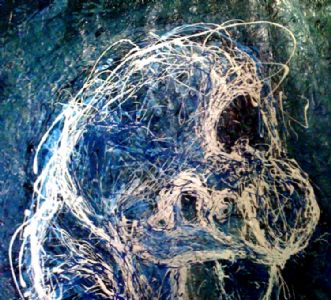
another painting by Holly Suzanne, emptied of me

The trick is to keep exploring and not bail out, even when we find out that something is not what we thought.  That’s what we’re going to discover again and again and again.  Nothing is what we thought.  I can say that with great confidence.  Emptiness is not what we thought.  Neither is mindfulness or fear.  Compassion – not what we thought.  Love.  Buddha nature.  Courage.  These are code words for things we don’t know in our minds, but any of us could experience them.  These are words that point to what life really is when we let things fall apart and let ourselves be nailed to the present moment.”

Preying Man then, hunched over and hauling it out, rhythmically breathing into the present, a turbulent pain fueled by fear…searching into what I usually avoid.  Hopefully not so much as a way to solve problems, but an undoing of native ways of seeing and hearing, smelling and tasting and thinking…along with the courage to die.

-all quotations Pema Chodron, When Things Fall Apart