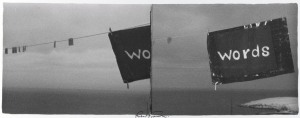
Religion Revision

I was raised in a faith that was based on a book full of words. At times it exploded with prescience and resonances in the life I was becoming, at others it fell flat or rang false, but its education in languaging experience held merit. When I say “raised” I mean inculcated and immersed. I learned terms and their arrangements by “heart” or memory and rote – as principles and rules for interpreting world and self. Childhood learning has a way of patterning subsequent life, and it comes back to me again and again when world overwhelms and skips past my reason plopping its bulky finger on “play.” I woke to it this morning and I listened. This is what I heard:


The Word: A Commentary

In the beginning was the Word

the Word was with God

and the Word was God.

(the same) was with God in the beginning.

Through (the Word) all things came into being,

not one thing came into being except through (the Word)”

  • Gospel of John 1:1-3 –

The light comes on and I see that you are there. I can describe you now, move toward you, interact with more knowledge and intention. I now see the table and chair on my right, between us to the side, underneath the window which is covered and which I had not known to be there, nor the “outside” or beyond, even the gap of it, the doorways, the thresholds, until the light came. On.

I had not known the cat nor dog that made their sounds of presence, like your voice and breath I sensed, until the space of living was enlightened.

The Writer’s gospel, the good news, about language and mystery and its use to shed light. Brings to awareness, aids comprehension, might even be said to bring into being (for its users) all that comes to register as existent in its own particular way.

Emotions and landscapes, persons and things. The self, once considered in words, takes on. Until that moment all is inchoate, unformed, a mix of sensations unlocalized like innumerable living points in air. The Word(s) direct and give shape, question and expose. Let there be light.

Whatever rudimentary forms of communication prevail, among cells, among plants, among animals and stars, this light, language, the words and ideas, is the light of humankind. The life of its persons.

This is a gospel that I can believe in, bearing itself out in experience. As one’s vocabulary expands to circumstances and situations, life begins to seem understood, seen-through, engaged, if only in the duration of the verbal processing.

Linking the field like fenceposts and wires, the word traverses the between and the voids or the opens, like light reflecting matter, whether in the subtlety of the atmospheric layers or the gleam of a yellow school bus. It is there, I am here, we become. Same registering difference, word requiring letter and sense, being: being-with.

And so the surface grows scribbled. Notated, defined, addendum’d and erased. The living word, in action as much as its participants, adjusting, accounting, enumerating; revise and repeat. Expand. Express.

It is the territory between exterior/interior, centripetal/centrifugal, ever breathed into the void, calling to and called by. Ever beginning, the become of all things. As we segment times and spaces, sense duration and bounds, so the Word moves along with each complex, reporting, revising,

Recall. The naming of ocean and air – what were they before but a void exhibiting difference? The animals, people, feelings and actions – unknown variations – “behaviors” and “appearances” – then light.

It has come into the world. Avail yourselves of it. Turn on the lights – and read, and write. Bring what is (for you) into being. In the beginning, the Word, and at its end, the beginning. There is always more word for the void.

N Filbert 2012
Shopping the Shelves

Had a blast yesterday…when kids were engrossed in their own realms…browsing my own shelves…resulting in today’s readings:

House Mother Normal by B.S. Johnson

Plainwater by Anne Carson

The Last Novel by David Markson

Chinese Sun and Dust – Arkadii Dragomoshchenko

History – A Novel by Elsa Morante

dancing lessons for the advanced in age, In-House Weddings and the little town where time stood still by Bohumil Hrabal – man! he just lets stories run away with him – what a blastula of reading joy!

Rot by Janet Kauffman

such delights all around!

Those breathless ones

Finishing Simon van Booy’s “Everything Beautiful Began After” reminded me of those books throughout life that once you begin you don’t finish without swallowing…browsing my shelves I remembered a few (and I’m usually reading over 20 at a time, so if one demands the patience of the others it has some driving pulse something in me can’t ignore)…

“If Nobody Speaks of Remarkable Things” by Jon McGregor

“The Trick is to Keep Breathing” by Janice Galloway

“Master and Margarita” by Mikhail Bulgakov

“Beatrice and Virgil” by Yann Martel

“The Road” by Cormac McCarthy

“Possession” by A.S. Byatt

“Notes from the Underground” by Fyodor Dostoevsky

“Dust” Arkadii Dragomoshchenko

“Impossible Object” by Nicholas Mosley

“Entrance to Porlock” and “Final Beast” by Frederick Buechner

keep thinking of them!  those startling ones that catch you off guard!

“Three Steps on the Ladder of Writing” Helene Cixous

“On Love” Alain de Botton

“To Whom it May Concern” Raymond Federman

“The Way through Doors” & “The Curfew” Jesse Ball

what books don’t allow you to put them down?

A day’s work

Films of Maya Deren

words of Clarence Majors, Helene Cixous, Simon van Booy, MAK Halliday, Samuel Beckett, Alain Badiou

coffee

therapy

music – Do Make Say Think and  a composition of my own

the thises and thats:

“For we live in deeds, not years; in thoughts, not breaths; and our time should be counted in the throbs of our hearts as we love and help, learn and strive, and make from our own talents whatever can increase the stock of the world’s good.” from a monumental-looking effort of A.C. Grayling “The Good Book: A Humanist Bible” – I recommend you pore over it

“The author has a passion for doors.  All doors:  doors to mystery…the passion for books, the ferocity, the need, the exultation, the haste to flee the places inhabited by those people close to me, in order to regain the poets and other characters, in their books…In the middle of the house we open the white door and we’re no longer here…escape in broad daylight…people I would’ve never dreamed of approaching while they were alive enter, sometimes, in the very moment I turn toward them as toward people essential to my existence, forever indissociable from my taste, my mobility, my view, enter, suddenly, my other country…” -Helene Cixous “Firstdays of the Year”

and perhaps:

Begin Ending Beginnings

To learn from crows

To father children

To accumulate and recede

Some event sets in motion

Taking wing or stumbling feet

To oscillate between

Begin or conclude

Always the same at once

No difference that we know of

So begin, ending something

as crows and as carrion,

and the first buds of Spring

N Filbert 2012

The Firstdays of the Year

As we press the pedals into 2012, a couple of things really lodge in my sternum: the surprise that this venture into the blogging world (though only a month along) has been for me – a very humbling gratitude to anyone and everyone who takes the time to peruse my thoughts and inspirations – and the fascinating forum it becomes as one is able to see one’s own work influencing and influenced by what so many others are doing! Yay for humans! Please, everyone – keep at what drives your hearts and minds – and thank you for doing so. Secondly, these natural contextual rituals like a calendar and a “New Year,” arbitrary as they may be, stimulate some wonderful and interesting contemplations of turnings. Year after year at the turning of years, I revisit Helene Cixous’ Firstdays of the Year, and each year it grows in its timeliness and profundity in a camaraderie of projects, of languaging, of approaching life. A quotation I have underlined in red at every reading, this year expanded to a whole page of certain significance for me, and I’d like to share it for you others out there scribbling away from your blood onto surfaces of light or papers:

——————————————————————————————————-

from Firstdays of the Year by Helene Cixous:

“She began like this: “The book I want to write, the one I dread writing, is the one that would begin like this: I’m going to tell you at last, and for the first time, everything I now know about the most hidden truth.”

“With these words, with the word hidden followed by the word truth, doubt spread out inside her, and just as quickly hopelessness began. She feared. With the one fear, she feared discovering, at the end of a long, cruel excavation, that there was no “hidden truth,” that there never had been.

“She (truth) was not at the beginning, there was no secret. There were only mistakes and corrections. She feared having to, in the end, lose all hope and all illusion. And those who had always affirmed truth’s impossibility would laugh at her.

“And at the same time she feared, with the other fear, discovering the truth. And seeing in the end with her own eyes her own face unmasked, to her eternal regret. Yet, she told herself, isn’t every discovery true? And everything we say is truth. And we only lie in the hope of creating a more tolerable reality. And lying is often preferable, lying can be a kindness.

“Still, Truth had always been her dream. But reaching the truth? It seems so far away. The sun hidden behind the sun…

“She had writing, she had the desire. She hadn’t the possibility.”

 —————————————————————————————————–

Repeatedly, in reading this passage, I have scribbled along the edges: “yes! with every writing” or “yes! every book!” And indeed, with each thing I attempt to language, my instigation is always that “I’m going to tell you at last, and for the first time, everything I now know about the most hidden truth(s).” And I am wanting to again. Whether examining a photograph, recounting an experience, experimenting with languaging itself, or attempting the creation of a story or character…I am wanting to tell the most hidden things, the ones I don’t know how to say, that seem impossible to say, that seem like they must be said. And I appreciate all the rest of you who also are making the effort at depicting the “sun behind the sun,” somehow, I believe, it moves us all along. Here’s to the efforts!

Deep traces

Wanted to share a few poems from William Bronk’s collection “Death is the Place.”  Reading today included M.A.K. Halliday’s “Learning How to Mean: Explorations in the Development of Language” – I am continually fascinated by the social construction of reality and the self, and the part the structuring of language assimilation plays (literally) in it.  One thing that struck me was how the interplay of “observer” (the individual accounting for encounter and experience with not-self) and “intruder” (the individual participating in effecting not-self and being effected by through interaction) develops into growth: the apparently infinite expandability of the weaving of language-types and functions and uses with the world as we experience it, and ourselves as they are formed by our interactions with whatever is different and distinct from us.  The utter reciprocality of experience, creation and shaping between self/not-self; intrusion/reception and the like – Derrida’s differance challenges and fascinates me.  Which pressed me immediately into Bakhtin, of whom not enough can be read or said.  Beyond that I spent a number of rewarding hours in Italo Calvino’s “The Literature Machine” – always refreshing and invigorating re: the uniqueness of literary language in the scope of languagings.  Errol Morris’ “Believing is Seeing” is delightful – like a well-made documentary in language, tight, challenging and full of little surprises.  Jesse Ball’s “The Curfew” – his slightly odd universes and quirky phraseology mesmerizes me.  H.L. Hix’s work is gaining weight in my esteem…nice Ashbery-like music and reflection with tart Orr/Johnson/Stevens’ aphorisms woven throughout.  I worked on an essay about life’s requirement of unending submission (in light of more rejections of my own – probably an attempt at soothing myself) and fashioned a couple of poems on the way.  Here, from Bronk, death truly being the place always present that shows the shine on the flip-side, life, and keeps us cognizant of what almost counts for “truth.”

THE FICTION OF REAL

The false roles we play are a way to rid

ourselves of falsity and be real in a real

world as we need to be to realize

our potential.  There is where the action is

and inaction is wrong.  The need is for faith

and vision and, unless we believe, our fiction falls

and we with it, our civilization ends.


OF POETRY

there is only the work.


The work is what speaks

and what is spoken

and what attends to hear

what is spoken.


LOOK WHAT’S TALKING

It isn’t what we say of reality

is metaphor but reality itself

which is.  Reality as God or as

cosmos or as, more often, both at once

-whatever-reality is metaphor

not more not less and, being that,

is real as can be and not quite real:


always brilliantly true and less than whole.


FOSTERING

Ed asks me

does the poem depend

on what is said

or language saying


but the poems are

acts of love:


they depend.


Thank you, William Bronk

A Portrait


“Tornado Baby 2” by Larry Schwarm


The Portrait

“nothing more than silver crystals arranged on paper or, in the case of digital photography, nothing more than a concatenation of 1s and 0s resident on a hard drive. Yet, when it’s a portrait, a person looking back out at us from a photograph, we could believe that the photograph has captured something of the sitter’s essence – something of the stuff that is in his head…we are programmed by natural selection to project ourselves into the world…we want to know where we end and the world begins…where that line is. It’s the deepest problem of epistemology”

Errol Morris, Believing is Seeing

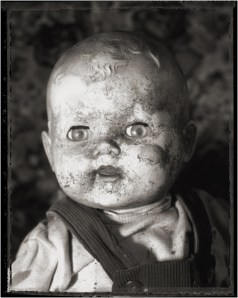
Disabused of nonsense, I examine the paper. Silver crystals or programmed numerals, eh? Both I cannot see. What I see is an arrangement of darker and lighter on a grey scale, constituted by hundreds of gradations and variances. I see whites and blacks bastardized into shapes and forms making up the content of an 17”x22” piece of archivally produced watercolor paper, matted on one side. There the code has adhered.

My looking I will say “automatically” seeks resemblance in the shapes and differences I perceive to anything I may have perceived sensually before. It reports “rounded,” “textured,” “wrinkled,” “object” and “background” (notice three dimensions – space, time and substance) without question. But the paper is strictly rectangular, its surface has a subtle grain, but by no means “wrinkled or textured,” and it is patently two-dimensional, a flat plane.

But perception had bypassed even these errors and already concluded “head,” “eyes,” “face,” “mouth,” “nose,” “ears,” “clothing.” Beyond that “corduroy,” “shirt,” “doll,” “cracks” and “sand” or “dirt,” “young,” “infant,” perhaps even “toy.” Far cries from variations of color on pulped and compressed organic matter. And a radical leap from fact or “truth” (something corresponding to reality)!

Intelligent and rigorous as I propose to be, I am clearly susceptible to grand illusions. In fact I find myself incapable of convincing my mind or senses of the truth of the matter. I stopped myself short of providing name or narrative to what I perceived, but nothing held me from taking it as far as gendering a figure!

This “light-writing” – how do I read it? Clearly I read the contents of my own brain onto it. This piece of paper littered with variables of grey becoming a full-blown imagined, invented physical object in a context, instantaneously with it coming into view!

If this doesn’t prove me religious or mystical or addicted to fictions and fantasies, it indisputably labels me as primed from groundless faith and beggars my “rationality.” I take the bait, compose a scene and conjure an experience.

“To understand is to interpret. And to interpret is to restate the phenomenon, in effect to find an equivalent for it…it’s the revenge of the intellect upon art…upon the world!…to interpret is to impoverish, to deplete the world – in order to set up a shadow world of ‘meanings’…it is to turn the world into this world…it is the modern way of understanding something”

-Susan Sontag, Against Interpretation

And did I deplete it? Instead of seeing the open subtle radiance of what was there before me, I took to deconstructing, categorizing and delimiting it. “Forming” or “fabricating” it toward narrower and narrower possibilities (allowances?). As if I were arbiter, de-Terminator, as it were.

Show me light and dark and I’ll dismantle, disentangle and simplify it down to specifics, something bite-size. But not available specifics, no, not the particulars there before me – in themselves – open and presenting – no, not those free existing presences, but to particulars I can re-cognize, things I am ready to see. What something in me wants to see, familiar or unfamiliar.

My socioeconomically-shaped brain saw light and dark dusted together and secured to a surface and re-presented it to myself in ways that supported or validated my trained and chosen view of things – a doll’s head wrecked from use or disuse, floating free as an object within a surround. I lied to myself to support what I’d accepted in belief, what reassured me. To make an order I could not understand into a reordering that I could.

This masterfully selected and developed photograph arrive to my body unnamed, with no captions or text, no intention or meaning. It presents a photographer’s interest – something caught in a person’s perception at a certain moment of time, an arrangement of world that we say “spoke” to him, albeit without language or sound.

The photographer’s eye then detached and defined, from a context endless in all directions, this frame of materials, of sight, and tore it away at just these parameters, from just this angle, and recorded it – took it. From there he expanded the size of what he saw, magnified it and brought it through darkness and an elemental chemical stew into light. He scanned the result, still looking for more, perhaps even seeing more than could literally be seen.

Further affecting this discreet tiny rip of the reality of the world, he manipulated it carefully, painstakingly, revealing and creating ever more extant artificiality, unto his own personal, private and unknowable satisfaction. At that point he produced a new object of matter into the world that we call a “print.” Jetting countless points of ink with the aid of a mechanical device onto hearty paper created for paints, he concocted (remember – always in tandem with machines, ever relational, in flux, at risk and imminently malleable) this single variable fingernail-thick object reflecting light to our eyes: a portrait photograph.

The elaborate efforts of a human at one end of an emblematic chain, toward the elaborate efforts of another human being at the other…a something we may, given incalculable and mind-bogglingly enormous situationally-specific conditions, come to encounter as “art.” And it is this I am declaiming to you here, with something very much like a religiously fervent belief.

N Filbert 2011

Traces

“Language is not predicated on the existence of meaning, but is an unpredictable outcome of a world that produced first fire, then birds.”                      -Ludwig Wittgenstein

“Responsible for creating Creation, for the reading veiled within reading, the word hushed amid disclosed words, for the silence, finally, of a trace disfigured by a thousand traces, the silence of the Void at the heart of radiant Totality?”  -Edmond Jabes

after Wallace Stevens & William Bronk (2 heroes)

What Is: Real

It’s the initial question, it seems to me: the Unanswerable One.

The query and experiment, the apparently necessary or natural one, the one seemingly inherent, the one for which there can be no verification or results.  No development, no progress, no advance.

It would appear that we can add to what we “know.”  We seem imminently, even outrageously capable of “belief.”  And we pass judgments accordingly – basing them on descriptions and experience.

Things like pain and harm, pleasure and enjoyment.  And on things like survival, like getting to “be.”

But the question remains, all the same.  Always here, always unsatisfied.

And we are always here, and then always gone.

But the question remains: the Unanswerable One.

No proofs exist.

-N Filbert

Deaf Beethoven

Terrible things will happen to us even as

we hold each other to hold them off even as,

elsewhere, atoms disintegrate and stars

explode and niether are they of consequence

to what really happens without we know

if it does or how, the real unmodified

and deaf to what the deaf Beethoven heard.

-William Bronk

“any problem that has an answer isn’t important enough”

-Gary Miranda-

“The only really difficult and insoluble problems are those which we cannot formulate,

because they have the difficulties of life itself as their content.”

-Franz Kafka-

December 11, 2011

It’s wet in Kansas.  Finally.

Listening to Max Richter – “Sarah’s Key” soundtrack and “Die Fremde”

My wife is home.

Ideal-ish sorts of things.

Planning to start a new longer project.

Thinking these things:

“Language arises in the life of the individual through an ongoing exchange of meanings with significant others…language is a shared meaning potential…the context plays a part in determining what we say; and what we say plays a part in determining the context”

-M.A.K. Halliday-

“Only in the stream of thought and life do words have meaning”

-Ludwig Wittgenstein-

“…in writing, one cannot say anything extraneous to writing”

-Italo Calvino-

“..we would have very little if we only had words.  What we need are the presences that words leave in dotted lines in their mysterious intervals, and that words in themselves cannot restore to life”

-Yves Bonnefoy-

“Zeno, pressed as to whether anything is at rest, replied: ‘Yes, the flying arrow rests'”

-Franz Kafka-

Good night.  And good luck.