compliments of Percival Everett

compliments of Percival Everett
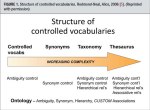
Here follows a rambling response to a course discussion post relating to social-media-tagging and authority-derived-taxonomies in information resources (pros/cons, advantages/disadvantages, issues, etc.)…from my unedited perspective. Perhaps it will interest some.
Option 2: Discuss issues surrounding social vs. professionally created metadata, citing examples from the readings. What are the problems and challenges as you see them?
“Naming entities in the world is a tricky business” (Mai, 2011, p. 116). Socially-created metadata is a fascinating approach and response to the inherent ambiguity, flexibility and complexity of the human use of language and the co-ordination of communicating the range of contextual usages of information resources / objects in contemporary life. I particularly appreciated Mai’s attention to the plurality and “heterogenous settings” (settings where there are “no unified contexts, goals, or objectives against which objects can be named and ordered…” p. 116) of networked global information resources. “Naming, indexing, has its limits – it can only be done within a given context” (Mai, p. 116), and as George W. Trow pointed out long ago – we are in the “Context of No Context” once we’ve embarked on a world-wide web engagement. The stimulating idea is that if you have those who are interacting with the resources “tagging” their meaningful engagement with those resources “in their own terms” – you are replicating the range and breadth and depth of ACTUAL human use and inference and representation of interaction with information. Now THAT is FASCINATING!
On the other hand. By now we are all mostly aware of the extreme subjectivity involved in perception, acquisition, attention, selection, and utilization or effecting of data-available-to-us (individually) in the experiences that afford us, expose us, enable us to actuate and in-form whatever available reality that resource represents for us. This means that each individual organisms experience of a given interaction with an available resource is intensely situation-specific. Which also implies that their report, account, or “tricky naming” of said interaction is apt to be highly idiosyncratic. Which (OBVIOUSLY) presents an enormous problem for the stability or repeatability or findability or accessibility of the potential import of said resource for any other organism. This, it seems to me, is where even collective or massive social input still engenders community-and-individual-sized gaps in findability and usability of digital information resources.
As I see it, the concept of “folksonomy” and social democratic tagging is a practical response to Wittgenstein, Heidegger, Uexkull, et. al.’s realization that any and all conscious human individuals will seek, access, perceive and select elements of their environment FOR THEMSELVES – limited by every aspect of their own physiobiology, neurobiology, social contextualization and environmental situation – if a WHOLE BUNDLE, an aggregate, a swath of humans “tag,” “name,” “label” a resource according to the meaning it gave rise to in them – we might get an approximately adequate representation of the (at least human) RANGE of meaning or import that resource might have for our species – the uses to which it might be put, the ideas it might give rise to, the practical effects it may indeed effect. HOWEVER – it will by no means have overcome the inherent ambiguity, openness and possibility of said entity/resource/ordination of “information” for any further context / individual / situated need going forward, unknown. This is where things like mathematical language, artistic form/contents, agreed-upon languages, domain-specific terminologies, “controlled vocabularies” SERVE our species – they give us COMMUNAL resources by which to evaluate and organize our experiences – and COMMUNICATE. Private languages, really, tell us no more than the barking of a dog. We infer and intuit, but then, that is OUR language imposing order on someone else’s expression. Standardized, collectively agreed-upon terminologies and languages allow us to participate, interact and coordinate our experiences and understandings, while “folksonomies,” “tagging” and so forth allow us to nuance and extend or specify aspects of the agreed-upon discourse. At least these are the uses I find compelling around both Controlled Vocabularies AND individual or privatized labeling.
It’s fascinating because it allows a democratic voicing which accounts for many more human facets to ANY and all resources, while “social” in a “societal” sense – domain-oriented, authoritative and agreed-upon terminologies allow us a way to flesh out, fuel and invigorate COORDINATED meanings – something accessible to us more like our own bodies – a corporate interaction – avoiding both solipsism (isolation) and equivalence (anonymity). All sources seemed to agree that all things “con-” (con-sensus, co-llaboration, co-rrespondence and so on) are ESSENTIAL for our worlds to be useful and meaningful to us.
We have work to do in finding the dynamic balance in agreed-upon vocabularies as touchstones maybe not necessarily rules and the open source of additive description to equal something perhaps more in accord with human “reality.” I sense that this is the dream of the Semantic Web…and of all communities worldwide. I appreciate how the internet re-invigorates this ancient human process.
another old post intimately related
“A way of connecting, on relatively safe middle ground, with another human being”
“that ‘neutral middle ground on which to make a deep connection with another human being’… was what fiction was for. ‘A way out of loneliness’…”
Jonathan Franzen, on David Foster Wallace
“If the novel were able ‘to give the reader, who like all of us is sort of marooned in her own skull, to give her imaginative access to other selves,’ it opens the potential that she might, as a result, feel ‘less alone inside’”
Kathleen Fitzpatrick, on David Foster Wallace
My son and I arguing about the nature of things – is there anything we can agree on? mutually believe? are we similar? – in what began as an attempt (on my part) to soothe obvious hurt and confusion (on his part). He kept pointing to (referencing) his mirror, his bedside table, in…
View original post 706 more words
related items popping up from the past
We Make Art: A Query toward Perceptive Extension
 paper snowflakes by Holly & children
Waking reminded –
I’ve been working over things in my sleep. Parenting issues, marriage. Vocation deadlines, assignments. Logistics and payments and scheduling. Improbable care of the self.
– that overwhelm is inevitable, inherent.
Everything we know (or surmise) about anything indicates vast beyonds unknown and ignored. In order to see, to breathe, to speak, to hear, to feel, to think, to live. We filter and avoid. Press the vast majority of the world’s availability into a void. So of course we can’t manage our world, or comprehend, even minimally control. We can barely deal with even a relatively microscopic set of variables, and those only enough to survive.
Reminded, awake then, that overwhelm is constant and inevitable. Inherent to the systems of which we are and are a part. Living is processing vastness. Essentially unscalable. And…
View original post 401 more words
Greetings, in an effort I am making to “make sense”… I have been encouraged to chronicle the benefits of my experiences to investigate personal meanings. That might not make sense. Suffice it to say that I am plunging into the world of my recent past in an attempt to discover how it has changed me. A working title might be “Intolerable Vulnerabilities,” (a phrase lent me by my mental physician) and its subject is yet to be defined…but here are the beginnings of an intro…
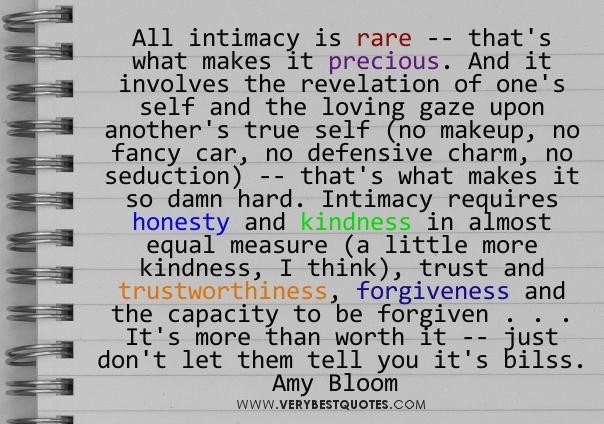
The hesitant beginning…
” Most all of us have been caught up in the proverbial “throes of love.” The ecstasy and heartache of opening oneself to another, being enraptured, plagued with doubt and hope, captive to longing and the myopia of the significance of the beloved. But perhaps less of us experience intimacy. Intimacy may be something quite different from love. Although usually initiated in its atmosphere, intimacy reaches beyond the experience of love and journeys toward closeness. Intimacy is about the intertwining of lives, the multiform intricacies of barely-boundaried involvement. What occurs when lives are meshed and melded – shaped with and around one another – physically and immaterially, actually and theoretically, imaginatively and really. Where histories are remade and revamped together in a present. Where hopes are remade and reshaped as a couple. Where the unit and body that counts as an “I” extends to a “we,” and sensation, perception and thought happen always with an external mirror.
Where intimacy takes us is awesome. I mean this in the most fearsome and incredible ways. Human closeness is fraught with archetypal danger. When exposed in such nearness, our lives seem at stake. It goes to the “heart of us.” Within the weathers of love, the wedded experience that intimacy brings seems to make us or break us – our futures and fortunes, significance and meaning rise or fall in accord with an Other. We, in ways, “are not our own” but become something new, something larger and fresh. Something open, extended and possible. Something at risk, distended, and vulnerable. Our lives shared in the hands of another. Our minds shaped with the mind of another. Our purposes, intentions and behavior ever effecting conjoined scenarios. The world is different. Intimate. Involved. Precious and fragile.
There are (at least) two sides to the story…a territory of doubled strength and minimal safety. Of terrifying exposure and (possibly) multiplied protection. Of enhanced security and absolute danger. This is the province of love. This is the prospect of intimacy.”
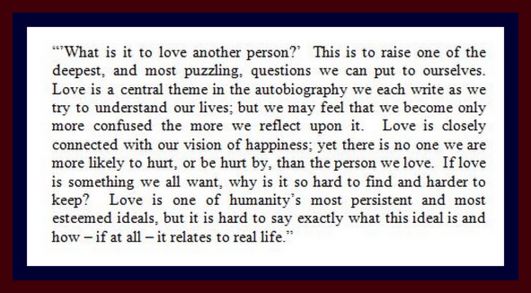
-John Armstrong, The Conditions of Love–
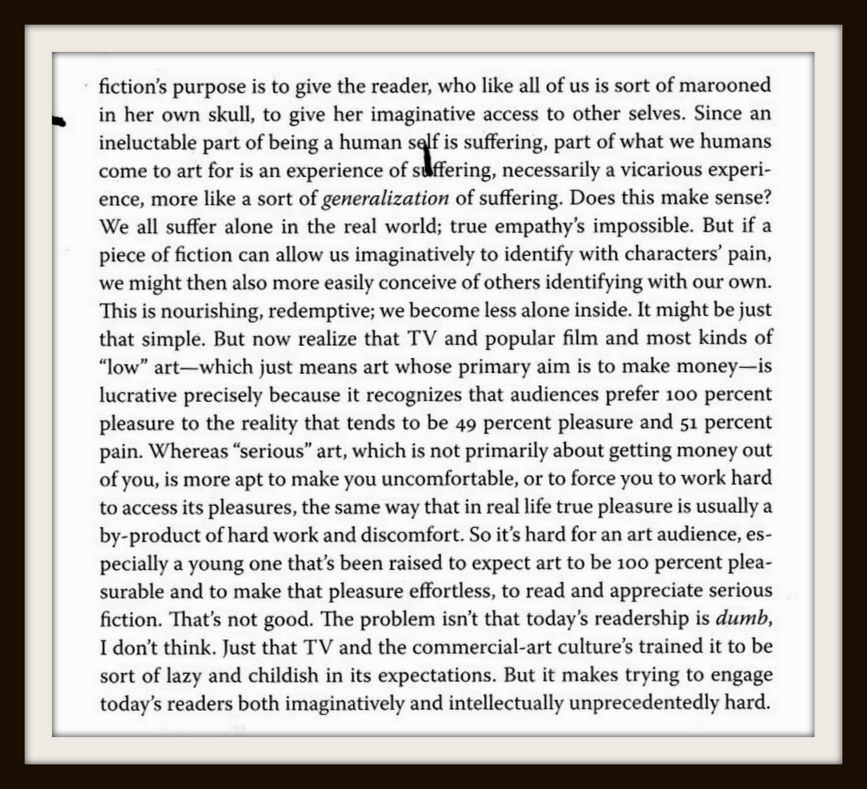
-David Foster Wallace interview
I apologize in advance and beggar your patience regarding the length of the following post. It is not often that I have over 10 hours straight of anonymity and limited distractions to read, study and write. I spent yesterday and last night flying from Wichita to London for a week-long course examining over 10 specialty libraries there. For the course I must keep a diary online, and while not about “library business” per se, this is about the journey…

Over the Atlantic
I have no idea what time it is. I have been airborne for perhaps four hours, having left Houston around 7:35 PM after an hour of mechanical fix-its, preceded by departure from Wichita at 3:36 PM earlier this same afternoon. We seem to be flying fast enough that my electronics are scrambled and I haven’t worn a wristwatch since high school. I’ve been lucky enough to have booked onto an half-full flight, allowing me the pleasure and benefit of a two-seated section all to myself. Almost a work-cubby – two tray tables stacked with books and an empty seat for sundry supplies.
At all times I pursue readings that might deepen and expand both my abstract and subjective life – I’m certain that could be stated better – perhaps that challenge and enhance my lived experience. Most honestly: that cause me to think, help me make sense, prompt change and give me pleasure. Writings that move me, would be another way of saying it. In the cabin I have arranged Focusing by Eugene Gendlin, Elegy Owed by Bob Hicok, Impenetrable Screen of Purest Sky and Wonderful Investigations by Dan Beachy-Quick, Light Everywhere – Cees Nooteboom, Buddha’s Brain and Just One Thing by Rick Hanson, Infinite Jest by David Foster Wallace, A Thousand Plateaus by Gilles Deleuze and Felix Guattari, and Art as Therapy with A Week at the Airport by Alain de Botton. Which could be explained in so many ways.
Traveling internationally, one is limited for selection – in fact it’s by far the most difficult portion of packing – which books will I need – not knowing how the movement and context will affect me? So I choose:
Whenever I’m struggling with depression, I reach for Wallace and books of wisdom – on staying present, taking steps, coping skills, the breath and body. Reality therapy, as it were. Poetry helps as well, with its attention to detail and sensual triggers. Books that remind me that I’m alive, regardless of felt experiences or circumstance.
I will finish A Week at the Airport on this flight, I’m almost there – or maybe I won’t, saving the “Arrivals” chapter for that moment in my journey. It is the account of de Botton’s stint as writer-in-residence at London’s Heathrow Airport (my immediate destination), and in his inimitable and typical fashion – exposing those human universals embedded in the familiar, or overlooked, or hardly spoken. What he asks from other writers, he provides (and I quote): “I was looking for the sort of books in which a genial voice expresses emotions that the reader has long felt but never before really understood; those that convey the secret, everyday things that society at large prefers to leave unsaid; those that make one feel somehow less alone and strange.” Maybe that is my true criteria – “those that make one feel somehow less alone and strange” – for the books I end up digesting do just that.
Here are some of the portions I have highlighted:
Departures
Airside
need I go on?
Yet on I fly…listening to and “Gustavo” from the new Sun Kil Moon album Benji on repeat; performing breathing exercises while silently repeating blessings on those I love to the quivering thrum of this airborne albatross; catching glimpses of “Before Midnight” on face-sized screens where perhaps mirrors should be; and reading and reading and reading and trying to conceive…
stories imagined and rejected
in which the yachtsman drowns
in a remembered winter
and exists as a poem,
.
but the last thought is of
her, the woman who disappeared,
who everything was about, the yachtsman, the bay,
the poet. The air it all breathed
is the loftiest fabrication, a life
possible now it’s no longer
possible.
-from Cees Nooteboom’s poem penobscot
and worrying about “how modest and static a thing a book would always be next to the chaotic, living entity that was a terminal,” our relationships, our lives.
14 February 2014
Please take the time to watch the video.
What “prompts” us?
A pain. A joy. Surprise. Loss, meaning, something that crashes, crushes, alerts or in some way causes blurts or blasts to our system that create cross-connections – surge energy / electricity / pulsings between links and channels that otherwise run their own course. Unexpected. Expected. SIGNIFICANCE.
I am intrigued by what “catches” us, “moves” us, CHANGES us. As many times askance as head on. What gathers and whispers behind us. What we are confronted with. Explosive, erosive, evolutional. You could call them “shocks to the system.” Sometimes cumulative, sometimes immediate. But they effect change, and attention. Design, and process.
I’m thinking of them as prompts.
There are a few works of literature and art, throughout my life, that ALWAYS “prompt” me. A few authors. A few painters, sculptors, musicians. I do not know why this is, but it is so – some voices, some styles, some appearances and sounds unfailingly “move” me, by which I mean continuously change my orientation to the world. Often subtly, sometimes radically, but surely.
Macedonio Fernandez is one such creator.
 His writings NEVER FAIL to alter me.
I could query my analytics to find how many times I have quoted him, referenced his “first good novel”
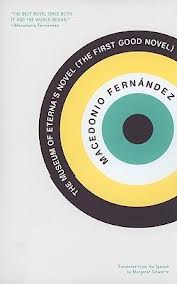
and today I am passing the PROMPT that this novel is – and IS contained in it – on to you… from Fernandez himself – I have lived with it, considered it, dreamt of it… a prompt he left us that haunts and inspires me… an ultimate sort of prompting….
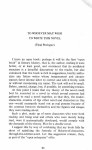
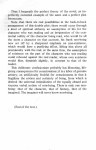

– Paul Celan
Student Magazine of IISER Mohali
Music, Musicology, and related Matters
a photographic pilgrimage to Orthodox Christian monasteries across the continent
Meandering Through a Literary Life
Orthodox Christianity, Culture and Religion, Making the Journey of Faith
Erik Kwakkel blogging about medieval manuscripts
"That's the big what happened."
Networking the complexity community since 1999

 All my Words are Silent