Scripting the Photographer: The Photographer Discusses His Many Eyes
I did not choose the square, I merely direct it, I “aim” it, what philosophers refer to as “intention.” The rectangl’d eye limits me, but also sees things I’m unable to. I need extra eyes, to see. As you know, my vision has been bad from birth, have required many assistants. Left to my own body I see a fuzzy swollen version of a clear night sky lain over transparencies of its negative. Clouds and pom-poms.
I’ve turned to lenses. They transcribe the world to me. They record for me, cross-writing the world through direct impressions of light bounding off objects. My boxed eye evidences existence and matter I might never know. Where my vision is rounded and illusory, darting and fluid, my extra eyes, borrowed eyes freeze it a moment, show me distinctions and planes, colors and forms, what, perhaps, is really there? Or also there? Out there, out beyond the gauzy curtains draping my own eyeballs, spotted and stained and all warbly.
My four-eye captures shapes, tones, responds rather than interprets or occludes. Perhaps mine is not a misfortune? Perhaps multiple visions would benefit everyone? Perhaps all human eyes inherently skew to their shapes, their veils, the thoughts and feelings of the bodies that house them, now constricting, now expanding what they perceive? Smearing discrete objects and occurrences into a wash of associations, altering what they take in into an image of what they actually apprehend?
Sunset seen, described into a version of sunset seen, concocted over said sunset, compared to still other forms, visions, images of “sunset”?
I cannot speak for those of us boasting the proverbial 20/20, clear in-sight, for this I’ve never experienced, enjoyed? I only know my many apparati that combine to provide, present, re-present an interesting show of the “world.”
Including myself. Snapshots and Polaroids taken of me and those I know rarely reflect the image we have of ourselves, like hearing my own voice through a machine or over a wire or recording. I never “feel” identical to what I see or hear. I notice those around me (more reliant on other eyes than they might think) repeatedly and continually (constantly?) comparing what they are seeing to images, other visions – “that looks like a photograph!” (which photograph?), or “if only I had my camera” (how would that change, signify, preserve?), or “I don’t remember it like this” and so on.
My many eyes help expose each other’s deficiencies, particularities, distortions, additives and deletions. I’m not certain I can ascribe purpose to any of the various visions, it seems that the blurs and framings, foci and subjects/objects chosen are particular to each kind and moment of eye.
But its why I listen to the speech of eyes, listening also to my own (“reading” – listening with the eye?). The eyes of children and foreigners, the aged or disabled, the rich or the poor, males, females, video, color, black & white. Every eye seeing its own reality, even from camera to camera, lens to lens, light to light to photograph (after all, once developed and materialized, the print has gone through processes replete with adjustments and accidents, alterations and mediums becoming yet another subject/object to be variously, multifariously “seen”).
Nothing exists unchanged or unaltered. This is the message of my many eyes. “Original” is an illusion – a manifestation of disappearance – a mirage. This is part of the reason I suggest you grab for eyes, multiply eyes, hear eyes out from any direction or make – to “see what you can see.” For each and every I/eye reports individually, uniquely, distinctly. Layering and unlayering veils of vision, the optics demonstrate convergences and separations, agreements and arguments that help me, at least, to “see” what might possibly be “being seen” of this fluid process we call “world,” call “vision,” call “life.”
“But them…they’ve got…no eyes. More precisely: they’ve got eyes, even they do, but there’s a veil hanging in front, not in front, no, behind, a movable veil; no sooner does an image go in than it catches a web, and right away there’s a thread spinning there, it spins itself around the image, a thread in the veil; spins around the image and spawns a child with it, half-image and half-veil…and in my eye the veil is hanging, the movable one, the veils are hanging, the movable ones, you lift one and the second one’s already hanging there…”
-Paul Celan-
“the camera may be thought of as comparable to the eye. The difference is that the camera is not more than an eye. It does not think. Any connection with judging, choosing, arranging, including, excluding, and snapping has to be with the photographer…what the picture is of limits meaning while it encourages the exploration of meaning”
-Mary Price-
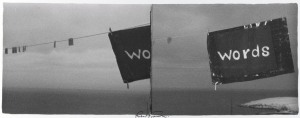


 All my Words are Silent