Metamorphosis: 2013: Insect Intensity

Termite Art

Working the edges and angles.  “Part of the woodwork,” they say, though not in a structural sense – rather more a destructural or deconstructional way, one should probably add.  We’re usually fairly quiet, but work is constant, at times involving even groups or clans.  What we create looks like a whole full of holes.  Feeding on the solid, reducing it to doubtful tunnels, leaving some beautiful patterns.  Rhythmic, at least.  Once in a while you can hear the hum of our work, but more often than not our efforts are simply stumbled upon.

What you once thought sturdy enough to lean upon often crumbles out from under.  Usually we’ve been there first and found the flaws.  We scramble and burrow, many even fly.  Keeping mostly to ourselves, gnawing and chawing away at the things we all believe in and trust, things assumed to hold fast and true, the shapes that give substance to lives.

Of course many consider us sinister nuisances, think we work to undermine, but we really don’t take much – just leave it considerably different than when we first come upon it and passage our way through.  Left to ourselves we accomplish a lot, are industrious, but we’re more often pestered, hampered, sealed-off, even (and yes, I’m serious!) exterminated!  Treated as pests or threats or dangers.

We might be admired, theoretically, but we’re never welcomed as guests.  Not invited in houses where public or money are smelled.  There we’re only talked about – as worming and wriggling our ways through the infrastructures – “fluttery, ephemeral critters” we’re called – parasitic to power and ultimately debilitating if left unconfronted.

Harmless enough as ourselves, simple units to squash, but we happen to be many.  Think: ants.  Think: pestilent plague.

We can be quite beautiful in the light (as a specimen!) – translucent and fine and opaque, exhibiting a powerful delicacy.  But given free reign we undo the foundations, and therefore, it is feared, the whole edifice too.  An elephant, for instance, might be trained – used for tricks or for jokes – is easy to keep an eye on, but not us “weasly and scuttling creatures,” no, no.

All I’m saying is that some of us are always eating away at the edges and bounds, plundering thresholds, slobbering the barriers and gates – they’ll acknowledge us if forced to – but with a mind to be rid of.  If featured, we watch out for the shadows and sprays, closed quarters and boots.  They’ll let us have slush piles and compost, a few trimmings or what’s already abandoned, but it’s always in hopes – always – of keeping us OUT.  Mark my words, no one really loves a thriving insect but itself.  Grind and tear with all you’ve got, our lives are short and there’s much to do.

Requiring so little, any medium will do, only to find access…and…wizzle inside…

“A peculiar fact about termite-tapeworm-fungus-moss art is that it goes always forward eating its own boundaries, and, likely as not, leaves nothing in its path other than the signs of eager, industrious, unkempt activity.

The most inclusive description of the art is that, termite-like, it feels its way through walls of particularization, with no sign that the artist has any object in mind other than eating away the immediate boundaries of his art, and turning these boundaries into conditions of the next achievement.”

-Manny Farber-
Identity & Flipping Numbers like Coins

What exactly is it about the arbitrary changing of numbers, parceling of time, divisions and subdivisions of existent moments, that prompts and wriggles us to consider change – feel obligated or massaged toward it – dream of it?  I can say that in all my dizzying thoughts about it – how society and culture (Petrie-dish like) inundate and stimulate individuated personal alterations – I cannot figure out why crossword-puzzle-like taxonomies and designations of life-fragments labeled by stick-systems of reference, mathematical calculations and so forth stimulate (simulate?) desires, wishes, regrets, metamorphic movements in the human gang…

Be that as it may, today is the first day of the first month of the year containing 0-1-2-3 (my wife comments what a delightful play that  must be for numerologists), and while my beloved is out signing up at the Y and beginning self-care with new devotion, I am denuding my desk, dusting and polishing its surface, taking revised stock of the pounds of books that weight its surface, reorganizing, selecting, making hard choices about what is necessary for me TODAY with some forward thinking.  The numbers have changed.  The game must be different, no?

In the process, I open a drawer I apparently haven’t for a very long time, coming across a miniature moleskine notebook, first entry dated January 2003!  A decade ago, how interesting!  I leaf through…and here are some of the things that capture my attention:

  • a quote from my son Aidan (he would have been 5 at the time) on being unable to remember something:  “it’s in my brain, I just can’t find the right aisle.”
  • and Steinbeck: “its inhabitants, as the man once said, ‘whore, pimps, gamblers and sons of bitches,’ by which he meant everybody.  Had the man looked through another peephole he might have said ‘saints and angels and martyrs and holy men,’ and he would have meant the same thing.”
  • Cixous: “it is this hunger for flesh and for tears, our appetite for living, that, at the tip of forsaken fingers, makes a pencil grow.”
  • Handke:  “in any case, I experienced moments of extreme speechlessness and needed to formulate them – the motive that has led men to write from time immemorial.”
  • “Books should not flatter our sense of self.  They should investigate it.  I read another person in order to get better at interrogating my own unexamined narrative” – Richard Powers

The last entry reads like this…”We used to always pick models or icons we wanted to be like: have what they had, whole persona and possessions – WHO would I want to be?  … When does it hit you that you only want to be you with some other life?”

Wonder where I was…a kind of number-flipping query…

further to go….2013

“It’s always a question of beginnings”

Another year.  The title of this post comes from Helene Cixous’ introduction to Clarice Lispector’s The Stream of Life, both books being part of the tight reliable necessities of each of my own repeated beginnings.  No matter how I try otherwise, when the first of a calendrical year comes around with its socio-cultural aura-like atmospheric influence of the idea of new beginnings…I find myself tracking to the shelves for these few cellular texts like the body seeks to breathe.  This has been my inalterable habit for so many years now, that I can not avoid recommending them (with the highest deepest forms of  loving attachment), to all of you.

“evoking the incommunicable realms of the spirit,

where dream becomes thought,

where trace becomes existence…

I write you because I do not understand myself…

it is always a question of beginnings.”

“And for many years I have been writing,

borne by writing,

this book that book;

and now, suddenly, I sense it:

among all these books is the book I haven’t written;

haven’t ceased not to write.”

and additionally, today:

“What I mean is, if you have ink in your blood it’s hard to get it out of your hands…

Our reputation for excellence is unexcelled, in every part of the world.

And will be maintained until the destruction of our art in some other art which is just as good but which,

I am happy to say, has not yet been invented.”

“Samuel Beckett: Try again.  Fail again.  Fail better…

to conceive of writing as a possibility space where everything can and should be considered, attempted, and troubled.”

May your 2013 be filled with incredible texts and integral growth and development!

back at it with renewed vigor for the new year!

All That & More : 2012 in Review (w/musical moods and interludes)

Evincing

The term is evincing.  That word that stands for the complex of tangled strands stuck and striated into a confrontation with blankness.  You know what I mean?

Balled up like a sap-thickened snot-slickened hardening knot of twine, all strung together, unruly, but wadded and crushed, like a snowball – a large icy one – but dirtied – clodded thick and gluey-thready – distasteful, a kind of impossible object – something like the idea of the innards of a self – what one sees in a mirror – like a melancholy music – tunes that you love that empty and sicken you – help you to feel more alive – all that.  More.  The unaccountable enormity that feeds into a stream called entity.  All that.  More.  Horrible, beautiful things.

            The fact that we are far more than we are able to surmise, and far less than we hope or wish to be.  Messy.  Contents of a dump.  A lifelong of it.  From every here and there that has ever counted as “around” us.  All that.  More.

It comes to bear.  In its confusing ways.  Its overwhelm, that is not too much, indeed, we hang together by its incredible pressure.  All that.  More.  We are composed of far more than we can consciously carry or categorize.  Too much.  All that.  More.  The too-much encroaches, suffocates, immerses us in such a way as to individuate and differentiate us as misshapen identities, figures in rubbled ground, that which we spy in mirrored surfaces and the reflections of others’ faces.

That is what I bring to blankness.  And stare.  All that.  More.  Scrambled and disturbing.  Flustercucked and discombobulating.  Lost in the morass that makes me, that I am unable to peek through, even glance.  Life.  All that.  More.  Too much.  What cannot possibly be organized.  All that.  More.

            This is my life.  Such a jumble of grandeur, goodness, glorious juiciness and jubilant joyeux, with dark twisting tunnels of termiting fear, incapacitate fogs too bleary to count quite as fog – glaucous and cataracted visions.  Too much.  All that.  More.

I heave and haul it to blankness.  These pages.  I set it on fire, collecting the ashes.  Or pick at a corner, scabrous and stubborn, until a smidgen unravels and I can trouble it.  Or simply collapse on the paper, clod-like and unstable, leaving crumbs.  Thank you paper.  All that.  More.

            If you took all that was life-sustaining precious to me in this world and stacked it on top, I would die quickly, crushed under its weight like a sparrow cracked under boot.  That which breaks us makes us stronger?  Comes out of the mouth through the pen and returns through the tubes in my ear-throat to gag me.

I buckle under it like an aged Prometheus and slog, spilling it onto the blankness.  All that.  More.  I love what survives me.

“with no sign that the artist has any object in mind other than eating away the immediate boundaries of his art, and turning these boundaries into conditions of the next achievement.”

-Manny Farber-

All that and more.  It evinces.  I am thankful for the whole god-damned and gloriously blessed mass.  I gnaw.  It evinces a spittle, which falls on this blankness.

HAPPY NEW YEAR – HERE’S TO IT!

TO EVERYTHING…AND MORE!

Mysteries

DONALD BARTHELME, WINNER OF THE 1972 CHILDREN’S LITERATURE AWARD
FOR THE SLIGHTLY IRREGULAR FIRE ENGINE

Writing for children, like talking to them, is full of mysteries. I have a child, a six-year-old, and I assure you that I approach her with a copy of Mr. Empson’s Seven Types of Ambiguity held firmly in my right hand. If I ask her which of two types of cereal she prefers for breakfast, I invariably find upon presenting the bowl that I have misread my instructions — that it was the other kind she wanted. In the same way it is quite conceivable to me that I may have written the wrong book — some other book was what was wanted. One does the best one can. I must point out that television has affected the situation enormously. My pictures don’t move. What’s wrong with them? I went into this with Michael di Capua, my editor at Farrar, Straus & Giroux, who incidentally improved the book out of all recognition, and he told me sadly that no, he couldn’t make the pictures move. I asked my child once what her mother was doing, at a particular moment, and she replied that mother was “watching a book.” The difficulty is to manage a book worth watching. The problem, as I say, is full of mysteries, but mysteries are not to be avoided. Rather they are a locus of hope, they enrich and complicate. That is why we have them. That is perhaps one of the reasons why we have children.

The Nourishing Silence

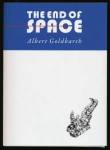
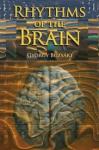
In the midst of busy, sometimes harried, rhythm-bashing holidays, Holly and I find our first day of quiet self-direction, spending a full day of her sketching, submitting images, reading… and myself completing an essay and Ida’s blank notebook and polishing on some poems…and, probably most nourishing of all (for me)…input.  Here are the sumptuous nuggets I’ve been sampling today:

This slideshow requires JavaScript.

Conclusion to the Gift that Explodes : Final Page

Notebook7

and the typeset:

7

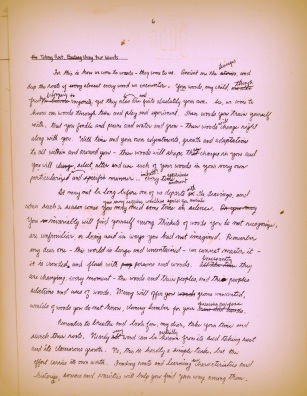
Taking Root, Using Your Woods

For this is how we come to woods – they come to us.  Ancient are the lineages and deep the roots of almost every wood we encounter.  Your woods, my child, though freely belonging to anyone, are also and quite absolutely, your own.  You see, we come to learn our woods through time and play, experiment and work.  Those woods you train yourself with, that you fondle and prune and water and grow – those woods will change right along with you.  With time and your own adjustments, growth and adaptations to all within and around you – these woods will shape those changes in you and you will select, alter and use each of your woods in your very own specific and particularized manner…in every moment, experience, and time.

It may not be long before one of us departs with The Leavings, and with such a season you may seek out woodless spaces for a while.  There is nothing wrong with leaving woods behind for a time.  You will invariably find yourself among thickets of woods you do not recognize, are unfamiliar, or being used in ways you had not imagined.  Remember, my dear one – this world is large and uncontained – we cannot master it – it is crowded and flush with persons and woods.  Incessantly they are changing, every moment – the woods and their peoples, and the peoples’ selection and uses of woods.  Many will offer you groves unwanted, wealds of woods you do not know, clumsy lumber for your yearning purpose.

Remember to breathe and look far, my dear, take your time and search their roots.  Nearly any wood can be partially known from its seed taking root and its clamorous growth.  Woods are formed of winds and waters, weathers and disparate soils – they are bound to have unique characteristics and histories, varieties and sources – learning these will help you find your way among them.  While hardly a simple task – its effort carries its own worth.

Then you may come to feel comfort in whatever woods construct the bosk where you are – they can speak to you, and you with them – becoming another precious person of the wood.

You have so much to offer us, as the forests of woods do you – all the many woodlands spread throughout our homelands, neighborhoods, countrysides and world – many, yes, loved child, many woodlands yet to be invented, discovered or known – and you, sweet forested one, growing now among them, taking roots, assembling branches and leaf piles and canopies, or ships with broad docks and high towers, realms and copses, barrels and fires and beds – as you learn to love and use your woods, multiply and form them – oh what wonders await us all!

Take your roots, then, gather seeds, use your woods – let them grow and shape you – plant, sprout and remake them!  All woods you engage are yours while you are in them!  So live, darling wonder, live and learn and create!  Staying open to woods – testing and investing and proclaiming them!  Even logging them for records or constructions, be certain to renew, and create!

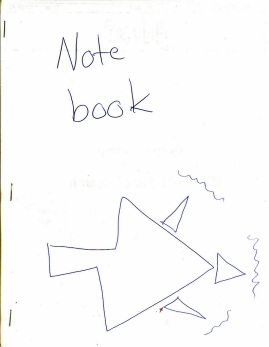
and the final product of the little gifted notebook from my lovely daughter, sussing me through these holidays

Notebook - Ida

Architectures of Possibility

“Writing is a manner of reading.  It is a mode of engaging with other texts in the world, which itself is a kind of text.  And reading is a manner of writing, interpretation, meaning-making.  Which is to say that writing and reading are variants of the same activity.  Existence comes to us in bright, disconnected splinters of experience.  We narrativize those splinters so our lives feel as if they make sense – as if they possess things like beginnings, muddles, ends, and reasons.  The word narrative is ultimately derived, through the Latin narrare, from the Proto-Indo-European root gno-, which comes into our language as the verb to know.  At some profoundly deep stratum, we conceptualize narrative as a means of understanding, of creating cosmos out of chaos.”

“Yet in many cultural loci these days we are asked to read and write easier, more naively, less rigorously.  We are asked to understand by not taking the time and energy to understand.  One difference between art and entertainment has to do with the speed of perception.  Art deliberately slows and complicates reading, hearing, and/or viewing so that we are challenged to re-think and re-feel form and experience.  Entertainment deliberately accelerates and simplifies them so we don’t have to think about or feel very much of anything at all except, maybe, the adrenalin rush before spectacle.”

-Lance Olsen-

“Literature is the question minus the answer.”

-Roland Barthes-

Using Our Woods – the Gift that Explodes 6

Notebook 6

and the typeset version:

6

Whose Woods are These I Think I Know

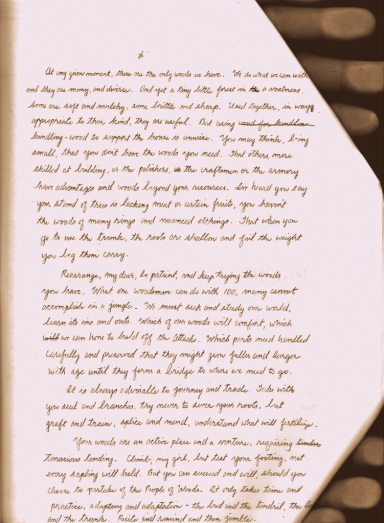
At any given moment, these are the only woods we have.  We do what we can with them, my dear, always many and diverse.  Yet just a tiny little forest in the vastness.  Some of our woods are soft and mulchy while some are brittle and sharp.  There’ll be splinters and cracks, switches and boughs.  But used together, in ways appropriate to their kind, they’ll be useful.  Like don’t use kindling-wood so support the house.  I know you often think, being small, that you don’t always have the woods you need.  That others more skilled at building, the polishers and craftspersons, or the armory whittlers have advantages and types of wood beyond your resources.  I’ve heard you cry that your stand of woods is lacking meat or certain fruits, you haven’t the wealth of many rings and nuanced etchings.  That when you rope the trunks, the roots are shallow and fail the weight you beg them carry.

Rearrange, my dear, and be patient.  Keep trying the woods that you have.  I’ve seen a woodsman create with 100 what many cannot in a jungle.  We must seek and study our world, evince all its ins and its outs.  Which of our woods will comfort, which we can hone for attacks.  What parts need handled carefully and preserved, that they might grow fuller and larger with age, ‘til they form a bridge toward where you need to go.

It is greatly advisable to journey and trade.  Take with you fresh seeds and young branches.  Try never to sever your roots, but graft and train, splice and mend, understand what will fertilize.

Your woods are an active place and a venture, requiring tenacious tending.  Climb, my child, but test your footing, not every sapling will hold.  You can succeed and will, should you choose to partake with the People of Woods.  It only takes time and practice – adapting and adaptation – the bud and the tendril, the log and the trunk.  Recite and remind and then jumble.

Above all, my daughter, please play.  Pick-up sticks, wooden boats and chutes and ladders.  Kites and slingshots, barrels and monkeys, apples to apples.  Now is the time to throw peaches and chew the walnuts’ rind, bowl crabapples, smoke the reed and sniff the pine.  Some whips will leave seams you’ll never forget, some falls may even break a limb, but you will grow and know, know and grow, until you, like the tree, flourish and bloom, strip and stand bare, proud and enduring, withstanding both wind and the wave, strikes and blows, the cold and the dark, all from your stock of woods and what’s possible.

Whoever dreamt a log could roll on rivers, or bend into a wheel?  Who knew they’d form enormous arks – large enough to save our world?  The handing of a tiny reed embossed with cursive love, sharpened to a blade, signs set to warn of danger, posts to fort a home.  My love, impossible does not apply with your woods – all that we know is unknown where the woods come into play.

Experiment, invent, babble the brook or construct a staying dam.  Use our woods, love and care for them, ignite your passion, rub them together toward sparks, thatch, nest, spear.  The woods are waiting – and these are yours.

click here for all 6 pages – The Notebook