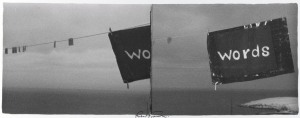
Leonhardt Conspiguous

Leonhardt Conspiguous


Leonhardt Conspiguous would have known the difference.  Between, say, BWV 161 and BWV 173; or a trunk or tail if he’d been born a blind mouse.  LC always knew the differences.  But he found similarities difficult to trace.

In conversation Leonhardt once encountered a man who’d read the entirety of his library, (the titles so resembling his own as to appear indistinguishable), drawing the same conclusions as LC in the shared vocabulary.  LC was unable to devise a category or designation for this phenomenon.  It was like looking in Leona’s eyes.

A concave lens forms a sphere of reflection, and hers – of grey of green of blue – mimicked Leonhardt’s so completely both in color and tone, that he’d instantly felt something farther back, back behind, any place he’d ever felt before.  In himself or another.  As time went on and her desire gained in details – their fancies so colluded he could not decipher whose were which – not in content nor expression.  The similarities baffled him.  And frightened.

But Hunter Green from Forest?  LC would know even the percentages and numbers.  Like every kind of sparrow, every human’s skin.

Leonhardt believed that what we come to know is inherently unique, but that same is imperceptible.  What startles us in those with whom we feel alike, is not the magnitude of what we hold in common, but how specifically each possesses it.  “To see eye to eye,” in Leona’s case, made visceral sense to him, but could not be understood.  “To see in or around” is what he labeled “comprehension.”

LC could see no further “in” to his cherished love Leona, than he could see within himself.  Which to some seemed deftly nuanced and unusually deep, but that was due to fierce attention and lots of time and mass filigrees of distinctions, not, Leonhardt insisted, to understanding.  “To analyze parts and fragments, was not to know a whole,” he was fond of telling himself, “and our lives are composed of fragments.”  Like arranging jigsaw pieces, separating by color and cut and number, and believing that they might fit, still never solved a puzzle, where new pieces are added all the while.

LC believed there was no whole, as far as humans perceived, just incalculable myriads of pieces arranged, rearranged, created/forgotten, damaged or lost in their fires.

He could never explain Leona.  Or synchronicity.  “Terms such as these synonym mystery,” he would say, “and should be kept in careful silence.”

LC despised religion.  The compulsion of the concocting of names, he called it.  A disease, an impatience, an anxiety of what is unknown.  Shuffling a hat full of vowels and consonants we look for what sounds as strange as our experience and assign it that – that which is odd to our senses, things we describe can’t explain.  A crapshoot or fancy, an oracle of chance.  Presuppositions he heartily derided.


We were left with description, he thought.  Of Leonard (his friend of shared library and thought) LC reported the odd sensation of someone other speaking words that more nearly matched one’s own ideas than the terms oneself could find.  And Leona, well, Leona.  Leonhardt preferred to call her by her body parts or textures, her language or beliefs, “Leona” ringing to him of the mystically unexplained, uncomfortable talisman, as if he were mumbling “YHWH” or “Zeus,” “Santa” or “Satan” or “Venus.”

(to be continued?  you decide…)

Jim

Jim

Jim is unable to utter a lie.  He simply cannot believe them.


Jim, sitting with friends around a hotel pool, once said: “I think every word says something about its author.”

After overhearing a tasteless joke, Jim no longer spoke with Darrell.


Jim disbelieved everyone.  His boss and his pastor, his spouse and his children; in fact, he found it impossible to trust humans (including himself) to know what they were talking about.  And yet he believed what they actually said.  The words they used.

Every statement or exclamation, every question, harrumph or faux-pas, he deciphered.  Jim doubted each “slip of the tongue.”  He said he believed in our languages.


Jim’s work was in “managing waste,” a lie that he knew they believed.  He spent most of his time in the noisy outdoors.  Chaotic, due to the mind-grinding sounds of the vehicular beasts they crept the city streets in, feeding them trashy fuel and guarding their grueling mastication.  Loud and smelly as well.  Rotten food, molded carpets, all manner of grotesque and disfigured things.  Jim saw what was hidden, discarded.  What most of us keep covered up.


His coworkers primarily proffered profanity.  He believed them.  But branching to politics or domestic intricacies, Jim only trusted their language.  It didn’t really matter what content spilled forth (he would say), the words that they chose and the ways they were delivered provided the confessions they “meant.”  “I’m afraid my wife no longer loves me” often intended its opposite, for instance, and nearly always equaled “I’m unhappy.”  Words worked like that, held Jim, worked all around one another.  “Assume the people are lying and the words will speak for themselves.”

Jim’s wife called this the “double bind,” or his “contra-contra-diction.”  And “paranoia” in worser moods.  “If you don’t believe in people,” she’d say, “and always think they lie, particularly to themselves…then say you believe their ‘language,’ but never what they actually say – really Jim – what have you?!”  “You’ve got nothing!” she’d complain, “no substance, no content, no motive – just a jumble of words that you (one of them!) reassemble…what else can that be but the rattling workings of your garbage-compactor of a mind, Jim?”  And Jim heard: “I don’t like the way you think.  It’s not practicable.  It’s egomaniacal and unfair.”  How Jim reads an utterance, with faith in the language, between all the lines, “it’s relation,” he’d say.


“I can’t speak for somebody else, dear,” Jim replied, “I just translate what I hear, or apprehend.”  “You say tomahtuh, I say tomaytoe, sort of a thing.  That’s paying attention.”  How words wrestle around and decompose, what parts go first, or crumble, get smashed.  What words stick out, slide easy, remain.  “And watch out for the oily and slime,” Jim would say, “that’s the trickiest danger to ‘manage.’”


“You’re not dealing with garbage here,” his boss declared, “I’m giving you straightforward instructions.  There’s nothing to sift through or weed out, Jim.  I need you to perform this task,” and on he would speak, accustomed to Jim’s sorting appraisal of words.

For Jim it was all the same.


Words were some overused and available aggregate, he thought.  People picked them out according to habits and taste, “nature and nurture,” he’d cliché, and then bandy them about until they felt understood, or relieved, or just plain empty.  But the resemblance was rarely precise.  Jim believed that most people simply grabbed at terms and sounds, gestures and winces without much a thought for precision.  “Think what all could be covered in silence,” he’d say, holding a field guide to transportational signage, or fingering the moves of sign language.

Most people just want to make contact, he’d hold forth, to be heard or effect something – a playing of power, a quest to convey – but not given much thought or concern.  “I basically rummage through all their crap,” Jim continued, “with an eye out for volatile substances, wounded heirlooms or inadvertent mistakes they rid themselves of, and put a pretty clear picture together.  Of their values and style, relations and status, family, religion and work.”

Joan (Jim’s wife) often speaks of what she deems Jim’s “arrogance.”  “How can he suppose to know,” she’d decry, “a person’s life story or intentions, education or political beliefs from a talk about weather or baseball or drinks?”  “It’s hypocritically bigoted, as if truth were the eye of beholding, each person’s puzzle to piece.  Unaware of themselves, Jim presents some ‘true meaning’ – its Gnostic, religious, a myth,” she’d complain.

Yet Jim was resoundingly insightful and most often correct, which simply buggered them more.  It seemed people really were giving something away when they opened their mouths, no matter what language they used.

“Words are functions,” Jim stated, “where text and image collide in a complex silence or sound.”  “Nothing escapes, really, just gets alternatively pressured and squeezed, mangled and reformed, mashed into a mushed conversation.”  “Every talker a monologue, every listener too, for the most part,” he said,  “a dialogue running oneself, a wrecked chorus, I listen for pauses and patterns, I try to decipher the breathing of noise.”

“These are just Jim’s thoughts,” snarled Joan, “things he puts into words like nonsense.”


(to be continued?  you decide…)

Writing: the Characters

Writing: the Characters (1)


Not beginning from anywhere but here.

Here being where I am looking for a character, a someone, and specific, with a mind, a body, and particular knowledge and actions, whom I might observe and record.  On whom I might test out my language.  Whom I create.

Exercise in perception, then.  To see what I could see, perhaps, if I looked a certain way, at or into a certain person.  What I might hear, and how to say it.  What would be felt and its work of translation.  The smells and the tastes and the histories, for both of us.  Or perhaps even all.  No, that’s too far.

Right here, though, investigating perception, that preform vehicle, formed by our surroundings – imagination – the multiplex of learning structures allowing me to sense, to perceive.  That also, is here.

Imagination and perception – their invention we call world, and a character, a subject/object like my hand I might observe, hold aside of me while attached by nerves and cells, tissues and blood, by life, its embodiment.

Non-abstract abstracted – that conundrum – here.  The truthfulness of experiencing becoming honest lies.  The words, the print of hand, what tells (or who), and how.

Perhaps another thinks this way?  Well, not exactly, but shares concerns with idiomatic nuances?  Perhaps his education (or hers) was difficult, or pleasurably a breeze, they mastered information like a large and thirsty sponge?  Absorbed and were absorbed in such interstitial structures.  Or not.  Not at all.

An uneducated person with adaptive gifts for resonance.  A mimicking trickster riddling what is heard into naïve and complex wisdoms?  That would be fun.

Perhaps another world – country, continent, planet?  Someone observed for years suddenly inserted in a strange context, situation.  How do they behave, react, manage and survive?  I could use myself in a planet of clouds, or the tunnels of worms, what would characterize me?  How would I change?  What might I effect?  If I were made of clay or had a thousand lovers in a desert?

The only edge to possibility is what experience brings.


But pretending to begin right now, I see him clear.  There is a woman he is watching he finds beautiful.  When she works he sees the curve of her small breast which he desires.  He is ruddy yet refined, of middling age.  He’d like to court her but fears all pain that can’t be bandaged.  He’s afraid of words and their millions of ropes and anchors.  Reality feels like conflict, for him, a continual coming-against, and adjustment.  Adaptation he experiences as loss.  Of unrealized ideals.  And so he walks, spinning narratives in his head.


Here, that possible visitor handmade.  But who?  And how would I know him?  And where was he from?  How was he formed?  Who does he belive?  And so forth…

One way to be here.

One way to press your hand against the wall.


Writing: the Apparatus

This slideshow requires JavaScript.

Writing: the Apparatus

“one can think of the work (of writing) as a dialogue between the two distinct demands bearing on it (the demand of possibility, the demand of the impossible).  Or between its two poles (measured form, measureless disintegration) or between the embodiments of these two ‘centers of gravity,’ if you will: reader and writer…two come together in a place where neither can be found…One of them keeps dragging it into the light of day as a completed oeuvre, a realized whole, something that has actually taken form and come to be (read, that is, or, you could say, heard), while the other pulls it back into the dark whence nothing ever springs (but where there is a chance that, coming to pieces, something might come to be written or said)”

– Anne Smock, What is There to Say?

-the demand of possibility, the demand of the impossible-

            The tools the writer possesses.

That there must be something to say…that it is impossible to completely say.  Finally, definitively, to have done with, saying experience.

What does one make of this?  With this?  Paradoxical demand, desire, exigency – imperative, self-generating, uncaused and ineffectual, drive?

Our tools:  awareness.  Attention.  Passion.  We observe and take note, feel-with, and seek to spell it out (for ourselves, for world).

Our tools:  available language, sound, gesture.  Entering the woven barrier and thoroughfare of what is shared, common, constitutive, we act, operate, select, arrange, choose, rearrange from this quilted information of the world, our saying of it.  Or singing, or stating, shouting or whispering and mumbles.

It seeks into fact.  We construct an object, made up of nothing, of airwaves, scratch-marks, designs.  Barely effable cues, hints, notions and signs.  We begin again with that.  With what it fails to say, to communicate or reveal.  We tinker with and tamper, excise and expand.  Ever the remainder.  Inexact invention.  Something there, some things not.

We pursue what is not.  What fell aside or seeped away.  The evaporate.  The unknown (here I adore the French: je ne sais quoi – that feeling that one knows it, and knows it so well and so deeply, and yet is unable to say what it is that one knows!).

Endless anticipation, expectation, a lusted desiring…

Endless frustration, falling short or to the side, inevitable (inherent even?) failing, shortcoming, irresolution.

These are the tools of the trade.  The writer’s apparatus.


A caveat:  from time to time I’ll wager to say we all of us take in some language or sound, vision or world that seems “just,” feels ripe, adequate, full and exact to the perception of our experience.  This is wondrous, thrilling, satiating, “ecstatic,” a moment’s completion, wholeness, perhaps.

Yet is it?  What does the masterful painting, the pregnant poem, the echoing song or fulfilling experience result toward?  Yes, toward, not “in.”  Not arrival but generation, bursts of multiplications of words, sounds, sights and movements now invigoratingly fueled and stimulated – fecund to go on…for more…fuller…richer…or even repeat!?

“Such then, would be my task, to respond to…speech that passes my understanding, to respond to it without having really heard it, and to respond to it in repeating it, in making it speak…To name the possible, to respond to the impossible.  I remember that we had designated in this way the two centers of gravity of all language…Why two to say one thing?  – Because the one who says it is always the other…”

– Maurice Blanchot, The Infinite Conversation