Fiction Family 4

Pieces that precede can be read in order here:  FAMILY: A FICTION
Family 1

section three closing thus….

They build a monument, calling it travel.  Stripping each other of context, providing a different forum.  Humans tend to revert to familiar.  Habitude of experience.  With no experience, alteration comes to bear.  Predictable as weather.

No one’s leaving home.

Other words coming to mind.

4

            Resistance.

There is, it seems, in families, this propensity.

Whatever is said, corrected, even when agreed.


Existing to clarify his spouse – to illuminate and exhibit.  In turn, she elucidates him.  Providing bases or cause – extrapolates.  Siblings arguing each other, united they stand, all as deserters.  Seven eventual versions of the parental wake-up blare: AWOL.

It’s good to be king.  Graph the assassination attempts – looks like innards of clocks.  A searing clap of surprising betrayal each time.  Unlike the spurned and necessarily nutrient mother.  Shagg proclaiming the law (as devised and developed by nature – read lifegiver/lawgiver “mom” – female coupling nurture and structure within dependency).  He handles rebellion, warding attacks and spying the skirmishes, she breeding resentment from ongoing need.

These are general patterns, biologically driven, no symphony the same.  With eight keys plus a half, on a twelve-tone scale, the songs recognizable according to differing orders.  Typify and characterize.  Declare it false.

Scraggydad is nurturing, allowing/confirming resistant responses and recumbent emotions, shame-shirking under her gaze.  In other words – as one of them – a remedial complicity.  Which she echoes into her drama – the leadership, the guilt, the collapse.

Each wanting to be cradled – rock, paper, scissors style – with an occasional simultaneous Bingo.  However unlikely, it’s what probability’s for.

Thus every level its lingo.  Select a word (sex or heaven, death or boy) and provide a taxonomy of related meanings from the eldest parent through littlest child.  It comes clear.  There are altering thesauri of usage.

Family as a game of Scrabble on the board of Life, each settling Catan.  With beeps and whistles and a slew of avatars.

A technique known as mapping provides lay of the land, similar to a geneologist’s tree applied to the present.  A thing to be explored or verified.  Corrected through each journey.  In several dictions.

The family edition.

A Family of Fiction, pt. 3

“all attempts at interpretation must abandon any pretence at direct understanding and concentrate on second degree understanding.”

-Victor Stoichita, A Short History of the Shadow-

Family 1

FAMILY A FICTION (the story to now)

Section 3:

3

            Girl-princess-daughter, her experience as only.  Not quite true collectively, there being also steps- and halves- another, older, never cohabitant, but still.  The members were stacked.  Against or for, another matter.  Depending.

The younger, caged one, doesn’t eat.  Is self-restricting.  Flutters like a bird.  Her brain engulfs her self, a genetic trait.  Possessed also, in some measure, top-down.  Each with their own rendition.  One definition of family.

Cohabitants.  Genetics.  Affinities.  Their opposite.  Relations.  Some, after all, being half-habitants, some post-, some occasional-, some rare-.  Or endangered.  Or in transitions.

If there is a nucleus, it is Scraggly and Self-aware, both co- and in-habitants constantly, at least according to them.  In the minds of their children.  Whenever they were.  Adding an unknowable “if.”

The grown and growing exhibit it.  The three on their own.  Three nearly capable, at least two of which: disinterested.  This is not about them, not a descriptive analysis.  Maybe more like a song, composing a fugue: each line for itself replete with recurring variations, cringes of dissonance and harmonic highlights.  Something like a family, a novel, a history, religion.

Oscillations that swivel near a truth, only to loop and to veer into something more real.  Being actual.  That is to say, is happening.

Inopportune call and subsequent jail time.  Jealousies and rivalries, differentials of power.  Stirred with a paste of abuse and traces of –isms.  Coupled to all the unpredictably brave accomplishments.  That sort of thing.  The life of a species.

With no one sure how to tell it.  Who solos, who’s chorus.  And when.  Where hardly matters in webs.  Or does it?  Authoritative nights at the table, father propounding to a coven of illumined and down-turned faces – forged not of incantations, but synergies of private networks.  Ubiquitous strands of escape.  Virtual tunneling.  Not to mention insolence.  Or simply vanishing within.  Daddy lost in thought.  Or mum diagnosing (she doesn’t like to think it that way).  Seldom either/or.

They build a monument, calling it travel.  Stripping each other of context, providing a different forum.  Humans tend to revert to familiar.  Habitude of experience.  With no experience, alteration comes to bear.  Predictable as weather.

No one’s leaving home.

Other words coming to mind.

Family is Fiction, part two

FAMILY: A FICTION, PT. 1

Family 1

2

            Quick to give up, or in, to description.  Sidelong glances, or enough periphery, and it’s known – they are there.  Are here.  Which is firstly what needs be established.  Shaggy in-turned male and self-consciously-nondescript-as-a-waged-war-within-herself – are here – whether explicitly denoted or not, for that is not what this story’s about.  And all of their children – as if we’re in shadows – near presences felt.

If the man were currently reading (he is reading now), and is sitting at his desk, surrounded by more words, words bound up to burst and licking the chops of their leafy lips, prepared to murmur and shout.  It seems to him.

And she would be (read “is”) pushing a broken body into limited stress-inducing motions purposed to loosen and tighten.  Laying on a mat on a floor watching women on a screen count and stretch and breathe, mimicking them with her own limbs and torso. Accentuating her “core,” strengthening her “self” for this losing battle.

The children are learning and eating, playing and working – whatever it is youth do to fend for themselves and their futures – their shadow-dance with age.

Unable to say it as is – the is too complete and far from attainable – in segments and particles, or a falsified whole from great distance.  Oh nature.  Oh being.  Because of the facts, we have to just enter, and being recursive it matters only slightly where or when – inception/conclusion are unrecognizable to a decentralized everywhere, connective and mobile.

Some are known by their doings, some by their fathers’ or mums’; others according to their works or the times.  Some hardly known of at all.  To speak of them is to personally encounter –  as if face-to-face – an intersubjectivity of optimal expressivity.

Or not.  Language gets carried away.  When we search for a meaning or some explanation is it not because we already believe it is there?  Something already imagined?  What remains is a tying together in  idealized systems like logic – building a case or crafting a theory, replete with supporting cast of regulatory theorems.  Which demonstrates little but our ability to make science out of anything.  Exercise in closing the systems.  While all remain open.

The rugged male shifts from his papers, given possibilities, which it turns out rhymes everything.  She teases her hair nonchalantly (she hopes) and attempts to forget her over-calculations by delving into them – representing them – externalizing image and textures.  Viewed askance not head-on, but in outlines and shades or peered at and through, as we’d envision a form from behind.  Anything to remove the scrutiny of mere appearance – incorporate more and defraggle illusions of skin.

She scribbles it onto used papers,  ready surfaces already marred, turning scarrings and blots into figures and wounds; while he accentuates the peculiar, alarmed by specifics and seeking connective similitude.  If a thought comes queer, he tattoos it with ink until it sounds available.

Both, in a way, finding commerce, a transaction with others engaging/avoiding themselves.  Feeling so like and unlike.  A pestilence of the species, er, human condition – overwhelming similarities of form with infinite intricacies of difference.  Everything related – never one without another – a closed system of incalculable possibilities.  They labor in.

Male smells sour in just a few days, not accustomed to shouldering public, perhaps what allows for his mess.  Adapting  to the threat of her attention, though in the absence of comprehension.  She allows him his comforts till they confront and offend.  Peaceable enough – this arrangement – and duly provocative:  they enhance and combine, stimulate and remind one another in a struggling intimacy – they love.  Not without precedents or fear, but they love.

And in their sleep, the gears will turn.

He writes off stuck places – the uncanny processes of dreams.

The children behave like loosely arranged magnets, at times slamming close, or sullenly repelled.  Usually vibrating, tensely, between.  The volatility of past and a future reacts in young bodies as now.

Viewed collectively – it’s an inter-&-co-dependent mechanism, sketchy and atomically diagrammed – similarly potent (at least potentially) in its splittings and pressures.

Live things best metaphor themselves.

Mysteries

DONALD BARTHELME, WINNER OF THE 1972 CHILDREN’S LITERATURE AWARD
FOR THE SLIGHTLY IRREGULAR FIRE ENGINE

Writing for children, like talking to them, is full of mysteries. I have a child, a six-year-old, and I assure you that I approach her with a copy of Mr. Empson’s Seven Types of Ambiguity held firmly in my right hand. If I ask her which of two types of cereal she prefers for breakfast, I invariably find upon presenting the bowl that I have misread my instructions — that it was the other kind she wanted. In the same way it is quite conceivable to me that I may have written the wrong book — some other book was what was wanted. One does the best one can. I must point out that television has affected the situation enormously. My pictures don’t move. What’s wrong with them? I went into this with Michael di Capua, my editor at Farrar, Straus & Giroux, who incidentally improved the book out of all recognition, and he told me sadly that no, he couldn’t make the pictures move. I asked my child once what her mother was doing, at a particular moment, and she replied that mother was “watching a book.” The difficulty is to manage a book worth watching. The problem, as I say, is full of mysteries, but mysteries are not to be avoided. Rather they are a locus of hope, they enrich and complicate. That is why we have them. That is perhaps one of the reasons why we have children.

Conclusion to the Gift that Explodes : Final Page

Notebook7

and the typeset:

7

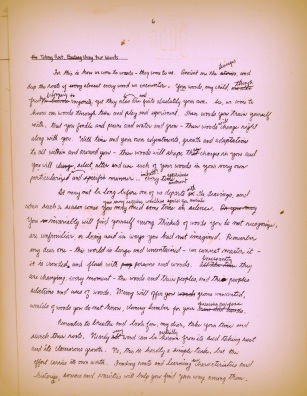
Taking Root, Using Your Woods

For this is how we come to woods – they come to us.  Ancient are the lineages and deep the roots of almost every wood we encounter.  Your woods, my child, though freely belonging to anyone, are also and quite absolutely, your own.  You see, we come to learn our woods through time and play, experiment and work.  Those woods you train yourself with, that you fondle and prune and water and grow – those woods will change right along with you.  With time and your own adjustments, growth and adaptations to all within and around you – these woods will shape those changes in you and you will select, alter and use each of your woods in your very own specific and particularized manner…in every moment, experience, and time.

It may not be long before one of us departs with The Leavings, and with such a season you may seek out woodless spaces for a while.  There is nothing wrong with leaving woods behind for a time.  You will invariably find yourself among thickets of woods you do not recognize, are unfamiliar, or being used in ways you had not imagined.  Remember, my dear one – this world is large and uncontained – we cannot master it – it is crowded and flush with persons and woods.  Incessantly they are changing, every moment – the woods and their peoples, and the peoples’ selection and uses of woods.  Many will offer you groves unwanted, wealds of woods you do not know, clumsy lumber for your yearning purpose.

Remember to breathe and look far, my dear, take your time and search their roots.  Nearly any wood can be partially known from its seed taking root and its clamorous growth.  Woods are formed of winds and waters, weathers and disparate soils – they are bound to have unique characteristics and histories, varieties and sources – learning these will help you find your way among them.  While hardly a simple task – its effort carries its own worth.

Then you may come to feel comfort in whatever woods construct the bosk where you are – they can speak to you, and you with them – becoming another precious person of the wood.

You have so much to offer us, as the forests of woods do you – all the many woodlands spread throughout our homelands, neighborhoods, countrysides and world – many, yes, loved child, many woodlands yet to be invented, discovered or known – and you, sweet forested one, growing now among them, taking roots, assembling branches and leaf piles and canopies, or ships with broad docks and high towers, realms and copses, barrels and fires and beds – as you learn to love and use your woods, multiply and form them – oh what wonders await us all!

Take your roots, then, gather seeds, use your woods – let them grow and shape you – plant, sprout and remake them!  All woods you engage are yours while you are in them!  So live, darling wonder, live and learn and create!  Staying open to woods – testing and investing and proclaiming them!  Even logging them for records or constructions, be certain to renew, and create!

and the final product of the little gifted notebook from my lovely daughter, sussing me through these holidays

Notebook - Ida

Using Our Woods – the Gift that Explodes 6

Notebook 6

and the typeset version:

6

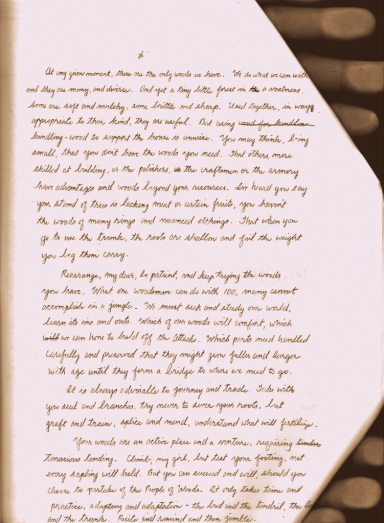
Whose Woods are These I Think I Know

At any given moment, these are the only woods we have.  We do what we can with them, my dear, always many and diverse.  Yet just a tiny little forest in the vastness.  Some of our woods are soft and mulchy while some are brittle and sharp.  There’ll be splinters and cracks, switches and boughs.  But used together, in ways appropriate to their kind, they’ll be useful.  Like don’t use kindling-wood so support the house.  I know you often think, being small, that you don’t always have the woods you need.  That others more skilled at building, the polishers and craftspersons, or the armory whittlers have advantages and types of wood beyond your resources.  I’ve heard you cry that your stand of woods is lacking meat or certain fruits, you haven’t the wealth of many rings and nuanced etchings.  That when you rope the trunks, the roots are shallow and fail the weight you beg them carry.

Rearrange, my dear, and be patient.  Keep trying the woods that you have.  I’ve seen a woodsman create with 100 what many cannot in a jungle.  We must seek and study our world, evince all its ins and its outs.  Which of our woods will comfort, which we can hone for attacks.  What parts need handled carefully and preserved, that they might grow fuller and larger with age, ‘til they form a bridge toward where you need to go.

It is greatly advisable to journey and trade.  Take with you fresh seeds and young branches.  Try never to sever your roots, but graft and train, splice and mend, understand what will fertilize.

Your woods are an active place and a venture, requiring tenacious tending.  Climb, my child, but test your footing, not every sapling will hold.  You can succeed and will, should you choose to partake with the People of Woods.  It only takes time and practice – adapting and adaptation – the bud and the tendril, the log and the trunk.  Recite and remind and then jumble.

Above all, my daughter, please play.  Pick-up sticks, wooden boats and chutes and ladders.  Kites and slingshots, barrels and monkeys, apples to apples.  Now is the time to throw peaches and chew the walnuts’ rind, bowl crabapples, smoke the reed and sniff the pine.  Some whips will leave seams you’ll never forget, some falls may even break a limb, but you will grow and know, know and grow, until you, like the tree, flourish and bloom, strip and stand bare, proud and enduring, withstanding both wind and the wave, strikes and blows, the cold and the dark, all from your stock of woods and what’s possible.

Whoever dreamt a log could roll on rivers, or bend into a wheel?  Who knew they’d form enormous arks – large enough to save our world?  The handing of a tiny reed embossed with cursive love, sharpened to a blade, signs set to warn of danger, posts to fort a home.  My love, impossible does not apply with your woods – all that we know is unknown where the woods come into play.

Experiment, invent, babble the brook or construct a staying dam.  Use our woods, love and care for them, ignite your passion, rub them together toward sparks, thatch, nest, spear.  The woods are waiting – and these are yours.

click here for all 6 pages – The Notebook

The Gift that Explodes, 5 : Whispered Leavings

Notebook 5

This constitutes the 5th page of the Notebook given me by my daughter…here it is in typescript:

5

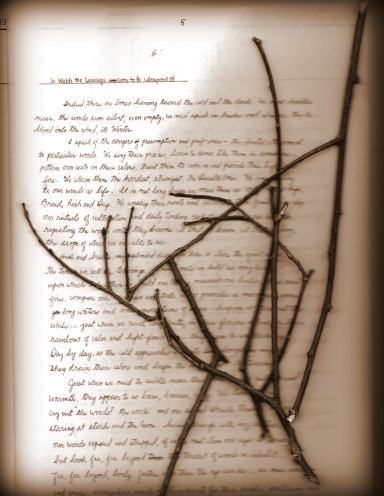
In Which the Leavings Whisper

Indeed there are times of leaning toward cold and the dark.  We huddle close, our woods seem silent, even emptied, so we hush and sound our whispers, to blend them into wind, its Winter.

I speak of the dangers – presumption and preference – too-devoted attachments to our particular woods.  You hear us sing their praises, we dance like them in breezing sunlight, pattern our coats according their colors, entrust them to shelter and shade us, providing our true light and fire.  We claim them the hardest and strongest, the Durable Ones.  We come to cling to our woods as life.  Dear child, it is not long before we view them as the “only.”  The Most and Highest, the Broadest, Richest, Rooted Deep.  We worship their hold, celebrating their fruit.  Develop our rituals of cultivation by tending them daily, each of us making our rounds, repeating the woods until they are all that we know, all that we love, the scope of which we are able to see.

Hush and beware, my splendid dear, for here is where the quiet comes.  The times we call The Leavings.  These very woods to which we cling, within and upon which we build our homes, nourish our bodies and fuel our fires, compose our messages and texts, which provide us with movement over long waters and vast mountains of snow – keeping us warm all the while – just when we revel most confidently in their glorious splendor, their rainbows of color and light-glowing hue…they begin their wandering away.  Day by day, as the cold is approaching with its elongating nights, they drain of their colors and begin letting-go.  These, my child, are The Leavings.

As we cuddle near their time-trusted fullness and warmth, they appear to us bare, barren, and grey.  We look up, we cry out “the woods!  the woods!” and our sound shrieks right through, we are staring at stark and the Gone.  Seeing past in icy clarity, our woods exposed and stripped – if we do not close our eyes in terror, but look far, far beyond our own tangled thicket of woods…far, far beyond, my lovely, farther even than the eye can see…are more woods, and more, everywhere woods making scents for their peoples, sheltering and shading them, burning and abandoning them as well.  If we hush and refuse ourselves despair as we see our woods give out, in turn setting ourselves silently to listening and keenly looking out – we can know the lessons of the Leavings.  That there are further woods than ours, many woods and other, only farther out.

We grow easily impatient of our woods in our discomforts and our panics and our fears.  Yes there are countlessly many Leavings – you can count on them, and by them, but my tender one, if you will persist and endure, if you are open to their lessons and their silence, the woods will come back to you, freshly and new.  There will be young woods you never knew before, and the old ones return too.

Our woods are never so much lost as that they undergo strange changes.  They break and wither, shrivel and drop – they must shed themselves of their embellishments and gathering continually – so they might produce themselves again, altered and renewed.  Their many uses over untold years are logged within their roots and cores, marked and divited, scarred and sapped – it is for us to remember and adapt, let go with them and wait, wait, enduring the Leavings with all that we have, slogging onward toward new growth.

Oh yes it is frightening to feel all is lost, sweet child of wonder, but our woods never fail us finally, they leave us to be born.

And this is why I gather samples wherever I happen to go – fruits and nuts, leaves and needles, parts of any woods I chance to see or hear – in order to remember and remind in times of Leaving that somewhere, and at any time, we will live again in woods that will be full and bright, returning the woods that we’ve known toward our unknown need.

Now rest, child, rest…the night is quiet and cold, let the woods hush and whisper through your dreams…

click this image for the document in its current entirety:

Notebook - Ida

Continuation of the Gift that Explodes: In Which is Entered the Rich Thicket of Woods

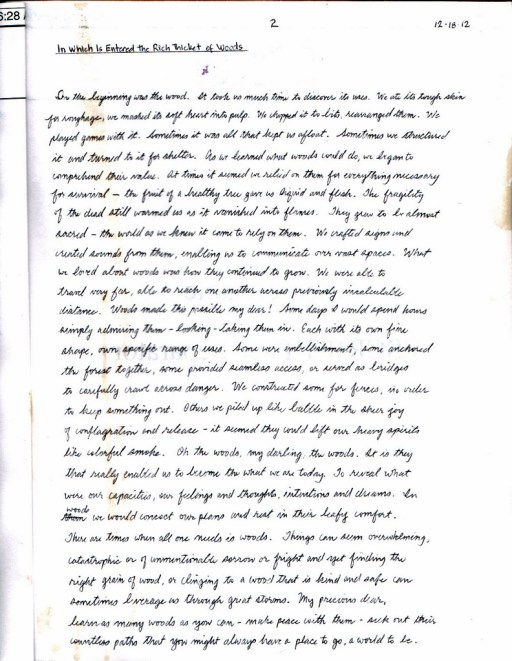
Here is page two of the blank notebook from my daughter as it fills:

Notebook

and here it’s typeset form:

2

In Which is Entered the Rich Thicket of Woods


In the beginning was the wood.  It took us much time to discover its uses.  We ate its tough skin for roughage, we mashed its soft heart into pulp.  We chopped it to bits, we rearranged them.  We played games with it.  Sometimes it was all that kept us afloat.  Sometimes we structured them carefully and turned to them for shelter.  As we learned what woods could do, we began to comprehend their value.  At times we relied on them for everything necessary to survive – the fruit of a tree gave us sweet liquid and meaty flesh.  The fragility of the dead still warmed us as it disintegrated in the flames.  They grew to be almost sacred – the world as we knew it came to rely on them.  We crafted them into signs and created many sounds from them – enabling us to communicate over vast spaces.  We were capable of traveling quite far, able to reach one another over distances before considered impassable.  Woods made this possible my dear!  Some days I might spend hours simply admiring them – looking them over – taking them in.  Each with its own fine shape, and own specific range of uses.  Some were embellishments, some anchored the whole forest together, some provided seamless access or served as bridges to crawl carefully across great dangers.  We constructed some for fences and walls – they helped us keep the unwanted out.  Others we piled up like babble in the sheer joy of conflagration and release – it seemed they could life our heavy spirits like colorful smoke.  Oh the woods, my darling, the woods!  It is they that really enabled us to become what we are today.  To reveal our capacities, our feelings and thoughts, intentions and dreams.  In woods we could concoct our plans and rest in their leafy comfort.  There are times when all one needs is woods.  Things can seem overwhelming, catastrophic or of unmentionable sorrow or fright, and yet finding the right type of wood, or clinging to a wood that is kind and safe and strong can sometimes leverage us through great storms.  My precious dear, learn as many woods as you can – make peace with them – seek out their countless paths that you might always have a place to go, a world to be.


Lifecycling Parenthood

For those of us with children.

How different the meaning of “precious.”  Also “alive.”  What the self rearranges.

There was a time.

In the beginning, the excitement of puppies.  That generosity.  The concept of dependence revised.

A dawning recognition involving hope and helplessness – their power.  Sheer organism.  Complexity.  Alive, mobile, emerging.  What wears away, gets broken.  What heals, what hardens.  Your part in it.

The changing nature of survival, and terms like “health,” “okay,” and “wellness.”

An awareness of trajectories: expansion versus maintenance, collage versus carve, assembling as opposed to mending.  The children, the parent.

What persons are.  Attachments.  Difference.  Freedom.  Control.

The blowing snow left in their absence.  The ways they vanish, into themselves, their people, cracks in the world, airstreams and oceans.

How control rarely changes hands, nearly always remains invisible, what no one grasps.

The erratics of growth, the scale of unexpected development, of motives, of attention.

Intention and the noise inherent in communication.  The stage of sighs – their nuances.

We age.  Our eyes grow joy and sorrow, and both look like pride coupled to grief.

Randomness of adulthood.  Vagaries of time and consequence.  Learning curves like tangled thread.

Inevitable dismissal.

N Filbert 2012

Another brief lapse

Branson Landing Fountains

with kiddos at Branson and Table Rock Lake

Table Rock Lake, Missouri