Economics of e-books & public-driven acquisitions – a query

libricide2

– Bibliobabble? – 

(click for full article)

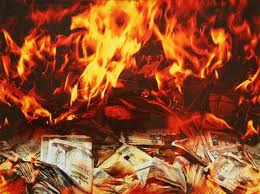
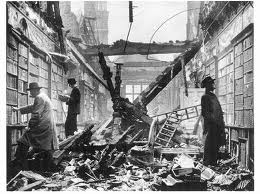
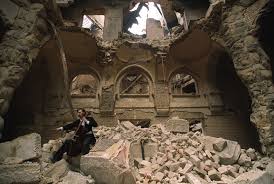
The surge towards a print-less e-library recasts academic librarians as “rare book engineers”

by Colin Storey

libricide3

Is “just in time” preserving what will be needed for a (hopefully) long future?

How preservable and verifiable are digital bits?

Who ensures there are physical, tangible copies of information that may come in handy one day…

even if it seems passe or unnecessary in current socio-cultural perceptions?

What if cloud data gets scrambled, wears away, ebook vendors aggregate totalitarian-ly,

Where are our contingency plans for the preservation of knowledge and culture?

How will we verify digital content?

and so on….

libricide

“A meaning only reveals its depths once it has encountered and come into contact with another, foreign meaning…” – M. M. Bakhtin

Response to a Question from Novy Mir

– M. M. Bakhtin –

Straightforward: Words from the Book of the Living

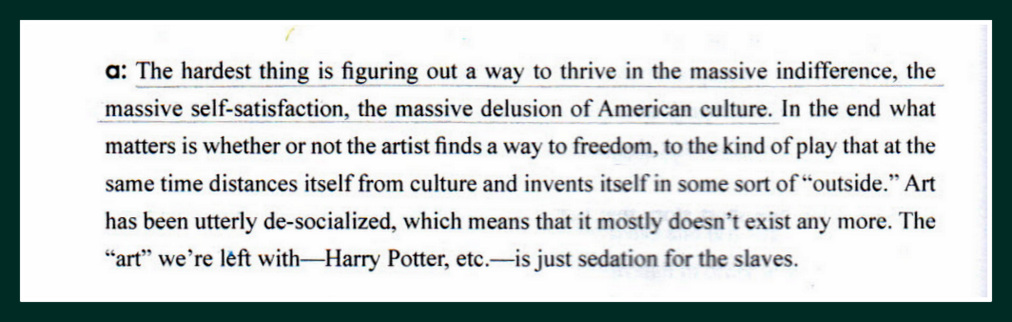
Curtis White, in response to the question “What do you think is the hardest thing about being a creative in this culture?” (North America, 2012):

Curtis White
from, Architectures of Possibility by Lance Olsen

and to “What’s the best advice you might offer a beginning writer?” (I just ‘slipped’ and typed “writher”!), he replied:

“So my best advice is to read Nietzsche until you understand him and go from there”

thank you Curtis White 🙂

A strong mid-section

OCTOBER 2011

POSTMODERNISM AS LIBERTY VALANCE: NOTES ON AN EXECUTION

THE RITUAL KILLING OF POSTMODERN LITERATURE IS A THREE-MAN GUNFIGHT AT THE O.K. CORRAL (ALLEGORICALLY SPEAKING)

Finding a lot of resonances and curiosities in this collection that I’d like to recommend – a fruitful pattering of words to engage – I especially have liked the introduction (can’t find pdf of online) and then I thought the midsection of the essay linked above (click anywhere on the opening titles to read) was strong and productive.

Architectures of Possibility

“Writing is a manner of reading.  It is a mode of engaging with other texts in the world, which itself is a kind of text.  And reading is a manner of writing, interpretation, meaning-making.  Which is to say that writing and reading are variants of the same activity.  Existence comes to us in bright, disconnected splinters of experience.  We narrativize those splinters so our lives feel as if they make sense – as if they possess things like beginnings, muddles, ends, and reasons.  The word narrative is ultimately derived, through the Latin narrare, from the Proto-Indo-European root gno-, which comes into our language as the verb to know.  At some profoundly deep stratum, we conceptualize narrative as a means of understanding, of creating cosmos out of chaos.”

“Yet in many cultural loci these days we are asked to read and write easier, more naively, less rigorously.  We are asked to understand by not taking the time and energy to understand.  One difference between art and entertainment has to do with the speed of perception.  Art deliberately slows and complicates reading, hearing, and/or viewing so that we are challenged to re-think and re-feel form and experience.  Entertainment deliberately accelerates and simplifies them so we don’t have to think about or feel very much of anything at all except, maybe, the adrenalin rush before spectacle.”

-Lance Olsen-

“Literature is the question minus the answer.”

-Roland Barthes-
David Foster Wallace – Salon.com

an interview of interest – worth an attentive read

David Foster Wallace – Salon.com.