8th segment

’cause I don’t have to stop.  ’cause it doesn’t.

experience anyway cover

8

            And now “I” am different, again.  Change.  Is how I would “put it.”  What with the whip of atoms calling “I” ever-coupling to the Itself that the “I” calls “world,” really, when one gets down to it, in it (always), the distance is elusive (is “illusion”).  And so “I” changes at the rate of the wind “I” is sharing; of the sea “I” is seeing; of the matter (volatile shivering).

It is Here.  We are.  Since we cannot claim a territory, we strain for modes to re-fer (de-fer?).  Differ.  We’re attuned to it.  The rhythm of our tune is differance.  There is no reason that suffices.  We are in it.  It.

A live.

In vocalizing, movement sounds (for humans).  Or in gesture – perceptible matter (always suited to the version capable).  It is always a matter of moving around, shuffling space with time.  I cry, there is movement.  The air and the chemical sea.  I look – things displace, replace, are placed by my gaze – an interactive mechanism – part of a NEVER discontinuous train.

We touch, because sound, because cell, because particles and waves (as both) – because movement.  Because “separate” is an aberrant traction (abs-traction).  A practical folly.

I love you – re-cognition that borders are empty, margins erased.  That “you” and “I” intersperse (wind, sea, light) molecules.  Movement.  Alive.  I love a live.

Because live doesn’t noun an “f.”  Life.  Life is a period, an arbitrary stop.  Imposed.  But a “v” simply vibrates.  We are a-live.  We are the living.  Even the “the” can’t contain it.  It rushes the punctual, overcomes it.  We are us and I love you (us).

Perhaps we need little realms to find out.  To discover.  Acting networks to re-member (to sew, to put back together) what’s dismembered convention.  “The way it is” – what we’re impressed to “get by” (“survive”).

This, It, is NOT the survival of fittest, a live is the fittest and cannot be dismembered, “I’s” just being particled Lifes – and those not really – except in that most human of ways (itself a “not really” invented by us).  It is more complex than that (call it “what’s live” or Enaction), and can’t be reduced to its “parts.”

Nor combined in a “whole” (another punctuated word).  It’s not final, complete, but just changing (rates of wind, of sea of weather; of stones and planets, emotions and plants) – if we could dissect it (and we try) the variation of paces “seem” astounding…but It’s chock full of seams like two sides of paper – not different but same save the semes that are perceptible.

These semes are intended for motion:  I love you.  My so-called chapters and segments to “say” – we are us, there’s no other, and we’ve little idea of that.

“I” lean back, am exhausted, and rest (always moving).  “I” don’t see the difference in sleep.
Experience, anyway. (parts 6 and 7 are new)

This work is a slow-grower.  I think it wants to be read that way as well.  Slow accretions of interaction and recursively referent.  Not sure where it will continue.  Click the title page to investigate.  Comments are welcome.

experience anyway cover

Experience, anyway. sector 4


The following being part 4 of the growing mycelium that happens when I’m alone…

if interested, to-date is accreted here
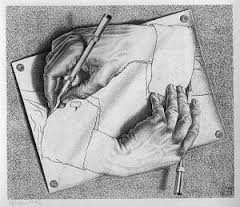
Escher

4


Relatively speaking, it will all be over soon.  For some sooner than others, but soon all the same.


I’ve seen a lake filled with upright sticks and trees.


What’s written on the body dies with it.


There are reasons to stay alive.


A mysterious pressure arrives with “real.”


To think of recounting, embellishment.  A pressure to remain “true.”  Wherefrom do these come?  If I transcribe only facts as they are agreed to – collaborated – I do not accord with “real,” for imagination is always active and participant.  It would be like deleting affect.

Emotion.

And yet.  To consciously create a re-telling – devise a version – something’s different from experiencing’s bricolage.  The positing of author, I-collage, selection of pieces.  The pieces also selecting – opportunities for perception.

Only another experience.  Another form of framing.  A novel utility.


I write – construct a world – at times aiming for mimesis, but, as it happens, the interaction required between resources and agency = experience anyway.


Telling of my son is never writing him, it’s composing MY.  Which in no way obviates the Other off whom I riff.  Only keeps him discrete from my perception and activates subjectivities for us.  Unless I seek to define or contain – to account for him – ab-straction, object-ify.  Caesura of love: to falsify.


Whatever one takes as “real” exerts pressures of false.


Demands one set one’s course for “proof” as opposed to “truth” – a demonstration.


It’s experience, either way, and a variant sort – the staking-of-real or searching-for-proof sort – joining a demonstration – no less fabric of experiencing than any other, no less interactive or “real,” ever unique.


Categories falsify.  And enable.  No matter, still they matter.  I relate to them as things.  As limits and opportunities.  It equals changes.  Equaling experience, anyway.


To look toward wife and perceive.  To co-orient agreements.  Perchance to be/have experience to-gether (to gather).  Align what we share in kind.


“Real” being what we organize of reality, changing each moment’s notice (before-during-aft each the moment itself) – unlocatable present.  As I collage it (now past tense).


I listen to your story, constructed-on-the-run, as it were.  Me too.  Co-being.  I agree as I edit and reform.  Agreements forming knots, not points or solid nodes.  Tangles of perceptions, cast, re-cast, and still wet clay.  The surface never hardens.  When it “seems” there are still seams – a thoroughfare.


How we know that we’re alive, or better, “living” – curse the verbal nouns.  There are no steady states – but constructed patterns.  Sane inventions.  At times.  Experience, anyway, “experiencING” – seamingly changeless change.


The urge, in writing, to stay.  To thwart or channel flow.  Progression of narrative – a pressure.  Another experience:  the tension of process and now.


Why inscribing haunts us with false.  Telling or speaking too.  Even in song, something occurs.  The fluidity cripples and hardens.  We strive to trick it loose.  Account for dangling threads at every touch, but even the threads are intangible.  Change is a force of form.


I recall.  To vocalize back or again.  The loop a seductive model.  And I fragment.  The attempt to be impartially partial (or “real”) winds its way through every act.  Acts don’t start and finish, English-infernal-nouning.  To name is to kill it is said.  To stop up beING.  But it seams another example of change, going-on, the ever-activity experiencing.  Why fight back (wards)?


Recall: back words?  Assembling experience anew?  Only different (our noticing change) – i.e., experience, anyway.


To loop is false, such lovely model.


New Fiction: “Experience, anyway.”

For some time I have been lacking for representation.  Processes and patterns go on, no doubt, but nothing materializes save scattered words, informed thoughts, scholarly papers, and so on.  Spouse says of self: “I need something to shoot for, develop toward, to propel…otherwise I stagnate, repeat…” and I agree with her – I’ve been itching for fiction – a larger project – something to belong to and build while fulfilling responsibilities, learning, parenting, husbanding, being “professional.”  But the pages have been blank.  This morning I began, and it started like this:

**************************************************************************************************************

Experience, anyway.

            And stared at the head of Buddha.  As if literature were whatever could be fitted to symbols.  There were experiences anyway.  Complex goings-on.

He started.  As if starting were the only thing he could do.  He, she, self, other, organism – whatever.  It had begun.  If there were a god, it might know where, but they – for the life of them – could not figure it.  Not literature.

And for all the anyway-experiences, also.

In other words.

They stitched and thatched and wove, tore through, ripped out, clipped and pasted and tagged.  For all the cross-hatching and shading, foregrounding and back-, no image came through.  Or if it did, it never matched.

Representation.  Representamen – for a more mystical suggesting.  Arcane.  Obtuse.  That which is metaphor’d.  That which signals, indices, or forms.  That which functions.  Which can be acted on, or with, within, without.  Functioning ephemera.  To latch.

And undo.  It passes.  Lock on – decipher.  Pass around the room.  Agreeing by argument, it becomes.  Difference.  Evaporate.

The head of the Buddha is shaped out of stone.  More likely poured, cast.  More likely art – official.  What is artificial? – But human construction of world.  That radical deflect.  That begin.  In symbol.

At a certain time (constructed, invent), cross-purposes : experience.  Anyway, perceived.  So aroused – appreciation, cognition, desire, belief – purchased (bought, fallen-for, faith-in) : acquired.  Experience, anyway – head in corner on bookshelf knick-knack antiques, money (that wasn’t there), and taken away.

Evaluation = meaning.  Interpretation.  Somewhere whereabouts and how, or when – experience, anyway.  Action occurs.  It’s started.

Grenzsituationen II

Please read previous post with this in mind:

I would love for any/all to share what those “Limit Texts/Artifacts” are for you?

grenzsituationen

Please share via comment what encounters or engagements with works of art, science, philosophy, writing, music, and any other cultural artifactual form has altered from then on how you select, evaluate, engage other related artifacts from then on?

Thank you!

Another paradox (David Foster Wallace)

Another paradox (David Foster Wallace).

Going on from there…

“For that I blame the craven desire to speak, to write, to be heard.”

-Ben Marcus, The Flame Alphabet

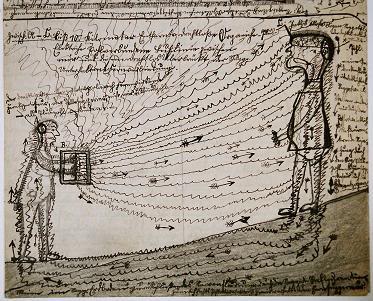
Nerve Language by Daniel Schreber

Semantic Animals

It goes on.  Seduced (sickened and soothed) by symbols, I read.  I write.  In dilettante-like forays into advanced mathematics, physics, cognitive sciences and biology,  I learn:

“The first message is that there is disorder”

(-James Yorke, attributed with naming the science known as Chaos)

            So back to first principles (they have a habit of coming in threes, and splitting into fragments).  I take out a blank sheet of paper, filled with lines.  A patterned absence.  Boundarying void.  I write “seduced” because I’m thinking about language.  Thinking instinct and survival and desperate need.  Thinking overload, “more than you could possibly imagine.”  Semantic animals.

When I last saw the snow fall, it was raining, offering an impression of “wet.”

She is far from me in two dimensions.  Only two, of multiples of three.  I count by the “trick of the nines.”

If only there were a way to collect accurate data.  Then adequately calculate and organize.  Unfortunately, life is mostly made of problems existing on continuums of countless dynamic variables, most of which – unsolvable.  They call these “differential,” or Derrida’s Infinitude of Differance.  Professionals finally agreeing: “regularity is aberration.”

We search for patterns.  Even in chaos we find them (or create).  Seduced (sickened and soothed) by symbols, we “read.”  There are so many oscillating signals that even the few we don’t inherently tune out we call “noise.”

Philosophically, on the other hand, where I feel more like an amateur or novice, I understand the problem/hypothesis/theory equation to be: EVERYTHING goes into EVERYTHING, that we’re only ever engaging possibilities.  That probables are fleeting, and certainties are few:  You are limited, peculiar, and definitely will die.

In other words, “the very process of cutting up and cutting off, opens up and opens out,” or some of us are developing “a belief in the musicality of creative disjunction” (Lance Olsen), because, seduced (sickened and soothed) by symbols, we select and collage our own inspection.

It’s easy to forget the first things that we find, i.e. that all positive statements and beliefs are built on “that there is disorder,”

and seduced (sickened and soothed) by symbols,

we go on from there.

ELSE – Erasure : Beginning

Erasure

It will have to be something new, you think to yourself, beginning.  What’s been done before is already present.  All the brief and poignant things gathered.  Already processed and past-eurized.

Heroes are made, families described.  Every aberration.  Otherwise we wouldn’t know, would we?  So much sex and images, and the inner lives of children.  Histories and sciences, and the nothing that affords, beyond.

New probably just means different, you say, using old words already.  If it’s a word it’s definitely been done.  Or an action.  Dreams and thinking too.  Which leaves you with little, if not naught.

You once composed a text of tinntinnabuli – it was fascinating to you.  Also a fugue of sorts, even a classical symphony, all in words, one in the twelve-tone scale.  Little matter with a missing orchestra.  Fit snugly into your drawers.

The series of anthropomorphic fruit.  What they felt and how they perceived, from rind to seed.  Even the veins in their fleshes, bruises, and each distinct and delicious juice.  Cycles of life, inevitability of change, sprout to rot.

Who cares?

Yet it’s what you do.  Identify moments and make them stories to exist.  Wrapped in the tangles of problems, sentence-wriggle-thread your way elsewhere.  A place that looks like knowledge.  And sometimes feels.

Like mathematicians with their unknown variables – it’s the ocean you swim, an amoeba almost.

You sought after mastery but found it banal.  Meaning didn’t make any sense.  You turned to hypotheses, but not the wilder the better.  You had to squeeze through gaps, hoping for openings.  A friend called it spelunking, and it did seem dank and cold and blind.  Often.

Restatement is not what you’re after.  Nor refining.  If thinking is digestion, you order an autopsy and strange foreign parts.  Intake as transplant.

Distinctive takes a while, but quickly regurgitates style, and you’re back to remarking, remembering…remorse.

Today you’re dissecting an Else.  Not again, or if\then, or more, but the Else.  What else? you say.  You don’t know.  But it lies here dismembered, deconstructed on your desk.  It’s pretty messy.  The pieces aren’t going to fit, even though you’ve studied jigsaws and puzzles.  Inventing new ones feels like metaphor or code, a twiddling thumb to decipher, something no one has time for even if they wish they did.

It will have to be something new to count as satisfaction, you consider.  And you take up the large eraser.

Lost in the World

            Lost in an inscrutable world and running out of time.  Always running out of time – don’t you feel it?

We try to describe it to each other – what we experience, perceive, how we learn to survive.  We call this – in varying levels – relationship.  Depending on the amount of explanation and exposure, cataloguing “acquaintance,” “stranger,” “family,” “friend,” “lover,” and the like.  A kind of measure.  Recognizable connection or estrangement.

But the world is inscrutable, as are we, thus we name ourselves “lost.”  “At least we’re lost together,” some said, but others thought we’d find out more apart, in other words “split up and look for clues.”

What would the clues be for?  From whence this idea of “clues” to be searched?  I wonder this.  Did someone somewhere “find” something indicative of something really “else”?  Other than this world and we in it?

I meet one of us who “has a feeling.”  She has this “sense,” she says, that there really is an Other – something or someone truly outside of this barely discernible world we (at least) found ourselves and other things in.  I ask her to describe the feeling and her ensuing language reminds me a lot of feeling-collections I also have gotten from time to time.  Without, I might add, ever considering them Other-worldly.  What is to account for this?  These are the sorts of discussions we wanderers have.

How might I recognize a clue?  Where did the idea/referent/template for such a signifier originate?  Martin found an interesting, that is, noticeable pattern on the shell of a turtle.  It appeared roughly to resemble little squarish shapes of wood we use to count by or play games with, sometimes even to carve on and trade for fruit or grasses.  Martin thinks this might indicate that the shape we use for wood was natural – inherent in the world – purposeful.  Not coincidence or accident, but a sign or clue about “the way things are.”  There were 16 of these rectangular shapes on the turtle’s back.

“Why would you think that, Martin?” I asked.  It is curious and fun to find similarities in the world – between people, smells, shapes, sounds and colors – all sorts of things – but why wouldn’t we notice like or familiar things in new situations?  To make it feel, well, less inscrutable?  That way we could learn about the unlike, describe the difference.  This, at root, was what I understood by the word we used, or called – “learning.”

I ponder the projection that making things seem more uniform might help us feel less “lost” or confused in our surrounding world.  So I might be expected to gravitate toward humans of the same height, weight, or hair color; that  make the same sounds as me, recognize the same shapes, eat the same objects, and so forth.  Somehow this practice strikes me as less interesting, ever running out of time (as we all agreed, once we’d broken our existence up into increments) and with so much unexplored and perhaps unknowable world still surrounding us all.

I take on the habit of investigating difference – I discover that finding similarities in my surroundings comes rather easily, nearly automatically, but aspects that are unique or defamiliar tend to more efficiently further my familiarity with the world.  It becomes a strategy not of looking for clues or surfaces pointing to something else, but simply finding else everywhere.  Even in the same “place.”  There appears to be no end to variance (even in myself) and therefore no static “same.”  I find myself always finding, discovering other in every moment, the differences forever expanding my knowledge of, but also maintaining my ignorance level of, the world I find myself in.

A perpetual state of wonder.


What Happens (with a semblance of truth): A True Story (that is never true)

Many things might have happened, indeed, could have happened.  It is impossible to tell until it happens.  Whatever happens.  And so it goes.

Recollection subjects what happens to interpretation, a puzzling assemblage of memory (embodied brains in changing circumstances) and occurrences (embodied brains in specific situations), making it impossible to tell what happens, when it happens, or after it happened, save from a very particularized attention and intention, point-of-view, disposition and enmeshment (the factors being relatively endless).

And so we call histories, scientific observations, statistical reports, etc. al., “stories;” journalism, research, theories or assays (essays), “fictions;” and personal memoirs, dialogue, descriptions or statements – “fantasy.”

Everything that happens or happened is what might have happened.

Let’s theorize that an author or reader, group or individual, has a concern for “truth” – something being what it seems to be – who or what has total and essential access?  The only truth in human expression that I can surmise is that it is truly “made up.”

An individual may have something approximating total and essential access to a thought or feeling, personal experience or idea, but insofar as it actually occurred according to an experiencer, there are already multiple points of view, ranging from molecular to cosmic, matter/energy to cultural.  To say nothing of the complicating fabrics incumbent on expression – whether a grimace or a novel, a shriek of pain or a tally mark on a chart – it has entered uncertain and collaborative interpreted ground.

All to say “experience” is utterly specific and solipsistic (non-transferable “truly”) and is an enabled product of embedded participation in significant (if identifiable as an “event” or “occasion,” “moment” or “intuition” – any feeling, sensation or awareness) surroundings, expanding niches of existing things with variant points of view.

This is how I can guarantee that nothing I show you or tell you is “true.”

It may be more or less accurate to my experience or understanding of it (depending also on your experience/understanding of my presentation of it) but it will in no wise be what it is or was, in truth.  I assume truth to be as impossible as god.  It would require omnipresence, omniscience, boundary less experience (which could not accord with our experience, or a grain of sand, or an ocean) and would be immediately foiled by the omni-ability (omnipotence?) those other necessary qualities would demand.  One could not be absolutely enmeshed or identical-with and entirely and completely objectively separate or alien-from at once.  At always.  That is not a paradox but a contradiction.  If imaginable, incommunicable.

So we speak of a “semblance of truth” or a “truth-seeming” quality to account for our realities and desires (our want for security, to grow order in chaos, to know, to choose or act with less fear or uncertainty).  Things like our ages, census reports, laws and principles (grammar, mathematics, semantics, processes and methods, etc.) a creepage over toward what we think of as “facts” – majority-mutually-agreed-upon-interpretations/perceptions/hypotheses.  These can hold for a long time because they’re held by so many, so widely.  But they most assuredly change over time, again, from atomic behaviors to the shape of the earth and its relation to elsewhere, from what constitutes pain to what gets moniker’d “god.”

What counts as fact does so by being open and shared.  Semblance of truth comes by corroboration, conversation and multiplying points-of-views and expressions of experience.

Perhaps this is one reason we blog.  To try “it” out on everyone, potentially.  If our expressions resonate with others, perhaps they have a semblance of truth, or contribute toward creating it.  Enough “I know, right?’s” and we’re on our way to a fact.  But no amount of data or language, materials or activity makes it so…it rests on agreement and compromise, observation and interaction shared most widely, coagulations of interpretations, accretions of experiencing – fabrication.

Make then, express.  Hypothesize and share your experience – we ask for your two-cents worth – we’re accumulating a fund.