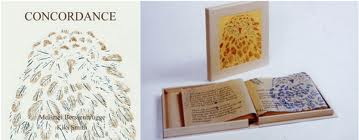
Excerpts of Mei-Mei Berssenbrugge

Ideal

by Mei-mei Berssenbrugge
1

I did not know beforehand what would count for me as a new color. Its beauty is an analysis
of things I believe in or experience, but seems to alter events very little. The significance of a bird
flying out of grapes in a store relates to the beauty of the color of the translucency of grapes.
There is a space among some objects on a table that reminded her of a person, the way the bird reminded her,
a sense of the ideal of the space she would be able to see. Beauty can look like this around objects.
plastic bag on a bush, moving slightly, makes an alcove, a glove or mist, holding the hill.
Time can look like this. The plane of yourself separates from the plane of spaces between objects,
an ordered succession a person apprehends, in order to be reminded.

Mei-mei Berssenbrugge

Red Quiet, Section 3

by Mei-mei Berssenbrugge
Our conversation is a wing below my consciousness, like organization in blowing cloth, eddies of water, its order of light on film with no lens.

A higher resonance of story finds its way to higher organization: data swirl into group dreams.

Then story surfaces, as if recognized; flies buzzing in your room suddenly translate to “Oh! You’re crying!”

So, here I hug the old person, who’s not “light” until I embrace him.

My happiness at seeing him, my French suit constitute at the interface of wing and occasion.

Postulate whether the friendship is fulfilling.

Reduce by small increments your worry about the nature of compassion or the chill of emotional identification among girlfriends, your wish to be held in the consciousness of another, like a person waiting for you to wake.

Postulate the wave nature of wanting him to wait (white space) and the quanta of fractal conflict, point to point, along the outline of a petal, shore from a small boat.

Words spoken with force create particles.

He calls the location of accidents a morphic field; their recurrence is resonance, as of an archetype with the vibration of a seed.

My last thoughts were bitter and helpless.

Friends witnessing grief enter your consciousness, illuminating your form, so quiet comes.

berssenbrugge red quiet

A Reading of Red Quiet

Potent Selections from Vacation Reading

“I wondered what indeed it meant about me that I was so set against the notion of convention that I should attack it.  So, I replaced the dream with the novel, stripping the stories of my dreams of any real meaning, but causing the form of them to mean everything.”

“…the gap between the subject of enunciation and the subject of enunciating not only failed to appear to me as a place of entry, but also failed to register as something I might elide.  For me, there was no gap, as there is no gap for anyone.”

P Everett 1

“…generally, people are only inclined to speak of the past with those they believe will somehow not only share some commonality, but who will also be disposed to exhibiting sympathy.”

“Is a photograph always present tense?  I described them so…better, let the question be, is what is in the photograph always in the present, without a before, without an after?  Of course, it is.  And isn’t that actually you in the picture?”

ennuyeux

“On Ludwig Boltzman’s tombstone is carved: S=k. LogW.  S is the entropy of a system, k represents Boltzman’s Constant, and W is a measure of the chaos of a system, essentially the extent to which energy is dispersed in the world.  This equation meant little to me as I read of it the first time, but as I considered it I grew excited.  The space between S and W is the space between the living thing in front of me and stuff hidden inside beyond my observation and comprehension.  It raises the question:  How many ways can the parts of a thing be rearranged before I can see a difference?  How many ways can the atoms and molecules of my hand move and recombine before I realize that something is wrong?  Thinking about it scared me.  Certainly, I understood that natural events symbolize collapse into chaos and that events are motivated by dissolution, but the idea of such subversive and invisible change moved me.  I likened it to observing the minds of others.”

P Everett 2

ootheca

“Ezra Pound said, ‘Every word must be charged with meaning to the utmost possible degree.’  Let it be the case then.  But words need no help from anyone.  Bet thew ords kneeknow hellip freeum heinywon.  Context, story, time, place – don’t these work like Bekins men, packing the words like so many trunks?  But finally, words are not cases to be packed at all, but solid bricks (and, of course, like a brick, even a word’s atoms are not motionless).”

“We do not give the creature reality enough credit, choosing to see it sitting out there as either a construct of ours or an infinitely regressing cause for the trickery of our senses.  But I claim here that the most important thing I have learned is that reality has a soul, reality is conscious of itself and of us, and further is not impressed by us or our attempts to see it.  In fact, we see it all the time and don’t know it, perhaps can’t.  It is like love in that way.”

-all quotes by Percival Everett

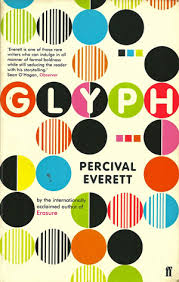
from his novel, Glyph

Glyph - Everett

(The First Good Novel)

Meaning

In any breaks in necessity – between semesters, breaks at work, children otherwise occupied, no “required” readings or commissioned work, etc… – with each passing season, I gradually discover what matters most to me (literarily speaking, which, for me, involves much of my lived life) – perhaps I might refer to it as my meaning-making-factory-resources (Blanchot says of Borges that he is “an essentially literary man – which means that he is always ready to understand according to the manner of comprehension that literature authorizes).”  At this point in my living, over four decades along, and a large percentage of the pie devoted to reading, those voices I turn to, their messages and efforts, have become quite consistent.  Each year there are new ones, new threads and concepts, theories and expressions that very significantly impact my living – but they tend to find their place as commentaries, extensions, additives and queries to what (I suppose) now forms my central “canon” of sorts.

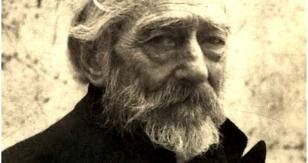
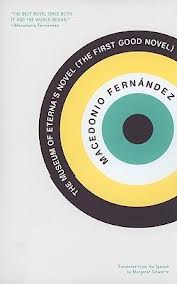
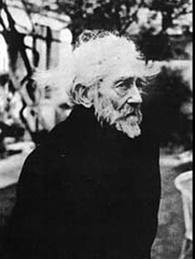
This struck me, following my return to Bakhtin and Blanchot, and as we prepare for vacation how I immediately reached for Soulstorms by Clarice Lispector and The Museum of Eterna’s Novel (The First Good Novel) by Macedonio Fernandez.  In searching for this image of Fernandez:

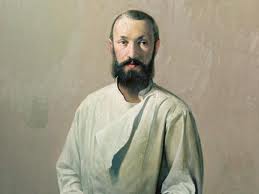
Macedonioa host of Google’s “related images” arose – including Borges, Lispector, David Foster Wallace – and I got that vision of how pantheons develop and connect and gradually form a kind of woven semiotic pattern – a “worldview” or “Innenwelt” I guess – it begins to make sense what’s connected to what and whom to whom throughout time and space of world-being.  Beckett, Blanchot, Dostoevsky, Pessoa, Rilke, Cixous, Kafka, Bakhtin, Jabes, these visions and verbals I return to again and again and again and again – inexhaustibly – and although my copies are nearly glutted with markings and underlinings – and they feel intimate and familiar (on the one hand) – that I also feel I am always learning them anew, freshly, with EVERY read.

These things astound me.

Museum of Eterna's Novel

Of this particular book (which I often say is the very best novel I have ever read, repeatedly), Adam Thirlwell writes “It is a novel which does not want to begin.  Or, perhaps, it is really a novel which does not want to end…The aim of Macedonio Fernandez’s novels is to convert all reality into fiction (or the other way around).”  “The real subjects of this lightly playful novel are the grave ones of death and love.”

“In his novel, Fernandez tests the possibility that all philosophical questions are only meaningful in relation to human relations: that all questions of infinity are really questions about love.”

and so on.

Macedonio 2

Macedonio is, for me, a hero the likes of Bakhtin, Blanchot, Beckett – those writings and writers I will never “get over,” never “get around.”  Writings I can only ever “go through.”

Perhaps these writings are characterized by the question – “What is it to be real?”  I recently discovered in one of those “shock of recognition” moments that although I’ve studied theology, philosophy, classical music, art and literature and now information sciences and systems theories – that none of the CONTENTS of these fields sustain my passions – it is the relationships between them – the ligaments and synchronous reverberations they emit – the MEANING-making effects of their pursuit and inquiry that is REALLY what drives me toward, into and through them.  I’m not looking for truth or necessarily facts or any answers – but for PROCESSES and PRACTICES that enrich, enhance and extend my biological life in relation to the world I’m “thrown into.”

Borges wrote of Fernandez: “Macedonio is metaphysics, he is literature” and that “writing was no trouble for Macedonio Fernandez. He lived (more than any other person I have ever known) to think.  Every day he abandoned himself to the vicissitudes and surprises of thoughts as a swimmer is borne along by the current of a great river.”  The novel’s translator writes: “The method is madcap; the intent is desperately human.”

Perhaps that is what I’m after – to be “desperately human.”

and now we’re heading off to the wilds – to be desperately human with-world with-family – replete with above-mentioned authors and without wi-fi or internet services!

P.S. (also from current reading – The Waste Books by Georg Christoph Lichtenberg):

“Be attentive, feel nothing in vain, measure and compare:  this is the whole law of philosophy.”

and

“To grow wiser means to learn to know better and better the faults to which this instrument with which we feel and judge can be subject.”

All the best!

As relates to…


bakhtin2

I have wanted to share (for years) the significance and import of Mikhail Bakhtin‘s manner of thinking, writing in the formation of my own worldview and understanding of the confounding irritations of working in language and the interactional miracles of the medium.  C.S. Peirce and Bakhtin strike me as two composers with whom I do not encounter a brilliantly organized thought or true-ringing arrangement of letters that they are not echoed in.  I discover re-presentations and simulacra of their models, but rarely extensions, corrections, or improvements.

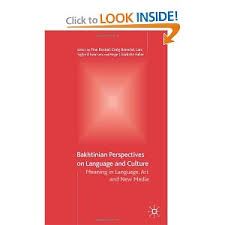
With that in mind, I have been poring through a multi-authored volume entitled Bakhtinian perspectives on language and culture: meaning in language, art, and new media edited by Bostad, Brandist, Evensen and Faber.  Note-taking, underlining, cross-referencing, formulating, and it has occurred to me that these texts are SO mesh-marked with mnemonic traces for me, that I should simply provide interested readers access to all I can link.  Setting out to locate a Pdf of the introduction and chapter 2: “Rhetoric, the Dialogical Principle and the Fantastic in Bakhtin’s Thought” I came across the entire collection available online – and so I offer it here.  If you begin, and the perspective captivates you – read on – to the chapters that carry concepts you are passionate about.  If not, never ye mind!  I am happy that texts like this can be available – not easily “stumbled upon” in contemporary bookstores and libraries (unfortunately).

To life:

Bakhtinian Perspectives


par example:  “Language is to be experienced as an interaction of signs neither neutral nor innocent: the word bears the burden of the contexts through which it has passed.  And every speaker or listener bears the consequences of signs put into circulation, of signs he perceives and answers, of signs he picks up and makes use of for his own ends.  One cannot stifle the traces stored in them.  One has to face the cultural experience a whole language underwent in its history.  Speaking this language and listening to it one unwittingly responds to this experience – the ‘word that lies on the border between one’s own and the other,’ the ‘word that is actually half someone else’s.’  The one meaning cannot maintain itself in the face of the many meanings.  B’s concept irritatingly links the atomizing intrusion of the many meanings into the one (an act that atomises this meaning) with the idea that meaning ‘explodes’ in the contact of two different meanings.  In other words: splitting up and differentiation, accumulation and trace must be thought of as occuring in the word simultaneously…Because meaning is always a recourse to another meaning and a project for creating new meaning, it doesn not achieve a decisive, definite presence.”

And so forth….!!!!

Experience, anyway. Coupling. (section 5)

Coupling Chaos


5


Couplings


            We conferred, that is, we engage, experiencing contact.


We will set out, clinging, and submerge in, together.  To gather, to keep hold.  To track and trace in the tracing of trackings.  To recognize with(-ness).  To witness with-ness.  As experiment – critical.  Experience, anyway.  “Ours.”


Between the quark and the jaguar, we leap in, already moving.  Enduring much criticism: stop-motion behavior/practice.  A snipping tool.  We move on.


Must have been moving before we begin, different organization, as also (ever “also,” both/and) until “we” is spoken, still speaking.  In other words.


If complexity allows purpose, however shallowly combined – moment-airy radiant gradient – if selection involved “choice” (in other words), so we.  So-viet.  Co-Be=”It.”


We continue beginning potentials.  Experience.  Anyway, any way at all, even those unimagined per se – potentially – given contexts (complexes before and beyond) to speak spatially (corrupted language: co-ruptured, erupting-together).  “Always more than one,” our simple mantra.  Breathe.  Walk.


Early ones (to speak temporally, parler temporellement, another language) tout “the world knows not boundary.”  Perceptual divisor, arbitrary (i.e. species-specific) and then some.  Or boundary as invented in traversal, trespass, complex thoroughfare, reciprocity.  Feed-forward in a sort of randomness, chaos emerging orders.


We blend thus to cognize.  We merge to pattern difference.  Another way of saying “no boundary” (i.e. engagement, interactivity, living, being).  To couple.


Beginning again in infinite multiplicity (our limited numeracy) – were we able to count even to we.


casclick here to read Experience, anyway. in its current entirety

Experience, anyway. sector 4


The following being part 4 of the growing mycelium that happens when I’m alone…

if interested, to-date is accreted here
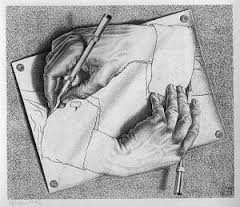
Escher

4


Relatively speaking, it will all be over soon.  For some sooner than others, but soon all the same.


I’ve seen a lake filled with upright sticks and trees.


What’s written on the body dies with it.


There are reasons to stay alive.


A mysterious pressure arrives with “real.”


To think of recounting, embellishment.  A pressure to remain “true.”  Wherefrom do these come?  If I transcribe only facts as they are agreed to – collaborated – I do not accord with “real,” for imagination is always active and participant.  It would be like deleting affect.

Emotion.

And yet.  To consciously create a re-telling – devise a version – something’s different from experiencing’s bricolage.  The positing of author, I-collage, selection of pieces.  The pieces also selecting – opportunities for perception.

Only another experience.  Another form of framing.  A novel utility.


I write – construct a world – at times aiming for mimesis, but, as it happens, the interaction required between resources and agency = experience anyway.


Telling of my son is never writing him, it’s composing MY.  Which in no way obviates the Other off whom I riff.  Only keeps him discrete from my perception and activates subjectivities for us.  Unless I seek to define or contain – to account for him – ab-straction, object-ify.  Caesura of love: to falsify.


Whatever one takes as “real” exerts pressures of false.


Demands one set one’s course for “proof” as opposed to “truth” – a demonstration.


It’s experience, either way, and a variant sort – the staking-of-real or searching-for-proof sort – joining a demonstration – no less fabric of experiencing than any other, no less interactive or “real,” ever unique.


Categories falsify.  And enable.  No matter, still they matter.  I relate to them as things.  As limits and opportunities.  It equals changes.  Equaling experience, anyway.


To look toward wife and perceive.  To co-orient agreements.  Perchance to be/have experience to-gether (to gather).  Align what we share in kind.


“Real” being what we organize of reality, changing each moment’s notice (before-during-aft each the moment itself) – unlocatable present.  As I collage it (now past tense).


I listen to your story, constructed-on-the-run, as it were.  Me too.  Co-being.  I agree as I edit and reform.  Agreements forming knots, not points or solid nodes.  Tangles of perceptions, cast, re-cast, and still wet clay.  The surface never hardens.  When it “seems” there are still seams – a thoroughfare.


How we know that we’re alive, or better, “living” – curse the verbal nouns.  There are no steady states – but constructed patterns.  Sane inventions.  At times.  Experience, anyway, “experiencING” – seamingly changeless change.


The urge, in writing, to stay.  To thwart or channel flow.  Progression of narrative – a pressure.  Another experience:  the tension of process and now.


Why inscribing haunts us with false.  Telling or speaking too.  Even in song, something occurs.  The fluidity cripples and hardens.  We strive to trick it loose.  Account for dangling threads at every touch, but even the threads are intangible.  Change is a force of form.


I recall.  To vocalize back or again.  The loop a seductive model.  And I fragment.  The attempt to be impartially partial (or “real”) winds its way through every act.  Acts don’t start and finish, English-infernal-nouning.  To name is to kill it is said.  To stop up beING.  But it seams another example of change, going-on, the ever-activity experiencing.  Why fight back (wards)?


Recall: back words?  Assembling experience anew?  Only different (our noticing change) – i.e., experience, anyway.


To loop is false, such lovely model.


A probable linguistics

“In our day-to-day use of the English language we possess a perfect record of the language’s evolution; when we hear ourselves speak we listen to the voices of all those many millions who have come before us, who have, in their own use of the language, constructed ours, as we continue to construct it.

Whether or not we’re able to decipher this record is another matter altogether.”

-Evan Lavender-Smith-


The fluid character of the life process

Alright – I know that if you’re scrolling through a blogroll you aren’t looking to read intently, carefully and thoroughly some theoretical finely-tuned creative innovative rendition of what it is to “be alive.”  Beyond that, I’ve posted this before.

Here’s the thing.  Over a couple of years of this blog-o-sphere bus(y)ness, I’ve been happy to have network/meshworked into some pretty intriguing and instigative minds here.  And a few of these things that spur me – well, I get compelled again and again (as I reread them again and again) to share them – with the compulsion murmuring – “this is going to feel like home, elation and release” to these mind-persons.

So, I offer Tim Ingold’s “Bringing Things to Life: Creative Entanglements in a World of Materials” once again – hoping that those of you (you’ll know who you are when you start into it – you’ll have a difficult time stopping) who accord with this sort of thing will take the time (when you’re able), NO, that you’ll MAKE some time, a nourishing opening – to pore through this one and respond or reverberate with it…

Tim Ingold – click image for article fulfillment

FYI in addition:

Tim Ingold: To Learn is to Improvise

I trust you’ll be delighted

Take it from here…

“If one wishes to describe the enunciative level, one must consider that existence itself; question language not in the direction to which it refers, but in the dimension that gives it; ignore its power to designate, to name, to show, to reveal, to be the place of meaning or truth, and, instead, turn one’s attention to the moment…that determines its unique and limited existence.  In the examination of language, one must suspend not only the point of view of the ‘signified’ (we are used to this now), but also that of the signifier, and so reveal the fact that, here and there, in relation to possible domains of objects and subjects, in relation to other possible formulations and re-uses, there is language

-Michel Foucault-

Fynsk - Claim of Language

“The opening of speech – every time – presupposes the material site provided by that structure of exposure that defines the essence of human being ( at least insofar as we are dealing with human speech), and the problem of thinking that exposure requires a new understanding of what calls for thought and the possibility of thought’s answer…An offering occurs in language, but this gift and its historical unfolding – thought from the way language is given – cannot be thought apart from a usage of the human that it presupposes…The notion of an experience with language, in other words, pointed to a thought of the way the human being, in its essence, is itself given to the speaking of language – every speech event entails at its limits an exposure of the human – language communicates im-mediately – the human essence is relation

-Christopher Fynsk-

Experience, anyway. Empty, the space of life. (page 3)

“To reach, not the point where one no longer says I, but the point where it is no longer of any importance whether one says I…

…A book has neither object nor subject; it is made of variously formed matters, and very different dates and speeds…

…There is no difference between what a book talks about and how it is made…

…A book exists only through the outside and on the outside.”

gilles deleuze & felix guattari –

3

“My relation to others is staggered all the way to the infinite;

from the bottom up, never horizontally, the distance from here to there…

…what you call ‘distance’ is but the time of breathing in, of breathing out.

All the oxygen man needs is in his lungs.

Empty, the space of life.”

-Edmond Jabes-

            Passage to and fro.  Fore and aft.  Passing through.  So many streams of signs and symbols, sounds, referents – in some pores and out from others.  A long and endless middle.

If photons, neither particles or waves (or both) – packs of energized events.  Here, then there, everything on its way.  As if life (the verb) is journey.  Booking passage in a network of traces.  Slug-lines.  Marking, evaporate, recombinant maps.

Convergences – sense/perception/neurons and quanta.  Convergences – weather and molecules and thises and thats (write “I” and “you”) and light and air, ground and other conjoining disjunctive matters.  Convergences – roving planets in orbital trajectories, distances sustained by what is near, all the kinds and classifications.

Descriptions and errors.  Adapt, adjust, revise.  And err.  Trial err trial err, survive.  For now.  Temporarily.  This way.  The always-conditioning clause: Now.  If.

A stone Buddha, or just its head, being drawn by an artist.  A trace, remark, a transcription – transformation – another form.  For now.  And then…

Tracing convergences – our qualia – as events describe – the meeting and meshwork of lines, of motions, of pathways and bendings in travel, of stars and their dust.  Refraction, reflection, sharing directions, constraints.  Opportunities for pulse, for pattern, for wave.

To journey then, to map.  Now, if.  The long and ever-ending middle always already begun.  Trajectories and knots, unravel.

Experience, anyway.  Breathe in, breathe out, the trace.  The empty plenitude, the pregnant space, and timing’s distance.  We join.