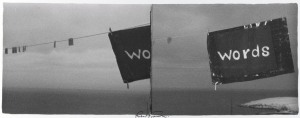
“…as if there is always a little less in the response than in the question.”
-Maurice Blanchot-

“…as if there is always a little less in the response than in the question.”
-Maurice Blanchot-
“Writing is a manner of reading. It is a mode of engaging with other texts in the world, which itself is a kind of text. And reading is a manner of writing, interpretation, meaning-making. Which is to say that writing and reading are variants of the same activity. Existence comes to us in bright, disconnected splinters of experience. We narrativize those splinters so our lives feel as if they make sense – as if they possess things like beginnings, muddles, ends, and reasons. The word narrative is ultimately derived, through the Latin narrare, from the Proto-Indo-European root gno-, which comes into our language as the verb to know. At some profoundly deep stratum, we conceptualize narrative as a means of understanding, of creating cosmos out of chaos.”
“Yet in many cultural loci these days we are asked to read and write easier, more naively, less rigorously. We are asked to understand by not taking the time and energy to understand. One difference between art and entertainment has to do with the speed of perception. Art deliberately slows and complicates reading, hearing, and/or viewing so that we are challenged to re-think and re-feel form and experience. Entertainment deliberately accelerates and simplifies them so we don’t have to think about or feel very much of anything at all except, maybe, the adrenalin rush before spectacle.”
-Lance Olsen-
“Literature is the question minus the answer.”
-Roland Barthes-
Here is page two of the blank notebook from my daughter as it fills:
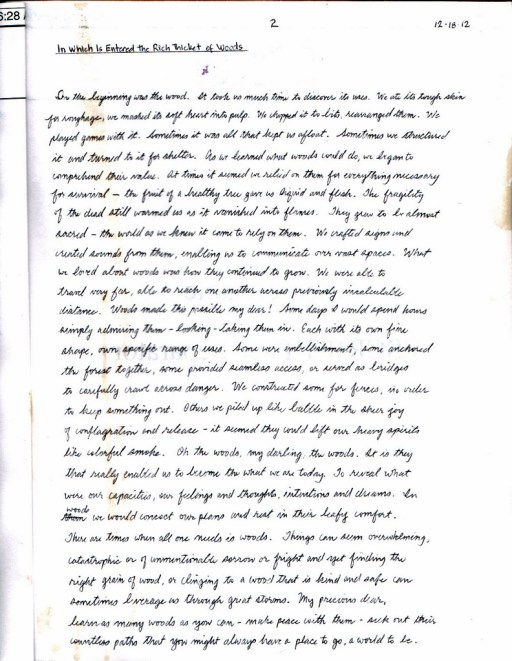
and here it’s typeset form:
2
In Which is Entered the Rich Thicket of Woods
In the beginning was the wood. It took us much time to discover its uses. We ate its tough skin for roughage, we mashed its soft heart into pulp. We chopped it to bits, we rearranged them. We played games with it. Sometimes it was all that kept us afloat. Sometimes we structured them carefully and turned to them for shelter. As we learned what woods could do, we began to comprehend their value. At times we relied on them for everything necessary to survive – the fruit of a tree gave us sweet liquid and meaty flesh. The fragility of the dead still warmed us as it disintegrated in the flames. They grew to be almost sacred – the world as we knew it came to rely on them. We crafted them into signs and created many sounds from them – enabling us to communicate over vast spaces. We were capable of traveling quite far, able to reach one another over distances before considered impassable. Woods made this possible my dear! Some days I might spend hours simply admiring them – looking them over – taking them in. Each with its own fine shape, and own specific range of uses. Some were embellishments, some anchored the whole forest together, some provided seamless access or served as bridges to crawl carefully across great dangers. We constructed some for fences and walls – they helped us keep the unwanted out. Others we piled up like babble in the sheer joy of conflagration and release – it seemed they could life our heavy spirits like colorful smoke. Oh the woods, my darling, the woods! It is they that really enabled us to become what we are today. To reveal our capacities, our feelings and thoughts, intentions and dreams. In woods we could concoct our plans and rest in their leafy comfort. There are times when all one needs is woods. Things can seem overwhelming, catastrophic or of unmentionable sorrow or fright, and yet finding the right type of wood, or clinging to a wood that is kind and safe and strong can sometimes leverage us through great storms. My precious dear, learn as many woods as you can – make peace with them – seek out their countless paths that you might always have a place to go, a world to be.
On Beauty: A Portrait of My Wife
If I don’t write it, what reality does it possess? What substance or content are a memory or vision? Sound? Fleeting concatenations – experiences. Which is why I ask. Like Dante or Cervantes, Homer or Herodotus, does not here a duty lie?
If no one inscribes remarkable things – they will not be remarked, thus no further remarkable. But is writing a re-mark? Are we indeed marked by perceptions – jumbled, edited and collated into what we call experience – do they leave some discernible trace like magnets in the guts of a computing machine – that might be recalled, rebooted, reformatted and marked again? Or is that creation? New traces born of the old? What similarity – what identity – obtains?
If the scribe exists to codify – to translate vanishing occurrences into a relatively more stable domain – how should he select? What criteria? Whose testimony? Should he, as artists of old, gather the evidence and forge, in his matter of medium, some combinatory new myth? Take account of as many angles of appearance or observation as he is able, to contain and collage them into space like Cubists?
We call it “re-presentation” but we are crafting something new, something else. The eye is not a camera. Seeing, hearing, what we taste and feel are highly selective pro-activities – never catching a solid snippet or observing still life. We develop according to what we expect. Intuitive anticipation.
The façade of a building – you’ve already supplied it with volume. Unseen. The photo of your child – gains dimension and sound, perhaps even smell and sense. Context invested. Invented. We cannot stop the alchemy from going on. Nor would we really want to. And yet – what might we preserve?
Suggestions?
This began as a portrait of my wife. An impossible thing. It will end still farther from its goal. I meant to remark what has marked me profoundly, filled me of scars and traces, redirected my nerves and my blood, and I am left with the unexpressed, and these scribbled words of a man.
“What does it mean, to know it and not be able to say it?”
-Ludwig Wittgenstein-
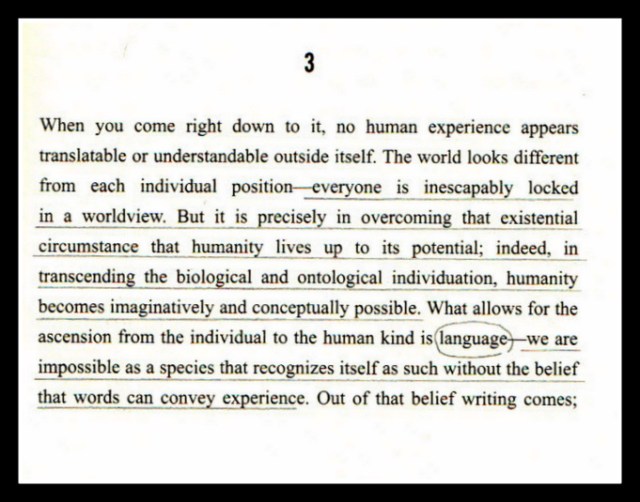
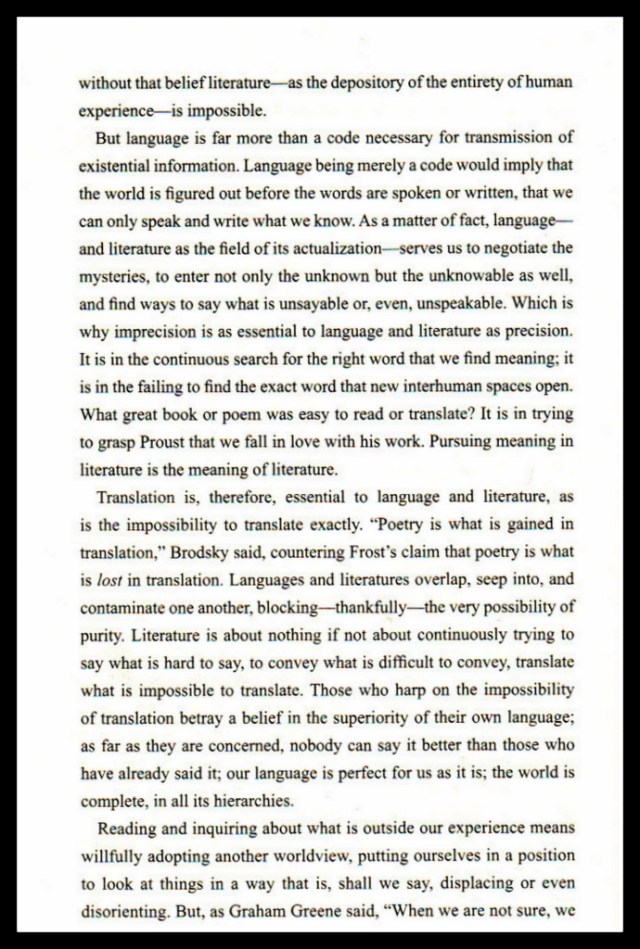
“When we are not sure, we are most alive”
-Graham Greene-
“I received 500,000 discrete bits of information today, of which maybe 25 are important. My job is to make some sense of it…[I want to write] stuff about what it feels like to live. Instead of being a relief from what it feels like to live.”
-David Foster Wallace-
That sense that the moon is obscure – cracked or marred in some indefinable way. That it might never rain. That parenting equals living with people you helplessly love.
Or marriage as painting, but you can’t control the medium, or even learn to think in it. You’ll never be wood, cloth, pigment or oils. I was never good at math, chemistry or geometry. For making a masterpiece, my chances are slim. Manic-depressive’s “in love” – like playing chess with marbles and confusing the rules of the games.
It seems possible that people who age wish they were young – tighter, unwrinkled, new-made. I don’t know – people don’t seem satisfied, somehow. You get the feeling, sometimes, I don’t know…I get the feeling sometimes that people wished they weren’t people. You know, that, like, they wished they were simple or something. Simple scientifically. Not complex, elaborate organisms, you know? But more like a single cell or an amoeba – something with apparent purpose or sort of unified mission. That they knew what to do. Or would – if they could just pull everything together, into line.
I think that’s what people mean by “making sense”? Something like that. Something like inventing God, some unified theory, some golden thread, some identity, some narrative. People are weird like that, but it makes for a fascinating species – the Storytelling Species – ingenious and fantastic, often unbelievable – the lengths to which these collectives will go to spin a yarn. Fit experience.
They’ll use numbers and actions and colors. Matter or energy and form. Inventing for anything a space and a duration. It looks like fighting with nature, but it’s kinda not – ‘cause it’s also how they perceive it. People.
With these enormously intricate mechanisms for constructing order, fabricating texture and variation and difference. To mash it all back together uniquely – imprinted, as it were – some new amalgam and full of traces – shadows and whispers of origins. Con-fused. Remade. Undone.
I used to think that was a purpose – to give meaning. Now I see it as a condition. A convention of rare and specific animals. At least we convene. We wouldn’t do well isolate – craving a single-cell or elemental type existence. We’re collectives – conventional conceptions. People! (said with a huff-sigh of air and exhausted incredulity).
You gotta love ‘em! ‘Cause if you’re reading this – “making sense” of these frenetic marks and spaces, light and shadow – then you’re one of them, and it does you no good to resist or despise yourself. Your own kind. Though people can, and many do.
Funny (peculiar) how you’ll find people that want to be much greater, grander than the mysterious incalculable beings they are, and then a bundle that wish they were less, tinier, singular things, and then the incredible bulk of people who somehow conflate the two: believing simplicity to be grandeur, the one – the all, everything/nothing, unity/diversity same difference and so on – go figure! (Really, try it).
Let’s choose a pinnacle example: say unpack “God” or the workings of atoms and molecules, hell, even protoplasm – seems we could learn an awe-full LOT from each of these straightforward messages we uncover: “I am that I am.”
Investigating “breaks”: antidote? meaning?
When there are assignments – yes, that’s the word – trajectories commissioning the laborious application of signs – I resemble a young school-age girl white-bloused and checkered-skirted skipping little curlicues down a sunlit autumn sidewalk. Either in performance or avoidance of what demands to be done. Activity testifies to play. The weight of the backpack keeps the frolic tethered to the ground.
Geometrically you could geo-graph-ically map the carefree trail, which would end up looking quite a bit like the path of Woodstock’s flight (extended)
[how I investigate world]
Relieved of positive burden – reputation, obligation, guilt, shame, agreement – anywise some sort of internal enforcer relating to the external world – is as if Schulz erased the yellow birdy’s gravitation. The backpack become balloon with the force of hot air but random like helium – set free of a hand and willy-nilly flitting to loss in midwesternly wind-raked sky.
Mine is more of a breach or a gap in the hedge – squares of deconstructed sidewalk without boards.
Collapsing toward me in slow-motion imminence are towers of books and billings, due dates and mouths to feed, souls to placate or nourish…rebar extending in its warped way out of the soil behind me – projects halfway done, future commitments previously agreed, promissory plans enacted for stabilizing measures. Even now I hear the dogs barking outside, wanting in. But the knot of rubber and tie of string are so easily undone…like mowers accidentally thud-chopping coiled garden hose that lay mimicking the hoppity school-girl’s jaunting…and all drifts off and away, falling through space, spinning in time – neither up nor down nor to or fro – simply set free / total loss – momentary or not: unknown – vacuous absence – somehow unmoored.
Where I am.
“I am someone who tries to write, who right now more and more seems to need to write, daily; and who hopes less that the products of that need are lucrative or even liked than simply received, read, seen…why I’m starting to think most people who somehow must write must write. The need to indite, inscribe – be its fulfillment exhilerating or palliative or, as is more usual, neither – springs from the doubly-bound panic felt by most persons who spend a lot of time up in their own personal heads. On one side – the side a philosopher’d call ‘radically skeptical’ or ‘solipsistic’ – there’s the feeling that one’s head is, in some sense, the whole world, when the imagination becomes not just a more congenial but a realer environment than the big Exterior of life on earth…The need to get words & voices not only out – outside the sixteen-inch diameter of bone that both births & imprisons them – but also down, trusting them neither to the insusbstantial country of the mind nor to the transient venue of cords & air & ear – a necessary affirmation of an outside, some Exterior one’s written record can not only communicate with but inhabit…the textual urge, the emotional urgency of text as both sign and thing. The other side of the prenominate 2-bind – … – is why people who write need to do so as a mode of communication. It’s what an abstractor like Laing calls ‘ontological insecurity’ – why we sign our stuff, impose it on friends, mail it out in brown manila trying to get it printed. “I EXIST” is the signal that throbs under most voluntary writing – & all good writing…
what must the world be like if language is even to be possible?”

got it, David. Thank you.
Student Magazine of IISER Mohali
Music, Musicology, and related Matters
a photographic pilgrimage to Orthodox Christian monasteries across the continent
Meandering Through a Literary Life
Orthodox Christianity, Culture and Religion, Making the Journey of Faith
Erik Kwakkel blogging about medieval manuscripts
"That's the big what happened."
Networking the complexity community since 1999
 All my Words are Silent