What Happens (with a semblance of truth): A True Story (that is never true)

Many things might have happened, indeed, could have happened.  It is impossible to tell until it happens.  Whatever happens.  And so it goes.

Recollection subjects what happens to interpretation, a puzzling assemblage of memory (embodied brains in changing circumstances) and occurrences (embodied brains in specific situations), making it impossible to tell what happens, when it happens, or after it happened, save from a very particularized attention and intention, point-of-view, disposition and enmeshment (the factors being relatively endless).

And so we call histories, scientific observations, statistical reports, etc. al., “stories;” journalism, research, theories or assays (essays), “fictions;” and personal memoirs, dialogue, descriptions or statements – “fantasy.”

Everything that happens or happened is what might have happened.

Let’s theorize that an author or reader, group or individual, has a concern for “truth” – something being what it seems to be – who or what has total and essential access?  The only truth in human expression that I can surmise is that it is truly “made up.”

An individual may have something approximating total and essential access to a thought or feeling, personal experience or idea, but insofar as it actually occurred according to an experiencer, there are already multiple points of view, ranging from molecular to cosmic, matter/energy to cultural.  To say nothing of the complicating fabrics incumbent on expression – whether a grimace or a novel, a shriek of pain or a tally mark on a chart – it has entered uncertain and collaborative interpreted ground.

All to say “experience” is utterly specific and solipsistic (non-transferable “truly”) and is an enabled product of embedded participation in significant (if identifiable as an “event” or “occasion,” “moment” or “intuition” – any feeling, sensation or awareness) surroundings, expanding niches of existing things with variant points of view.

This is how I can guarantee that nothing I show you or tell you is “true.”

It may be more or less accurate to my experience or understanding of it (depending also on your experience/understanding of my presentation of it) but it will in no wise be what it is or was, in truth.  I assume truth to be as impossible as god.  It would require omnipresence, omniscience, boundary less experience (which could not accord with our experience, or a grain of sand, or an ocean) and would be immediately foiled by the omni-ability (omnipotence?) those other necessary qualities would demand.  One could not be absolutely enmeshed or identical-with and entirely and completely objectively separate or alien-from at once.  At always.  That is not a paradox but a contradiction.  If imaginable, incommunicable.

So we speak of a “semblance of truth” or a “truth-seeming” quality to account for our realities and desires (our want for security, to grow order in chaos, to know, to choose or act with less fear or uncertainty).  Things like our ages, census reports, laws and principles (grammar, mathematics, semantics, processes and methods, etc.) a creepage over toward what we think of as “facts” – majority-mutually-agreed-upon-interpretations/perceptions/hypotheses.  These can hold for a long time because they’re held by so many, so widely.  But they most assuredly change over time, again, from atomic behaviors to the shape of the earth and its relation to elsewhere, from what constitutes pain to what gets moniker’d “god.”

What counts as fact does so by being open and shared.  Semblance of truth comes by corroboration, conversation and multiplying points-of-views and expressions of experience.

Perhaps this is one reason we blog.  To try “it” out on everyone, potentially.  If our expressions resonate with others, perhaps they have a semblance of truth, or contribute toward creating it.  Enough “I know, right?’s” and we’re on our way to a fact.  But no amount of data or language, materials or activity makes it so…it rests on agreement and compromise, observation and interaction shared most widely, coagulations of interpretations, accretions of experiencing – fabrication.

Make then, express.  Hypothesize and share your experience – we ask for your two-cents worth – we’re accumulating a fund.

Writing: the Apparatus

This slideshow requires JavaScript.

Writing: the Apparatus

“one can think of the work (of writing) as a dialogue between the two distinct demands bearing on it (the demand of possibility, the demand of the impossible).  Or between its two poles (measured form, measureless disintegration) or between the embodiments of these two ‘centers of gravity,’ if you will: reader and writer…two come together in a place where neither can be found…One of them keeps dragging it into the light of day as a completed oeuvre, a realized whole, something that has actually taken form and come to be (read, that is, or, you could say, heard), while the other pulls it back into the dark whence nothing ever springs (but where there is a chance that, coming to pieces, something might come to be written or said)”

– Anne Smock, What is There to Say?

-the demand of possibility, the demand of the impossible-

            The tools the writer possesses.

That there must be something to say…that it is impossible to completely say.  Finally, definitively, to have done with, saying experience.

What does one make of this?  With this?  Paradoxical demand, desire, exigency – imperative, self-generating, uncaused and ineffectual, drive?

Our tools:  awareness.  Attention.  Passion.  We observe and take note, feel-with, and seek to spell it out (for ourselves, for world).

Our tools:  available language, sound, gesture.  Entering the woven barrier and thoroughfare of what is shared, common, constitutive, we act, operate, select, arrange, choose, rearrange from this quilted information of the world, our saying of it.  Or singing, or stating, shouting or whispering and mumbles.

It seeks into fact.  We construct an object, made up of nothing, of airwaves, scratch-marks, designs.  Barely effable cues, hints, notions and signs.  We begin again with that.  With what it fails to say, to communicate or reveal.  We tinker with and tamper, excise and expand.  Ever the remainder.  Inexact invention.  Something there, some things not.

We pursue what is not.  What fell aside or seeped away.  The evaporate.  The unknown (here I adore the French: je ne sais quoi – that feeling that one knows it, and knows it so well and so deeply, and yet is unable to say what it is that one knows!).

Endless anticipation, expectation, a lusted desiring…

Endless frustration, falling short or to the side, inevitable (inherent even?) failing, shortcoming, irresolution.

These are the tools of the trade.  The writer’s apparatus.


A caveat:  from time to time I’ll wager to say we all of us take in some language or sound, vision or world that seems “just,” feels ripe, adequate, full and exact to the perception of our experience.  This is wondrous, thrilling, satiating, “ecstatic,” a moment’s completion, wholeness, perhaps.

Yet is it?  What does the masterful painting, the pregnant poem, the echoing song or fulfilling experience result toward?  Yes, toward, not “in.”  Not arrival but generation, bursts of multiplications of words, sounds, sights and movements now invigoratingly fueled and stimulated – fecund to go on…for more…fuller…richer…or even repeat!?

“Such then, would be my task, to respond to…speech that passes my understanding, to respond to it without having really heard it, and to respond to it in repeating it, in making it speak…To name the possible, to respond to the impossible.  I remember that we had designated in this way the two centers of gravity of all language…Why two to say one thing?  – Because the one who says it is always the other…”

– Maurice Blanchot, The Infinite Conversation

Content’s Dream

“The essential aspect of writing centered on its language is its possibilities for relationship, viz, it is the body of ‘us’ness, in which we are, the ground of our commonness, 

Language is commonness in being, through which we see & make sense of  & value.  Its exploration is the exploration of the human common ground.  The move from purely descriptive, outward directive, writing toward writing centered on it wordness, its physicality, its haecceity (thisness) is, in its impulse, an investigation of human self-sameness, of the place of our connection: in the world, in the word, in ourselves.”

-Charles Bernstein-

Ache ( the words, pt. 1)

I think it significant that this post and these thoughts were constructed/composed to Max Richter‘s composition “The Haunted Ocean 4” from his Waltz With Bashir soundtrack.  I have been unable to figure out how to load that piece here but so wanted you to be able to listen while you read.  I have found “Haunted Ocean 1” which has similar themes, but if you are able to listen to #4 please do!

(our environment writes as much as we do)

Ache


Borges writes “immanence,” Blanchot “infinite” and “void;” Beckett’s “dim” is Jabes’ “absence.”

– Let the attributes ring in your bodies like hymn –

Someone’s “silencio” is another one’s “vague.”  Heidegger’s “Dasein,” a collective of “Tao’s.”

Whence this pull toward placed-ness, toward wholes, toward meaning?

What evidence have we that this could ever be the case?

From “birth”?  Or “death”?  And what might we mean by “life”?

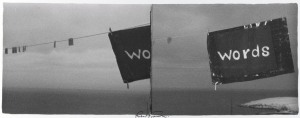
Words.

Language.

“words are not the reality of language: words – by themselves – do not exist”

Jorge Luis Borges

He illustrates this simply.  And might be demonstrated even more concisely, like this:

God.  DieuיהוהAllah.  and so on…

Or, with Borges:

“En un lugar de la Mancha, de cuyo nombre no quiero recorder” (12 words)

“In a place in La Mancha, whose name I do not wish to recall”  (14 words)

“En un pueblo manchego cuyo nombre no quiero recorder”  (9 words)

“In a Manchegan village whose name I don’t want to recall”  (11 words)

or

I love you.  Te amo.  J’taime.  Я тебя люблю etc…

or

I adore, crave, honor, respect, delight, select, prefer…

            It isn’t the words, it’s the language.  And the language isn’t just words.

Ache.

Torment lies here.  Angst, frustration, agitation, anger and want.  Fear and inadequacy, limitation and failure, desire and doom.

Ache.

If the words not the thing nor the thing without sign or presentation…for what, for what do we yearn?

Ache.

We seem unable to be HERE, PRESENT, and simultaneously FULLY SO.  Some faculty, some capacity slighted.  Either intellect suffers to passion, or understanding commands immersive sensation.  Ever a split, a just-nigh or just-shy.

Ache.

To long for, to crave covet and burn…

Ache.

My love is absent.  I ache, I yearn.  But when she returns and is present, I lose the pregnant and consumptive fullness of her absence.

Either way I ache, for more, for all – for comprehensive life.

            Called by “I,” “void” or “it.”  “Being,” “nirvana” or “love.”  “Youth” or “joy” or “wholeness.”  “Pleasure” “emptiness” or “thou.”  Nothing.  or All.

I name it Ache, today, intending by it some constitutive condition or state, a description of “living,”

by which so many meanings are lost,

and I ache.

2 Sources

Breathlessly discovering these treasure troves of inspiration and encouragement (and great thinking!):

M/E/A/N/I/N/G (particularly examine the essay by Lucio Pozzi – 12 Questions of Art – amazing!)

L=A=N=G=U=A=G=E

“Art, to me, is nothing but a testimony of a flow where order and disorder are interchangeable

and where the darkness of inspiration and desire fulfill unknown purposes within the appearance of space and time”

-Lucio Pozzi-