Here is yet another duckling passed over in the hopes to be a real story – I’ve hopes its life isn’t over yet!
(click pic for larger image, title for full text)
Thank You for reading!


Here is yet another duckling passed over in the hopes to be a real story – I’ve hopes its life isn’t over yet!
(click pic for larger image, title for full text)
Thank You for reading!
“”I write.” This statement is the one and only real “datum” a writer can start from. “At this moment I am writing.” Which is also the same as saying: “You who are reading are obliged to believe only one thing: that what you are reading is something that at some previous time someone has written; what you are reading takes place in one particular world, that of the written word. It may be that likenesses can be established between the world of the written word and other worlds of experience, and that you will be called upon to judge upon these likenesses, but your judgment would in any case be wrong if while reading you hoped to enter into a direct relationship with the experience of worlds other than that of the written word.” I have spoken of “worlds of experience,’ not of “levels of reality,” because within the world of the written word one can discern many levels of reality, as in any other world of experience.”
-Italo Calvino-
p.s….
“A work of literature might be defined as an operation carried out in the written language and involving several layers of reality at the same time”
“The preliminary condition of any work of literature is that the person who is writing has to invent that first character, who is the author of the work”
(further Calvino’s)
I, for Instants, You
I activate the mechanism
by opening.
All there.
Which happens to be here,
between
eye and this book.
I’ve taken someone’s advice and picked up David Levithan’s The Lover’s Dictionary – what a potent little delight! Immediately slid into place with Alain de Botton’s On Love and Macedonio Fernandez’ The Museum of Eterna’s Novel; Jesse Ball’s The Curfew and The Way Through Doors. Also moved me back to Daniel Handler’s Adverbs and (so-far) wonderful Why We Broke Up. In the process, feeling forever stunted as a “writer,” I cracked A. Alvarez’ The Writer’s Voice yesterday to these jewels:
“For freelance writers like myself who belong to an endangered species which, as long ago as 1949 Cyril Connolly was already calling ‘the last known herd in existence of that mysterious animal the man of letters,’ writing is less a compulsion than a misfortune, like a doomed love affair. We write because we fell in love with language when we were young and impressionable, just as musicians fall in love with sound, and thereafter are doomed to explore this fatal attraction in as many ways as we can…fifty years of writing for a living have taught me that there is only one thing the four disciplines have in common: in order to write well you must first learn how to listen. And that, in turn, is something writers have in common with their readers. Reading well means opening your ears to the presence behind the words and knowing which notes are true and which are false. It is as much an art as writing well and almost as hard to acquire.”

Reading, Writing – the ‘Rithmetic
You know, I honestly don’t know why I think of the many things I think of. “About” usually, yes, usually I can surmise why I stick to a thinking project – it might be something that troubles or worries me, maybe it involves something about which I care deeply or enjoy – then I’ll ruminate around on the subject or object for awhile, attempt to figure or follow the thinks, arrange some digits or sounds, contents, feelings or symbols until I make fit or get lost in the simple joy of tinkering.
But then other times, and really quite often, I can’t locate the instigative trail or balancing of reason for why (or how) items pop into or swish by my apprehending (apprehensive?) brain.
For instance, just now (and it’s precisely the unknowing that prompts me to write about it, to squeeze it through language), I was sitting quietly to desk after a very full day of soccer games, bicycle rides and birthdays, perusing Ron Loewinsohn’s Goat Dances, Anne Carson’s plainwater, Jon Anderson’s The Milky Way and Robert Creeley’s Collected Essays – a very normal way I have of grounding myself, discovering a location by mapping found paths, when sploosh! across the internet of my mind zipped:
“I guess I always read and write as if my life depended on it”
And then I stopped. Closed the books, slid them aside, rested my chin in my hand and gazed toward nowhere, wondering what question that sounds-like-an-answer phrase was responding to or anticipating.
Why would I think that?
Lost in language like dancing and syllables, stars and night skies, withs and relation and choros, why would my only clear thought (recognizably anyway) be:
“I guess I always read and write as if my life depended on it”?
When something stops me like that, and I already hear a rhetorical response, but no answers satisfy and questions only multiply exponentially…
I grab loose blank notebook pages and a ball-point pen…
and begin doodling, dabbling, and “showing my work.”
“I guess I always read and write as if my life depended on it” (implied automatic resonant answer: because it does) leads precisely (in this case, given all the contingencies and conditions) to the chicken-scratching rambling preceding this period.
In other words, not to a solution, or perhaps even a working equation or problem, but simply to activity. Reading, writing, thinking it out in lines, shapes and signs.
Now during all this scribble-sketching around the inceptive phrase, my bodymind has been mantra-ing responsorials: “because it really does,” “because I’m not even aware of things happening until verified in language,” “because life just occurs and I don’t know about it until I manifest the experience some way – bounce it off of a counterpart or internal funhouse mirror (other’s words) to learn what it is and isn’t” and so on…so-called “reasons” I guess? Hypothetical rationales for the random (apparently) phrase having typed itself in my nervous wirings?
The only “fact,” as I experience them, is that this phrase: “I guess I always read and write as if my life depended on it” clearly spat itself across the innards of my cranium while I was going about the very normal activity of recovering, soothing, pausing and nourishing myself on books at hand, wishing somewhere it hadn’t taken me all day to reach this quiet, wishing somewhere that all conversations went like this listening, wishing somehow I had something that felt like it needed to be written down, wishing somewhere that I understood myself.
And alas: a baffling sentence in response to no one silently carves and engraving on my consciousness:
“I guess I always read and write as if my life depends on it”
My entire body replying: “well…YEAH! It does! It’s the only way YOU know that there’s possibly LIFE at all, and not just sensations, emotions, thinkings and dreams; reactions, responses and stimuli! Without reading about it or writing words out I personally have no concrete object to sound my experience against, to test a happening – everything else out there from spouse to “god” is always moving, shifting, adapting, changing…just like me.”
“I guess I always read and write BECAUSE my ‘life’ depends on it”
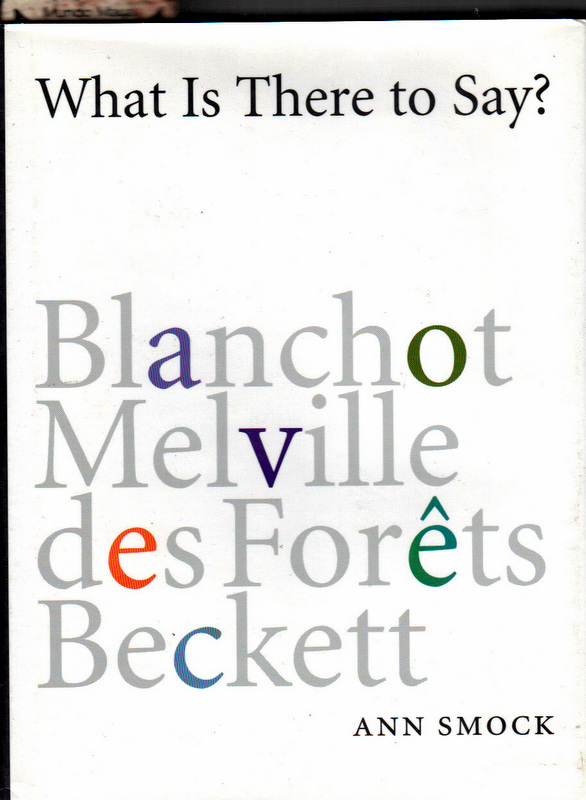

A book I am reading asks, in its title, What is there to say? Another, next to it on its anticipating shelf, states “very little…almost nothing.” Are they in conversation?
In completing Dust by Arkadii Dragomoshchenko for perhaps the ninth time, I come across a phrase I’ve starred and underlined in three colors: “We talk only because of a persistent desire to understand what is it that we are saying.”
If someone took the time to calculate how many times the word “other,” used to refer to a subjective entity, occurs in philosophical texts post-Heidegger.
What is being?
I often experience the anomalous reality of hoping wildly in the midst of despair, a fervent belief in oxymorons – things like “Poetic Influence” and “Romantic Love.”
How music crafts melancholy and joy.
Perhaps someday we will concoct a system of chaos.
The weather is large enough.
I say “I love you” because I’d like to understand it.
Edmond Jabes has it that “the words of the book were trying, in vain, to say Nothing” (writing of sacred texts) or, in other words, some persistent and extravagant Babeling into Derrida’s vast abysme of origins and effects. What is impossible. “Our persistent desire.” So Jabes asks “Is our relation to the world first of all a relation…to an expectation, a hope of world pregnant with all possible beginnings?”
I ask myself, then, what is it I have to say? The echoing answer “very little…almost nothing.” Persistent desire.


Ah, April 1. And I had been breathlessly preoccupiedly waiting the work day to begin…today I begin a journey into The Maximus Poems by Charles Olson, after a gentling scan into The Anxiety of Influence by Harold Bloom, both of which “just happened” to arrive at my local library yesterday – arbitrary arrivals from my Interlibrary Loan list of “wants”. Fool or not, nose in book, pack on back, and harried by wolves, it is what I do (am?). Here I go! (no fooling) 🙂 (why have I not seen so many cliffs and falls just ahead?)
Music, Musicology, and related Matters
a photographic pilgrimage to Orthodox Christian monasteries across the continent
Meandering Through a Literary Life
Orthodox Christianity, Culture and Religion, Making the Journey of Faith
Erik Kwakkel blogging about medieval manuscripts
"That's the big what happened."
Networking the complexity community since 1999
 All my Words are Silent