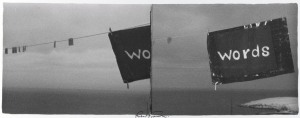
Waiting for words to tell…

Immersed in summer and studies, I find myself struggling with capacities of some purer form of origin beyond connections.  The creativity that satiates me in relationship and studies is one of associations, extensions, combinatory experiments of life-experiences and informations and knowledges.  Fiction and poetry, in a unique manner, seem to process the connectivities and associations invented somehow more within myself.  Not so much in activities of external bonds and ties that loop within/without between concepts and voices, persons and family, and my own; but what bonds those activities and informations spawn within me.  I am finding that these recognitions and constructions take a different sort of time and attention than the frenetic and immediate processings of conceptual knowledges and intimate relations.  Those, of necessity, must be continuous, on the fly, in situ.  Creative writing, in distinction, requires for me the ability for bracketing a space and time in which I am able to attend (somehow) to the recursive loops and dangling ganglia of my own organism of thoughts and emotions.   A sort of internal processing vaguely distinguishable from reciprocal or social processing.  It may not even be real, but only a sensation of process, a variant attention, a sidelong perspective.  In any case, it emits something unique in my writing and reflection, feelings and sensations, and something that I cannot simply produce; something that must be prepared and allowed for, visited, beckoned, welcomed.

I recognized this as I struggle to create for a project, and also possess a yearning to be creating new fictions.  The process art both provides and requires is unique and intense, difficult and serious.  It calls to mind the “effortless efforts” of things like meditation and awareness, mindfulness and tolerance.  The writings of Laura (Riding) Jackson piqued this recognition for me and I will share a couple of early paragraphs from her book The Telling.

“[1] There is something to be told about us for the telling of which we all wait.  In our unwilling ignorance we hurry to listen to stories of old human life, new human life, fancied human life, avid of something to while away the time of unanswered curiosity.  We know we are explainable, and not explained.  Many of the lesser things concerning us have been told, but the greater things have not been told; and nothing can fill their place.  Whatever we learn of what is not ourselves, but ours to know, being of our universal world, will likewise leave the emptiness an emptiness.  Until the missing story of ourselves is told, nothing besides told can suffice us: we shall go on quietly craving it.

[4] Everywhere can be seen a waiting for words that phrase the primary sense of human-being, and with a human finality, so that the words themselves are witness to what they tell.  The waiting can be seen not only in the eager inclined posture of believers.  It can be seen also on the faces of disbelievers, the idolizers of the evident: they are not happy in their impatient assurance of there being no cause but uncaused circumstance, they wear the pinched look of people whose convictions make them a meagre fare.  In the eyes of all (in the opaque depths in them of unacknowledged presentness to one another) are mirrored (but scarcely discerned) concourses where our souls ever secretly assemble, in expectation of events of common understanding that continually fail to occur.  We wait, all, for a story of us that shall reach to where we are.  We listen for our own speaking; and we hear much that seems our speaking, yet makes us strange to ourselves.

[5] …A religion addresses the longing in us to have that said from which we can go on to speak of next and next things rightly, in their immediate time – the telling of what came first and before done forever…How our story has been divided up among the truth-telling professions!  Religion, philosophy, history, poetry, compete with one another for our ears; and science competes with all together.  And for each we have a different set of ears.  But, though we hear much, what we are told is as nothing: none of it gives us ourselves, rather each story-kind steals us to make its reality of us.

from The Telling by Laura (Riding) Jackson, 1967


Infinite Medium / Unlimited Meaning

“And the fact is that ordinary words don’t have just two or three but an unlimited number of meanings, which is quite a scary thought; however, the more positive side of this thought is that each concept has a limitless potential for variety.  This is a rather pleasing thought, at least for people who are curious and who are stimulated by novelty.”

– Douglas Hofstadter & Emmanuel Sander –


Henry Magazine

Greetings all – thanks to the continuous hard work of Lisa Thatcher et. al., the experimental literary-aesthetic new magazine Henry is live!  I’m excited about this project, not only because Thatcher’s own work and interests are so astute and lively, but the principle of the thing and the open energy of the legacy of Henry Miller.  I invite you all to check it out (helps if you are able to read French), and you will also find a piece of creative writing by myself within.  Thanks Lisa & co., thanks Henry for verve and example, thanks writers and readers – it manifests!

a link to my piece on The Whole Hurly Burly

Accompanying me home

“For my father, the road had to wind uphill both ways and be as difficult as possible.  Sadly, this was the sensibility he instilled in me when I set myself to the task of writing fiction.  It wasn’t until I brought him a story that was purposely confusing and obfuscating that he seemed at all impressed and pleased.  He said, smiling, “You made me work, son.”  He once said to me in a museum, when I complained about an illegible signature on a painting, “You don’t sign it because you want people to know you painted it, but because you love it.”  He was all wrong of course, but the sentiment was so beautiful that I wish to believe it now.  What he might have been trying to say, I suppose, thought he never would have even thought about it in these terms, was that art finds its form and that it is never a mere manifestation of life.”

-Percival Everett-

compliments of:

Systems Everywhere

On the Dissimilarity of the Similar (excerpt) – Viktor Shklovsky

“A meaning only reveals its depths once it has encountered and come into contact with another, foreign meaning…” – M. M. Bakhtin

Response to a Question from Novy Mir

– M. M. Bakhtin –

It’s complicated

“In a complex relationship with the environment, very similar substances with the same chemical structure can become quite different in their reality and form”

-Michael Gazzaniga-

“On the evolutionary tree, we humans are sitting at the tip of our lonely branch…We have the same roots as all living organisms.  All those similarities are there.  Our cellular processes depend upon the same biology, and we are subject to the same properties of physics and chemistry.  We are all carbon-based creatures.  Yet ever species is unique, and we are too.  Every species has answered the problem of survival with a different solution, filling a different niche…Homo sapiens entered a cognitive niche…

…in one sentence Garrison Keillor captures humanness…such a simple sentiment, yet so full of human complexity…

BE WELL.  DO GOOD WORK.  KEEP IN TOUCH.

-Michael Gazzaniga-

Another strong recommendation from me for those interested in the what’s and how’s and some where’s and when’s of being a particular we.

Updating Margins

Greetings all you who take the time to peruse my blog.  I thank you.  Let me begin this by saying how I have missed creating blog entries that feel creative to me, that require me to a degree that is nourishing and satiating, rather than feel like marginal notes to my studies.  Thank goodness for a few projects and Friday Fictioneers that  spur me to some dedicated time spent “creating” purposively – differently from intellectual processing toward understanding.  And yet…

As I emerge into a brief pause between semesters, I find myself bewildered with experience and an oddly felt “freedom” that spawn confounding questions in me.  As I completed my final semester paper this week, my mind and body revved to the thought that fictions, essays and poems that participate in the structure of my desk – beckoning and ready as I researched away – can be grasped and delighted in, engaged at will, enter my cranial conversation…but this is also true of my researching – I have been consistently able to construct academic projects that involve and enable my immersion in those things that inspire and enthrall me – that feed my “what do I want to know?” urges.  So where this different nuance of feeling/experience in reading?

This is the question occupying me currently (or field of questions).  As I re-entered Robert Musil’s writings these past few days, while skimming and browsing an unbelievable desk laid with exquisite appetizers (Hejinian, Okri, Danto, Deleuze, Shklovsky, Creeley, Fante and so on) I recognized a feeling I can only describe as “insight.”  My preferential selections do not differ much between resources for academic work and resources for some other purpose.  I am driven to “know” what I am driven to know – it is continuous, related, dynamic.  Any sources from any genre or field or discipline that provide a certain “something” accomplish it.  What felt like “insight” was the recognition as I ranged over very different styles (Floridi, Serres, Wittgenstein, DFW, Larry Levis and so on) that what I seek consistently (and an effect that Musil invariably realizes for me) is work that I must achieve, that challenges, that invents, wrestles, requires change and adaptation, innovation and labor on my part to be ingested, understood.  That forces dialogue between my micro-world of knowledge and understanding and another.  Be it in the mode of expression, the language employed, the ideas, questions and concepts examined or points of view – it must be something that invigorates and surprises, invites dialogue and conversation toward meaning and understanding to occur.  Writing that requires change to be engaged.

At the same time I recognize that I read differently different writings.  I expect poetry, aphorisms, fragments to require percolatory time, as if the texts and spaces sprinkle my mind-lawn and will find their way to the roots in their own time.  I expect logical writings, perspectives or positions to argue with me, to have asked questions beyond what I have had the knowledge to ask, therefore pushing whatever I contain toward corrections and new formulations – adaptation and growth.  If writing asks that I be passive, within sentences it is set aside.

These are the questions I’m formulating and troubling in this margin –

  • How are freedom and restraint – affordances and constraint related (particularly in relation to my felt experience of reading selections – and to what purposes (“academic” vs. – ?)  (is there a versus? or is my criteria for reading homogenous regardless of “assignments” or artifact?)
  • Related: compositions – whether related to schoolwork or blog or journal or artistic projects – are they dissimilar in any way other than forms of expression, manifestation and items?  Or is all processing and expressing work similarly creative, inventive – processes toward meaning?
  • Can I begin to dissolve my penchant for categories and tasks, loosen a little my instinct of organizing complexity?  Do I want to?  Why?

These are my offering for today – reports from the margins, the notations always accruing and collocating in my experience – given air through a shifting of immediate responsibilities…

“To accept questions consists in immersing oneself in the search for the answers that answer them.  Furthermore, the questions specify the answers that they admit.”

-Humberto Maturana-

attached: a phenomenal recollective account of the theory of Autopoiesis – of creatively self-organizing systems like ourselves and our molecules that stuns me.  I invite you to read and differently consider your experience of the world:

Humberto Maturana – Preface to “Tree of Knowledge”

“the pursuit of knowledge does not mean conquest, but invention, the establishment of new relations, which supplement already existing ones and can transform them, make them branch out into unexpected dimensions, rather than deny them, or discredit them as manifestations of opinion, illusion, ‘culture.'”

-Isabelle Stengers-

attached:  a powerful account of “knowing” and how we conceive/relate to the acquisition of knowledge.  Again, if these sorts of things interest you and you are not familiar with her work – I highly encourage you to browse this writing:

Isabelle Stengers – Do We Know How to Read Messages in the Sand?

And again, I thank you for indulging me  in sharing some of my process of living

through this blog…

In addition

This slideshow requires JavaScript.

A lightening, a delicious weight

The semester is beginning to dissolve, moments opening up for readings that wander further afield… the pleasure of not squeezing freedoms into necessity however inextricably they are entwined… the reprieve arrives today in the form of:

“What is to be understood through seeing and hearing (even if not at first glance) cannot be too far removed from what is already known.  As incomparably as something unutterable may be expressed at times in a gesture, a grouping, a picture of feeling, or an event, this always happens only in immediate proximity to the word; as something hovering, so to speak, around its core of meaning, which is the real element of humanity…the essence of the person does not reside in his experiences and feelings but in his silent, persistent quarrelling and coming to terms with them.”

-Robert Musil-

Additional “freedom fare:”