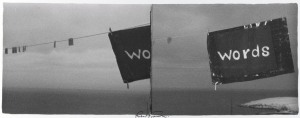
“The truth is that large tracts of human speech are nothing but signs of direction in thought…”
William James

“The truth is that large tracts of human speech are nothing but signs of direction in thought…”
William James
Writing for children, like talking to them, is full of mysteries. I have a child, a six-year-old, and I assure you that I approach her with a copy of Mr. Empson’s Seven Types of Ambiguity held firmly in my right hand. If I ask her which of two types of cereal she prefers for breakfast, I invariably find upon presenting the bowl that I have misread my instructions — that it was the other kind she wanted. In the same way it is quite conceivable to me that I may have written the wrong book — some other book was what was wanted. One does the best one can. I must point out that television has affected the situation enormously. My pictures don’t move. What’s wrong with them? I went into this with Michael di Capua, my editor at Farrar, Straus & Giroux, who incidentally improved the book out of all recognition, and he told me sadly that no, he couldn’t make the pictures move. I asked my child once what her mother was doing, at a particular moment, and she replied that mother was “watching a book.” The difficulty is to manage a book worth watching. The problem, as I say, is full of mysteries, but mysteries are not to be avoided. Rather they are a locus of hope, they enrich and complicate. That is why we have them. That is perhaps one of the reasons why we have children.
Music, Musicology, and related Matters
a photographic pilgrimage to Orthodox Christian monasteries across the continent
Meandering Through a Literary Life
Orthodox Christianity, Culture and Religion, Making the Journey of Faith
Erik Kwakkel blogging about medieval manuscripts
"That's the big what happened."
Networking the complexity community since 1999
 All my Words are Silent