
Content’s Dream

“The essential aspect of writing centered on its language is its possibilities for relationship, viz, it is the body of ‘us’ness, in which we are, the ground of our commonness, 

Language is commonness in being, through which we see & make sense of  & value.  Its exploration is the exploration of the human common ground.  The move from purely descriptive, outward directive, writing toward writing centered on it wordness, its physicality, its haecceity (thisness) is, in its impulse, an investigation of human self-sameness, of the place of our connection: in the world, in the word, in ourselves.”

-Charles Bernstein-

Passing Thoughts

Passing Thoughts

“People don’t always understand what they see…it’s always better with a few verses”

-Henri Rousseau-

“I don’t understand it.  The injustice of it, the random, unpatternable thing life is, feels like guilt, at first, and then matures (thought the verb is obscene in the context) into sorrow.”

-Larry Levis-

            I often feel something that must be near sorrow when I pretend for a moment that I am able to reflect or observe my own life.

Usually this occurs a few minutes after everyone that inhabits the home in which I live have tottered off to their beds or their dreams or wherever it is that they go when they’re alone.  I pour myself a cup of coffee, take on cigarette out of its case, and swing gently on the porch in the night’s dark.

At first, I simply listen.  For the trees, the breeze, my breath.  Then I let my eyes  gaze.  Neither here nor there but some middle-distance that never asks to focus.  Three or four puffs in, two or three sips of day-old reheated coffee, and I begin to feel.  My body reports its day.  How long it has been awake, what muscles have been used, what nutrients processed (or wasted).  I start to find emotions.  Perhaps lodged in the elbows or neck, gut or temples or knees.  Places they sneak off to in the day’s demands.  I gain what feels like a sense of things.  A “this is what you’ve enjoyed, endured, has transpired in your waking.”

And I breathe.  The smoke, exhaling, tells me so.  And the knowing the days that remain are smaller.  And that the days that compose me stretch out.  And I wonder.  “I don’t understand it.”  It baffles me so.

I have the impression throughout my aging frame, that so many places, engagements, and events that require all of me should not feel so dangerous, such threatening.  That the places we spill for one another, on one another – where we come forth – why do we fear so deeply? and try so hard? – why don’t they give rise to elation rather than wound?

I see moments, occasions, and encounters that have scared me to my silent howls – but from here, now, look like people in love giving themselves or trying to – declaring, expressing, vulnerably opening.  Why the fullness of human persons should overwhelm and frighten us so, when we are also one of them – why is this?

Why do I not feel I can hold my own in another’s anger or grief, sorrow or fear?  What is so uncomfortable about difficulty and complexity and unknowns?

The haunting guilt of finitude, of insufficiency, eventually levels out toward a universe of conundrum peopled with questions, and a kind of sorrow and grace seeps in.

By now my smoke has gone out, the coffee has cooled, and it is high time I join my spouse in our final accord.  The waves rise, they wash out.  They rise again.  There is a passing, and some passage, it is ephemeral and sure, and it goes on.

All these passing thoughts, and days.

I don’t understand what I see, but it’s usually better with a few verses…

I have the suspicion that the meaning of things

will never be sorted out

-Denis Johnson-


(click image for musical accompaniment to the text:

“Broken” by S. Carey)

(it’s worth listening to even if not reading all the text)

Remarking Mark…Part the Second

Mark Marking Questions

“Man is a riddle.  Our complex relation to others may also be affected by our fascination with this riddle…Origin means, perhaps, question”

Edmond Jabes


“Writing as the ‘talking cure

he thought, thinking in language what he thought language might do.  Be doing.  To him.

He heard “why?,” a term learned early in order to learn, and thenceforward laid over nearly everything he read, encountered, overheard or stumbled across, as if it were his placeholding destiny in some infinitely progressing equation simplified “world.”

He’d read he needed other persons and things, places and times to know his own.  – “Why?”

He’d heard “until others acknowledge or teach you your shape, your ideas, what you see what you feel what you taste or speak or hear, your perceptions and scope, you won’t be aware of a thing.  You’ll have no ideas or sensations per se, you’re essentially Nothing without Them.”

Arching his back and shrieking a sound at an absence of breast: “why?”

“I guess I’m just punctuated that way,” he came to think, as he adapted vocabulary.  “My role in a sequence is: – ?”

“And God said ‘Let there be light,’ and there was…” well, maybe – ?

“The Tao that can be named is not the eternal Tao…” well, maybe –  ?

“1 + 1 = 2,” well….maybe – ?

“You are Mark, a male form of a human animal, replete with these working organs, the English language, and certain beliefs.  These are your parents, your sibling, your probable friends.  Here are some feelings, some expressions and thoughts.  Here are your words.”  Well.  Maybe – ?

Shaped with letters and numbers and sounds.  Voices and touchings and feels, he became, slowly, surely, puttied toward a recognizable form – perceptible to others, acknowledged, even affirmed or engaged from time to time.

“Why?” propelled the lengthening problem of life but never grew toward solutions.

He read elaborate explanations and descriptions as he borrowed more languages.  Spiritual terms, medical terms, words scientific, political, philosophical and intimate.  Thick reams of median symbols asking to be joined or embraced, understood or imbibed.

Mark enjoyed these fabrics, and found a belonging among them.  Layers and theories, emotions and dreams – he simply need append his simple gesture – ?


Trouble, in the form of discomfort or pain, of disjunction, arose when agreement was desired.  Explicitly or implicitly, this undermined his form.  In situations where reciprocation or statement, some firm relation was called out for, his questioning mark failed to serve.  Choices, commitments, integrities or beliefs turned to drizzle around his definitive (self-identified) symbol.

“I love you,” she wooed.  “-?-“ he replied.  “I cannot know what you mean, what your language portends, I am unable to verify why?” he’d respond.  To collapse and retreat.

Even thoughts and decisions were questioned and split open on his sharp weapon of a mark.  He was not trusted or deemed trustworthy as doubt was perceived an anomaly.

He remained uncertain.

Self-perceivably, he reliably questioned, he’d respond and then take it away with his mark, his “signature move” as it were, his undoing.  “Yes I will…” “This I think…” “I am…” always followed by his -?- (which sounded like “why?” in the air) and found no rationale that could not be further put to query.

The world was unstable as well as a “self” for him.  All under the branding shadow of “why?”  This Mark never outgrew in all his adaptations, acquisitions, mutations and metamorphoses.  His certain core of uncertainty.  His permanent doubt.  His oxymoronic reality of being, not-being -?-

They perceive him – they really do – but as full of content with no substance; as possible and capable yet a great risk; as veritably human but unnamed from within.  Without “identity.”  This is true even of his wife and his children, parents and friends, all unsure who or what they are relating to, marked with the sign of the -?-  The indeterminate one, the questionable and uncertain, the duplicitous and vague, are various ways he is read and conceived – standing there as he does on his tiny spot of here, long-legged and stooped as in prayer, or inquiry – ? –
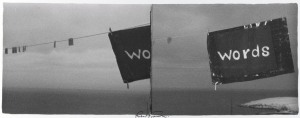
Telling Our Stories

This slideshow requires JavaScript.

Telling Our Stories

After all, it is language, this story.  This telling of you, of me, of our feelings and years, whatever we’ve done.  We are just speaking, really, creating from language our world and our children, our works and our actions as if we remembered.

I can’t see the harm in it.

I say I remember, here looking at you, that first time in your eyes, whether 18 or 40, when we may have sat facing each other or entwined, as if we’d first met and must absorb everything.  How large they seemed, how blue and soft as rain, how far I could swim there as if building a nest.

I don’t see the danger in using our language to say so.  In making up stories, alone or together, about us; our world and our selves, what we think.

After all, it is language we share.  As you bend at your work, your collar reveals a fresh sentence, your skirt a painting of terms, in your flesh all these stories I study to learn.  Of your breast and your elbow and hair.  The nape of your neck exclaims and your scars everywhere.  What the poet said, also with words, combining verbs and adverbs and nouns: “Your body is a book of thoughts that cannot be read in its entirety.”  Just words, but I keep them and sing them again, I can’t see the harm in the trying.

I love you with terms of my body.  I sign them to you when it’s dark.  It is language, oh yes, and you hear me.  We read with our skin.  Typography refers to impressions.  You impress me, even as I Braille what I need.  How else might we weave what is we without terms and strokes or gestures?

Only language, after all, that we borrow, I get it.

But where is the frailty in trying?

I read and I read and I read what you tell, ever growing a Talmud of comment.  I notate, I argue, I vent.  Then repeat.  I praise and I question and soothe.  You likewise make of my verbiage a stream; a spring from far peaks that dissolves to a delta.  What should we call what we do?  Relat-ivity?  Our capacity to engage and to meet – to relate?  Communication?  Always co-, ever with, filling munitions and messaging, our vocation?

To say, to listen, to hearken, to spell.  Here we tumble and thicken and age.  Her we interpret, reply and enrage.  Here we bind ourselves, it is language we keep using, keep finding, continue to tell…

“………………..Even in sleep

our bodies seek each other, your face the moon

lighting my dreams.  And by day, scenes beyond

untanglement.  Tell me my story, love;

how could I know it, we are such knotted things?

-Philip White, from Aubade

Heroes Ringing True

Robert Musil

On “the writer type”:

One can describe this type as the person in whom the irredeemable solitude of the self in the world and among people comes most forcefully to mind:  as the sensitive person who is never given his due;  whose emotions react more to imponderable reasons than to compelling ones; who despises people of strong character with the anxious superiority a child has over an adult who will die half a lifetime before he will; who feels even in friendship and love that breath of antipathy that keeps every being distant from others and constitutes the painful, nihilistic secret of individuality; who is even able to hate his own ideals because they appear to him not as goals but as the products of the decay of his idealism.  These are only isolated and individual instances, but corresponding to all of them, or rather underlying them, is a specific attitude toward and experience of knowledge, as well as of the material world that corresponds to it.”

On the writer’s region (“nonratioid”):

“There is no better way to characterize this region than to point out that it is the area of the individual’s reactivity to the world and other individuals, the realm of values and valuations, of ethical and aesthetic relationships, the realm of the idea…in this region facts do not submit, laws are sieves, events do not repeat themselves but are infinitely variable and individual…there is in the writer’s territory from the start no end of unknowns, of equations, and of possible solutions.  The task is to discover ever new solutions, connections, constellations, variables, to set up prototypes of an order of events, appealing models of how one can be human, to invent the inner person…which then nevertheless branches out somewhere into a boundless thicket, although not without somehow fulfilling its purpose…”

These quotes come from his exceptional small essay Sketch of What the Writer Knows

which I desperately wanted to reproduce here…

if it “rings true” for you – please find a mentor and friend in Robert Musil:

A resonance in technical difficulties

“Writing is for me a means of modulating and organizing phenomenal and circumstantial information from all points of experience, a process I refer to as ‘tuning’ myself.  As I grow older and seemingly remove myself from unity with any singular, or even plural, socio-cultural environment, I seem more ‘on my own’ in a vast environment of internalized experience.  My approach to poetics has become the search for responses and behavioral modes relative to this experience, to surviving it as well as conditioning myself to it.  Constantly the effort seems to be away from any formalization of ideas or structure or definitive process and towards a rejuvenating line of ‘basics’, that mythical point where each process is fresh and new and wholly responsive to indigenous conditions…

“In a sense, I am trying to cope with the urge of poetry as opposed to the structure of it.  This urge seems to lie within the rooted and individual beginnings of the activity, centered on a meditative, self-encoded embrace of those issues and inclinations I find within my own humanness.  The intention therefore becomes the opening of experience toward a continual address of the self”

-Craig Watson-

in

The Bewildered Bewildering (attempts toward clear thinking)

Searching for truth(s)

As one attempts to come nearer to one’s existence as a human – its systems, structures and functions – from mental imaginative realms down to cellular genetic levels – the complexity and confluences involved can be bewildering.

Are bewildering.

It is easy to get one’s self “lost” as a human being.  On literally billions of levels we participate in constant (and I mean unceasing) input and output of information, movement, form, energy and so on.  It’s more than we can individually handle.  Yet we are made to.

In other words, it is we as individual humans – our bodies, our minds and experiencesdoing the bewildering we find bewildering.  Perhaps this is my first noble truth: consciousness means being aware of and bewildered by our bewilderment.

How to proceed?  There are a bewildering amount of possibilities and processes for us bewildered humans to bewilder our way into.  We can study, forge purposeful relationships, work, play, think, dream, parent, fight or flee our bewilderment.  Opened up, we do not know the options or capabilities, the extent our bewilderment can reach.

Everything is strange.  If this were my second noble suggestion, it would imply that with each moment of our existence we are encountering the unknown.  We recognize our existence by dissimilarity, non-identity, difference.  This makes all things new.  We literally have never been where we are in space, time or living at any instant, before.  We do not re-live, we are ever living-into.  The contents of the past can become part of our structuring and processing, but nothing repeats, everything “enters.”  Each no-time now is brand new experience of unknown reality, experienced, imagined, interpreted, perceived and felt by us in incalculable ways through a vortex of communications and processes we have very little control over.

We, the producing products.  Perhaps this is noble human notation number 3.  What happens in our bewilderment of presentness is that our individuality opened out ubiquitously functions to produce experiences which are products of our experiencing.  In other words we are unceasing experimentors producing experiences as our products.  It all applies; it all exports.  There are no deletions, erasures or extractions – only new experiences, new dissimilar moments of ongoing processing.

There is no exit from this process.  Form 4: NO EXIT.  Imagined observation, fabricated explanation, hypothetical objectivity, invented theories, meanings, interpretations of sense – none of these removes us from our experiencing or transfers us to any other point-of-view from our individual field.  Bewildering in our bewildering surround.  Semblances, “insights,” knowledge and so on are just pieces of the ongoing differentiation in bewilderment.  How we exist, perhaps not the ant or paramecium or tree cell.  But, then again, perhaps so!

If a lion spoke we wouldn’t understand them, Wittgenstein proffered.  Another way of saying we’re us, bewildered and bewildering beasts, forging into the unknown.  Our access limiting in its unlimitedness (i.e. finitude); systematically mind-blowing and ecstatically depressing in an awe-full or awe-some(?) way.

Be human.  Be glad for it.  Be wilder.

N Filbert 2012

The Howl and The Whisper

Howling is a buried feat

epigenetic

leaking everywhere

Howling is done with the body

in terror

 a raging fear

imagine the reddened and purpling frame

a six-month-old baby left

naked on a hardwood floor

arching back

jerking tremors

piercing wail

flailing, throttling, choking at air

it will not stop

it is vulnerable.

Say the father rushes it

say he scoops it into his arms

whispers and cradles

The infant fits in the fathers’ large hands

held close to his cheek

ear-brushed lips

the father coos

infant trembling revolts

feeling its death

the father rocks it gently

kisses its skin

sniffing the child

while the infant howls.

He says “leave it to me.  Everything will be alright”

on repeat

says “I know we are vulnerable”

as the shuddering

comes to cease.

Let the infant howl

raise it up

bring it near

hold it close

that is all.

I, an infant’s father.

note:

I have had many incidents of late in which I howl at the dreaded prospect of losing my wife (to others, to distance, to death, to herself).  These have come out slantwise:  as anger or jealousy, criticism and challenge.  It is physiological.

A therapist recently suggested some alternate meanings.  When my body convulses in paranoia and terror, what might its messaging be?  Might it be saying that something or someone is terribly important to me, as significant as my own life and that I might well feel utterly helpless at that vulnerability?  He suggested that my body is indeed feeling real-life threat…and that the left side of my brain whooshes in hoping to rescue (“SuperMeaningMan”) to concoct a story to match, to account for the tremors and heartbeat and anxious breaths.  Things like: “I must not be good enough for her.  She must be cheating.  See how she dresses?  See how she is tired when she looks at me?  See how she keeps leaving the house?” and so on, or any number of scenarios…

When in possible fact I’m a flailing infant desperate for assurance and comfort, for a tender voice near.  Which made a world of sense.

He said:  supply it.

This is part of that work.

N Filbert

ALL MIXED UP

Mark Kozelek

I am Looking for Words

I Am Looking for Words

(click above for full text)

Baffling Wisdom (really a long roundabout babble aimed towards my wife)

Going back through the writings that have been piling up on, around and near my desk over the past few days working out the hoped-for verbalization of whatever it is that’s been stirring around in my brain I ran across a few more pages that seemed interesting / to the purpose…

“I am looking for words….”

Baffling Wisdom

i.e. thinking things through