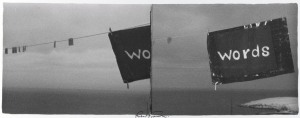


“Feeding the Reach”
Yesterday evening, I sat down in an early dusky chill, on the back steps of my home, for an after-dinner coffee and cigarette, watching with delight my two youngest bounding as penguins on our trampoline.
The sky was clear with an odd bright-but-sunken diffusion of sun, above the roof of the garage thin branches from three separate trees converging and tangling, criss-crossing and enmeshed, forming intricate thick silhouettes of scribblings in the even-ing air.
As I gazed and traced with my eyes and deep breaths, it struck me that after nearly two years of freedom to devote my days and hours to words, reading-writing-reading, a scene, an image like this incredibly marked and tangly night sky, almost immediately, spontaneously metaphored two references in me:
– a sentence
– the connections between ourselves and our world, the ganglia of mind and body enmeshed with “other”
I retraced my day to a half-an-hour I’d snuck to myself to read, while feigning a chore, from J.R. Firth’s later essays on linguistics. In one paper, Linguistic Analysis as a Study of Meaning, Firth very patently set out some fundamental assumptions he believed crucial for understanding the functions, processes, “meaning” of human languaging. I would like to copy entirely these three brief points and then add a touch of commentary, what my mind riffed as I pondered the trees (the tangles and lines, nerves and events conspiring to make a single utterance, a phrase, a sentence), a body and mind (my own) inundated, saturate, with language, and the squawks and giggles of my penguin-children.
First then, from J.R. Firth: (let’s call it “presuppositions crucial to reflecting on words”):
“The meaning of any particular instance of everyday speech is intimately interlocked not only with an environment of particular sights and sounds, but deeply embedded in the living processes of persons maintaining themselves in society”
“1. The human being is a field of experience in which the life process is being maintained in the social process. The human being in society is endowed with an urge to ‘diffuse’ and ‘communicate’ his experience by voice and gesture.
2. All language text in modern languages has therefore:
(a) the implication of utterance, and must be referred to
(b) participants in (all language presupposes ‘other’ – events linguistic and non- linguistic)
(c) some generalized context of situation.
These categories must also cover ‘talking to oneself’.
3. The participants in such contexts are social persons in terms of the speech community of which they are members. The key notion is one of personality, the essentials of which are:
(a) Continuity and the maintenance of the life process, the social process. In this
connection the concepts of context of culture and context of experience (continuity of pattern and process) are necessary abstractions in stating the continuity as well as the change of meanings.
(b) The creative effort and effect of speech, including talking to oneself. The preservation of the essentials of life in society from the point of view of the participants in the situation forms a large part of the meaning of language as creative activity.
(c) Personal responsibility for one’s words.
(d) The organization of personality and of social life depends on the built-in potentialities of language in the nature of the human beings and on what is learned in nurture.
“In the most general terms, the basic principle is the unity, identity and continuity of the human personality, bearing constantly in mind that ‘we are in the world and the world in us’…The contextual theory of meaning employs abstractions which enable us to handle language in the interrelated processes of personal and social life in the flux of events.”
For starters. Then Wittgenstein, Heidegger, Sukenick and Blanchot, Beckett, Maso, Nancy and Stevens, Cixous, Kafka, Calvino, Derrida and Austin, Wimsatt, Peirce, Jakobson, Malinowski, Thirlwell, Shakespeare, Homer and Celan and more and more and more came flooding in like the chatter of branches, and I listened with my eyes, and felt deeply in my ears the scramble and magic of our glittering alphabets and strings of letters, colors and symbols and my mind murmuring over and over “feeding the reach, feeding the reach, feeding the reach…”
And I begged patience to add – from what I know of this elegant, flexible, complicated medium – WORDS – their implementing our humanness implementing them – that their primary glorious recklessly beautiful use is just this:
feeding the reach of our humanness
its depth, breadth, height and scope and volume
languaging is the vocation of feeding the reach
N Filbert, March 2012
 All my Words are Silent