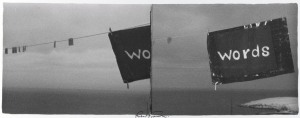

Addenda: Contemplating Language…

Coming clean.
Honestly.
There are many a day that I feel alone or odd or perhaps even neurotic in my obsession with languaging. I go to write…and end up being able only to write language. About language, with language, in language, against language, through language…a medium I am incapable of escaping. I think of those who write stories, or poems, articles or essays about subjects behind the words, things referred to, recounted, and I get excited, think: “I can do this!” – head into artworks or subjects, characters or narratives, and sure enough, soon as I put instrument to page…I’m locked in language…what it does, how it functions, what it means. With the gut feeling that exactly that, is what it does…means. Not something else, more, under or beyond, but means in its being languaging.
So I circle, spiral, seek into, try to self-criticize, split, examine, understand, observe, listen…and end up creating these whirligig texts where language spurs and follows, begins and begins and begins.
I wonder if it bores readers. I wonder if most persons, when I try to hash these conundrums out (the “prison” and “window” of languaging), are thinking…”why don’t you just get on with it…say something! Try it! Communicate, describe, hypothesize, anything – but don’t just dissolve your saying with saying!” I wonder if, to the bulk of our kind, reflecting on reflections without answers, resolutions, commercial products, and so on, is a stumbling block, a misfortune, a psychosis?
And things happen like this morning, where I suddenly feel validation of my contemplation…where the “eternality” of the issue feels ok for me to be obsessed by…today it comes in the form of a lengthy essay by Nobel Laureate (validation!) Octavio Paz, titled Reading and Contemplation. In it, he also enters into the trail of sources that has so shaped me: Benjamin Lee Whorf, Wittgenstein, poets, philosophers and physicists throughout the ages responding to: “Language is society’s foundation and at the same time is founded on it. Without language, there is no society; without society there is no language. To me this is one of the great enigmas of human history. Or rather the enigma.”
Sigh! I’m NOT alone! I’m digging around in perhaps the enigma of being human. “Language is more powerful than the individual self…this language that imprisons us is also a window, a lookout post on the world, on our fellows and on other languages…Perhaps the answer is to recognize that each culture – that totality of material, intellectual, and emotional structures: the things, institutions, and persons that go to make up a socity – is predominantly a symbolic system…that every act of human beings – even their crimes – say something. We are condemned to voice meaning endlessly. We are language.”
Further, “it goes without saying that everything human beings touch is impregnated with meaning; the trouble is that the moment we perceive it, meaning scatters and disappears. There is no meaning but meanings. Each one of them is instantaneous and lasts no longer than its appearance. Ashes of meaning: ashes without meaning…Meanings cancel each other out; on the ruins of meaning there appears a reality that cannot be named or even thought. To question language is to question ourselves.”
And, in a kind of ultimate reciprocation, connection, correlation…at the very core of my daily work, Paz writes:
“If everything we touch and name becomes full of meaning, and if all these meanings – provisional, disparate, contradictory – instantly lose their meaning, what is left to us? To begin all over again.”
And so I do…with this added courage. Perhaps I am not crazy. Perhaps others are interested. Perhaps languaging language matters.
*if you share my intrigue at all, I highly encourage you to seek out a copy of Paz’s Reading and Contemplation. It is a Pazian-version of my “Up with Word(s)” contemplation – nicely done, about 50 pp. I have read it in my copy: Convergences: Essays on Art and Literature by Octavio Paz


 All my Words are Silent