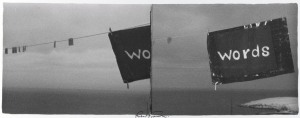

Mapping the Landscape
Some say that everything happens for a reason. What could/would that reason be? Even for the statement itself? (This is not rhetorical). Others say: “Who says?” “Who they?” (I’m sure they have their “reasons”).
None I can decipher.
Maybe truth is horizontal, “as the culminating reinterpretation of our predecessor’s reinterpretation of their predecessor’s reinterpretations…this tradition does not ask how representations are related to non-representations, but how representations can be seen as hanging together.” As in a map or chart. Relative, relational. I could see that. But, like zealous learners in their youth, dependent on a belief in cause and effect, or attempts to substantiate or materialize emotions – no map is large or long enough.
There’s always a horizon, at which limit no vision is of use, the beyond imperceptible.
So we take the reinterpretations and test them, thereby reinterpreting…what more can we do? Walk the maps they give you at birth, try them against each step, each new landscape or trail. “That’s where Foster’s barn used to be.” “There once was a great old tree here signaling the upcoming swerve in the road.” “This land used to be glacial, giant sheets of ice.” “Where you’re standing was once a mountain.” And so on.
“It is the difference between regarding truth, goodness and beauty as eternal objects which we try to locate and reveal, and regarding them as artifacts whose fundamental design we often have to alter.”
Go smaller, tighten your horizon. Analyze your own skin. This freckle, that wart, this scar, that mole. My son was identifiable by his long blonde hair blowing in Kansas wind – last week – now he runs in a pack of crew-cut kindergartners indistinguishable from a distance, but for his red coat. My voice changed. Eyesight. Posture and laugh. The contents of my “mind.”
It’s a long erratic affair – his unreasonable search for certainty.
Take up a dictionary or go online and pick any word – then add “etymology.” Where did your term “come from”? What’s it mean – then, now? How many common uses, nuances, ironies? Multiply that by users plus gestures plus intonation plus context = what certainty have you got? What’s the reason for that? Why?
In other words, explanations are no reason. They’re either well-informed observations, careful descriptions or wishful hypotheses (in which case they even cease to explain anything but may fuel observations – of imagination or psychology, sociology, philosophy – so-called ‘human sciences.’)
Look, I’m just trying to get the lay of the land here. From my vantage point it’s extremely varied and multi-layered. Everywhere I dig or fly, seek or describe, the horizon recedes as I advance. I leave marks along the way, but they seem different when I come back around, sometimes they’ve vanished altogether like the old cottonwood or Foster’s barn.
Within/without my horizontal globe is ever limited by me, so I “take your word for it” – perhaps there’s something beyond it…I’ll tell you when I get there. Perhaps I’ll send a map. (Perhaps we are a map, floating in a sea of them?)
(quotations from Jacques Derrida and Richard Rorty, in that order)
 All my Words are Silent