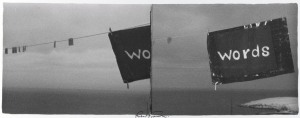
“…as if there is always a little less in the response than in the question.”
-Maurice Blanchot-

What I’m buried in this week or this moment
“…as if there is always a little less in the response than in the question.”
-Maurice Blanchot-
Writing for children, like talking to them, is full of mysteries. I have a child, a six-year-old, and I assure you that I approach her with a copy of Mr. Empson’s Seven Types of Ambiguity held firmly in my right hand. If I ask her which of two types of cereal she prefers for breakfast, I invariably find upon presenting the bowl that I have misread my instructions — that it was the other kind she wanted. In the same way it is quite conceivable to me that I may have written the wrong book — some other book was what was wanted. One does the best one can. I must point out that television has affected the situation enormously. My pictures don’t move. What’s wrong with them? I went into this with Michael di Capua, my editor at Farrar, Straus & Giroux, who incidentally improved the book out of all recognition, and he told me sadly that no, he couldn’t make the pictures move. I asked my child once what her mother was doing, at a particular moment, and she replied that mother was “watching a book.” The difficulty is to manage a book worth watching. The problem, as I say, is full of mysteries, but mysteries are not to be avoided. Rather they are a locus of hope, they enrich and complicate. That is why we have them. That is perhaps one of the reasons why we have children.
In the midst of busy, sometimes harried, rhythm-bashing holidays, Holly and I find our first day of quiet self-direction, spending a full day of her sketching, submitting images, reading… and myself completing an essay and Ida’s blank notebook and polishing on some poems…and, probably most nourishing of all (for me)…input. Here are the sumptuous nuggets I’ve been sampling today:
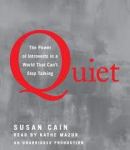


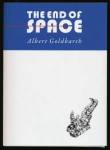

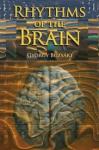
“Writing is a manner of reading. It is a mode of engaging with other texts in the world, which itself is a kind of text. And reading is a manner of writing, interpretation, meaning-making. Which is to say that writing and reading are variants of the same activity. Existence comes to us in bright, disconnected splinters of experience. We narrativize those splinters so our lives feel as if they make sense – as if they possess things like beginnings, muddles, ends, and reasons. The word narrative is ultimately derived, through the Latin narrare, from the Proto-Indo-European root gno-, which comes into our language as the verb to know. At some profoundly deep stratum, we conceptualize narrative as a means of understanding, of creating cosmos out of chaos.”
“Yet in many cultural loci these days we are asked to read and write easier, more naively, less rigorously. We are asked to understand by not taking the time and energy to understand. One difference between art and entertainment has to do with the speed of perception. Art deliberately slows and complicates reading, hearing, and/or viewing so that we are challenged to re-think and re-feel form and experience. Entertainment deliberately accelerates and simplifies them so we don’t have to think about or feel very much of anything at all except, maybe, the adrenalin rush before spectacle.”
-Lance Olsen-
“Literature is the question minus the answer.”
-Roland Barthes-
“As I was saying perhaps ignorance is the key. We all of course know what’s going to happen next.
Only artists don’t know what’s going to happen next a quirk of ignorance they share with history and the weather.
This is the key quirk of the quirky mind that produces the work of the artist…
…Stories don’t have reasons.
Or if they have them they have them after the fact like the weather.
Then the reasons become part of the story.
The mind is like the weather and this is the reason that everyone likes a good story.”
-Ronald Sukenick-
“For, in effect, the humanities have as their implicit agenda the cultivation of hypotheses, the art of hypothesis generating.
It is in hypothesis generating (rather than in hypothesis falsification) that one cultivates multiple perspectives and possible worlds to match the requirements of those perspectives…
…the language of evocation substitutes metaphors for both given and new, leaving it somewhat ambiguous what they are substitutes for…
the ‘relative indeterminacy of a text’ that ‘allows a spectrum of actualizations.’
And so ‘literary texts initiate ‘performances’ of meaning rather than actually formulating meanings themselves.’
And that is what is at the core of literary narrative as a speech act: an utterance or a text whose intention is to initiate and guide a search for meanings among a spectrum of possible meanings…
…the author’s act of creating a narrative of a particular kind and in a particular form is not to evoke a standard reaction but to recruit whatever is most appropriate and emotionally lively in the reader’s repertory…
…set forth subjunctively to allow them to be rewritten by the reader, rewritten so as to allow play for the reader’s imagination.”
-Jerome Bruner-
It promises to be a very good day!

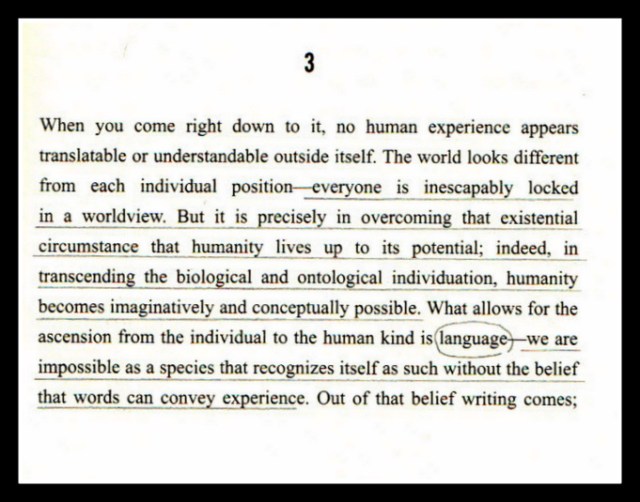
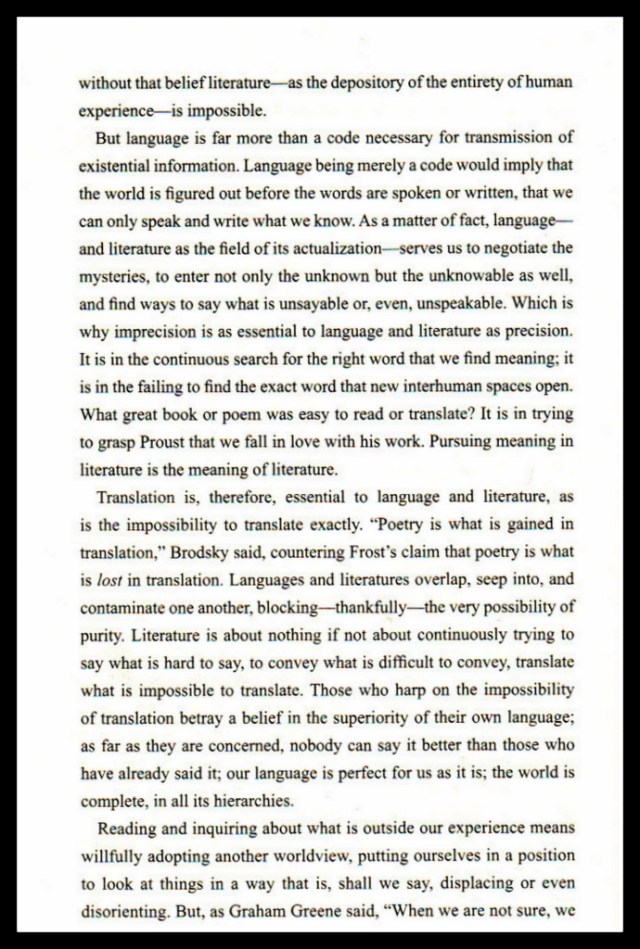
“When we are not sure, we are most alive”
-Graham Greene-
Student Magazine of IISER Mohali
Music, Musicology, and related Matters
a photographic pilgrimage to Orthodox Christian monasteries across the continent
Meandering Through a Literary Life
Orthodox Christianity, Culture and Religion, Making the Journey of Faith
Erik Kwakkel blogging about medieval manuscripts
"That's the big what happened."
Networking the complexity community since 1999
 All my Words are Silent