What is there to say?


A book I am reading asks, in its title, What is there to say?  Another, next to it on its anticipating shelf, states “very little…almost nothing.”  Are they in conversation?

In completing Dust by Arkadii Dragomoshchenko for perhaps the ninth time, I come across a phrase I’ve starred and underlined in three colors: “We talk only because of a persistent desire to understand what is it that we are saying.”

            If someone took the time to calculate how many times the word “other,” used to refer to a subjective entity, occurs in philosophical texts post-Heidegger.

What is being?


I often experience the anomalous reality of hoping wildly in the midst of despair, a fervent belief in oxymorons – things like “Poetic Influence” and “Romantic Love.”

How music crafts melancholy and joy.

Perhaps someday we will concoct a system of chaos.

The weather is large enough.


I say “I love you” because I’d like to understand it.


Edmond Jabes has it that “the words of the book were trying, in vain, to say Nothing” (writing of sacred texts) or, in other words, some persistent and extravagant Babeling into Derrida’s vast abysme of origins and effects.  What is impossible.  “Our persistent desire.”  So Jabes asks “Is our relation to the world first of all a relation…to an expectation, a hope of world pregnant with all possible beginnings?”

            I ask myself, then, what is it I have to say?  The echoing answer “very little…almost nothing.”  Persistent desire.

The Fool

The Fool

Ah, April 1.  And I had been breathlessly preoccupiedly waiting the work day to begin…today I begin a journey into The Maximus Poems by Charles Olson, after a gentling scan into The Anxiety of Influence by Harold Bloom, both of which “just happened” to arrive at my local library yesterday – arbitrary arrivals from my Interlibrary Loan list of “wants”.  Fool or not, nose in book, pack on back, and harried by wolves, it is what I do (am?).  Here I go!  (no fooling) 🙂 (why have I not seen so many cliffs and falls just ahead?)

Some goods to get you through

Kozelek cover image

“Coincidences depend not so much on desire as on the density of existence”

-Arkadii Dragomoshchenko-

“The full meaning of the adage Humanum est errare, we have never woken up to”

-Charles Sanders Peirce-

“Act your heart.  There’s nothing else”

“The world is where we fling it”

Theodore Roethke-

“To live in the world but outside of existing conceptions of it”

Wallace Stevens-

“Action painting – action writing – the process is the same, with emphasis less on the finished product than on the author’s process of creation”

-Jerome Klinkowitz-

a personal p.s.: I love the poetic world of Mr. Scott Krieger, and the music of Mark Kozelek (ahhhh)

“The poet feels abundantly the poetry of everything”

-Wallace Stevens-

(for Scott)

A Positive Review

Max Frisch


What happens for you when you pick up a book lying on some surface of your home with a bookmark in it so that when you lift it and absent-mindedly thumb the edges of the pages of course it gaps at that location and you glimpse a single-sentenced paragraph:

“In the process the scissors break”* ?

Read it again.  Lie back.  Close your eyes (or not).

That’s what I’m talking about.

“Perhaps the chair slipped -“

“only human beings can recognize catastrophes”

further examples.

And if every  sentence does enough work to be its own paragraph like that?  You’ve probably stumbled upon a great book.

*sentence-paragraph occurs on page 60 (where the bookmark is) of Max Frisch’s Man in the Holocene (what a name for our geological era, eh?  Holo – cene, pronounced hollow-scene, interesting enough meaning wholly now or “entirely present” in its Greek constituents (it’s thus been totally now for over 12,000 years), just saying…

An Addition to Credo: the Liturgy

WOW!  From Edmond Jabes, kicking off morning and work…

Rabbi Ed

“The gap between prose and poetry, between rose and rosebush, he had said, ‘is a variable space reserved for the deepening of one and the same love.”

“The book is a promise of writing…the words…are perpetual fulfillment.  Behind them, eternity.  Before them, the distressing and increasing weakness of the infinite.”

“The place of language is language.”

“We read only our own reading.”

“The book is a ‘You’ that temporarily makes us an ‘I.’  But the book is also something else.  It is an ‘It’ that embraces the I/You, dialogue being always in three voices.”

Edmond Jabes, A Foreigner Carrying in the Crook of His Arm a Tiny Book

Blogging Reality – stumbling upon an addenda

This slideshow requires JavaScript.

Blogging Reality – Other’s Thoughts

After completing some thinking-in-action-in-words-as-blog earlier this week, I took up a book and read…the section following where I’d left off in the illustrious and continually praised and most highly recommended text (now in my seventh turn…) Dust by Arkadii Dragomoshchenko, I stumbled upon this smattering of letters:


“In reality, the logic of these changing textures and modes of writing bear witness to something altogether different, and applies to their various manifestations.  Generally speaking, each new mode seems richer than the preceding one; and while the new one does indeed repress what came before it, it also adds new possibilities to what already exists…the means by which new forms of writing subsequently influence ‘writers’ is a history of a different kind.

“In the course of the last decades, with the creation of the Internet and the Web, we have seen not only a gradual revolution in the perception of time and space, and consequently of the possibilities of expression, but also – strange as it may seem – one other fundamental phenomenon: a return to writing, perhaps to virtual writing, but nevertheless to writing.  It turns out that we have unconsciously come full circle, returning to ‘paper’ in spite of all the ardent speeches in defense of the new, digital order of things.  Indeed the Internet has turned us back toward the past because, as Adam Gopnik has written, the Internet is a kind of writing, given that it is literally written ‘from beginning to end.’

“This can of course be refuted: even assuming that you’re right, what is the ‘carrier’ then of this writing?  Can it still be considered ‘writing’?  Paper can be touched.  A book is a tangible, physical object; moreover, it has a smell: printers’ ink, manufacturing chemicals, etc.  And how priceless is writing paper itself, its special, unique odor and color, to which literature has paid much homage so often!  Finally, what separates the first, primordial sign etched in stonen from the image on a computer screen?  To this imaginary question I give the following answer: what is most important to consider are the changes in the concept of materiality, as well in the system of concepts – a process stretching back over the last hundred years – relating to the very possibility of describing any material object whatsoever.  This object, the description of which previously relied on the coordination of the concepts ‘beginning and end’ (every object had both), is now conceived as some kind of oscillating point of a perpetual ‘now,’ a definitive account of which is extremely difficult, if not impossible, to obtain.  Indeed, isn’t it rather naïve to claim that we can feel a sign, as if it were a slab of painted, reinforced concrete that could be dragged up to the forty-fourth floor?

“All in all, ‘to be online’ signifies, on the one hand, a perpetual ‘now,’ real time, but on the other hand it means reading words written by others, no less than typing out one’s own words, addressed to someone else…

            “…writing.  Written language has the inherent ability to create a salutary barrier, a kind of second skin or distance that allows one to disappear from sight whenever one wants.  This is a space in which no one can deprive you of the right to instantaneous solitude on this otherwise all too overcrowded, unlivable island.”                                                    –Arkadii Dragomoshchenko


So…skin, perpetual ‘now,’ “real time,” without beginning or end, a “salutary barrier,” “textures,” “changing forms” and so on….writing

What we do.  What we love.  What we need / depend on.  How we “touch,” of a barrier like skin…flexible, moving, light and air and signs…

Flow on bloggers!  Flow on!

The Fine Line

This slideshow requires JavaScript.

The elusive and ever-present “fine line”

So-and-So comments on my poem “Corpus:”

“Gratitude.  Yes, without flesh, our emptiness would show – more than it already does”

Soooo…what if we stripped it all down?  If we could see through the surfaces and veneers?  Could X-ray skins and masks, barriers and betweens?  What would we find?  What would be there?

I’m not certain I know what Arkadii Dragomoshchenko was writing when, in sort of remembering a painting by Edward Hopper while looking at, listening to, and thinking of other things, he said he caught something the artist had “kept silent about” – “I saw the fine line that separates emptiness from plenitude…like the memory of something that never happened, and which sinks then to the cunning bottom of words…” he says,

which suddenly plunged my own mind/imagination into a fictional mind and body of Alberto Giacometti, strafing and violently thumbing and stripping at sloppy wet clay glopping off wires, or scratching scattering lines upon lines upon lines around toward across and through the densities of a head’s face, a skull’s gaze, to – “get at it,” “down to it”…it, it, it.

Beckett writing round after round, chicken scratching sludgy paths, barnyard maneuvers after…it…

anyone obsessed…the idea of North, a perfect composition, to say something truly or clearly, the search for love, for that specific yellow, for shadow, emotion…anything,

that craving driving hounding driving us after “it”…limned so elastically with emptiness…plenitude apparently (possibly?) impossibly just the other side, just “through,” beyond, “it.”

So let’s Giacometti the flesh, tear it away to tendons and strips, resistant clumps and stains clinging to the fresh gruelly bones.  Empty the organs, scoop out the brains and guts…get rid of the extras, trim the fat, we’re after the core…”it.”  The “plenitude” just the other side of skin, of bone, somewhere…it must be somewhere in all this mess of in-between the structuring holds, no?

Dig to the center of the earth.  Scoot on out of the galaxy.  Find “it”, “it,” “it” – the plenitude…what will it be?  What will you swallow, cuddle, absorb, grasp, “obtain”?

I can’t remember if “empty space” is an oxymoron now or not, akin to the wonderfully wise and riddled aphorism of Wallace Stevens: “Nothing is itself taken alone” – STOP.  Think of it.  “It.”  Is he right?  Anything “taken alone,” “in itself,” is NOTHING?

In other words – pursuing some “essence,” some “right” or singular universal (or personal) “truth” is destined to leave us empty-handed?  Grasping “nothing”?  “Absence”? “Empty space”?  “Void”?

Or the human (we, us, you, I), body stripped apart in a search for a “soul”…

             On the other hand…sometimes Giacometti added.  Put wire together with string together with plaster, clay and cloth, plus chisel and hammer and hands, also paint; and sometimes he kept tracing more and more and more furious lines, strokes, deepening (thickening) eye sockets, figured shapes…

sometimes Wittgenstein multiplied words after word after symbol and equation, sign upon mark attempting to scratch them away…

And there’s the other half of Stevens’ aphorism: “Things are because of interrelations and interactions.”

Perhaps the “fine line” separating (or incorporating?) emptiness and plenitude is the very mess of glop of surface and structure, blood and mud, skin and bone and tangled nerves, oil and pigment, letters and lines, sounds and shapes, all the mixed-up pieces and parts, mushy impurities, congruences and convergences, masses and movements smeary and ever-so-tenuous…

perhaps that’s “it”?  Emptiness and plenitude mutually dependent like each side of this sheet of paper?  Indistinguishable?  The same-different “it”?

So put the body together, love the skin and the noises and fluids that issue from beneath it.  Slap words and songs, shapes and colors, space and time and breadth and depth, subject object, idea emotion and everything you’re able to in your quest for…

well, perhaps actually, your experience of…”it

Everything composes this line.

Blogging Reality

Blogging Reality

“we should start from the notion of actuality as in its essence a process”

-A.N. Whitehead-

“there is only one thing you can do about the kinetic, reenact it…which..is why art is the only twin life has – its only valid metaphysic.  Art does not seek to describe but to enact.”

-Charles Olson-

“life is preoccupation with itself”

-Robert Creeley-

            If indeed “reality is continuous, not separable, and cannot be objectified [read “stopped” or “paused”].  We cannot stand aside to see it” (Robert Creeley), as our sciences and philosophies have come to speak of it.  If language is an enormous fluid complex of systems, of ideologies and referents, socio-physico-psychological sounds and gestures always forming their contents and functioning their forms, as it is currently prevalently demonstrated to be.

In other words:  if life is a process we are unable to abstract ourselves from without thereby ceasing to live.  And “the reality of life is organized around the ‘here’ of my body and the ‘now’ of my present” (Peter Berger) our organizational notions of space and time, or mass and motion…and therefore all existing things are moving about, around, against, in or through one another (“Nothing is itself taken alone.  Things are because of interrelations and interactions” – Wallace Stevens).

“If” these faith-based-in-observational-perceptive-categories are anything like “on the right” (correlative, coherent fluctuating track) “path,” saying something functional or “meaningful” (say here “true”) about humans and the world – how might we be conscious of it?  How align ourselves mind and body with an unceasing flow we are unable to “step aside” or “back” from in order to observe or reflect, remember, recount or experiment “on,” but can only, in reality/actuality act “in”?

Another version:  how might we have some idea or “knowledge,” apprehension of what we “do” living?  (“we do what we know before we know what we do” – Charles Olson).

One possibility is to enact our own forming processes in/into the motion of all things.

i.e. “everything, always, in life just as much as art, is precarious – since it is mutable, everything is a disappearing act.  Things only survive if given an artistic form.  Art is, therefore, in a way, more real than life.  It is only art which is not mutable, which does not disappear: everything else is transient.  Only art, with its passion for form, makes up a permanent version from the made-up things of this world” (Nabokov as termed through Adam Thirlwell).

But art does disappear.  It is mutated by translation and new readings in different times and languages and contexts, different versions/pictures of the world held by each and every member of its audience.  Is worn away, stolen, lost, damaged.  Art is also part of the fluid precarious flow of actuality/reality.

And yet, perhaps, the work of art, the making process itself, provides us with something like a “knowing” or apprehending process within the process life is?  Adding rivulets to the river in the river, additional possible processes in process.  If the artist seeks to make from the full experiencing of its present motion, the many layers and currents a human touches, senses, perceives (and imagines to themselves – a “putting-together,” “drawing,” “enacting presentation”) converting them through one’s self into text, paint, clay, dance, song and so forth…

…no “product,” like no “event” is immutable, spaceless, timeless or immobile, any more than a stone or the earth or sun or moon is, and yet…

“electronic writing will give us a deeper understanding of the instability of texts, of worlds” (Carole Maso)

“What I seek is an active seriality…I write because it is there to be written…it keeps happening and the way the world then enters, or how I’m also then known to myself, is a deeply fascinating circumstance…a deeper fact of revelation I feel very actual in writing, a realization, reification, of what is” (Robert Creeley)

In other words, art-making, enacting in paint, in text, in images, sound and movement, is activity, not a “subject.”  We cannot complete a story or poem or song about what is, because what is always keeps occurring, to blog, to write in such an unstable, ephemeral and mutable medium as light and electricity is, perhaps, an extremely mimetic, representational forming of life itself.

It’s there, it’s gone, it’s always in process, revision, adjustment, open to alteration, deletion, disappearance.  Arising and passing, like thoughts, emotions, utterances and sensations.  Like beliefs and love, wars and peace.  Nothing is stable…blog it so!  The medium chosen, like film, like music, like the fluids of paint and possibilities of stone, paper, clay – themselves are our activity and process of being.

Precarious, mutable and disappearing…and important (to us) and beautiful (at moments)…instants processed in the flow, circumstances in the ongoing situation, new contents and obstructions in the river.

Flow on bloggers!  Flow on!

“You’re simply stuck with the original visionary experience of having been you, which is a hell of a thing…

that which exists through itself is what is called meaning”

-Charles Olson-

and facts are just points of departure
 

Today

A steady, raining day (rare) for Kansas.  Filling it with Blanchot, Kafka, Beckett, Jabes, fervent standbys, companions in favorite times.  Stumbled across this while playing around with making a business card for myself (for a “Writer for Sustenance” – a “Heteroglossic Hominid”)…

for bloggers, then…

“right near the center lies a choice: to speak – a swift, unhesitating, irrevocable choice that leaves everything undecided…to choose speech turns out not to consist in choosing so much as in maintaining the wavering, undecided movement of the either-or (self-other)…What is it that must be said but not the only way it can be?…All that counts is to play; that means seriously.  Without reserve.”

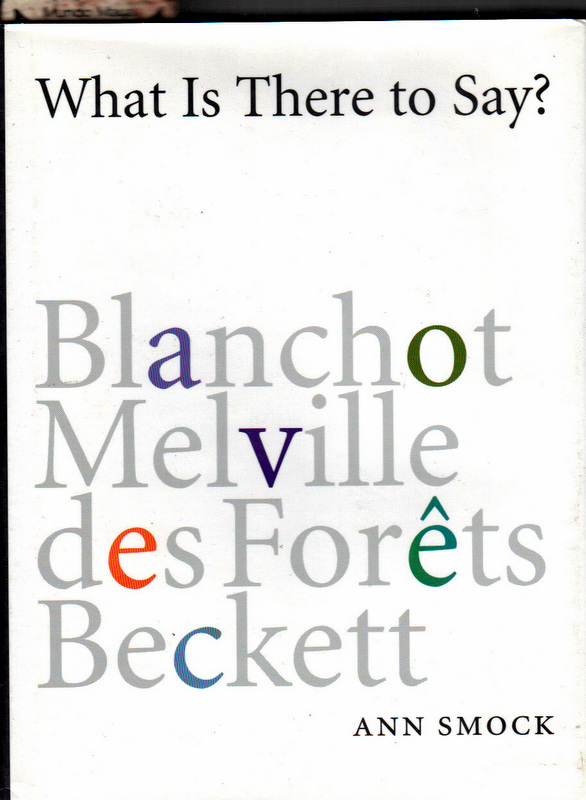
-Ann Smock, What is There to Say?-

As good as any…

This quotation from Arkadii Dragomoshchenko is as good as any I’ve yet come across in attempts to define or circumscribe what I think of in relation to whom or what or how a “manoftheword” is (in this case attributed in the masculine, because I am of the male gender, as is, supposedly, Arkadii) – but equally (as I see it) applied to any “personoftheword”:

“The place where I’ve finally found myself, is as simple as a child’s board game.  Everything in it echoes everything else.  Coincidences aren’t always believable.  And they don’t always count.  Obliqueness has its own charm…He’s writing…

The man forces out word after word.

The letters run in the rain and pour into the message.  The man, no doubt, is reading the message as he inscribes his letters.

In the message, unflinching, unfolding via ink blots, there are detailed instructions on how to correlate one letter with another, one word with another, and then the rest with rain, paper, war, objects,  fear, the hexagram of ‘fragments,’ toothaches, questions, history, tobacco smoke, poetry, foolishness, you name it…

The message also suggests that neither he nor you will receive a thing for it – this work is done gratis.”

-Arkadii Dragomoshchenko, Here” from Dust