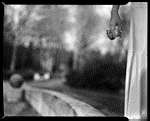
I for instants…borrowed

Arkadii Dragomoshchenko

this one is too good to deny…

“The insignificant position of two associated objects is probably determined by both the randomness of their relationship (let us remind you that neither the ‘statue,’ nor ‘I’ in any way ‘expressed’ a desire to be together, to be united thus by a proposal of anticipation followed by a separation) and – if you will – one’s semic insufficiency.  Indeed, if the semic nucleus of the word ‘statue’ or, say, ‘she’ governs the layers of contextual semes, then ‘I’ is empty (or infinite and hollow, from the very beginning).  This lexeme has no nucleus whatsoever; it’s nothing more than a cocoon of ‘contextual semes,’ like the knot that is a constant deflection of an illusory straight line towards its starting point.

“Frankly, I’d like to say, as I did at the beginning, that ‘I’ is reduced to a ‘seething, ever-changing void.’ But let’s leave it at that.”

-Arkadii Dragomoshchenko-

And, in very much seriousness…if you are a writer in any sort of way (letters, memos, journals, ANYthing)…I find it hard to stomach you not having read Dragomoshchenko’s book Dust.  Really.  Truly truly truly.  Please, if you have even a passing interest in the use and creation and employment of language (even for conversation, thought or memory)…Dust, Dragomoshchenko, Dust, Dragomoshchenko…(mantra until you hold it in your hands)

I beg of you.

Contemplation Validation: an Addenda

Addenda: Contemplating Language…

Robert Frank photo


Coming clean.

Honestly.

There are many a day that I feel alone or odd or perhaps even neurotic in my obsession with languaging. I go to write…and end up being able only to write language. About language, with language, in language, against language, through language…a medium I am incapable of escaping. I think of those who write stories, or poems, articles or essays about subjects behind the words, things referred to, recounted, and I get excited, think: “I can do this!” – head into artworks or subjects, characters or narratives, and sure enough, soon as I put instrument to page…I’m locked in language…what it does, how it functions, what it means. With the gut feeling that exactly that, is what it does…means. Not something else, more, under or beyond, but means in its being languaging.

So I circle, spiral, seek into, try to self-criticize, split, examine, understand, observe, listen…and end up creating these whirligig texts where language spurs and follows, begins and begins and begins.

I wonder if it bores readers. I wonder if most persons, when I try to hash these conundrums out (the “prison” and “window” of languaging), are thinking…”why don’t you just get on with it…say something! Try it! Communicate, describe, hypothesize, anything – but don’t just dissolve your saying with saying!” I wonder if, to the bulk of our kind, reflecting on reflections without answers, resolutions, commercial products, and so on, is a stumbling block, a misfortune, a psychosis?

And things happen like this morning, where I suddenly feel validation of my contemplation…where the “eternality” of the issue feels ok for me to be obsessed by…today it comes in the form of a lengthy essay by Nobel Laureate (validation!) Octavio Paz, titled Reading and Contemplation. In it, he also enters into the trail of sources that has so shaped me: Benjamin Lee Whorf, Wittgenstein, poets, philosophers and physicists throughout the ages responding to: “Language is society’s foundation and at the same time is founded on it. Without language, there is no society; without society there is no language. To me this is one of the great enigmas of human history. Or rather the enigma.”

Sigh! I’m NOT alone! I’m digging around in perhaps the enigma of being human. “Language is more powerful than the individual self…this language that imprisons us is also a window, a lookout post on the world, on our fellows and on other languages…Perhaps the answer is to recognize that each culture – that totality of material, intellectual, and emotional structures: the things, institutions, and persons that go to make up a socity – is predominantly a symbolic system…that every act of human beings – even their crimes – say something. We are condemned to voice meaning endlessly. We are language.”

Further, “it goes without saying that everything human beings touch is impregnated with meaning; the trouble is that the moment we perceive it, meaning scatters and disappears. There is no meaning but meanings. Each one of them is instantaneous and lasts no longer than its appearance. Ashes of meaning: ashes without meaning…Meanings cancel each other out; on the ruins of meaning there appears a reality that cannot be named or even thought. To question language is to question ourselves.”

And, in a kind of ultimate reciprocation, connection, correlation…at the very core of my daily work, Paz writes:

“If everything we touch and name becomes full of meaning, and if all these meanings – provisional, disparate, contradictory – instantly lose their meaning, what is left to us? To begin all over again.”

And so I do…with this added courage. Perhaps I am not crazy. Perhaps others are interested. Perhaps languaging language matters.


*if you share my intrigue at all, I highly encourage you to seek out a copy of Paz’s Reading and Contemplation. It is a Pazian-version of my “Up with Word(s)” contemplation – nicely done, about 50 pp. I have read it in my copy: Convergences: Essays on Art and Literature by Octavio Paz

Goods for all

Virginia Woolf:  “What is the phrase for the moon?  And the phrase for love?  By what name are we to call death?  I do not know.  I need a little language such as lovers use, words of one syllable such as children speak when they come into the room and find their mother sewing and pick up the scrap of bright wool, a feather, or a shred of chintz.  I need a howl; a cry.”

Jean-Luc Godard:  “Put another way, it seems to me that we have to rediscover everything about everything…There have been periods of organization and imitation and periods of rupture.  We are now in a period of rupture.  We must turn to life again.  We must move into life with a virgin eye.”

Carole Maso:  “Precious words, contoured by silence.  Informed by the pressure of the end.

Words are the lines vibrating in the forest or in the painting.  Pressures that enter us – bisect us, disorder us, unite us, free us, help us, hurt us, cause anxiety, pleasure, pain.

There is no substitute for the language I love.

I close my eyes and hear the intricate chamber music of the world.  An intimate, complicated, beautiful conversation in every language, in every tense, in every possible medium and form – incandescent.”

Jacques Derrida:  “Shall I just listen?  Or observe?  Both…reading proceeds in no other way.  It listens in watching.

Writing…coordinates the possibilities of seeing, touching, and moving.  And of hearing and understanding…Writing…gives itself over to anticipation…associated with the hands, not the eyes, it must recognize before it cognizes, apprehend leading toward comprehension”


Writing(s)

“Electronic writing will give us a deeper understanding of the instability of texts, of worlds.

Print writing will remind us of our love for the physical, for the sensual world.

Electronic writing shall inspire magic.  Print writing shall inspire magic.  Ways to heal.”

-Carole Maso, Break Every Rule-

Good ol’ Franz

“The variety of views that one may have, say, of an apple: the view of the small boy who has to crane his neck for a glimpse of the apple on the table, and the view of the master of the house who picks up the apple and hands it to a guest.”

-Kafka, Zurau Aphorisms

photo by Viggo Mortensen

Up with the Word(s)…continued (Pt. 7)

Part Seven:

Do we “know” what we’re talking about?

What can we (are we) know(ing) in words?

that we cannot know the essence of language (that we cannot escape language in order to view it cognitively) – know it according to the traditional concept of knowledge defined in terms of

cognition as representation – is not a defect, however, but rather an advantage through which

we are drawn forth in a distinctive realm, that realm where we, who are needed and used

to speak language, dwell as mortals.”

-Martin Heidegger-

the human engagement with language in usage engages us in our mortality; second, our relation

to language, our dwelling as mortals with(in) language, can only be thought from our

linguistic’ usage, that is, from the way we are used and engaged in usage for the speaking

of language…in other words, we must speak the relation in order to begin to think it.”

-Christopher Fynsk-

the ‘relation of relations’ (is now the relation in which language itself unfolds)

thereby our saying remains, as an answering, always relational”

-Martin Heidegger-

So what happens in our palatizing of the palette of language, our utilizing and being-used-by the fund of signs and gestures we appropriate toward communication? Do we “know” what we’re talking (writing, translating) with, through and about? If we can never quite adequate our signs to individual or universal experience, if we line and limn the threshold of entity/not-entity with this matter of language(s), ever seeking to approximate the “all” of our experience into available sounds and gestures that might be sensed and understood, but incompletely, what do we actually result with(in)?

Samuel Beckett has written that the conditions of our experiencing are the “ill-seen, ill-said,” ever striving for the “well-seen, well-said” that would stop it all, silence us, allow us to rest…completely…comprehensibly.

We are limited, finite. Our eyes perceiving always from their particular point of view, their stance in relation to the world, turning, deleting, comparing, choosing, focusing, blurring out, etc…millions of things in order to see anything at all – “ill-seen.” Our languages and vocabularies, grammars and knowledge and palates are also distinct and finite, our experience (no matter how broad or deep) an excruciatingly microscopic fraction of the happenings of the world – “ill-said.”

In seeking to express the happenings specific to us into a world specifically various and multiplicitous incalculably, we encounter an inconceivable expanse, breach, rift between our microcosm and the macrocosms of microcosms that might possibly acknowledge us, share or join with our experiences.

Given all that…for what might we hope? What content, substance, matters might be communicable? Might we “know” anything together? What is the nature of the signs?

Here, Heidegger, Fynsk, Bakhtin, Wittgenstein, Jakobsen, Halliday and their likes redirect us…joyously. They point out that what is being known in languaging are systems of relations – our very connectedness – interconnectedness – in fact, utter mutual dependence, absolute co-dependence with our world and others. In examining HOW language is used, what occurs in the actions of signing and saying, they help us see perhaps further than the apparently impossible struggle or lost battle of adequate communication.

Our own using of language(s) already immerses us in relatedness, whether it is “incommunicable,” “private” (questionable possibilities) systems of marks, movements or sounds, or efforts at comprehensive lucidity to the widest possible audience. To “make language” means as much to be “made by languages,” as an abstract painter whom we find it difficult to “understand” is still using materials and movements theoretically available to all.

In other words, in languaging, we are always already communicating –with even as we strive to communicate. There is always a prior relatedness before we seek to relate. Therefore, every ill-seen, ill-said attempt functions as both a pointing out of the enormous rift between each and all, and as the suturing that cleaves the gap.

Signs are relation, whether “successful” “comprehensible” or not. This is where, again, Derridean deconstructionist mythologizings of differance comes handily into play.

Along the vast scale of gradations of comprehensibility – each understanding, correlation, comprehension, or connection is only possible because it can be apprehended, shared, insofar as it is different, that is knowable, identifiable, recognizable, perceptible.

So whether speaking to ourselves (teasing out our worries, fears, feelings, hopes and so on) or shouting for someone to get out of the way – the miscommunications, disjunctions, incompletions, multipossibles of languaging forge us together via incomprehension.

“Ill seen, ill said” means necessary relatedness…that knowing, communicating, saying, thinking, feeling, doing at all, requires a world and others, a world of others, even to be conceivable, perceptible, possible.

Singing (even signing “poorly”) might be said to be the “relation of relations,” relations exemplar in the very rudimentary awareness that a sign does not exist except as a human utilizes it, nor a human identifiable apart from signs and gestures (even isolated, or “to-oneself”). No self occurs until we make a rift, invent a sign that might refer, imaginatively separate it enough to treat as something capable of being investigated or related to…like all things for the human.

What we “know” languaging…what is experienced languaging, then, is RELATION – an ill-seen ill-said asking and answering toward….
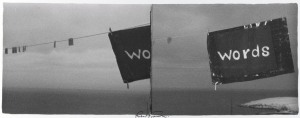
 

To read…to save your lives…

nuggets…

if you squirrel them away and chitter at the meat…

your life can/will be different….

Eugenio Montale, The Poet in Our Time

Aleksandr Hemon ed., Best European Fiction 2012 (the preface by Nicole Krauss & intro by Hemon remind)

H.L. Hix, Spirits Hovering Over the Ashes

I urge…encourage…envision…plead…hope…wonder…

A quotey-quote

“Once philosophy was stories, religion was stories, wisdom books were stories, but now that fiction is held to be a form of lying, even by literary sophisticates, we are without persuasive wisdom, religion or philosophy”

Ronald Sukenick

“Everything happens and everything that happens is part of the story and everything that everyone thinks about what happens is part of the story…and isn’t it interesting how in stories everything comes together but to continue…

Wording on…Part 4

Part 4: At the Threshold

Which brings us to:

the look in the eye/I.

Tell me you don’t know this:

you flood – you are filled up with an exceedingly distinct comprehension, you are “in it,” “getting it,” for now, let’s say this is a “profound sensation.”

simultaneously (usually) you are experiencing what seems to be an all-over, thorough-going “impression” (or impressions), this all meeting in what we are calling “profound sensation,”

inner and outer; incoming outgoing; expression impression, these are overwhelming and gravitate to interpretation and communication, expression and recording or description, in signs or series of signs and gestures.

Might be through sound or gesticulation, a color shaped, an action or behavior…these interfusions come out / in all the time, it is what it is to be living, it makes us who and what we are, the world and ourselves, to the world and to ourselves.


Words are the signs that conceivably might carry the largest amounts of this sensation…could they be found, or adequately arranged. It would incarnate this experience – give it body and form and objective factual existence among I and not-I.

Animals shriek, bark, run, tussle, shiver, bite, rise up, lay low, paint, scratch, gesture and so forth…but human animals have this additional matter – concept-conveyors and description-declaimers – able to stand in solidly, as beings, for gestures, sounds, colors, actions, emotions, events, and so on…separately. Words.

Outside rushing in and through, inside processing around and out, the threshold filled with signs like skin…thoughts, perceptions, emotions, sensations, commands, refusals, representations, questions…apparently everything that can happen in this mutual conditioning of person and world can be lexically signed.

The threshold double-passageways of terms.

Promising…exciting….intelligible….and yet?

Would you not agree that the moments the word-beings actually seem identical to the enmeshed flow are extremely rare?

You see her, or have seen her so long, you gaze, smell, listen, observe. You touch her, you are touched by, you taste her, this intimate between…you must convince her, exclaim to her what goes on in this…

you stammer or embellish, metaphor or moan, sing, laugh, cliché…

but it does not come out “right.” The arguments are unjust to the message intended. The emotions pour out through the sieve of the letters as you say them…uncontained, unconveyed, “at a loss.”

Or you read Heidegger or Pessoa, Blanchot or Lorca, you are moved and all the lights come out as in Spring, the sense of their words courses through you like brandy…you call your friend, you begin to sputter, attempting translation, your words sound foreign, unconvincing, unclear and inane…it is impossible to paraphrase – “unintelligible and untranslatable but not incomprehensible” after all, you “got it,” you’re suffused with “it” – the comprehension, reciprocation, “profound sensation” of the mutual conditioning of self and words/world…isn’t this what words are for? And yet…

This is the threshold of creative language. For speaker/writer “new layers of reality and insight have opened up” – language is required to factualize, birth this presence…but all the language you know seems unable…

Which brings us to:

the look in the eye/I

Tell me you don’t know this…

N Filbert 2012

Excerpt

“I do not know whether semiology will ever establish itself as a science.  The very people who observe this discipline have difficulty in defining it because everything is a sign in the world of forms, sounds, and colors, and a science embracing everything remains inconceivable.  But if we want to bide by verbal languages there are certainly considerable differences between the word as it is seen and the word as it is read and understood.  The word as it is seen is far less alphabetical than the word as it is read and pronounced.  It can be regarded as an ideogram.

Its faults are its lack of multivalence and its claim to some lasting truth.  The industry of communication would be basically undermined if the various means of expression claimed to have any duration in time.  What we need is not language but the suggestion, the arabesque, which is born and dies within a few minutes.  What we need is that which we see, hear, and touch for a single moment, and which is then consumed and replaced by a similar stimulus”

-Eugenio Montale-