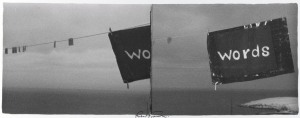
Would appear somewhere, must, would need to, a chapter called “Where Now? Who Now?” by Maurice Blanchot on Samuel Beckett…
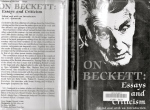
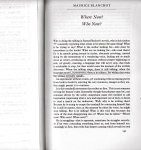

What I’m buried in this week or this moment
Would appear somewhere, must, would need to, a chapter called “Where Now? Who Now?” by Maurice Blanchot on Samuel Beckett…
Up Against the Word(s)
– a philosophy of language series –
in the sociology of knowledge
[if this book were a book and shaped like a rectangle, it would be redundant among other things and so on, but perhaps it is a circle and therefore repetition is therefore]
(one of many disclaimers)
Part the Second: True to your word(s)
And so one must wonder over/about how to shape or forge a writing that might be “true.” True to what? is the question that first comes to my mind. Immediately I sense an answer along the lines of “true to experience, human experience, living.”
Okay. But the options are many, perhaps limitless, no? It is easy to imagine someone setting out using language in hopes to be true to a theory, or a memory, an historical event, a relationship or a dream, a feeling or a painting one has seen. Some may intend to be true to the present (as it’s occurring) or to the past as it’s been recounted or remade in language or impression? To be true to ideas or previously languaged things (obviously involving so very many removes and hypotheses about what the previous tellers were attempting to be “true” to, or not). Or how about language itself, theis malleable system of signs, communication – how it works, what it references, invents, incites, depending on the terms selected, their organization, pronunciation, punctuation, etymologies, contexts and ideologies?
All would apparently boil down to the experience of the one implementing the signs: how that one has acquired the forms, contents, vocabularies, grammars and syntaxes of the utilized signs, or, beyond that, their singular perception and interpretation of their own memories, relations, readings, hearsay, acquisition of data and so forth. All to say “truth,” if one means by that some objective correlative to actuality, to “things as they are,” seems highly suspect, even as in this case, I might attempt to be “true” to the highly suspect meaning of the word and signified concept (ideology) “truth.”
So, if correlation to actuality becomes a highly individualized affair of each language-user, that a human, in fact, cannot hope to use words in any fashion directly translatable or apprehensible to another…why the setting out to inscribe?
One might suggest it’s a relative thing – like space and time – that communication takes place in fields of overlap between the flexible meanings of signs. That one hopes for difference and therefore the requisite similarities, to provide and provoke comprehensions limiting and expanding but somewhat assimilable – conversational – texting-with, vocalizing-with, another or others…some active reduction and proliferation of possibilities between multiple language-users and their contexts of situations.
Fair enough. A hope for convergences in a commonly based palette and culturation. Generalized and individualized from all sides.
Is this what the “writer” is after? Some correspondence (between themselves and their experience, between that relational complex and others)? Perhaps. Or maybe more accurately the languaging impulse fluctuates along a vast scale of minute gradations of aims and intentions, including, always, the relational effects of using (participating, knowing) language itself. It’s a mud pie! And so beautiful it looks like chocolate mousse sometimes.
And just became so, in the metaphoring of a kind of pie some persons will recognize, depending on their own experience and the culture they come from.
In part.
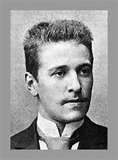
Each time I read again von Hofmannsthal’s “The Letter of Lord Chandos,” I resonate with it profoundly, each time with unique phrases and observations in it. Today it is the bewildering of art-working, the too much and too little of it at once. The overwhelm that becomes as perception received / perceptions projected cross and mingle in a deafening void – filled with “the thoughts of so many others caught and resting there.”
Hermann Broch, writing on von Hofmannsthal, speaks of man “unable to bridge the tension between perceiving and the perceived, completely at the mercy of unperceivable experiences, of objects, their impalpability, incomprehensibility, their irony…the contrast of the ‘I’ and the ‘non-I,” of being-‘I’ and being-the-world…one projecting the outer world to the inside, the other projecting the inside to the outer world, a result of mutual conditioning.”
“For of what elements does this non-‘I’ consist, this exterior world wherewith the ‘I’ is supposed to identify itself? Firstly, the world is in constant motion; secondly, and this is far more disturbing: all means of expression (linguistic or otherwise) given to man to describe the world are part of that world; and thus, thirdly, with each act of identification a portion of the ‘I’ enters the non-‘I’, changing and enriching the non-‘I’ so that a new act of identification becomes a necessity…which leaves only ever a work in progress and never a completed work of art”
“My case in short: I have lost completely the ability to think or to speak of anything coherently” I feel the terms crumble and proliferate in my mindmouth (heart?) – “to me it is as though my body consists of nought but ciphers which give me the key to everything” – the impressions that stir in and assault me, the world and its stuff that I soak in, hear, sense, the thoughts of so many others – indecipherable ciphers in me that feel they possess the key to everything…but for which I have no words…
So I face and engage the world, “experiences,” events, persons, the blank page, pregnant, saturate with languages that don’t equal…“because the language in which I might be able not only to write but to think, is neither Latin nor English, neither Italian nor Spanish, but a language none of whose words is known to me”
continually speechless in this profligate void
So what is to be done? No completing, “a new act of identification becomes a necessity,” apparently woven of my scattering perceptive confusion/profusion and all the not-‘I’ that feels so everywhere-at-once…it leaves Chandos silent, and a whole tribe of Bartleby’s…faced with a world and enormous impressions…but no apparent vocabulary fulfilling them both?
Silence? Or, possibly…
“Saying, it ceases to signify: it reveals realities that are unintelligible and untranslatable but not incomprehensible. It does not signify, yet at the same time it is impregnated with meaning” (-Octavio Paz-)
The breaches…speechless moments…never quite right…can I swing them? Term the betweens? To the breach – !!
Again with the word-thing! I feel immersed and splendored with what language is and does! Books like Ernesto Sabato’s Angel of Darkness and Macedonio Fernandez’s The Museum of Eterna’s Novel. Adam Thirlwell’s Delighted States and Octavio Paz’ Convergences. Eugenio Montale’s The Poet in Our Time and Jacques Roubaud’s Loop. J.R. Firth’s Papers in Linguistics and Kierkegaard’s Philosophical Fragments. Madeline Gins’ Helen Keller or Arakawa or C.S. Peirce on signs. The verbal object astounds and amazes me in its flexibility and invention, its capacities and catalystics. Simply holds me enthralled!
For instance: I draw a line (scribble a text) and immediately there are two parts which are inseparable. How describe that activity? Did I separate or unite? Both. The difference. Bridge and abyss. Rift and collapse. Reduction and expansion. All in this active solution, signs gestures language. Yeesh!
Celebrate today! Ingest and create! Read and speak! See what words do and ask what would there be without them, whether inner speech or conversation, engagement with the world or invention of the self. See how far words go!
I have been seeking a pdf version of Ronald Sukenick’s essay “The New Tradition” which I read in a wonderfully rich and challenging book of his called “In Form.” So far I haven’t been able to find it available online but wanted so badly to provide a link to the actual text that some of you might pursue it that far and come to take it into your psyches and bodies. Please believe me it is worth the time and effort to Inter-Library Loan this title (In Form) or uncover some of the essays therein. I urgently recommend his work to you! Particularly his nonfiction/essay works – from Wallace Stevens to Narratology…take delight and courage!!
“It is art which makes life, makes interest, makes importance…
and I know of no substitute whatever for the force and beauty of its process”
-Henry James-
I was raised in a faith that was based on a book full of words. At times it exploded with prescience and resonances in the life I was becoming, at others it fell flat or rang false, but its education in languaging experience held merit. When I say “raised” I mean inculcated and immersed. I learned terms and their arrangements by “heart” or memory and rote – as principles and rules for interpreting world and self. Childhood learning has a way of patterning subsequent life, and it comes back to me again and again when world overwhelms and skips past my reason plopping its bulky finger on “play.” I woke to it this morning and I listened. This is what I heard:
The Word: A Commentary
“In the beginning was the Word
the Word was with God
and the Word was God.
(the same) was with God in the beginning.
Through (the Word) all things came into being,
not one thing came into being except through (the Word)”
Gospel of John 1:1-3 –
The light comes on and I see that you are there. I can describe you now, move toward you, interact with more knowledge and intention. I now see the table and chair on my right, between us to the side, underneath the window which is covered and which I had not known to be there, nor the “outside” or beyond, even the gap of it, the doorways, the thresholds, until the light came. On.
I had not known the cat nor dog that made their sounds of presence, like your voice and breath I sensed, until the space of living was enlightened.
The Writer’s gospel, the good news, about language and mystery and its use to shed light. Brings to awareness, aids comprehension, might even be said to bring into being (for its users) all that comes to register as existent in its own particular way.
Emotions and landscapes, persons and things. The self, once considered in words, takes on. Until that moment all is inchoate, unformed, a mix of sensations unlocalized like innumerable living points in air. The Word(s) direct and give shape, question and expose. Let there be light.
Whatever rudimentary forms of communication prevail, among cells, among plants, among animals and stars, this light, language, the words and ideas, is the light of humankind. The life of its persons.
This is a gospel that I can believe in, bearing itself out in experience. As one’s vocabulary expands to circumstances and situations, life begins to seem understood, seen-through, engaged, if only in the duration of the verbal processing.
Linking the field like fenceposts and wires, the word traverses the between and the voids or the opens, like light reflecting matter, whether in the subtlety of the atmospheric layers or the gleam of a yellow school bus. It is there, I am here, we become. Same registering difference, word requiring letter and sense, being: being-with.
And so the surface grows scribbled. Notated, defined, addendum’d and erased. The living word, in action as much as its participants, adjusting, accounting, enumerating; revise and repeat. Expand. Express.
It is the territory between exterior/interior, centripetal/centrifugal, ever breathed into the void, calling to and called by. Ever beginning, the become of all things. As we segment times and spaces, sense duration and bounds, so the Word moves along with each complex, reporting, revising,
Recall. The naming of ocean and air – what were they before but a void exhibiting difference? The animals, people, feelings and actions – unknown variations – “behaviors” and “appearances” – then light.
It has come into the world. Avail yourselves of it. Turn on the lights – and read, and write. Bring what is (for you) into being. In the beginning, the Word, and at its end, the beginning. There is always more word for the void.
N Filbert 2012
Had a blast yesterday…when kids were engrossed in their own realms…browsing my own shelves…resulting in today’s readings:
House Mother Normal by B.S. Johnson
Plainwater by Anne Carson
The Last Novel by David Markson
Chinese Sun and Dust – Arkadii Dragomoshchenko
History – A Novel by Elsa Morante
dancing lessons for the advanced in age, In-House Weddings and the little town where time stood still by Bohumil Hrabal – man! he just lets stories run away with him – what a blastula of reading joy!
Rot by Janet Kauffman
such delights all around!
Finishing Simon van Booy’s “Everything Beautiful Began After” reminded me of those books throughout life that once you begin you don’t finish without swallowing…browsing my shelves I remembered a few (and I’m usually reading over 20 at a time, so if one demands the patience of the others it has some driving pulse something in me can’t ignore)…
“If Nobody Speaks of Remarkable Things” by Jon McGregor
“The Trick is to Keep Breathing” by Janice Galloway
“Master and Margarita” by Mikhail Bulgakov
“Beatrice and Virgil” by Yann Martel
“The Road” by Cormac McCarthy
“Possession” by A.S. Byatt
“Notes from the Underground” by Fyodor Dostoevsky
“Dust” Arkadii Dragomoshchenko
“Impossible Object” by Nicholas Mosley
“Entrance to Porlock” and “Final Beast” by Frederick Buechner
keep thinking of them! those startling ones that catch you off guard!
“Three Steps on the Ladder of Writing” Helene Cixous
“On Love” Alain de Botton
“To Whom it May Concern” Raymond Federman
“The Way through Doors” & “The Curfew” Jesse Ball
”
what books don’t allow you to put them down?
Films of Maya Deren
words of Clarence Majors, Helene Cixous, Simon van Booy, MAK Halliday, Samuel Beckett, Alain Badiou
coffee
therapy
music – Do Make Say Think and a composition of my own
the thises and thats:
“For we live in deeds, not years; in thoughts, not breaths; and our time should be counted in the throbs of our hearts as we love and help, learn and strive, and make from our own talents whatever can increase the stock of the world’s good.” from a monumental-looking effort of A.C. Grayling “The Good Book: A Humanist Bible” – I recommend you pore over it
“The author has a passion for doors. All doors: doors to mystery…the passion for books, the ferocity, the need, the exultation, the haste to flee the places inhabited by those people close to me, in order to regain the poets and other characters, in their books…In the middle of the house we open the white door and we’re no longer here…escape in broad daylight…people I would’ve never dreamed of approaching while they were alive enter, sometimes, in the very moment I turn toward them as toward people essential to my existence, forever indissociable from my taste, my mobility, my view, enter, suddenly, my other country…” -Helene Cixous “Firstdays of the Year”
and perhaps:
Begin Ending Beginnings
To learn from crows
To father children
To accumulate and recede
Some event sets in motion
Taking wing or stumbling feet
To oscillate between
Begin or conclude
Always the same at once
No difference that we know of
So begin, ending something
as crows and as carrion,
and the first buds of Spring
N Filbert 2012
Student Magazine of IISER Mohali
Music, Musicology, and related Matters
a photographic pilgrimage to Orthodox Christian monasteries across the continent
Meandering Through a Literary Life
Orthodox Christianity, Culture and Religion, Making the Journey of Faith
Erik Kwakkel blogging about medieval manuscripts
"That's the big what happened."
Networking the complexity community since 1999
 All my Words are Silent