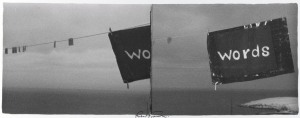
this is what i’m talking about! Yippee! Couple it with:
An Effective Procedure for Computing “Uncomputable” Functions
this is what i’m talking about! Yippee! Couple it with:

this is what i’m talking about! Yippee! Couple it with:
3,111 words into a midterm exam…welcome breaks:
-Emile Benveniste-
-Kaja Silverman-
I get a little weary of philosophy. It fascinates and intrigues, has its spectacular, glittering moments of what feels like beauty and “accomplishment” – like architecture, the sciences and arts, studies human and social and hard. But with each human activity and behavior there can be too much of a good thing. Perhaps it’s the fantasies involved in abstraction – in the feeling of “figuring things out,” or of “making sense” – our human super-additives to experience that are also experience themselves – that I, at times, weary of. That eminently falsifiable intuition that everything is made up.


It is extremely hard work to keep up a worldview. Involving enormous complexities and details, layer up on layer and strand interweaving strand of biological and logical, illogical, psychological, irrational, emotional, – ologies and descriptions, manipulated perceptions and re-interpretations of interpretations reinterpreted (ad infinitum) – it takes matter and energy, and particular organisms, which grow tired.
Those same realities, capacities and activities are also extremely inspiring, enervating and exciting for organisms – the behaviors of productivity, creativity, imagination and survival – and our weird confounding capacity to think we can observe our perceptions/observations to an infinite regress, make for a very strange frenzy of energy and matter indeed.
In a possibly (?!) infinitely webbed interdependence with our surround copious possibilities of activity are available – all bewildering: chaos can be so generative. Chaos can be so nullifying.
What might we know?
And why do we want to?
and…so…what!?
Alongside and within – in order to be – apparently (that is, according to OUR OWN perceptions) – however would could we exist either detached (abstracted) or without (independently, unattached). To imagine distance, “objectivity,” without the imaginative capacities of fantasy – illusions – for example logic, mathematics, economics, philosophy, psychology – codes and symbols – DElusions in order to play the games in these forms of life we are with delusional sincerity – effectively. And our fantastic delusions or profound poeitic creations are often effective, productive, pragmatic, dynamic and evolving – techniques and time – which would seem to imply that they also are part of being within a myriad of dynamic systems…
…one might suppose (i.e. “hypothesize”); or infer (i.e. “fantasize”)
All an immersion in symbols – languages – stipulated relations – codified behaviors –
– which is what I had set out to consider
drowning in symbols
the wonder and bewilderment of it
the sense of delusion and ecstasy
being human…
The WHYs of them:
“semiotics is not about the ‘real’ world at all, but about complementary or alternative actual models of it… an infinite number of anthropologically conceivable possible worlds. Thus semiotics never reveals what the world is, but circumscribes what we can know about it; in other words, what a semiotic model depicts is not ‘reality’ as such, but nature as unveiled by our method of questioning. It is the interplay between ‘the book of nature’ and its human decipherer that is at issue.”
-Thomas Sebeok-
“the forms and laws in our worlds do not lie ready-made to be discovered but are imposed by world-versions we contrive – in the sciences, the arts, perception, and everyday practice. How the earth moves, whether a world is composed of particles or waves of phenomena, are matters determined not by passive observation but by painstaking fabrication…Constable urged that painting is a science, and I suggest that science is a humanity.”
-Nelson Goodman-
“a mobile unsteady structure…with all the bits always moving about, fitting together in different ways, adding new bits to themselves with flourishes of adornment as though consulting a mirror, giving the whole arrangement something like the unpredictability and unreliability of living flesh…The endeavor is not, as is sometimes thought, a way of building a solid, indestructible body of immutable truth, fact laid precisely upon fact…Science is not like this at all.”
-Lewis Thomas-
“Perhaps the best way to think about post-modern self-referentiality is not as a denial of language and literature’s connection to the world but as their self-consciously pointing to themselves trying to point to the world.”
-Robert McLaughlin-

“For that I blame the craven desire to speak, to write, to be heard.”
-Ben Marcus, The Flame Alphabet–
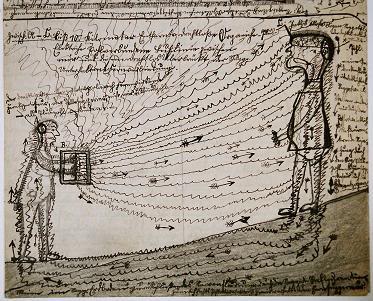
Semantic Animals
It goes on. Seduced (sickened and soothed) by symbols, I read. I write. In dilettante-like forays into advanced mathematics, physics, cognitive sciences and biology, I learn:
“The first message is that there is disorder”
(-James Yorke, attributed with naming the science known as Chaos)
So back to first principles (they have a habit of coming in threes, and splitting into fragments). I take out a blank sheet of paper, filled with lines. A patterned absence. Boundarying void. I write “seduced” because I’m thinking about language. Thinking instinct and survival and desperate need. Thinking overload, “more than you could possibly imagine.” Semantic animals.
When I last saw the snow fall, it was raining, offering an impression of “wet.”
She is far from me in two dimensions. Only two, of multiples of three. I count by the “trick of the nines.”
If only there were a way to collect accurate data. Then adequately calculate and organize. Unfortunately, life is mostly made of problems existing on continuums of countless dynamic variables, most of which – unsolvable. They call these “differential,” or Derrida’s Infinitude of Differance. Professionals finally agreeing: “regularity is aberration.”
We search for patterns. Even in chaos we find them (or create). Seduced (sickened and soothed) by symbols, we “read.” There are so many oscillating signals that even the few we don’t inherently tune out we call “noise.”
Philosophically, on the other hand, where I feel more like an amateur or novice, I understand the problem/hypothesis/theory equation to be: EVERYTHING goes into EVERYTHING, that we’re only ever engaging possibilities. That probables are fleeting, and certainties are few: You are limited, peculiar, and definitely will die.
In other words, “the very process of cutting up and cutting off, opens up and opens out,” or some of us are developing “a belief in the musicality of creative disjunction” (Lance Olsen), because, seduced (sickened and soothed) by symbols, we select and collage our own inspection.
It’s easy to forget the first things that we find, i.e. that all positive statements and beliefs are built on “that there is disorder,”
and seduced (sickened and soothed) by symbols,
we go on from there.


Roughly speaking, I understand “art” to be something created through human interaction with the world. Whether perceptually noticed or purposively constructed, that which we experience in what we might call “aesthetic ranges” are always results of interactivity and, as far as we know, only occur for human organisms.
In light of my previous post attempting to address the function, variability and necessity of language or sign-types for human perception, survival and being-in-the-world, I want to address something fresh for me that arose in that inquiry.
Previously, I lamented the inevitable distance that occurs in living organisms between originary experience in and with an environment and the organism’s perceptual experience of it. No matter how miniscule, there is always a gap between our encountering (for instance, of scent and our recognition of smelling; or of light toward eye and our “seeing” of colors; touching flame and reacting retracting) and our awareness of the encounter. Neurons and nerves pass time in their messaging. By the time we’re aware, our present is past.
But awareness and perception, cognition and sensation are themselves happening presently, occurring in a process continuously and simultaneously to ongoing encountering. In other words, it is always the present, and we are always present, doing many different things. Being presently and what we’re aware of presently are widely variant items, but always both and all, simultaneous with (indeed identical to); the present.
The present is the only reality occurring.
Who and what, where and how are all only ever present concerns. When is always already answered: NOW.
If the human organism has adapted and developed the creation and usage of sign-systems to more efficiently navigate processes of survival, I want to look a little bit into what the purposive involvement in, engagement with, those sign-usage capabilities might accomplish for us.
If our survival process, as I remarked before, is one of perceiving and predicting our individual organism’s likelihood and opportunities for existing in any given environment (context, situation), then our perceptive processes are amazingly collaborative toward quickly organizing and evaluating a chaos of inputs and outputs into maneuverable assessments and survivable actions.
Language is our principle medium of signs, used by humans to select, describe and choose what is going on at any moment both inside of us and around us. Something like water is for jellyfish, perhaps, the medium that both constructs their world and enables them.
But language become, becomes its own experience to become again and again. In other words, the processing of perception, awareness, consciousness, is also experience in itself.

This is where it struck me that sign-mediums are a kind of gifting again and again of present experiences. As we interact with mediums, forming and formulating them into semiotic artifacts (whether spoken phrases, bodily movements, plastic figures or oil-smeared canvases) we are both utilizing those media to organize and process (become aware of and perceive) select elements of our encounter/experience, but also concocting new experiences as well as future presents. Artifacts delineating our presents will be perceived, signed, comprehended again and again newly, each moment various and ever-present.
In other words, inhabiting our mediums purposively, experimentally, exploratorily, reflectively, creatively, we are both organizing, discovering and determining our own present(s) while simultaneously being new presents and gifting present experiences to become (for ourselves and others via artifacts, writings, sounds and movements).
This seems simple to me and I’m sure the wriggly seams of it, the liminal, necessarily RELATIONAL actualities of it have been sussed out much more eloquently and adequately (made present, re-presented) than this cursory blurt of mine, but it has flooded me recently like an a-ha (fresh awareness of the present?) in answering questions about “wrestling with everything inhabiting my medium.”
So thanks to all of you – writers and artists, filmmakers and philosophers – for plumbing the mediums that give you your present(s) again and again, and then offering them onward to us – a community continually re-gifting our present(s) by consciously inhabiting what our media inhabit. The What Where How Who it moves us within and between.
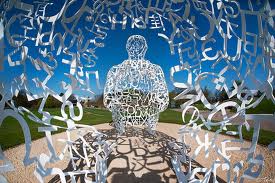
This post is an attempt at exploring and hopefully explicating (at least a little) a dialogue that began in a series of comments between the excellent thinker/writer Tocksin and myself. The comment thread can be read in full here (if you wish), but I will highlight two sections for purposes of this post:
At which point I made some bumbling effort toward it, seemingly tangling into more confusion. And was set thinking – how would I verbalize what I mean by the wrestling that using language is? The next two (or more) posts will be my preliminary attempt to language into it.
I interpreted Tocksin’s first message (above) to concern our propensity as writers to be unable to “leave ourselves out of it” (e.g. to let plot and characters, narrative and action be), rather than to voice-in, reflect, trouble and scrutinize our place in the mix of it, the ourness in the howness of any languagings aboutness. “Tooth and nail we will fight to have our day. Write we must.”
All of this started rattling about in my old noggin with what darts around in there from Wittgenstein, William James, Gertrude Stein, Bakhtin, M.A.K. Halliday, J.R. Firth, Benjamin Whorf, C.S. Peirce, Edward Sapir, Peter Berger, and thousands of other voices and ideas regarding LANGUAGE, THOUGHT, BEING, PERCEPTION, etc…
As far as I can tell, these relations have concerned humans since humans have experienced concern. Who are we? What are we? How are we? When are we? even from time to time expeditioning toward Why?

A few posts ago I quoted Judith Butler from her Excitable Speech to the tune of:
Much greater minds than mine have attempted to tackle this – in language, with language, to language, as well as in painting and music, film and image and architecture and dance: Who are we? What are we? How are we? When? What is? Happening? Basic problems of being as faced by our particular type of organism’s means of awareness: senses, perceptive apparatus, and largish brain – all inputting and outputting, inter- intra- extra- extro-putting simultaneously.
Due to our conditions, one of the stickiest problems seems insurmountable – the ability to experience (consciously) BEING. Or NOW. The Present. IS-ness.
In our splendiferous operations of surviving/existing, the mechanisms and processes of doing so (predictive, inductive, deductive, collaborative, receptive, perceptive, oscillatory, responsive, reactive, self-generated, externally infringed, incited, and so on – AMAZING processes!) TAKE TIME, if only nanoseconds…all to say that our perception and/or sensation of being and existing NECESSARILY are not simultaneous to its occurrence, and yet also ARE, because the organizing and perceiving of our activity also constitutes our experiences AS they occur.
This is one of the reasons William James insists on the metaphor of “stream” for our being.
Here he writes on introspection (self-reflection, becoming conscious of consciousness, or perceiving perception – what language and symbols, signs allow, enable, concoct):

And is also experience, experience becoming.
As I am considering language, that is – assigning description, value, reality using symbol/sign/or index to something in human experiences – I am presenting a coming-to-terms (languaging) for myself of what I attempted (languaging) to “mean” (communicate, share, RELATE) in my off-handed comment to Tocksin regarding “wrestling with everything inhabiting our medium,” as well as an hypothesis that has been haunting me since.
“Wrestling with our medium/habitat – language” means for me in this way: As I conceive (language) the being or existence of the human organism, I interpret an organism of proactive and retroactive complex processes organizing and imputing value to its environment, selectively perceiving and constructing a context or situation in which it can get what it needs to survive. In the scheme of things (or, its organismal specificities IN RELATION TO other organisms and contexts) the human has developed metaphoric and metonymic signification capacities for purposes of more efficient and productive navigation / survival.
Language, (or humans as semiotic beings) then is a medium in the sense of a manipulator of gaps, or a “thing” insofar as it operates between, RELATIONALLY. Signs are always IN RELATION TO. Inner experience, outer experience, communication, description, definition, etc…a SHARED HABITAT, an activity, indeed a primary thinking process – signing experience is a composition, exploration, examination and organizing (improvisational and purposive) of our world and our perceptual relations within experience of it.
Signing – languaging world – is for us our activity of finding out, making sense, interpreting, composing and exploring being/existing.
So when we go with purpose to the page to write language – all of this is inherent to the medium – we make our world (as we experience it) inhabit language so that we can experience it and also we inhabit language in order to experience (perceive our perceiving, become conscious of our awareness). Language is the “stuff”(?) – the medium – the lubricant of passage between ourselves and our senses and perceptions; and everything beyond those individual sensings and perceptions. Thinking organizes and determines experience.
So self-consciously involving ourselves in language opens up all our experience (known and unknown, much like dreams) to be wrestled with in attempting to make a poem, a story, a report, or a conversation, or, even, a thought.
That is part of what I was trying to say, Tocksin. Part two will be the idea that has haunted me since…
Immediate sources referenced:
Lyn Hejinian, The Language of Inquiry. U. of California Press, 2000.
R.M. Berry & Jeffrey Di Leo, editors. Fiction’s Present:Situating Contemporary Narrative Innovation. SUNY Press, 2008.
Gyorgy Buzsaki. Rhythms of the Brain. Oxford, 2011.
Rudolfo Llinas. I of the vortex. MIT Press, 2002.
William James. Principles of Psychology. Cambridge, 1981.
The following is, again, a fairly dense essay, but I find the content so fascinating and very well presented. The concepts and observations herein form a central core of what I desire to use language to explore – signs upon signs within signs over signs – living in the specificity of our species – and attempting to discover what/where/how that specificity (namely language) might lead/take/auto-generate itself forward. If these sorts of things interest you as well, i encourage you to lend Deely’s writing your time.
(click here for essay) – Umwelt by John Deely
Student Magazine of IISER Mohali
Music, Musicology, and related Matters
a photographic pilgrimage to Orthodox Christian monasteries across the continent
Meandering Through a Literary Life
Orthodox Christianity, Culture and Religion, Making the Journey of Faith
Erik Kwakkel blogging about medieval manuscripts
"That's the big what happened."
Networking the complexity community since 1999
 All my Words are Silent