Awarding Influence

1. award, n. c1386

…A decision after examination, a judicial sentence, esp. that of an arbitrator or umpire; the document embodying it….

2. award, v.1 c1386

…To examine a matter and adjudicate upon its merits; to decide, determine, after consideration or deliberation. 

1. influence, n. c1374

The action or fact of flowing in; inflowing, inflow, influx: said of the action of water and other fluids, and of immaterial things conceived of as flowing in. Also concr. flowing matter. 

2. influence, v. 1658

trans. To exert influence upon, to affect by influence….

Etymology:  < French influence (13th cent. in Hatzfeld & Darmesteter) emanation from the stars (also inflow of water; affluence)…

(Oxford English Dictionary)

most-influential-blogger-e1364230844577

In the first place, I thank you Madeline Scribes for honoring me with this blogging award – I would think that any blogger is happy to hear that they have influence somewhere, somehow.  As concerns its meaning – its effect in ongoing flow – I am thinking that our passing these awards along through the blogosphere is an aspect of recognizing that the world around us matters that what we encounter continuously throughout our days effects the flow of them.  To award such influence must mean that, upon consideration, deliberation, we consider that influence to be of benefit or merit to the flow of our lives.  To diminish the function and roles of these eminently reusable and transferable images by querying the authority, justification, compensation or some other arbitrary criteria of significance or import seems to me to miss the point and ideologically dismiss their networked purposes and potentials.  I am very honored and very thankful for the effort and gift of recognition and assessment.

That being said – all of these awards (as with any gift) bring responsibilities…This particular badge indicates:

Award Rules

THE QUESTIONS:

1.  What makes you happiest?

developing attachment with my wife and children; inquiring and creating new knowledge.

2.  Do you love mountains or oceans more?

mountains

3.  What has been a special moment in 2013?

reading has provided millions of them

4.  What is your favorite quote?

Today?: “I love quotations because it is a joy to find thoughts one might have, beautifully expressed with much authority by someone recognized wiser than oneself.”
― Marlene Dietrich

5.  Do you like yourself?

sometimes

6.  Do you stay up until midnight on New Years’ Eve?

rarely

7.  Is there something you wish could be done ASAP?

global peace and cooperation

8.  What is/was your favorite class in school?

philosophy/social science courses 

9.  What musical instruments do you / have you try/tried to play?

piano, saxophone, organ, drums, trumpet, harmonica, guitar, voice

10.  Anything you wished you would have learned earlier?

the world’s complexity and the constancy of change

11.  Do you like to do crafts, drawing or painting?

the effort extends and challenges me uniquely

And, given the reflective caveat above (that ALL we encounter influences us), I pass the award along to these fellow bloggers –

Life in Relation to Art

Multisense Realism

draw and shoot

AGENT SWARM

Unwanted Advice

Simon H. Lilly

midnighttheblues

ineedartandcoffee

tocksin

searching to see


The Perfect Sense of Embodiment

I have recently had the good fortune of correspondence with a tremendous thinker of whose work I have greatly admired and utilized continuously.  At some point he queried me as to my central concern or research interest which I pondered over a number of days.  About a year ago I recognized that filtering through all of my curiosities and fascinations (passionate inquiries) – in the end they were all about ways that meaning might be made for humans.  Thus I figured semiosis or semiotics was my central field of concern.  How we forge meaning in our surrounds.  As I’ve pursued library and information science I have attuned to the eagerness with which we as a species produce, hoard and waste information.  We’ve produced veritable clouds of data/information/knowledge and now it seems as if we swoon and drown in it.  For meaning, this cosmos of affordances must be utilized, integrated, incorporated.  As technologies explode and become increasingly symbiotic or synergistic with our own bodies and purposes, I have found that my responsive concern is one of remembering that the nexus or filament-combining locus for humans is the body.  No meaning can be had without the physical processes on which our being relies.  Every think I can think rests on the chemistry and material flows that comprise my organism.  It seems that even while we seek to develop intelligent robots and machines, ubiquitous data-recording and instinct-responsive computing, work with data sets increasingly monumental and robust, that a strong percentage of the human populace has the idea that the stigmergy and emergence of virtual social realities construct meaning, promise, potentiality.  I am not denying the fascinating quality of our rhizomic replications of our actual interconnectedness, overlap and interdependent influence, but I am committed to the fact that meaning only arises as relations are incorporated.  The translation and transformation of continuous relational events whether electronic and virtual or face-to-face and co-present into MEANING only occurs organismically, physically, presently in the knotting of convergences through our embodied existence.  Emotion, sensation, cognition, movement all ALWAYS play a part in the construction of meaning.  These are my thinkings/feelings.

In keeping with that, serendipitously my wife and I happened to view “The Perfect Sense” – a movie pursued to listen to Max Richter‘s incredible soundtrack in action – but resulting in a sort of visual commentary on my above thoughts.  We recommend it!  And would love to hear what you think!

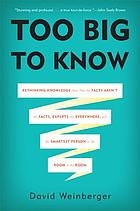
Too Big to Know (Essential Readings in the Philosophy of LIS)

I’m currently reading Too Big To Know by David Weinberger and quite intrigued by his observations – Lane’s account is a cogent analysis of why.


Lane Wilkinson's avatarSense & Reference

If David Weinberger is to be believed, the Internet hasn’t just changed how we access information, it has altered the very meaning of ‘knowledge’. In a recent interview with The Atlantic, Weinberger claims that “for the coming generation, knowing looks less like capturing truths in books than engaging in never-settled networks of discussion and argument.” Supposedly, the networked, collaborative, and social nature of the Internet has changed our very understanding of knowledge to the point that knowledge is no longer tied to concepts of truth, objectivity, or certainty. Instead, as Weinberger argues in his recent book, Too Big to Know, “knowledge is a property of the network” (p. xiii). That is, the Internet has profoundly changed what it means to be a fact, to be true, or to be known. This book has been making the rounds among librarians, so I thought it might be a good idea…

View original post 1,765 more words

Thinking Literac(ies)

Literacy“Ultimately we find that the cognitive consequences are more about the new meaning systems and activities that occupy our minds than they are just about the character of work with symbols…”

“Whether one form of inscription is more efficient or more easily learned than another (the asserted alphabetic advantage) may be less consequential in its cognitive consequences than if a society has developed a large bureaucracy, literary culture, philosophic tradition, technology, commerce, and educational system using whatever form(s) of inscription it has historically developed”

“The world we know, think about, and act within is saturated by and structured on the texts that travel from place to place and have some durability over the years.  The built symbolic world on which we have elaborated new social meanings and relationships and that is the object of our thought and attention as we try to live our lives as successfully as we can within it, in that we find the consequences of literacy.”

“literacy is part of the stuff out of which a way of life is made”

-Charles Bazerman, Social Implications of Writing-

Person-al Interference

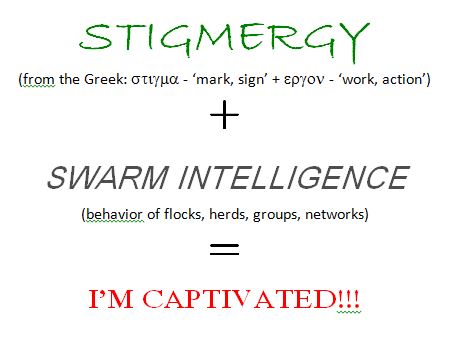
Stigmergy - Swarm


more on stigmergy here

swarm intelligence here

Intriguing Thoughts

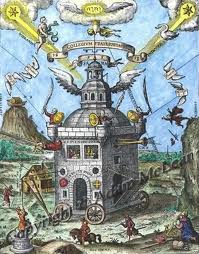
invisible college

Invisible College – Clay Shirky

What Follows

As I mentioned in yesterday’s post, the notebook I grabbed in case of moments of free creative scribbling contained prior forgotten reflections that carried me into further reflections…recorded below:

journalingThe wonderful thing…

The wonderful thing about writing…

The wonderful thing about writing is that you can always begin.  You always face opportunity.  BEGIN.

In addition to that…”in other words”…

In other words, you can always start over.

Begin.  Start over.  Begin.  Start over.

It’s a wonderful thing.

Language.  like moving your body, there’s a kind of body to inhabit.  A world.  A way of being.  You wake.  You move.  You remember…by dis-membering.

In other words.

You sleep.  As you cease to sleep, you remember.  You remember by feeling your limbs, your breath, by seeing, by feeling things (Dismembering).  As you dismember (stuffy nose, neck-ache, coffee smell, pain behind the eyes, the need to potty, and so on…) – you also re-member (stitch together, sew, seam, canvas, invent) and become (again).  Writing is like this.

Language.  A body dismembered – waiting for membering (memory, membership) – invention, use.  Beginning.  Again.

In other words, like organs instructured in-skinned, awaiting awareness, the fabric of socio-cultural symbology (languaging) lies:  in wait:  to be animated, enlivened, embodied:  woke up.

The substance, the atoms and organs – await.  Circulation, enervation, emergence – to live – animate –

to be possible

And become.

In other words, to create, to move, to motivate.

There is no such thing as starting from scratch.

But a scratch is a beginning.

In our bodies, within matter,

in the world – moving gauze, filling quilts,

sensing flesh, donning clothes, filling whispers…

I’m alive.  I begin.

The wonderful thing about writing…

…to awake into a way of being.

IMG_6607p.s… i’m thinking that each begin includes a hope to mean

Surround

recent posts and discussions with brilliant co-bloggers (e.g. multi-sense realismAnacephalaeosis, unwanted advice, tocksin and others) have reminded me how woven, interactive and co-constructed we are with our environment… which sounds something like this (the awareness and attention and presence of it) to me:

A Kind of Credo : Intertextuality : “Art is Difficult” : Manifesto?

“perhaps our arrival at interpretive conclusions participates in that process and affirms the inescapability of attempting to read the world in an empowered way, even if we are always missing the point”

-Anne McConnell, Approaching Disappearance

But then there is a reality to writing – the unexpected, the making-up, emergence and invention.  I believe in it, in spite of my theories, in spite of acquired knowledge.  Something like the terms of paradox.  Little matter, much substance (not really).

For fun, let’s say (in the manner of a credo):

  •  “I believe…

that language is a socially constructed resource recursively constituting and innovating meaning potential

  • “I believe…

‘the notion of meaning potential can be characterized as a heterogeneous totality of knowledge of conventionalized patterns of normatively correct situated verbal behavior which manifests itself and emerges from social practices of a given social community’ (-Mika Lahteenmaki)

  • “We believe…

that actual meanings are emergent from meaning potentials – are jointly created – recursively and interactively dependent – in their situatedness and perspectivity, unique and irreducible

  • “We believe…

‘reality works in overt mystery’ (-Macedonio Fernandez, via JL Borges)

  • “We believe…

that to live ‘is to make all these repetitions coexist in a space in which difference is distributed’ (-Gilles Deleuze)

  • “We believe…

that living occurs via the ‘conservation of autopoiesis and the conservation of adaptation – a constant and mutual structural coupling of continuous transformations betwixt organisms and environments (envorganisms)’ (-Humberto Maturana, Francisco Varela, Paul Kockelman)

  • “We believe…

in complexity and meaning, difference and repetition, redundancy and novelty, structures and contingencies, openness and change

Measures of reality (situated and perspectival…partial and relative to) – our As-if-oscope and Toxic spoon-deep.  A hurly-burly and chaotic entanglementintertwingled – adjoined in movements (writing of writing) to use an outdated metaphor:  textuality and trace.

  • “We could believe…

that ‘texts record the meanings we make: in words, pictures and deeds…shaping and shaped by our social relationships, politically, as individuals as members of social groups’ (-Jay Lemke)

That no effect is not mutual, recursive, intermingled and intertwined.  Life is ambient, writing of writing.

In other words.

  • “We believe…

that ‘Art is difficult’ (-Viktor Shklovsky) and meanings dialogic/multilogic / multimodal/multivalent (-Mikhail Bakhtin, Gunther Kress, Bruno Latour, semiosis)

Empiricism regarding ourselves is impossible (the situation and perspective necessary are not available) so we rely.  i.e. we need one another and beyond.  Envorganisms, we.  We believe (we could say.  I might).

“When we leave each other, we leave.”

Henrik Nordbrandt

A text composed is intertexuality – an Irish monk illuminating a copy; a modern blogger mashing-up – bricolage, meaning – I write, WITH.

To say I instantiate a social practice.  It becomes.

Thank you.  And welcome.

-a glyph is a hunt for optimism-

Slideshow of works cited:

This slideshow requires JavaScript.


A Real-ization?

A Real-ization(?)

“…And here begins my despair as a writer”

Jorge Luis Borges, “The Aleph


I should say, “began.”  And not “as a writer,” per se, or even primarily, no, I should more accurately portray the experience “…and so began, and ever continues to begin, my despair as a human.”

For experiences, no matter where or when, in full matter of where and when, are multitude that begin such despair.  They are occurrences of a process we call variously “knowing,” “comprehending,” “understanding” – encounters with unlimited and unnecessary contents we might describe as “revelatory,” “visionary,” or “true.”  We describe their feeling and fumble with content.

For they seem to circumscribe an everything – as contained and opening out – well-metaphored by the scientifically religious Big Bang, an un-caused cause or some like.  Experiences we couch in the babbles of mystery: synchronicity, omniscience, omnivorous, omnipotent and omnipresent.  We feel them like an orb or spiral, a series of looping waves without succession.

A.k.a “convergence,” simultaneity and emergence coming together at now and here.

I write “as a human” because I cannot be anything else.  And a human, as a living being, is characterized by limitations and potentials.  Although kinds of things never exhaust their potentials (as far as we know) – thereby always altering what might constitute affordances and constraints lists – nevertheless, in order to be unique (or anything at all – “what –so-ever”) humans must be limited, those limitations providing the very contexts for exploring potentials and potency.

One such environment or niche is the operation of our living processes in space and through time.  I.e. a simultaneous occurrence of everything cannot be processed, cannot be shared, as such.  It must needs be dissected and dismembered via many spaces and over time in order to be perceived by such an animal as we – re-membered and imaged-in (imagined) according to our nature (our processes and practices in our environments).

This is why moments we might re(in)fer to as “transcendent” or “wholistic” perhaps “encapsulating” or “converging” – compressing and expanding (synonymously) some happening that seems “total” generate despair for our kind or species.

I am unable to deny what comes to experience, but with labels and descriptions (interpretation) must take care.  One often turns to symbols or metaphors: icons that serve to absorb a variegated but comprehensible share of human experiences.  Accrued via descriptions and depictions over time, these symbols resonate and traverse times and boundaries in order to gather experiences of a kind.  Take for example the term “hunger,” or a drawing of an eye.  Mirrors, or a resolving I-IV-V progression.  These activities of reference and participation, renewal and recognition, present and re-present for us experiences that seem to extend or equal (again, synonymously) us.

Despair comes in the desired specificity each individual of the species wishes to convey (form of convergence – communicate meaning for our kind can be spotted by our use of the prefix co-).  That experience (in itself necessarily co-), in order to have meaning(humanly speaking) must be shared – we find that telling/singing/dancing/painting/acting/writing/ filming/making/working/sculpting/creating/crafting or any combination of them all and the human-specific processes this entails are unable to re-present such “totalizing” experiences, except at certain angles, perspectives, fragments, over time.

Yet, were it otherwise, we would have no need of any of our abilities – for we would know.  The relations, practices, potentials and processes depend on this inability (limitation) to be.  For us to be, as humans, what and whom, where and when, we are.

Unity would undo this.  In fact, we have no evidence that ANY living entity “shares alike” – reciprocates perfect understanding or replication (or reproduction, ex-ist-ing) exactly…down beyond our cells…there is difference, mis-matching, variation.  In fact, all the co-operations that provide con-vergence and co-mmunity, me-and-ing (meaning) depend on the disjunctions we strive to come over or through in order to express, be understood, known, “as one.”

So, though never “of the same mind,” perspective, or feeling, even when we experience me-and-ing together (gathered) – – this is also how we are.

Perhaps then, less despair than real-ization?