

So, I followed Flickr Comments “amusing” journey into being “typealyzed” by algorithms,
and here were my results (thank you, Flickr for the prompt)

pretty much guilty as processed!
and yet….


So, I followed Flickr Comments “amusing” journey into being “typealyzed” by algorithms,
and here were my results (thank you, Flickr for the prompt)
pretty much guilty as processed!
and yet….
“we fill pre-existing forms and when we fill them we change them and are changed”
-Frank Bidart-
Refractions on Fiction
Reflecting on fiction as representation, as presentation, as inquiry, investigation.
About how little I care – re: ideas – the freedom of impersonal investment – when a piece is duly fictional.
After the days spent composing Signs of Love I’ve only thought of how I haven’t thought of it since it was posted. Johnson’s theory of perception, the professor’s thoughts and ideas, Monte or Margaret, Frank or Lars – how they none of them reflect on me. How I didn’t have to worry how they came across or sounded, what positions or actions they became – what they represented – it wasn’t me! Who does battle with a shadow?
So often, the stringy stream of conception-reflection-creation-manifestation seems to pull heavy parts of the self along with it. Dark or slimy residue. As if a reader who took issue, questioned or challenged a something that I wrote or language I expressed as fiction were in fact addressing some aspect of ME – rather than an open work of invented text. Suppose, for instance, my wife reads a piece and follows it up with “so you’re saying that life is more difficult because of me?!” or a random visitor commented “how could you think or say this?!” When in fact, of course, I didn’t – Lorraine did, or the professor or husband, writer or sand crab or whomever the character that acted or expressed it did. Ask them then? Another way of saying – “ask yourself.” That’s what I as a writer continually have to do. Language comes out, forms an idea, or a behavior is described and I have to wonder at it – is that indeed what the voicing thinks or wants or does?
Like a painter with their lines and colors, textures and strokes: what belongs once something has been marked there?
The freedoms of fiction spread as I recognized the therapy-like patience and reflection I provide to characters and voices – to language – in texts (fiction or non-fiction). I do not feel threatened by them, do not take them personally, neither when I read nor write them. They are other – other matter, other contexts, other contents, other kind from me. I am busy handling matter…piecing it together, painting over, scraping away, diluting, splattering, letting it run…open to what “feels” or “sounds” right given the matter at hand – content, tools and resources. Strenuously engaged, passionately even (at times), and also separate, observant, addressed as much by the work as it forms as addressing it onto the page.
Which got me to thinking – how much kinder might I be, even towards my “self” were I to engage what creates me as “other”? We’re an oddly organized confabulation of matter and energy, after all, multiple diverse systems coordinate and constitutive, creative and adaptive toward a sort of dynamic organismic “whole.” My brain no more a “me” than my penis or big toe. How often with sharp pain in my knee or some zany daydream, a nail needing trimmed or hair left in a brush, do I question, challenge or take issue with a personal self for such systemic occurrence? I participate with, or have (am characterized by) knees and eyes and organs, but they do not equal me.
What if some kind of “I” (collective of natural dynamic and organic systems) listened to, read, inquired and engaged the contents, emotions, concepts, actions and instincts that occurred within as fictions engaged – as benign or indeterminate others – akin to characters or words in a story or play – organized matter with energy – rather than some sort of judgmental scrutiny so often readily applied to “Me”?
The “I,” the “me,” the “self,” the “brain,” the “calf,” the organs, veins, chemicals, liquids, cords and tendons, bones and tissues, the individual cells of me – all inter-relational organisms in themselves involved in a system I experience as “me.” With recognition, suspended disbelief, detachment, passion and care granted as I offer my own and others manifest creations in language or image, movement or sound?
Attend to your cells and systems as characters and languages today – manifestations of being – not entirely your”self” – welcome all the others inside as well.
-Nelson Goodman-
 Our Similarities are Different, our Differences so very Alike
I tell him he’s gotta grant she’s pretty much the same as the last one – skin all over, shoulder-length hair, fingernails and eyeballs. Her insides must resemble too – veins and nerves, capillaries and molecules, organs and structural bones. Her life can’t be that much different – born of a woman spent with a man, fluctuating assemblage of persons and animals, a fair share of good times and bad, events and arrangements all occurring in particular times at particular places. Spoken to and speaking, looked at and looking, heard and hearing, nurtured and natured. Surely a sign for something. A sign for herself.
“But she’s so god-damned different man!” he says. “One in 7+billion! ‘Like’ no other creature I’ve known! Her thoughts are anomalous. She sentences words her-uniquely, her habits, nuances, quirks. I tell you there’s no one else ‘like’ her!” he insists.
I point out that there are great similarities to her differences – we all of us with particularized habits, specified modes of talk, no two bones alike and what have you – but they’re bones, flesh and language all the same. She falls within the mean – income and weight, literacy, height, okay.
“But there’re so many differences in those similarities, you dig?” he whines. “It’s like everybody’s riffing and she’s got my groove!”
And Johnson has a theory of perspective. “TOP” he calls it. He’ll listen to you gloat or bemoan and respond with his “that’s the TOPs!” as if he’s settled the foundations. I try to get at what he means.
The undergrads recently requested that I speak to them of love, and I told them all this story (it conveniently being Valentine’s Day). I read through the roll call, through Margaret, Mary, Toby and Frank. Through Matilde and Jason and Luzanne and Lars. Some fat, some skinny, but most in-between, each exhibiting some marker – for instance, their names. We need those tags to tell us apart, do we not? We’re all so darn much the same. Autopsies, biopsies, EKGs, X-rays and cardiograms – most of our differences are ever so slight. Some flesh here, hair here or not, coloring, dialect, language, inches either way. However, what we notice – are attracted to or struck by, occasionally enthralled or repelled by – in other words, whatever catches your attention – will lie in those mini-borders of difference.
We’re programmed that way, it’s a survival skill bred in the chemicals – be aware of the unexpected, the variant, the things that are unique – sights, shapes, sounds or energy – locate, isolate, focus – survive it. Use your limited energy and resources for that – ignore the enormous other.
So every time you’re swept by lust or fall in love – there really IS a difference to that bloke or blonde – IN that gendered entity – you’ve perceived it. Now comes the process of fitting it to YOUR life. Your self, habits, knowledge and activities, groups and quirks and ways. “Normalizing” – becoming “intimate” with those astounding specificities – familiar.
Accommodate, adapt, survive.
By now you’re holding hands or marrying. Waking up next to. Joining your bodies and your mealtimes, work and pleasure, daily rounds – and it turns out your partner’s much the same as all the rest (without losing any of their uniquenesses you first attuned to – in fact at this point you’ve uncovered many many more – including a surprising set of facets regarding yourself) – fitting and squeezing and torqueing them into their “signs,” incorporating it all into your own.
They fight, they cry, they talk and fear. They’re selfish and sweet, funny and sour. Relatively weak and strong, smart and dumb, kind and cruel. What did you expect?
Yet having become part of your world, seaming into your point of view, you’re never so alert to them as first you were when they were strange to you and un-experienced, unless you’re threatened or faced with change. Your energy and perception (remember, by instinct) are set to trigger differences, out-of-the-ordinary readings and measures – the defamiliar.
So although your partner’s arse is golden – or curved similarly to any other – your eyes lock elsewhere. On unknowns. Untoucheds. It’s not adventure or risk that you seek – not exactly – although your senses could be called “restless” in their fearful jitterings and scans – you’re tuned to locate difference – unconsciously filing all that registers “recognize” as same.
As if the world were a line-up and your senses are always on call at the station.
And so on.
We all know (by now) that we’re all fundamentally, formally, the same. We’re of genus and species and kind. A school of fish, a hoard of bees. Excited by difference (spelled “possible danger”) and presumptive of same (spelled “familiar”).
“What’s love got to do with it?” a spritely student asks.
What “love” has to do with it is to shape perception intentionally. To recognize and remember the vastness of similarity (choosing to ignore many limbic cries over slight variations – the unreasonable feelings of attraction, shazaam, lust and novelty) and cultivating attention to the differences of the familiar. The creative work of defamiliarization.
A cloud is a cloud is fine droplets of liquids and gas, pressures and waves, particles in patterns and puzzles and billions of babbling atoms…OR…sketchy shapes of oceans, mountains, camel-backs or breasts. A cloud. If you dissect your partner’s thumb or knee, spine or brain, or even examine an eyelash or bead of sweat close enough – you’ll enter world upon world of mystery and minute difference…similar to everyone else. They’re individual entity’s shaped roughly like gorillas or aliens with less hair. Or angels. But they don’t think, walk, breathe, sleep, talk, dream, feel, sweat, laugh, stumble, fear, mimic, grieve, complain, remember, hope or anything else “like” ANY OTHER human in the world, not now, not past, not future. Tune to that – you’ll never ever exhaust it – as you’ll never come to the end of yourself.
“Love” or “attachment,” “personal relations” or whatever we refer to it by – orients and trains our perception through attention (intentional perception). Keeping in mind and check the reality of mass similarities (with all their exhilarating differences) and fixing determinedly on the magnitudes of distinctive, unrepeatable, specifics and uniquities of this one chosen familiar.
Anyway, that’s a version of Johnson’s TOP: “it all depends on how you’re looking at it.”
The WHYs of them:
“semiotics is not about the ‘real’ world at all, but about complementary or alternative actual models of it… an infinite number of anthropologically conceivable possible worlds. Thus semiotics never reveals what the world is, but circumscribes what we can know about it; in other words, what a semiotic model depicts is not ‘reality’ as such, but nature as unveiled by our method of questioning. It is the interplay between ‘the book of nature’ and its human decipherer that is at issue.”
-Thomas Sebeok-
“the forms and laws in our worlds do not lie ready-made to be discovered but are imposed by world-versions we contrive – in the sciences, the arts, perception, and everyday practice. How the earth moves, whether a world is composed of particles or waves of phenomena, are matters determined not by passive observation but by painstaking fabrication…Constable urged that painting is a science, and I suggest that science is a humanity.”
-Nelson Goodman-
“a mobile unsteady structure…with all the bits always moving about, fitting together in different ways, adding new bits to themselves with flourishes of adornment as though consulting a mirror, giving the whole arrangement something like the unpredictability and unreliability of living flesh…The endeavor is not, as is sometimes thought, a way of building a solid, indestructible body of immutable truth, fact laid precisely upon fact…Science is not like this at all.”
-Lewis Thomas-
“Perhaps the best way to think about post-modern self-referentiality is not as a denial of language and literature’s connection to the world but as their self-consciously pointing to themselves trying to point to the world.”
-Robert McLaughlin-

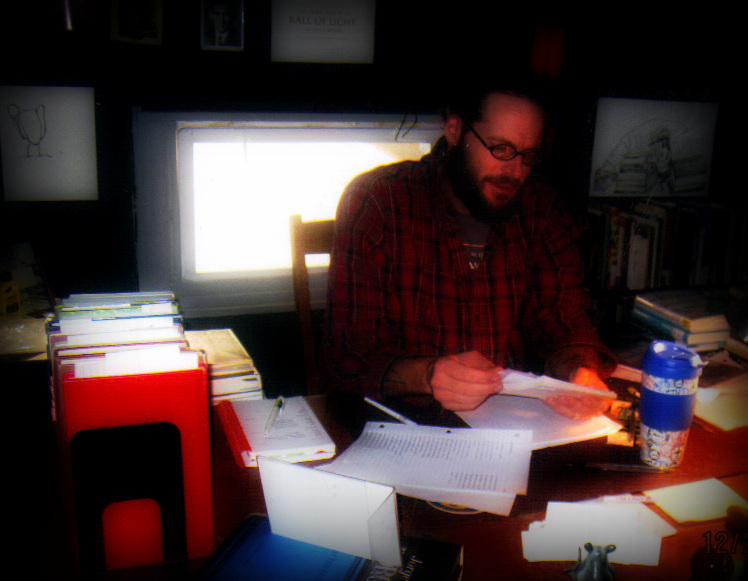
“Was there ever a period when my words weren’t already headed?”
-R.M. Berry-
the Superstitious Naked Ape had the great idea of each of you offering a photo of your workspaces – see comment below – would be intriguing – feel free to provide
I have to say I have strong urges to insist that no one’s gone farther…yet

“We are all born mad. Some remain so.”
“All of old. Nothing else ever. Ever tried. Ever failed. No matter. Try again. Fail again. Fail better.”
from Worstward Ho
“You’re on Earth. There’s no cure for that.”
“The tears of the world are a constant quantity. For each one who begins to weep somewhere else another stops. The same is true of the laugh.”
from Waiting for Godot
“Dance first. Think later. It’s the natural order.”
“Try again. Fail again. Fail better.”
“The end is in the beginning and yet you go on.”
from Endgame
“Normally I didn’t see a great deal. I didn’t hear a great deal either. I didn’t pay attention. Strictly speaking I wasn’t there. Strictly speaking I believe I’ve never been anywhere.”
“I always thought old age would be a writer’s best chance. Whenever I read the late work of Goethe or W. B. Yeats I…
View original post 205 more words
Notes on Fiction and Philosophy
(complete text linked)
Brian Evenson
I thickly recommend you print and mark up the entire essay, but to tantalize your imaginative mental taste buds, here’s a representative nuggety excerpt:
“Good fiction, I would argue, always poses problems – ethical, linguistic, epistemological, ontological – and writers and readers, I believe, should be willing to draw on everything around them to pose tentative answers to those problems and, by way of them, pose problems of their own. For innovative writers, I believe, philosophy is always best an errant affair, a personal and intense wandering, a series of tools that one can employ, move beyond, come back to; it is our ability as writers to stay curious, to borrow, to bricoler, and to adapt and move on that keeps us from becoming stale.”
a blast to read

10. According to Heisenberg’s Uncertainty Principle, the inability to simultaneously predict your and your lover’s locations and velocities means that, whether still or moving, spicing up the relationship is already implicit in the universe.
9. Spreading out like a wave comes in handy during lapses in judgement, because it allows you to consider or “try out” all the options at hand before compacting into a particle when it’s time to take responsibility for your actions.
8. Because you can only predict probabilities at the quantum mechanical realm of atomic and subatomic particles, you can never really win, no matter the argument.
7. There are minor temperature variations across the sky and as far back in spacetime as when it was cold enough for atoms to fire up their nuclei. These variations are leftovers from the formation of planets and galaxies billions of years ago. Analogously, that thing you did in…
View original post 415 more words
If you click on this cover you will open a brief essay regarding fiction, presently. I find it interesting, challenging, and compact. If you have an interest in writing as discovery, as research, as emergence, as investigation and creativity, I encourage you to read it…
Student Magazine of IISER Mohali
Music, Musicology, and related Matters
a photographic pilgrimage to Orthodox Christian monasteries across the continent
Meandering Through a Literary Life
Orthodox Christianity, Culture and Religion, Making the Journey of Faith
Erik Kwakkel blogging about medieval manuscripts
"That's the big what happened."
Networking the complexity community since 1999


 All my Words are Silent