
Home.
Category: Writing
Inscribing a Now
Inscribing a Now
Today I just feel like writing. I don’t have anything in particular to say, no specific emotion I am needing to express (that I know; or am aware of), simply a kind of quiet delight in our capacity to make language. To fit words together, to knit our lives, to be.
Enormously unusual (I cannot stress that enough!) it is around 50 degrees and solidly overcast in Kansas this June 1st. Not humid even, but sprinkling now and again, the kind of precipitation you could enter and be refreshed, but a long time in getting wet. As if the sky is asking us to take it easy, to relax, be reprieved, just enjoy.
My children are reading and practicing stringed instruments; my wife is making sounds that are delicious as she struggles with a painting; my room is dark. These are moments of peace, are unexpected, a relief, a protection, a comforted grief.
Language is a beautiful necessity, unnecessarily. Like bodies and voices, flowers and food. Like mountains. Oh, necessity can be argued for each, but what’s the point? The world is, and that’s enough, that’s what’s important. It seems. And what a hinge-word! It means we’ll never know, and that’s not the point. Is must be different from certainty.
Perhaps I’m engaging a kingdom of “trust”?
An as-if-ness that isn’t afraid?
How little I know.
So the ambling to no purpose again. “Angling” is how I heard it in my mind. Seems it must be so. To language in leisure must be near to the impulse of finding to-do for a bored adolescent. Dropping a line. Seeing what bites. Or even just nibbles.
Sprinkling rain. Haphazard, unpatternable, occasions. Delight.
No expectation, desire (that’s pressing). Just a wandering way.
It evokes a wishing-well torso for me. So many words in the world used in anxiety, in need. So much language and gesture, expression and sign, mobilized to “get” or “secure;” “ensure” or “relieve.”
Not that, not right now, not need. Just rest, an in-pleasuring, a reprieve. Just an hello or a thanks. A “notice that?” or an “indeed.” An agreement of person and term, an almost “natural” weave.
Sounds and sense, tones and rhythms, raindrops tickling shingles and birds. Tires whispering snare-drum waters, puddles triangle-tinkling away.
Hello. These are words. It feels good to shape them – a cursive-recursive flow. To be real (enough), here (enough), to know (enough) to inscribe. What a pleasure, a leisure, a joy.
Thank you, world, for that hour.
Content’s Dream
“The essential aspect of writing centered on its language is its possibilities for relationship, viz, it is the body of ‘us’ness, in which we are, the ground of our commonness,
Language is commonness in being, through which we see & make sense of & value. Its exploration is the exploration of the human common ground. The move from purely descriptive, outward directive, writing toward writing centered on it wordness, its physicality, its haecceity (thisness) is, in its impulse, an investigation of human self-sameness, of the place of our connection: in the world, in the word, in ourselves.”
-Charles Bernstein-
Passing Thoughts
Passing Thoughts
“People don’t always understand what they see…it’s always better with a few verses”
-Henri Rousseau-
“I don’t understand it. The injustice of it, the random, unpatternable thing life is, feels like guilt, at first, and then matures (thought the verb is obscene in the context) into sorrow.”
-Larry Levis-
I often feel something that must be near sorrow when I pretend for a moment that I am able to reflect or observe my own life.
Usually this occurs a few minutes after everyone that inhabits the home in which I live have tottered off to their beds or their dreams or wherever it is that they go when they’re alone. I pour myself a cup of coffee, take on cigarette out of its case, and swing gently on the porch in the night’s dark.
At first, I simply listen. For the trees, the breeze, my breath. Then I let my eyes gaze. Neither here nor there but some middle-distance that never asks to focus. Three or four puffs in, two or three sips of day-old reheated coffee, and I begin to feel. My body reports its day. How long it has been awake, what muscles have been used, what nutrients processed (or wasted). I start to find emotions. Perhaps lodged in the elbows or neck, gut or temples or knees. Places they sneak off to in the day’s demands. I gain what feels like a sense of things. A “this is what you’ve enjoyed, endured, has transpired in your waking.”
And I breathe. The smoke, exhaling, tells me so. And the knowing the days that remain are smaller. And that the days that compose me stretch out. And I wonder. “I don’t understand it.” It baffles me so.
I have the impression throughout my aging frame, that so many places, engagements, and events that require all of me should not feel so dangerous, such threatening. That the places we spill for one another, on one another – where we come forth – why do we fear so deeply? and try so hard? – why don’t they give rise to elation rather than wound?
I see moments, occasions, and encounters that have scared me to my silent howls – but from here, now, look like people in love giving themselves or trying to – declaring, expressing, vulnerably opening. Why the fullness of human persons should overwhelm and frighten us so, when we are also one of them – why is this?
Why do I not feel I can hold my own in another’s anger or grief, sorrow or fear? What is so uncomfortable about difficulty and complexity and unknowns?
The haunting guilt of finitude, of insufficiency, eventually levels out toward a universe of conundrum peopled with questions, and a kind of sorrow and grace seeps in.
By now my smoke has gone out, the coffee has cooled, and it is high time I join my spouse in our final accord. The waves rise, they wash out. They rise again. There is a passing, and some passage, it is ephemeral and sure, and it goes on.
All these passing thoughts, and days.
I don’t understand what I see, but it’s usually better with a few verses…
“I have the suspicion that the meaning of things
will never be sorted out”
-Denis Johnson-
(click image for musical accompaniment to the text:
“Broken” by S. Carey)
(it’s worth listening to even if not reading all the text)
Remarking Mark…Part the Second

Mark Marking Questions
“Man is a riddle. Our complex relation to others may also be affected by our fascination with this riddle…Origin means, perhaps, question”
“Writing as the ‘talking cure’
he thought, thinking in language what he thought language might do. Be doing. To him.
He heard “why?,” a term learned early in order to learn, and thenceforward laid over nearly everything he read, encountered, overheard or stumbled across, as if it were his placeholding destiny in some infinitely progressing equation simplified “world.”
He’d read he needed other persons and things, places and times to know his own. – “Why?”
He’d heard “until others acknowledge or teach you your shape, your ideas, what you see what you feel what you taste or speak or hear, your perceptions and scope, you won’t be aware of a thing. You’ll have no ideas or sensations per se, you’re essentially Nothing without Them.”
Arching his back and shrieking a sound at an absence of breast: “why?”
“I guess I’m just punctuated that way,” he came to think, as he adapted vocabulary. “My role in a sequence is: – ?”
“And God said ‘Let there be light,’ and there was…” well, maybe – ?
“The Tao that can be named is not the eternal Tao…” well, maybe – ?
“1 + 1 = 2,” well….maybe – ?
“You are Mark, a male form of a human animal, replete with these working organs, the English language, and certain beliefs. These are your parents, your sibling, your probable friends. Here are some feelings, some expressions and thoughts. Here are your words.” Well. Maybe – ?
Shaped with letters and numbers and sounds. Voices and touchings and feels, he became, slowly, surely, puttied toward a recognizable form – perceptible to others, acknowledged, even affirmed or engaged from time to time.
“Why?” propelled the lengthening problem of life but never grew toward solutions.
He read elaborate explanations and descriptions as he borrowed more languages. Spiritual terms, medical terms, words scientific, political, philosophical and intimate. Thick reams of median symbols asking to be joined or embraced, understood or imbibed.
Mark enjoyed these fabrics, and found a belonging among them. Layers and theories, emotions and dreams – he simply need append his simple gesture – ?
Trouble, in the form of discomfort or pain, of disjunction, arose when agreement was desired. Explicitly or implicitly, this undermined his form. In situations where reciprocation or statement, some firm relation was called out for, his questioning mark failed to serve. Choices, commitments, integrities or beliefs turned to drizzle around his definitive (self-identified) symbol.
“I love you,” she wooed. “-?-“ he replied. “I cannot know what you mean, what your language portends, I am unable to verify why?” he’d respond. To collapse and retreat.
Even thoughts and decisions were questioned and split open on his sharp weapon of a mark. He was not trusted or deemed trustworthy as doubt was perceived an anomaly.
He remained uncertain.
Self-perceivably, he reliably questioned, he’d respond and then take it away with his mark, his “signature move” as it were, his undoing. “Yes I will…” “This I think…” “I am…” always followed by his -?- (which sounded like “why?” in the air) and found no rationale that could not be further put to query.
The world was unstable as well as a “self” for him. All under the branding shadow of “why?” This Mark never outgrew in all his adaptations, acquisitions, mutations and metamorphoses. His certain core of uncertainty. His permanent doubt. His oxymoronic reality of being, not-being -?-
They perceive him – they really do – but as full of content with no substance; as possible and capable yet a great risk; as veritably human but unnamed from within. Without “identity.” This is true even of his wife and his children, parents and friends, all unsure who or what they are relating to, marked with the sign of the -?- The indeterminate one, the questionable and uncertain, the duplicitous and vague, are various ways he is read and conceived – standing there as he does on his tiny spot of here, long-legged and stooped as in prayer, or inquiry – ? –
The Vision – Friday Fictioneers June 1
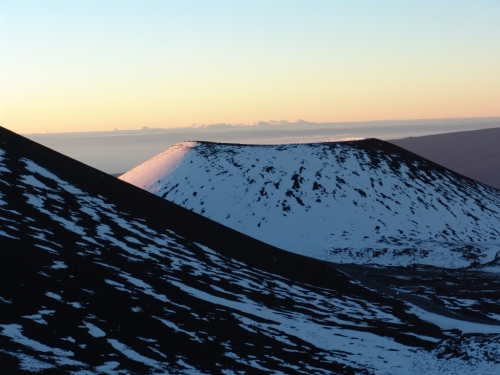
We could see what we wanted, almost taste it on our tongues. The smell of our promise with its head blown off. We’d never get there, our dreams were lodged in clouds. We stumbled to a halt to decide. Going up or going down? Together or parting our ways?
Contemplating our vision, we agreed it was beautiful. Perhaps beyond telling. It was then that it dawned: if we can’t say it to each other, we’ll never make it real.
N Filbert 2012
Friday Fictioneers, June 1, 2012
Making Senses: A short essay (perhaps poetic) of thoughts or aphorisms
my post today at Spoondeep mag : http://www.spoondeep.wordpress.com
thought it bore semblance to my workings going on here 🙂

Making Senses: A short essay of thoughts or aphorisms
In a sense, then, the world gifts us a skin, a flesh, in perceiving it.
And perhaps re-cognizing us, individual specimens, into a social situation.
In a sense, then, language expresses us. As our inner individual experience is able to fit itself into the social commerce of forms, terms, gestures, behaviors and intonations, so that “self” is able to be known, observed, engaged and interpreted or received. “Responded” to/with.
Each of our “Response – abilities,” our responsibility.
In a sense, then, our sense are middle ground clothed in mutuality – a “zone of contact with the present in all its openendedness” (Mikhail Bakhtin).
In a sense, then, here is where we meet, and that-here (“there” hypothetically) is where we continually be-come (or come-to-be).
In a sense, then, our “name” for existence – “Being” – is appropriately an action…
View original post 191 more words
Telling Our Stories
Telling Our Stories
After all, it is language, this story. This telling of you, of me, of our feelings and years, whatever we’ve done. We are just speaking, really, creating from language our world and our children, our works and our actions as if we remembered.
I can’t see the harm in it.
I say I remember, here looking at you, that first time in your eyes, whether 18 or 40, when we may have sat facing each other or entwined, as if we’d first met and must absorb everything. How large they seemed, how blue and soft as rain, how far I could swim there as if building a nest.
I don’t see the danger in using our language to say so. In making up stories, alone or together, about us; our world and our selves, what we think.
After all, it is language we share. As you bend at your work, your collar reveals a fresh sentence, your skirt a painting of terms, in your flesh all these stories I study to learn. Of your breast and your elbow and hair. The nape of your neck exclaims and your scars everywhere. What the poet said, also with words, combining verbs and adverbs and nouns: “Your body is a book of thoughts that cannot be read in its entirety.” Just words, but I keep them and sing them again, I can’t see the harm in the trying.
I love you with terms of my body. I sign them to you when it’s dark. It is language, oh yes, and you hear me. We read with our skin. Typography refers to impressions. You impress me, even as I Braille what I need. How else might we weave what is we without terms and strokes or gestures?
Only language, after all, that we borrow, I get it.
But where is the frailty in trying?
I read and I read and I read what you tell, ever growing a Talmud of comment. I notate, I argue, I vent. Then repeat. I praise and I question and soothe. You likewise make of my verbiage a stream; a spring from far peaks that dissolves to a delta. What should we call what we do? Relat-ivity? Our capacity to engage and to meet – to relate? Communication? Always co-, ever with, filling munitions and messaging, our vocation?
To say, to listen, to hearken, to spell. Here we tumble and thicken and age. Her we interpret, reply and enrage. Here we bind ourselves, it is language we keep using, keep finding, continue to tell…
“………………..Even in sleep
our bodies seek each other, your face the moon
lighting my dreams. And by day, scenes beyond
untanglement. Tell me my story, love;
how could I know it, we are such knotted things?
-Philip White, from Aubade
Heroes Ringing True
On “the writer type”:
“One can describe this type as the person in whom the irredeemable solitude of the self in the world and among people comes most forcefully to mind: as the sensitive person who is never given his due; whose emotions react more to imponderable reasons than to compelling ones; who despises people of strong character with the anxious superiority a child has over an adult who will die half a lifetime before he will; who feels even in friendship and love that breath of antipathy that keeps every being distant from others and constitutes the painful, nihilistic secret of individuality; who is even able to hate his own ideals because they appear to him not as goals but as the products of the decay of his idealism. These are only isolated and individual instances, but corresponding to all of them, or rather underlying them, is a specific attitude toward and experience of knowledge, as well as of the material world that corresponds to it.”
On the writer’s region (“nonratioid”):
“There is no better way to characterize this region than to point out that it is the area of the individual’s reactivity to the world and other individuals, the realm of values and valuations, of ethical and aesthetic relationships, the realm of the idea…in this region facts do not submit, laws are sieves, events do not repeat themselves but are infinitely variable and individual…there is in the writer’s territory from the start no end of unknowns, of equations, and of possible solutions. The task is to discover ever new solutions, connections, constellations, variables, to set up prototypes of an order of events, appealing models of how one can be human, to invent the inner person…which then nevertheless branches out somewhere into a boundless thicket, although not without somehow fulfilling its purpose…”
These quotes come from his exceptional small essay Sketch of What the Writer Knows
which I desperately wanted to reproduce here…
if it “rings true” for you – please find a mentor and friend in Robert Musil:
Signs
Signs
“We wanted love. This sentence has no meaning outside a sentence. We wanted a multitude of words. Love was to become the quarrying of ourselves, emerging from a completely different side of the narrative…Representing ourselves to ourselves was an unmanageable task from the beginning. To continue being a reality while simultaneously becoming its sign that dissembles nothing, only relentlessly elevates itself in a continuous shadow – “
-Arkadii Dragomoshchenko-
There was no doubt we wanted. What it was that we wanted, exactly, was another matter. We wanted love? Perhaps. Love made from words and signs and gestures. From the beginning we had trouble representing ourselves. Being a reality while also signifying it and being its addressee – inveigled us in a continuous loop. We needed another view. From a completely different side of the narrative.
Maybe we wanted to drink reality to its dregs. We wanted love. Someone who could read the being and its signs and comprehend its address. Someone to help interpret the loop, quarry the signs, chart and map the shadowy spiral. We wanted a multitude of words. Words we’d never thought of. Never heard before. Synonyms and antonyms to set apart our signs, that we might, perchance, see who we are. Learn, not just be. We wanted love.
Loving ourselves was clinging to continuous shadow. Ourselves always just ahead of us, being, quarrying experience, fabricating new signs, dissembling nothing. We didn’t know, anything. We wanted love and a multitude of words, of gestures – significations of action and matter – we wanted to be real.
Your side was completely different. There you were – being, assembling signs, dissembling words I thought I knew into paradoxical meanings. I’d see a sign that seemed familiar but the language was foreign, the reference obscure, of exotic materials. Where were you quarrying? I was stunned and fascinated – we could make such similar things of our surround and within – yet pointing in apparently opposite directions! How could this be?
We wanted love. I followed your signs, tried to tell you what they meant. We wanted for multitudes of words. You sought to explain, what with the being, the source, the signs and address, indicating your shadow, not mine. I, forever chasing the shade of your dress.
We wanted for love and showed each other signs. We gestured and addressed our bodies and songs, put on shows of ourselves for each other. Here are my banners and pennants. Here my consistent mottoes. Here the images we keep – representations of ourselves like lost memories. Here our directions and contents, graphics and readings. Signs, signs, and a multitude of words.
We began telling one another their stories as we read. Replete with new words, new signs and misreadings. This did not often go well. With each sign that we made we were reading the last. We couldn’t keep up, swimming in continuous shadow.
A multitude of loving and words. We believed we wanted reality. We decided to quarry together – our insides working into a shared surround. We disagreed on its representation and agreed to post personal options. We grew confused and crowded with signs and gestures. Grabbing some of these, we started swinging, thinking ours might outlast the others, might prove “right,” win out, or be “true.”
Our signs began to shatter as our words and gestures dissembled. We established picket lines and separate camps. We fashioned more signs with blazoned slogans of ourselves and our views, losing them inside our shadows. We decided to climb. Perhaps a view from afar, or you’ll be off on expedition. We located a guide. Who seemed to think all of our signs were true. We looked again and could read that we wanted for love. Our valley was riddled with signs. Our guide interpreted gestures the same. Words of pain, words of fear, a multitude of words. All quite similar but in our own languages.
We wanted love, he said.
Someone to read our beings, our signs and receive their address. Someone to help interpret our loops, quarry new signs, and map our spiraling stories. We wanted multitudes of words and we had them. Words we’d never thought of nor read. Words replete with variant meanings and references. Synonyms, antonyms distinguishing our signs, redirecting our shadows. If we listened and looked, and with care, he said, perchance we might see who we are, being. And learn how to be. If we wanted for love, we had it, he said. Just look at the signs.
 All my Words are Silent