“And our personal stories are the only moves, the only moves that help us postpone, at least for a while, the predetermined ending to our game. And even though we are going to lose the game from the strategic point of view, the idle moves of our stories always postpone the end. Even if they are stories about failure.”
2. From Li-Young Lee’s Book of My Nights
The Hammock
When I lay my head in my mother’s lap
I think how day hides the stars,
the way I lay hidden once, waiting
inside my mother’s singing to herself. And I remember
how she carried me on her back
between home and kindergarten
once each morning and once each afternoon
.
I don’t know what my mother’s thinking.
.
When my son lays his head in my lap, I wonder:
Do his father’s kisses keep his father’s worries
from becoming his? I think, Dear God, and remember
there are stars we haven’t heard from yet:
They have so far to arrive. Amen,
I think, and I feel almost comforted.
.
I’ve no idea what my child is thinking.
.
Between two unknowns, I live my life.
Between my mother’s hopes, older than I am
by coming before me, and my child’s wishes, older than I am
by outliving me. And what’s it like?
Is it a door, and good-bye on either side?
A window, and eternity on either side?
Yes, and a little singing between two great rests.
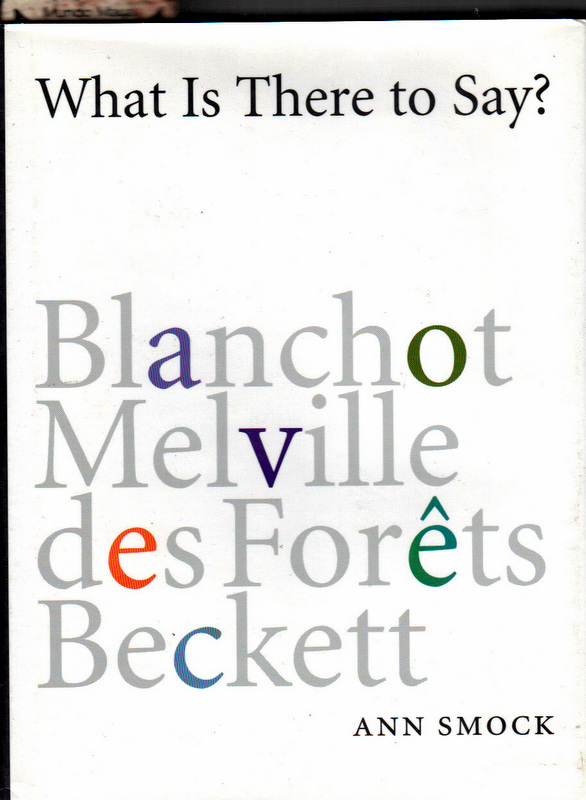
A book I am reading asks, in its title, What is there to say? Another, next to it on its anticipating shelf, states “very little…almost nothing.” Are they in conversation?
In completing Dust by Arkadii Dragomoshchenko for perhaps the ninth time, I come across a phrase I’ve starred and underlined in three colors: “We talk only because of a persistent desire to understand what is it that we are saying.”
If someone took the time to calculate how many times the word “other,” used to refer to a subjective entity, occurs in philosophical texts post-Heidegger.
What is being?
I often experience the anomalous reality of hoping wildly in the midst of despair, a fervent belief in oxymorons – things like “Poetic Influence” and “Romantic Love.”
How music crafts melancholy and joy.
Perhaps someday we will concoct a system of chaos.
The weather is large enough.
I say “I love you” because I’d like to understand it.
Edmond Jabes has it that “the words of the book were trying, in vain, to say Nothing” (writing of sacred texts) or, in other words, some persistent and extravagant Babeling into Derrida’s vast abysme of origins and effects. What is impossible. “Our persistent desire.” So Jabes asks “Is our relation to the world first of all a relation…to an expectation, a hope of world pregnant with all possible beginnings?”
I ask myself, then, what is it I have to say? The echoing answer “very little…almost nothing.” Persistent desire.
From most points of view, life is a system. Enormous and elaborate interlacing activities keep it going on. Biology, physics, religion, mathematics and logic; semiotics, psychology, aesthetics and history; chemistry and health, poetry and politics, philosophy and fame – all intricate reverberant systems of night (and possibly?!) infinite interconnections – visible and invisible, conscious and unconscious.
I feel it all the time. I’m “affected.”
Hubbub over sports, havoc of war, hullabaloo of cosmology and genetics. Tentacles of memory, omens from the past, illnesses and love. My own aches and pains. Allergies, anxiety, pleasure and joy. Tastes, values. All of/in these indecipherably interlocking worlds of living things, views, theories, events and conundrums. Words, images, feelings. Wires, energy, matter. Signals, symbols.
I feel it. I’m “affected.” Always.
All ways.
An hypothetically infinite ganglia or swarm of influences and infections — a finite and mortal middle-aged male inhabiting a very small space made of receptors, pores, nerves, cells and liquids: constantly thrumming, sloshing, snap-crackling, emoting and perceiving a cosmos of effects/affects.
This is why I keep saying: I get it, I’m totally “a/effected.”
The situation is perhaps similar to a paramecium channeling a bolt of lightning. Most likely the little sucker survives in some fashion – but what the – ?
How do we manage?
No wonder we blitz out, dull, “veg,” “pass out,” sleep. Drugs, fantastical entertainments, thrills, spills and crack-ups…anything to direct/divert the universe-sized charges incessantly overwhelming us.
Something struck me today. In our growing history of surviving, perhaps even thriving, how have humans as a species often overcome overwhelming difficulties? Well sure, all of the ways mentioned above: escape, denial, “tuning out,” apathy, ignorance, fantasy, insanity or violence, danger and so on, but when we are perceived (perceive ourselves) to “advance” “progress” or “grow” – what is the method? (When we can interpret one apart from “accident” or “effect”?)
Have we not repeatedly immersed ourselves in our reality (“the way things are”) and used them to our benefit rather than detriment? Technology, science, arts and beliefs – the seeking of the facts, turning them to our interests or needs, finding fulfillment and challenge – furtherance – survival.
What snapped in me today (I’ve had years of “managing” my “e/affectedness” thorugh alcohol, isolation or the dependence of my children) is this: if our inquiries and theories by and large agree/propose that “life” is one phenomenal, inescapable and gargantuan set of layered and inter/intra-relational systems, then “relating/relationships,” their process(es) and effects are precisely where the work, the living, the surviving (perhaps thriving) emphases ought to be engaged.
That balancing, recharging, nourishing, coping, diversion and awareness might be best figured out right where it happens – in systems of relationships. That where we are “affected” and what “effected” by is precisely where our greatest opportunity to “effect” must be. Our process of relating, our relationships with/in the cosmos of possibilities, is our living. What we know or think seems to tell us – our attention, our “solutions,” our being belongs there: in relationship.
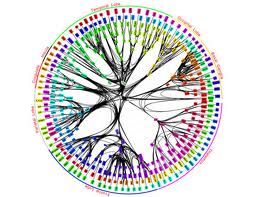
EnergyLinguistic diagram
Thank you Holly (my wife), Scott (my dearest friend), children (all of you, my charges) – and others – you truly regulate me in this world.
Woven in the circles of making, I felt and I thought, I wrote (I thought) “What is called writing?”
An action, a process, a braiding of becoming.
In that way it is like breathing, sensing, walking.
Also not.
I wouldn’t, for instance, “do it anyway” – wasn’t born with the instinct of muscle and nerve to be verbal, textual. I needed other people for that, and the whole history of the world, and the tiny stories of my community and location. All those things, all those “others” – elements and entities NOT me trained me to language. Taught me to “mean’ something with a sound or a gesture, out of an enormity of possible sounds and motions, infinite and miniscule in their variety. So that I utter and behave as a Kansas boy raised in the 1970s in the United States of America; I can say “what” about forty different ways, but not like someone from Tokyo, Moscow or Bangladesh.
Clearly I went along with it, became, developed my own versions of signification and cadence, intonation and grammar. Working well enough when among the great pool of English-speakers who read literature, philosophy, poetry or know something about parenting, divorces, theology or art.
Outside of that I suspect I’m a foreigner. A penguin squawking and waddling about.
Given the breathing, perceiving, pulsing, walking thing, I can usually find my way among other humans anywhere, but not without a strangeness and suspicious curiosity about the way I do it, and why.
Likewise.
Words written are things. Objects to collage, cut and paste, assemble/dissemble, rearrange.
That’s what I love to do. I like very much listening to their silences, their potential precision and fluid spillage and wash. I love finding shapes there and rhythms. After all, music isn’t about the melody, but all of its sounds and silences together. But writing isn’t music, it’s writing.
Stories aren’t histories, expressions or truths – they’re words. Lists aren’t tasks performed or groceries, notes aren’t emotions or commands – they’re words. A painting of a mountain isn’t a mountain. It’s a painting.
So my blog, my work, my play, my joy my grief my desire and delight is this puzzling and fiddling about with this (for all practical finite purposes and aptitude) infinite galaxy of lettered objects.
What it might “mean” or “say,” “express” “communicate” or “intend” and so on – I guess that’s up to you – making your own creative use of my arrangements from your very own culture of sounding signing and gesturing.
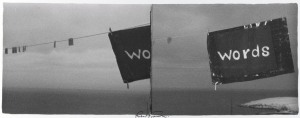








 All my Words are Silent