“The Creators Curse” – a raw deal – and everything is practice

When I stood up from the couch I thought.  I’m tired of everything being practice.  Each character sketch, each poetic fragment, each novel attempt, each theory, each relationship, each parenting moment, each breath.  All participated in as if the engagement might provide benefit, as if the pain will promote healing, as if the mistakes will prove corrective, as if fitness might improve health.  “Lifelong learning” – how nice it sounds, how endless.

But learning for what – ?  There’s just more life until… and then it’s probably simply (well, complexly) variantly continued – one situation hardly informs another – for the next now the context has changed, as well the elements, the matter, the flow.

So then I think again – perhaps it’s fear.  That lifelong learning, or anything meta- entails a splitting off – a doing WITH the observation; and thinking WITH  reflection; the subject’s objectification.  A remove.  And so it feels like practice rather than NOW.  

Earlier today (apologies – I’m really just rambling this post – no pre-write, no consideration or filtering) my son shared this with me:
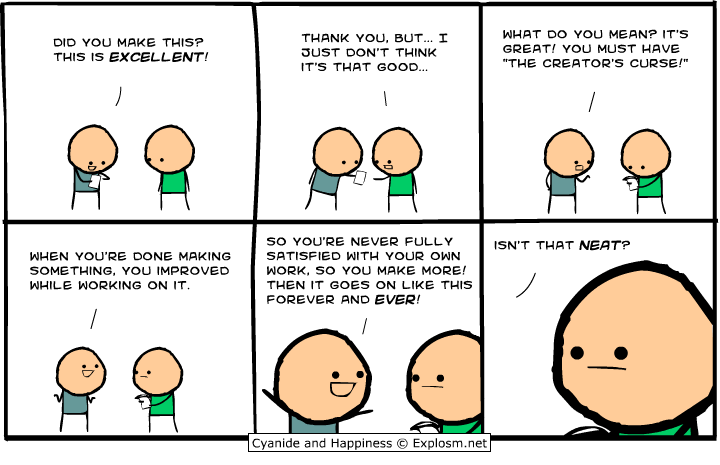
Cyanide Happiness Creators Curse


– The “Creators Curse” from Cyanide & Happiness.  In our making we extend and become in the risking required to attempt…to craft… to work… so it cannot end, for if we grow or move or change (which we will) the work will need to go farther, be finer, account for those fluctuations… ever stepping into new, fresh, dynamic, complex realities… PRACTICE IS IMPOSSIBLE.

But if we turn and try to bring the effort up to speed, in that turning, that editing, that effort, nothing stops.  Nothing stops moving into that next moment, next ream of realities, heart-beat’s context, juggling atoms and muscles and breath…  “Improvement”?  Who knows.  But different for sure.  And even if we reach and stretch toward the work we imagine versus the work we are capable of…it all changes in kind…as change.

In optimistic moments this is cause for hope.  The possibility that something might improve, benefit may come, a temporary health could be achieved.  But not achieved only altered.  And not altered only changing.  I’ve argued before that we must lose our tenses to be honest to living – everything must become verb.

But I don’t want anything to be practice anymore…rather maybe process – doing, making, saying thinking in or with … everything.

I’m very tired of the hesitation, illusory gap, the pretend-vision of seeing our seeing, or feeling our feeling; loving our loving, writing our writing, thinking our thinking our  thinking…

I want to be : living, writing, parenting, loving, doing, making, saying, thinking NOW and HERE as IS.  
Intolerable Vulnerabilities – the fictions

Intolerable Vulnerabilities – fictions

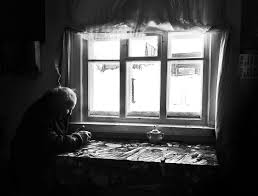
lonely old man

I.

There comes a time when being referred to as “sir” by 100% of an establishment’s wait-staff is no longer over-polite and ironic respect, but simply a pronouncement that in these contexts you have no peers.

Eventually you’ll be skeletal, perhaps before too long the way things are going, you’ve never been difficult to avoid.

And it’s never been easy to know what you want – are you being selfless or self-protective in the attention you pay toward your lovers?  Are your emotions inaccessible (some stunted empathy) or over-attuned in such a way as to pay your own processes no mind?

Whatever the case, you’re threatened.


And now you are old, sir, and alone.  And both nothing and everything is safe, because you are no one to lose.  And any potential of personal contact – some sort of opening – would inevitably create leakage, exponentially multiplying your probabilities of loss.

If only it could be viewed as sport – this frolicking across the page.  (It’s not).


Who lays the trail

in the white sand

of the page?


Who explains it?

-Cees Nooteboom

            You.  Not you.  Here.  Not here.  Ever trapped in beginnings because of so many ends.  At this age, sir, you must force it.  Opportunity becomes a consolation called survival.

No one is fooled, particularly not you, sir.

But she reminds you of something, probably someone, which is no help to you, just an increase in the accumulated weight of what’s past.  You’ll go on, because why not? – You are nothing to lose.

The Intolerable Vulnerability of beginnings…

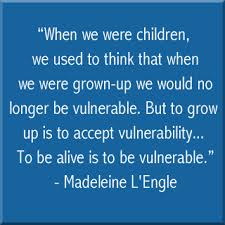
I am desperately vulnerable to being unable to move beyond beginnings….as witnessed by the following attempts…Lengle - VulnerabilityINTOLERABLE VULNERABILITIES

I.

When we begin – anything – we begin with.  We start out already always somewhere as some onesome thing.  Some entity or element among others.  There are no, is no, such thing as a ‘fresh start,’ as a living organism.

From our particular inceptions we are loaded and formed with genetic baggage – our cells and context shaped by conditions far beyond and external to ourselves.  And nary a freedom is advanced.  Sure we participate in the shaping and construction and continuance of us, but we are never extricated, abstracted, or independent from an environment, a shared and shaping surround – it’s the contingency for existing: Other(s).

A world not formed by us.  A plural existence, NEVER a solitary, isolated or uniform one.

Many find these ever-initiating constraints intolerable.  That one is unable EVER, to start from scratch, re-invent, re-formulate, or create ex nihilo.  Nothing, absence, void, simply – is not.

Therefore, ever existing in the already-established, already formulating, already-begun, we come together and transform.

Cells and genes, energy, matter and air conscribe to carry on in ripples and subject/objects of being.  Including, colluding us – we, you, me, I.

Wholly integrated (smoothly or with great difficulty) into the ongoing flux and flow of languages, practices, thoughts and behaviors of a very large and intricate, complex and dynamic world – we arise – conditioned, constrained and subject to our sort of organization – make-up, culture, circumstance, arrangement, perception, emotion, body, reason, available resources, types, renditions of being A being in this possible world.  A world, impossibly, that is just this way.

And the task is (always has) already begun – how will/does this particular, unique combination and configuration of elementary particles (a living, bounded, active, exchanging system/organism) adapt, effect, adjust, infect, evolve with its environment?

An environment of people, places, activities and things ALWAYS ALREADY begun, and also always already NOT-YET…awaiting, accepting, adapting, adjusting with US.

Our configurations, energy, activities and behaviors.  Nothing the same with us.  Nothing without.

Incalculable.

You, me, we make all the difference – along with EVERYthing else.

Some call this a paradox.  If you did not begin, it would make no difference.  If you do, it makes all difference.  Both, always, true.

Nothing is the same with you.  Nothing would be the same without you.

The world is a situation = both / and / more.  A complex and indiscernible system that just seems to work this way.  Call it “Butterfly Effect,” “Creation” or “Evolution,” “Chaos,” “Order,” “Life” – it all makes NO difference AND ALL the difference to actual experience.

And it is so.

Thus we begin – embedded, embodied, and extended – in an environment always long established, ongoing and begun: constrained, constructed, collaborated, and free.

I begin.  I beg – “let me start over”, fully incorporated, already begun – I: in.

Meaning is Molecular…

compliments of Percival Everett

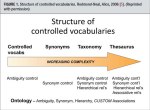
From Another Hand – “Folksonomies” & “Controlled Vocabularies”

Here follows a rambling response to a course discussion post relating to social-media-tagging and authority-derived-taxonomies in information resources (pros/cons, advantages/disadvantages, issues, etc.)…from my unedited perspective.  Perhaps it will interest some.

Option 2: Discuss issues surrounding social vs. professionally created metadata, citing examples from the readings. What are the problems and challenges as you see them?

“Naming entities in the world is a tricky business” (Mai, 2011, p. 116).  Socially-created metadata is a fascinating approach and response to the inherent ambiguity, flexibility and complexity of the human use of language and the co-ordination of communicating the range of contextual usages of information resources / objects in contemporary life.  I particularly appreciated Mai’s attention to the plurality and “heterogenous settings” (settings where there are “no unified contexts, goals, or objectives against which objects can be named and ordered…” p. 116) of networked global information resources.  “Naming, indexing, has its limits – it can only be done within a given context” (Mai, p. 116), and as George W. Trow pointed out long ago – we are in the “Context of No Context” once we’ve embarked on a world-wide web engagement.  The stimulating idea is that if you have those who are interacting with the resources “tagging” their meaningful engagement with those resources “in their own terms” – you are replicating the range and breadth and depth of ACTUAL human use and inference and representation of interaction with information.  Now THAT is FASCINATING!

On the other hand.  By now we are all mostly aware of the extreme subjectivity involved in perception, acquisition, attention, selection, and utilization or effecting of data-available-to-us (individually) in the experiences that afford us, expose us, enable us to actuate and in-form whatever available reality that resource represents for us.  This means that each individual organisms experience of a given interaction with an available resource is intensely situation-specific.  Which also implies that their report, account, or “tricky naming” of said interaction is apt to be highly idiosyncratic.  Which (OBVIOUSLY) presents an enormous problem for the stability or repeatability or findability or accessibility of the potential import of said resource for any other organism.  This, it seems to me, is where even collective or massive social input still engenders community-and-individual-sized gaps in findability and usability of digital information resources.

As I see it, the concept of “folksonomy” and social democratic tagging is a practical response to Wittgenstein, Heidegger, Uexkull, et. al.’s realization that any and all conscious human individuals will seek, access, perceive and select elements of their environment FOR THEMSELVES – limited by every aspect of their own physiobiology, neurobiology, social contextualization and environmental situation – if a WHOLE BUNDLE, an aggregate, a swath of humans “tag,” “name,” “label” a resource according to the meaning it gave rise to in them – we might get an approximately adequate representation of the (at least human) RANGE of meaning or import that resource might have for our species – the uses to which it might be put, the ideas it might give rise to, the practical effects it may indeed effect.  HOWEVER – it will by no means have overcome the inherent ambiguity, openness and possibility of said entity/resource/ordination of “information” for any further context / individual / situated need going forward, unknown.  This is where things like mathematical language, artistic form/contents, agreed-upon languages, domain-specific terminologies, “controlled vocabularies” SERVE our species – they give us COMMUNAL resources by which to evaluate and organize our experiences – and COMMUNICATE.  Private languages, really, tell us no more than the barking of a dog.  We infer and intuit, but then, that is OUR language imposing order on someone else’s expression.  Standardized, collectively agreed-upon terminologies and languages allow us to participate, interact and coordinate our experiences and understandings, while “folksonomies,” “tagging” and so forth allow us to nuance and extend or specify aspects of the agreed-upon discourse.  At least these are the uses I find compelling around both Controlled Vocabularies AND individual or privatized labeling.

It’s fascinating because it allows a democratic voicing which accounts for many more human facets to ANY and all resources, while “social” in a “societal” sense – domain-oriented, authoritative and agreed-upon terminologies allow us a way to flesh out, fuel and invigorate COORDINATED meanings – something accessible to us more like our own bodies – a corporate interaction – avoiding both solipsism (isolation) and equivalence (anonymity).  All sources seemed to agree that all things “con-” (con-sensus, co-llaboration, co-rrespondence and so on) are ESSENTIAL for our worlds to be useful and meaningful to us.

We have work to do in finding the dynamic balance in agreed-upon vocabularies as touchstones maybe not necessarily rules and the open source of additive description to equal something perhaps more in accord with human “reality.”  I sense that this is the dream of the Semantic Web…and of all communities worldwide.  I appreciate how the internet re-invigorates this ancient human process.


Groundlessness

Chodron - groundlessness


I seem to be unable to stop digging in and reflecting on When Things Fall Apart.  My memories range over its engagements with this book, most of the circumstances blurred and dissipate, but not the wisdom of the text.  I was trying to explain to my teens the odd euphoria that follows suicidal determination – what neuroscience knows as “shut-down.”  As the body begins to burn, or be ripped apart by fangs, riddled with bullets or smashed into bits…pain ceases to be useful to the organism and it is flooded with endorphins…a kind of blissed-out euphoria like a systemic morphine drip.  “There is definitely something tender and throbbing about groundlessness,” Pema says.

hypnotic-notions-holly-suzanne-filbert


But the idea isn’t shut-down.  The idea is more like a drowning compression without a bottom…a fall…a float…if fear – flight; if anxiety – distract; if anguish – addictive comfort; all these options for moving away, slipping out, attempt at relief, escape, a concretization of experience, rather than its flow.  It’s now-ness.  This drowning compression without bottom – what if we BE THERE?  What if we sit in it, and breathe.  The groundlessness, bottomlessness, suddenly becomes some space.  A little room…there’s opening.  We don’t know what to do, don’t know where to go, don’t know how this happened, don’t know why we did.  “Letting there be room for not knowing is the most important thing of all...Life is like that.  We don’t know anything.  We call something bad; we call it good.  But really we just don’t know.”

“Things falling apart is a kind of testing and also a kind of healing.  We think that the point is to pass the test or to overcome the problem, but the truth is that things don’t really get solved.  They come together and they fall apart.  Then they come together again and fall apart again.  It’s just like that.  The healing comes from letting there be room for all of this to happen:  room for grief, for relief, for misery, for joy.”

Blemishes

“Only to the extent that we expose ourselves over and over to annihilation can that which is indestructible be found in us.”

– all quotations Pema Chodron

“Leaning into the sharp points”

Suzanne(Beckman-Filbert)Holly-suzanne-prayingman.jpeg


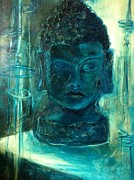
painting by Holly Suzanne

“Fear is a natural reaction to moving closer to the truth” – Pema Chodron

I modeled for the painting above.  It is propped beside the bed as I write.  A large painting, and heavy, maybe 4.5 feet long and 3.5 feet tall, loaded with layers of paint.  She called it “Praying Man,” but I wasn’t praying – the way it turned out I felt like a longshoreman, a hauler, tensed with the energy of pulling things out from the deeps.  I see why she called it that.

We’re reorganizing the house, and in that process I notice what’s gone, and discover things forgotten.  Today it was When Things Fall Apart by Pema Chodron, “heart advice for difficult times.”  I’ve depended on this one before.  It’s written with the situation in mind in which a human feels there is nowhere to escape.  Suffering floods in weights that compress one toward no option.  Chodron says that “No one ever tells us to stop running away from fear…the advice we usually get is to sweeten it up, smooth it over, take a pill, or distract ourselves…but by all means make it go away.”  “We don’t need that kind of encouragement, because dissociating from fear is what we do naturally.”  “Cheating ourselves of the present moment” according to Chodron.

Instead, she suggests, “we could step into uncharted territory and relax with the groundlessness of our situation…by inviting in what we usually avoid…adopting a fearlessly compassionate attitude toward our own pain and that of others.”  I am taking this on as the work of the “praying man.”  The longshoreman and hauler, reeling hand over hand over heart over hurt into the tumult of the pain of being.  “…getting to know fear, becoming familiar with fear, looking it right in the eye – not as a way to solve problems, but as a complete undoing of old ways of seeing, hearing, smelling, tasting and thinking…having the courage to die, the courage to die continually.”  The traditions align.  “He who saves his life will lose it.”  The terror that drives the boundaries, isolates the organism.  Protectiveness cuts the supply chain.  Security stanches generative flow.

What happens when we stay?  Nailed to the present misery.  Chodron suggests that when we move into rather than away from our life-threatening pain a kind of catharsis can occur – an acceptance that we are “precious beyond measure – wise AND foolish, rich AND poor, good AND bad…and totally unfathomable.”

2013-01-22 14.36.20

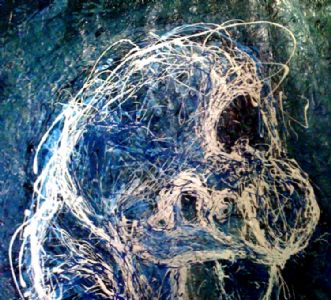
another painting by Holly Suzanne, emptied of me

The trick is to keep exploring and not bail out, even when we find out that something is not what we thought.  That’s what we’re going to discover again and again and again.  Nothing is what we thought.  I can say that with great confidence.  Emptiness is not what we thought.  Neither is mindfulness or fear.  Compassion – not what we thought.  Love.  Buddha nature.  Courage.  These are code words for things we don’t know in our minds, but any of us could experience them.  These are words that point to what life really is when we let things fall apart and let ourselves be nailed to the present moment.”

Preying Man then, hunched over and hauling it out, rhythmically breathing into the present, a turbulent pain fueled by fear…searching into what I usually avoid.  Hopefully not so much as a way to solve problems, but an undoing of native ways of seeing and hearing, smelling and tasting and thinking…along with the courage to die.

-all quotations Pema Chodron, When Things Fall Apart

Intimacy as Art

another old post intimately related

NW Filbert's avatarAll my Words are Silent

Intimacy as Art

“A way of connecting, on relatively safe middle ground, with another human being”

“that ‘neutral middle ground on which to make a deep connection with another human being’… was what fiction was for.  ‘A way out of loneliness’…”

Jonathan Franzen, on David Foster Wallace

“If the novel were able ‘to give the reader, who like all of us is sort of marooned in her own skull, to give her imaginative access to other selves,’ it opens the potential that she might, as a result, feel ‘less alone inside’”

Kathleen Fitzpatrick, on David Foster Wallace

My son and I arguing about the nature of things – is there anything we can agree on?  mutually believe?  are we similar? – in what began as an attempt (on my part) to soothe obvious hurt and confusion (on his part).  He kept pointing to (referencing) his mirror, his bedside table, in…

View original post 706 more words

We Make Art

related items popping up from the past

NW Filbert's avatarAll my Words are Silent

We Make Art: A Query toward Perceptive Extension

paper snowflakes by Holly & children paper snowflakes by Holly & children

Waking reminded –

I’ve been working over things in my sleep.  Parenting issues, marriage.  Vocation deadlines, assignments.  Logistics and payments and scheduling.  Improbable care of the self.

– that overwhelm is inevitable, inherent.

Everything we know (or surmise) about anything indicates vast beyonds unknown and ignored.  In order to see, to breathe, to speak, to hear, to feel, to think, to live.  We filter and avoid.  Press the vast majority of the world’s availability into a void.  So of course we can’t manage our world, or comprehend, even minimally control.  We can barely deal with even a relatively microscopic set of variables, and those only enough to survive.

Reminded, awake then, that overwhelm is constant and inevitable.  Inherent to the systems of which we are and are a part.  Living is processing vastness.  Essentially unscalable.  And…

View original post 401 more words

Intimacy

Greetings, in an effort I am making to “make sense”… I have been encouraged to chronicle the benefits of my experiences to investigate personal meanings.  That might not make sense.  Suffice it to say that I am plunging into the world of my recent past in an attempt to discover how it has changed me.  A working title might be “Intolerable Vulnerabilities,” (a phrase lent me by my mental physician) and its subject is yet to be defined…but here are the beginnings of an intro…

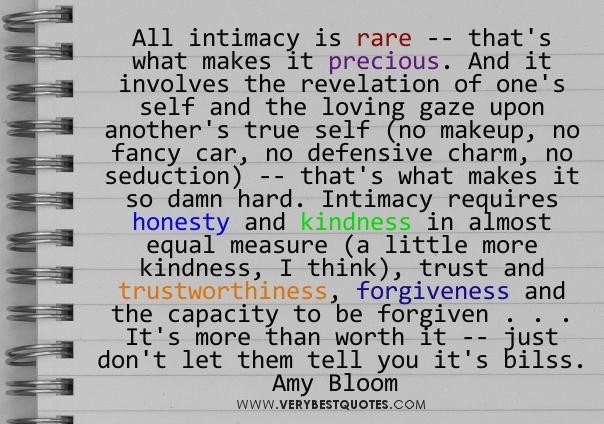
Intimacy - Amy Bloom


The hesitant beginning…

” Most all of us have been caught up in the proverbial “throes of love.”  The ecstasy and heartache of opening oneself to another, being enraptured, plagued with doubt and hope, captive to longing and the myopia of the significance of the beloved.  But perhaps less of us experience intimacy.  Intimacy may be something quite different from love.  Although usually initiated in its atmosphere, intimacy reaches beyond the experience of love and journeys toward closeness.  Intimacy is about the intertwining of lives, the multiform intricacies of barely-boundaried involvement.  What occurs when lives are meshed and melded – shaped with and around one another – physically and immaterially, actually and theoretically, imaginatively and really.  Where histories are remade and revamped together in a present.  Where hopes are remade and reshaped as a couple.  Where the unit and body that counts as an “I” extends to a “we,” and sensation, perception and thought happen always with an external mirror.

Where intimacy takes us is awesome.  I mean this in the most fearsome and incredible ways.  Human closeness is fraught with archetypal danger.  When exposed in such nearness, our lives seem at stake.   It goes to the “heart of us.”  Within the weathers of love, the wedded experience that intimacy brings seems to make us or break us – our futures and fortunes, significance and meaning rise or fall in accord with an Other.  We, in ways, “are not our own” but become something new, something larger and fresh.  Something open, extended and possible.  Something at risk, distended, and vulnerable.  Our lives shared in the hands of another.  Our minds shaped with the mind of another.  Our purposes, intentions and behavior ever effecting conjoined scenarios.  The world is different.  Intimate.  Involved.  Precious and fragile.

There are (at least) two sides to the story…a territory of doubled strength and minimal safety.  Of terrifying exposure and (possibly) multiplied protection.  Of enhanced security and absolute danger.  This is the province of love.  This is the prospect of intimacy.”

Love - John Armstrong


-John Armstrong, The Conditions of Love