Writing comes naturally…

For those of you intrigued by yesterday’s article about writing as a technology – here I’ll attempt to balance it with another fascinating article supposedly providing an “opposing view” to Walter Ong, et. al.
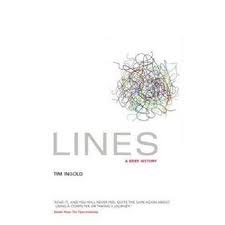
Ingold - Lines

Drawing, Writing and Calligraphy by Tim Ingold

(chapter 5: pp. 120-160)

what do you think?

Is writing “technological” artifice natural or unnatural?

I’ll tell my thoughts in time…


Quietest Show on Earth

Quietest Show on Earth.

Identities taking form…such brief individuations

Instigating a “family-tree” of sorts betwixt what I will call thinkers of relational ontology, I am providing another text to explore – this one from Erin Manning – the introduction from her book Relationscapes: Movement, Art, Philosophy. 

You can see the heritage (or ontogeny) is vast – to trace it more completely investigate The Four Ages of Understanding by John DeelyA Thousand Plateaus  by Gilles Deleuze and Felix Guattari, or The Primacy of Semiosis by Paul Bains (among others).  Bakhtin, Whitehead, William James, Nietzsche and others give testimony to this sense of the entanglement and fluidity of being, the emergence and always co- or inter- of existing.  The “relational nexus of experience,” as Manning has it here.  The incipient potential of each pre-moment and then following “instant,” the elasticity of the almost, the threshold ALWAYS of expression-in-the-making and all of its co-constituents from throughout time and space and anything else we have segregated arbitrarily.  Without further ado – What Moves as a Body Returns as a Movement of Thought, Events of Relation – Concepts in the Making by Erin Manning:


feel free to click image or title to read – (it’s a much shorter text than the last) – but no less engaging, creative, and provocative…


The big TOE

theory of everything

I have been fascinated by and greatly enjoying the discussions and promulgations of some very astute bloggers considerations of the possibilities of and potential candidates for a “Theory of Everything.”  See, for prime examples, the tremendous thought-work of MultiSense Realism and Anacephalaeosis.  Hoping to further conversation, I humbly post a couple of intriguing considerations of TOEs by two others of my thinking-hero-eschelon… and hope for responses from those above-mentioned and anyone else with thoughts on the matter (or process, as it may be)…!

From the Concept of System to the Paradigm of Complexity – Edgar Morin

and

Do We Know How to Read Messages in the Sand? – Isabelle Stengers

Other Writing Wisdom

“Writing is a question of becoming, always incomplete, always in the midst of being formed, and goes beyond the matter of any livable or lived experience.

It is a process, that is, a passage of Life that traverses both the livable and the lived.

Writing is inseparable from becoming.”

-Gilles Deleuze-

from article Literature & Life (read full here)

Writing Wisdom

This turns out to be the best thing I read this week on the art of writing…

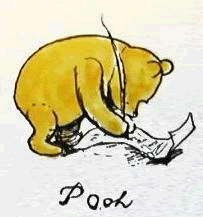
Pooh writing 2

“The friends could not agree which way to go.  Pooh looked for answers.

“Perhaps if we tell a story, the story will tell us how to get there…”

– Winnie the Pooh

struck me solidly as the way so very many of us who write

go about looking for answers.

Pooh writing

Write on…

New Publication – The Art of Salvage / Mining the Modern

An unexpected and happy surprise entered my day yesterday with the announcement of a terrific book highlighting a project I was lucky enough to be involved with – a group of artists utilizing materials being removed from an historical building in Wichita, KS during a renovation – and repurposing (creating them anew) into works of art!  I wrote an essay for this and now it is available in a wonderful edition you can peruse here:

The Art of Salvage

Art of Salvage


Experience, anyway. diverted toward Empty, the space of life.

Experience, anyway.

(click above if you missed the start)

2 pages in…the new fiction meets a message….

Empty, the space of life

“My relation to others is staggered all the way to the infinite;

from the bottom up, never horizontally, the distance from here to there…

…What you call ‘distance’ is but the time of breathing in, of breathing out.

All the oxygen man needs is in his lungs.

Empty, the space of life.”

-Edmond Jabes, from A Foreigner Carrying in the Crook of His Arm a Tiny Book

perhaps a title change, but certainly a deepening of the layers…

anyway, Experience, anyway. goes on into the encounters…

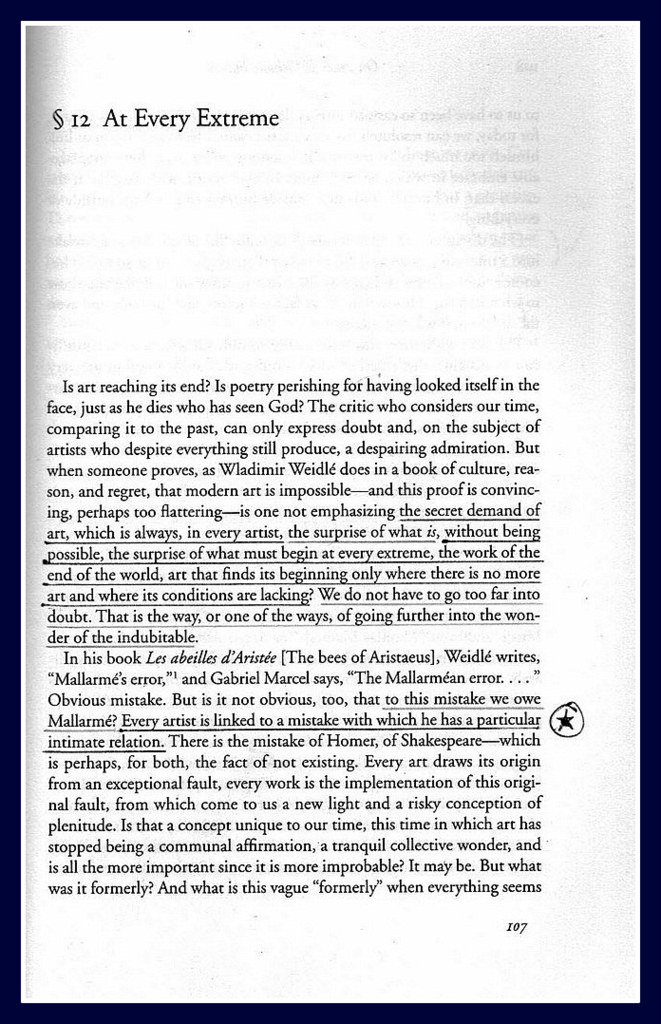
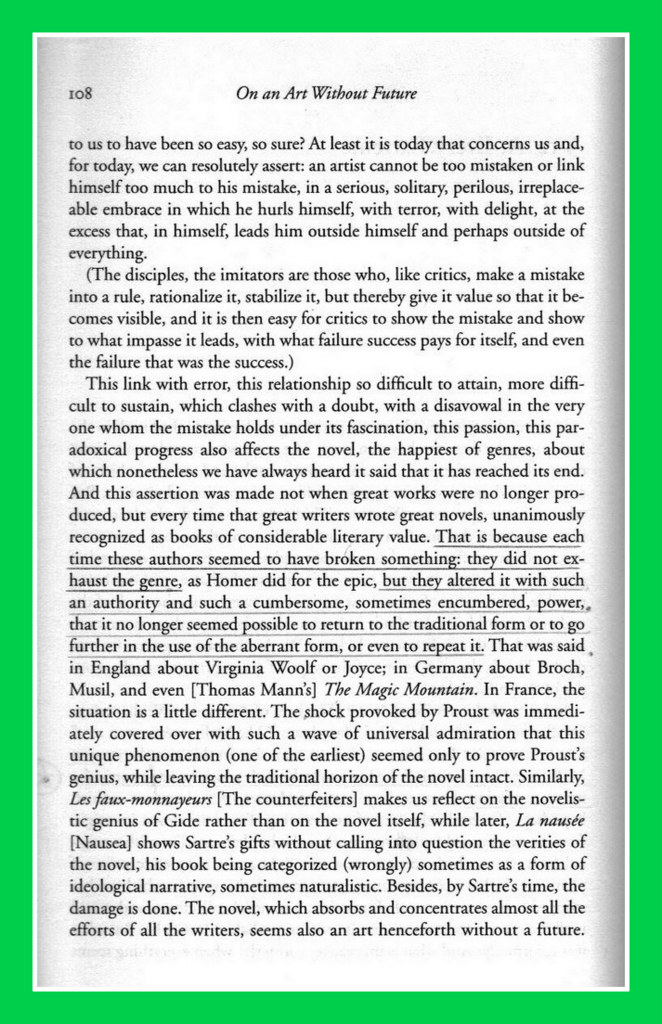
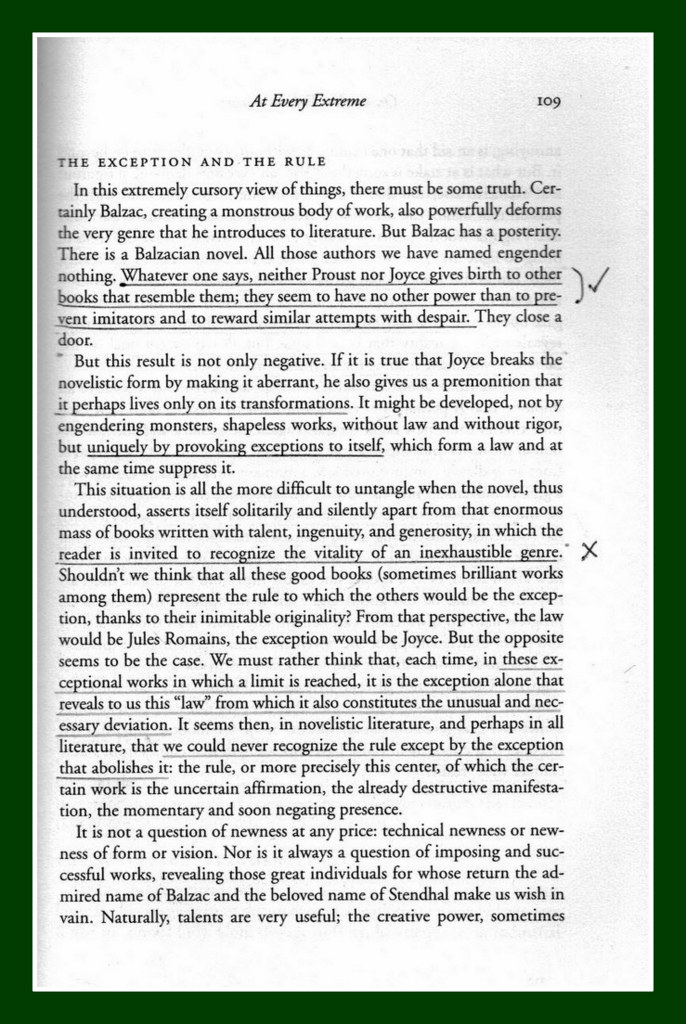
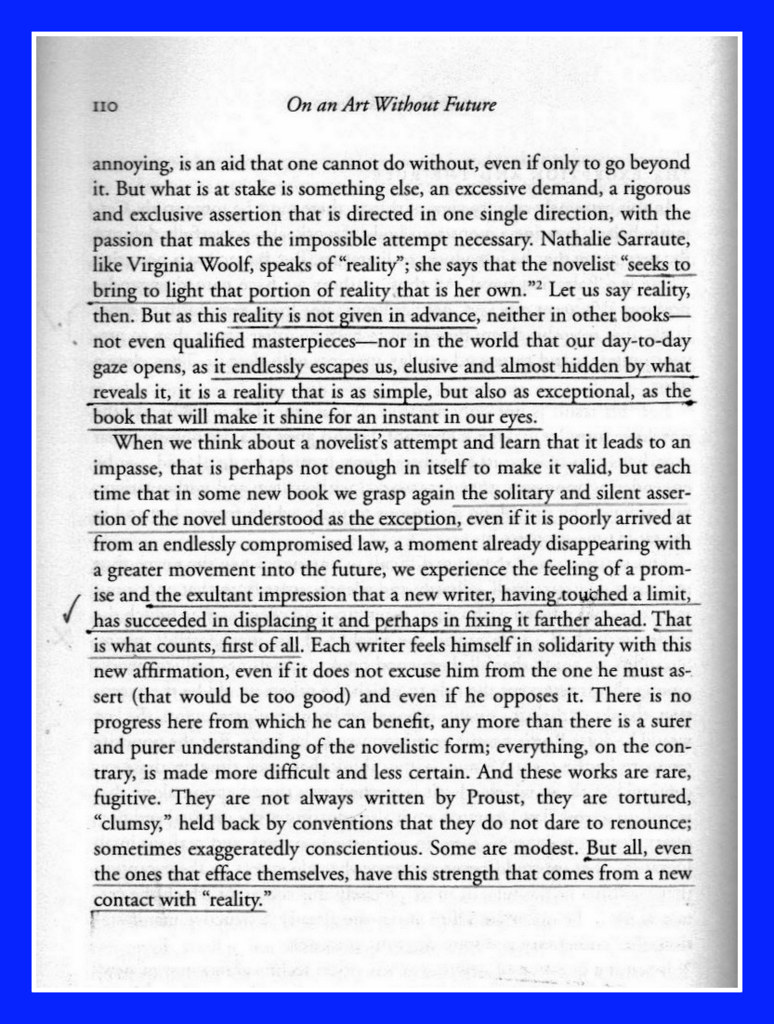
ART IS A MISTAKE

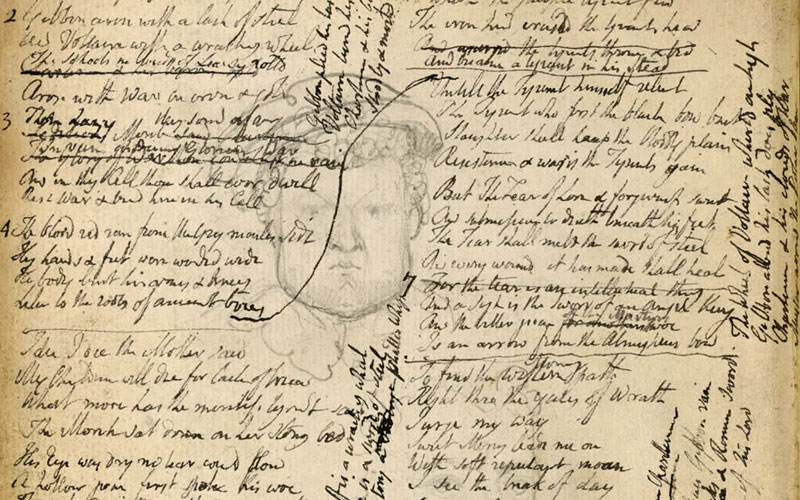
writing-britain-blake-lge

Blanchot Extremes-001Blanchot Extremes2-001Blanchot Extremes3-001Blanchot Extremes4-001

-Maurice Blanchot, from The Book to Come-

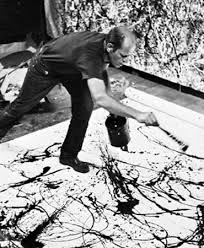
Pollack

MAKE THEM!

Writing’s Toxin

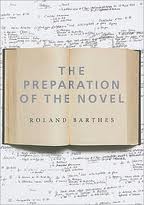
Barthes - Novel

“Is it possible to make a Narrative (a Novel) out of the Present?  How to reconcile – dialecticize – the distance implied by the enunciation of writing and the proximity, the transportation of the present experienced as it happens?  (The present is what adheres, as if your eyes were glued to a mirror).  Present: to have your eyes glued to the page; how to write at length, fluently (in a fluent, flowing, fluid manner) with one eye on the page and the other on ‘what’s happening to me?'”

“The novelistic ‘drive’ (the love of the material) is not directed toward my past.  It’s not that I don’t like my past; it’s rather that I don’t like the past (perhaps because it rends the heart), and my resistance takes the form of the mist i spoke of – a kind of general resistance to rehearsing, to narrating what will never happen again (the dreaming, the cruising, the life of the past).  The affective link is with the present, my present, in its affective, relational, intellectual dimensions = the material I’m hoping for (cf. ‘to depict whom I love’).”

“This is actually to go back to that simple and ultimately uncompromising idea that ‘literature’ (because, when it comes down to it, my project is ‘literary’) is always made out of ‘life.’  My problem is that I don’t think I can access my past life; it’s in the mist, meaning that its intensity (without which there is no writing) is weak.  What is intense is the life of the present, structurally mixed (there’s my basic idea) with the desire to write it.  The ‘Preparation’ of the Novel therefore refers to the capturing of this parallel text, the text of ‘contemporary,’ concomitant life.”

“Now, although at first glance making a novel out of present life looks difficult to me, it would be wrong to say that you can’t make writing out of the Present.  You can write the Present by noting it – as it ‘happens’ upon you or under you (under your eyes, your ears) – In this way, we at last come in sight of the double problem, the key to which organizes the Novel – on the one hand, Notation, the practice of ‘noting’: notatio.  On what level is it situated?  The level of ‘reality’ (what to choose), the level of the ‘saying’ (what’s the form, what’s the product of Notatio)?  What does this practice involve in terms of meaning, time, the instant, the act of saying?  Notatio instantly appears at the problematic intersection between a river of language, of uninterrupted language – life, both a continuous, ongoing, sequenced text and a layered text, a histology of cut-up texts, a palimpsest – and a sacred gesture: to mark life (to isolate: sacrifice, scapegoat, etc.)”
“On the other hand, how to pass from Notation, and so from the Note, to the Novel, from the discontinuous to the flowing (to the continuous, the smooth)?  For me, the problem is psychostructural because it involves making the transition from the fragment to the nonfragment, which involves changing my relationship to writing, which involves my relationship to enunciation, which is to say the subject that I am: fragmented subject (=a certain relationship) or effusive subject (a different relationship)…a Novel-Fragment…”