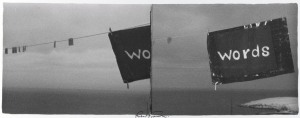
this is what i’m talking about! Yippee! Couple it with:
An Effective Procedure for Computing “Uncomputable” Functions
this is what i’m talking about! Yippee! Couple it with:

this is what i’m talking about! Yippee! Couple it with:
I get a little weary of philosophy. It fascinates and intrigues, has its spectacular, glittering moments of what feels like beauty and “accomplishment” – like architecture, the sciences and arts, studies human and social and hard. But with each human activity and behavior there can be too much of a good thing. Perhaps it’s the fantasies involved in abstraction – in the feeling of “figuring things out,” or of “making sense” – our human super-additives to experience that are also experience themselves – that I, at times, weary of. That eminently falsifiable intuition that everything is made up.


It is extremely hard work to keep up a worldview. Involving enormous complexities and details, layer up on layer and strand interweaving strand of biological and logical, illogical, psychological, irrational, emotional, – ologies and descriptions, manipulated perceptions and re-interpretations of interpretations reinterpreted (ad infinitum) – it takes matter and energy, and particular organisms, which grow tired.
Those same realities, capacities and activities are also extremely inspiring, enervating and exciting for organisms – the behaviors of productivity, creativity, imagination and survival – and our weird confounding capacity to think we can observe our perceptions/observations to an infinite regress, make for a very strange frenzy of energy and matter indeed.
In a possibly (?!) infinitely webbed interdependence with our surround copious possibilities of activity are available – all bewildering: chaos can be so generative. Chaos can be so nullifying.
What might we know?
And why do we want to?
and…so…what!?
Alongside and within – in order to be – apparently (that is, according to OUR OWN perceptions) – however would could we exist either detached (abstracted) or without (independently, unattached). To imagine distance, “objectivity,” without the imaginative capacities of fantasy – illusions – for example logic, mathematics, economics, philosophy, psychology – codes and symbols – DElusions in order to play the games in these forms of life we are with delusional sincerity – effectively. And our fantastic delusions or profound poeitic creations are often effective, productive, pragmatic, dynamic and evolving – techniques and time – which would seem to imply that they also are part of being within a myriad of dynamic systems…
…one might suppose (i.e. “hypothesize”); or infer (i.e. “fantasize”)
All an immersion in symbols – languages – stipulated relations – codified behaviors –
– which is what I had set out to consider
drowning in symbols
the wonder and bewilderment of it
the sense of delusion and ecstasy
being human…
We Make Art: A Query toward Perceptive Extension

Waking reminded –
I’ve been working over things in my sleep. Parenting issues, marriage. Vocation deadlines, assignments. Logistics and payments and scheduling. Improbable care of the self.
– that overwhelm is inevitable, inherent.
Everything we know (or surmise) about anything indicates vast beyonds unknown and ignored. In order to see, to breathe, to speak, to hear, to feel, to think, to live. We filter and avoid. Press the vast majority of the world’s availability into a void. So of course we can’t manage our world, or comprehend, even minimally control. We can barely deal with even a relatively microscopic set of variables, and those only enough to survive.
Reminded, awake then, that overwhelm is constant and inevitable. Inherent to the systems of which we are and are a part. Living is processing vastness. Essentially unscalable. And we thought bacteria were small!

So it comes as no surprise that at times we feel oppressed, drowned, immersed – helpless, confused and at loss. Pretend for a moment that we have to-dos that seem important + unforeseen and substantial grief + illness + snow days (which = a house full of ecstatic children, active and noisy and eager to be entertained) + inclement weather shuffling schedules and doctors, activities and possibilities around + limitations of time, energy and internal resources + anxiety or mood ‘disorders’ + love and high hopes + responsibilities and intentions + fears and deep hurts + a body (bodies) mind (minds) to feed and nourish +…
Too Much Information, a saturated context for the human organism. The black box crashes. The connections run slow. The screen jerky and fuzzy. Head aches, breath thickens or shallows, noise is incommensurate – the signals scramble…
At first breach, first sign of imperturb…we check in, acknowledge – perhaps argue or fight or make love (i.e. signify our overwhelm and our intensity), sit still, register what we can…
and wake up, reminded:
WE MAKE ART.
Once ground is touched, we go in (or out) – “seventh direction perception” – we begin to consciously process/perceive.


The query that sprouted is as follows: might the activity of art-a creative dialogic relation of index-sign-symbol, signifier-signifiant-and interpreter, i.e. “becoming-forth” – expand our perceptive capacities/processing?
In other words, in enacting the relationship of making, creatively, holistically, might we draw on more of the world’s availability – perceived and “dismissed” – a fuller context of experience less limited by intentional activities of categorical aims and constraints, thereby opening more of us to more of it in an open reciprocal dynamic interrelation, thereby sort of processing in “lump sums” – a gulping digestion of overwhelm?
We set aside prescribed roles, beliefs and opinions and work out, work into, an arbitrary generalized conventional (safe) medium…we fog our normalized paradigms and strictures of interpretive alertness – mores, values, expectations and censorship – we reach out gathering in. Interact. It seems something larger is carried, is moved – more than the medium, more than ourselves, more of a context, a world.
Does art extend our perceptive capacities? Our scope of perception – to process, to be? A kind of open-boundaried passage of experiencing between organism and world?

The WHYs of them:
“semiotics is not about the ‘real’ world at all, but about complementary or alternative actual models of it… an infinite number of anthropologically conceivable possible worlds. Thus semiotics never reveals what the world is, but circumscribes what we can know about it; in other words, what a semiotic model depicts is not ‘reality’ as such, but nature as unveiled by our method of questioning. It is the interplay between ‘the book of nature’ and its human decipherer that is at issue.”
-Thomas Sebeok-
“the forms and laws in our worlds do not lie ready-made to be discovered but are imposed by world-versions we contrive – in the sciences, the arts, perception, and everyday practice. How the earth moves, whether a world is composed of particles or waves of phenomena, are matters determined not by passive observation but by painstaking fabrication…Constable urged that painting is a science, and I suggest that science is a humanity.”
-Nelson Goodman-
“a mobile unsteady structure…with all the bits always moving about, fitting together in different ways, adding new bits to themselves with flourishes of adornment as though consulting a mirror, giving the whole arrangement something like the unpredictability and unreliability of living flesh…The endeavor is not, as is sometimes thought, a way of building a solid, indestructible body of immutable truth, fact laid precisely upon fact…Science is not like this at all.”
-Lewis Thomas-
“Perhaps the best way to think about post-modern self-referentiality is not as a denial of language and literature’s connection to the world but as their self-consciously pointing to themselves trying to point to the world.”
-Robert McLaughlin-

“Was there ever a period when my words weren’t already headed?”
-R.M. Berry-
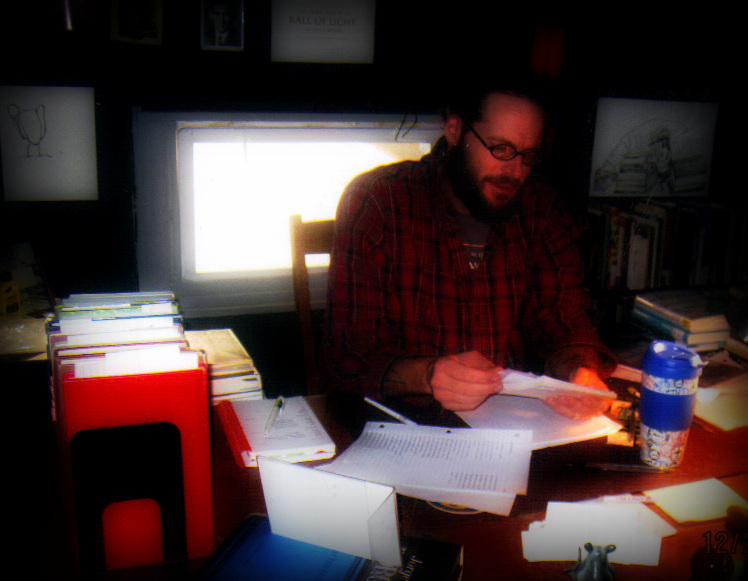
the Superstitious Naked Ape had the great idea of each of you offering a photo of your workspaces – see comment below – would be intriguing – feel free to provide
-Ludwig Wittgenstein-
the developing words:
and part 10:
10
It taking so long to figure it out. What it’s “about.”
Discombobulates like sporadic noise. The fragments living are.
Four decades, seven children from three wives until he recognizes relation. Which changes things. Significantly.
It is the third wife (times charm) – out three strikes she staid on. Stays on. The difference between things.
In relation to one another. Evolving perception. The what-not, call it “aboutness.” Or in relation to…
This in relation to that is about this much this high this far. Or else nothing at all. In itself. By itself.
By himself, barely amount, insignificant cipher, plus three plus seven plus anything adding up, er, becomes.
Alone is less than one, or, not a number. It takes 1 to know 1, in other words, all-one really means no 1. Unless distinguished from something else, another 1, an other.
This he could tell. The third wife, the difference between. The aboutness. Differing shapes entirely, nearer still, at this distance.
1 cannot equal. Impossible equation. Might as well be naught, be 0 – a 1 wrapped around itself (turned-in) – revealing just a hole, something seen through. Looked straight through.
Telescope, microscope, still substance unseen, a looking at, really, looking for. Simply looking, opened at both ends. Perhaps a simple function. What an organism is, alone.
She calls out, in fact pursues him halfway across. As if to say she sees something, peering through her self-same circularity – that he is there. He begins experience, begins to get it – something else must be looking, another 1, for him to be seen, to hear of himself.
In what she tells him.
Multiple inputs introduce noise (read chaos, read being), make possibilities, provide things to figure out. With all the variables it takes a lot of time (to get what it’s about).
from The Language of Inquiry by Lyn Hejinian
[worth every second]


Roughly speaking, I understand “art” to be something created through human interaction with the world. Whether perceptually noticed or purposively constructed, that which we experience in what we might call “aesthetic ranges” are always results of interactivity and, as far as we know, only occur for human organisms.
In light of my previous post attempting to address the function, variability and necessity of language or sign-types for human perception, survival and being-in-the-world, I want to address something fresh for me that arose in that inquiry.
Previously, I lamented the inevitable distance that occurs in living organisms between originary experience in and with an environment and the organism’s perceptual experience of it. No matter how miniscule, there is always a gap between our encountering (for instance, of scent and our recognition of smelling; or of light toward eye and our “seeing” of colors; touching flame and reacting retracting) and our awareness of the encounter. Neurons and nerves pass time in their messaging. By the time we’re aware, our present is past.
But awareness and perception, cognition and sensation are themselves happening presently, occurring in a process continuously and simultaneously to ongoing encountering. In other words, it is always the present, and we are always present, doing many different things. Being presently and what we’re aware of presently are widely variant items, but always both and all, simultaneous with (indeed identical to); the present.
The present is the only reality occurring.
Who and what, where and how are all only ever present concerns. When is always already answered: NOW.
If the human organism has adapted and developed the creation and usage of sign-systems to more efficiently navigate processes of survival, I want to look a little bit into what the purposive involvement in, engagement with, those sign-usage capabilities might accomplish for us.
If our survival process, as I remarked before, is one of perceiving and predicting our individual organism’s likelihood and opportunities for existing in any given environment (context, situation), then our perceptive processes are amazingly collaborative toward quickly organizing and evaluating a chaos of inputs and outputs into maneuverable assessments and survivable actions.
Language is our principle medium of signs, used by humans to select, describe and choose what is going on at any moment both inside of us and around us. Something like water is for jellyfish, perhaps, the medium that both constructs their world and enables them.
But language become, becomes its own experience to become again and again. In other words, the processing of perception, awareness, consciousness, is also experience in itself.

This is where it struck me that sign-mediums are a kind of gifting again and again of present experiences. As we interact with mediums, forming and formulating them into semiotic artifacts (whether spoken phrases, bodily movements, plastic figures or oil-smeared canvases) we are both utilizing those media to organize and process (become aware of and perceive) select elements of our encounter/experience, but also concocting new experiences as well as future presents. Artifacts delineating our presents will be perceived, signed, comprehended again and again newly, each moment various and ever-present.
In other words, inhabiting our mediums purposively, experimentally, exploratorily, reflectively, creatively, we are both organizing, discovering and determining our own present(s) while simultaneously being new presents and gifting present experiences to become (for ourselves and others via artifacts, writings, sounds and movements).
This seems simple to me and I’m sure the wriggly seams of it, the liminal, necessarily RELATIONAL actualities of it have been sussed out much more eloquently and adequately (made present, re-presented) than this cursory blurt of mine, but it has flooded me recently like an a-ha (fresh awareness of the present?) in answering questions about “wrestling with everything inhabiting my medium.”
So thanks to all of you – writers and artists, filmmakers and philosophers – for plumbing the mediums that give you your present(s) again and again, and then offering them onward to us – a community continually re-gifting our present(s) by consciously inhabiting what our media inhabit. The What Where How Who it moves us within and between.
Student Magazine of IISER Mohali
Music, Musicology, and related Matters
a photographic pilgrimage to Orthodox Christian monasteries across the continent
Meandering Through a Literary Life
Orthodox Christianity, Culture and Religion, Making the Journey of Faith
Erik Kwakkel blogging about medieval manuscripts
"That's the big what happened."
Networking the complexity community since 1999
 All my Words are Silent