Spilling the Marbles

Spilling the Marbles

Which got me thinking (a process I’d describe as internal), about how we find things out when we act.

My wife was talking (a process I’d call external), about what occurs for her when she journals (with a physical pen or pencil on physical paper).  Which she described as “internal processing,” (an activity I’d designate externalizing), whereby she mysteriously splits herself into observer and subject at once, providing case-notes or records of the interaction.  (Did I listen well?).  The arm a kind of thread-of-self arcing out to the needle of a writing instrument, jittering and inscribing its EKG-like “reading” onto the blank pages and looping back in for more.  The self as inkwell?

My body hitched at this.  Read: torso clinched and weather vane set spinning in grey matter.  Like I might if someone told me “god told me to…”, or that they were “inspired by the Muse,” or “carried away by the spirit” and whatnot.  A reaction remote from wife’s account – so what was happening for me?  In other words, am I re-enacting her activity presently?

There’s the thinking part, surely.  And then there’s the intention to find something out – observation, attention, inquiry – “why did I cinch up at that depiction?”, “what felt ‘off’ to me in that account (as related to my own experience)?”, “what was I ‘feeling’”?

I felt uncomfortable, that’s what.  Squirmy, antsy, bothered.  Was that chemically induced, like overall mood-disorder stuff, or related to her message?  I thought about this, and now I’m writing about thinking about it – what’s the difference?

It leaves traces?  It does.  And so?

I’m making something of it?  I suppose.  Why?  How?  And – ?

Why?  Hmmmm.  It comforts me to write.  Like organizing marbles on a tabletop.  It diverts my attention.

To the marbles.

Ah, yes.  That’s it, exactly.

That is to say (in this case silently with tangible markings), the reason I am unable to identify with my wife’s remarks about writing about thinking about her “self,” is that I get distracted.  In my head, it’s a swirl of sounds and concepts, images and sensation-symbols or impulses infiltrating and becoming one another like smoke strands in an overturned glass.  But transforming to paper it becomes language, marbles, metaphors.

            Some whispering gap of translation.  I wouldn’t have thought marbles on a tabletop or envisioned smoke swirling in an upside-down glass – what would be the point?  Do I need to describe myself to myself?  Could I even?  Deceive myself so?  But through a medium – a thick, loamy, granular medium like language – that’s cause for intention, apparatus of selection and choice, opportunities outside the body, drawn from the big wide world.  That’s external, that’s INTERACTION with a history, a culture, and a society of humans that gave rise to its agreements and standards, components and flavors and rules.

Jolting out through the arm via muscle controllers and a mechanical tool, I’m participant far outside my finite organism – in contents and structures, systems and meanings way beyond my doing or the thinks I might think.  The threads that I sew, the fabric I stitch in, the stylus, ink and letters I write are not mine – the pen, paper, leaves, spark, or smoke emitted into the clear crystal container all already exist, given or available, as it were, to me.

It’s hard to find the part I play in the process, or how the words relate to me – more like the words relate me – render me relatable – if I’m able to finagle myself to their categories and nuances.

So it is (for me) as if the movement to write is spilling the marbles – turning me out of myself into a world where language matters – discursive, discussive, dialogically or to some expressive purpose – catching at these rolling targets and corralling them toward some organizational assemblage (that, I suppose, being my part in the meaningful game).  I pick the red one and set it there, not there.  Or prefer the one with the chip in it next to the tiger’s eye, and so forth.  (There’s no accounting for taste – is that “style”?  (Really!?)).

So “what have I written?” I think, and I’m sure I don’t know, but thanks for the language and time, it’s a process – and now you have the bagful of marbles…

Happy Thanksgiving!!

“Bless Babel.”

Below I am going to share with you an essay that I promise is worth every hour or two you lend your attention to each paragraph.

It is written by this person:

(Donald Barthelme)

and it is called: Not Knowing

from his collection of the same name.

it contains statements like the following:

“Any work of art depends upon a complex series of interdependences”

“tear a mystery to tatters and you have tatters, not mystery”

“What is magical about the object is that it at once invites and resists interpretation.  Its artistic worth is measurable by the degree to which it remains, after interpretation, vital – no interpretation or cardiopulminary push-pull can exhaust or empty it”

“The combinatory agility of words, the exponential generation of meaning once they’re allowed to go to bed together, allows the writer to surprise himself, makes art possible, reveals how much of Being we haven’t yet encountered.”

“Art is a true account of the activity of mind”

“The aim of meditating about the world is finally to change the world”

and so forth.

Please understand me, if you maintain a blog, take photos, love your children, think about your self or the world you live in, dialogue with books or pictures or animals or people or movements…

take a little time to read this

Thank you.

  Not Knowing


Some Reasons…for Some of Us

“I am someone who tries to write, who right now more and more seems to need to write, daily; and who hopes less that the products of that need are lucrative or even liked than simply received, read, seen…why I’m starting to think most people who somehow must write must write.  The need to indite, inscribe – be its fulfillment exhilerating or palliative or, as is more usual, neither – springs from the doubly-bound panic felt by most persons who spend a lot of time up in their own personal heads.  On one side – the side a philosopher’d call ‘radically skeptical’ or ‘solipsistic’ – there’s the feeling that one’s head is, in some sense, the whole world, when the imagination becomes not just a more congenial but a realer environment than the big Exterior of life on earth…The need to get words & voices not only out – outside the sixteen-inch diameter of bone that both births & imprisons them – but also down, trusting them neither to the insusbstantial country of the mind nor to the transient venue of cords & air & ear – a necessary affirmation of an outside, some Exterior one’s written record can not only communicate with but inhabit…the textual urge, the emotional urgency of text as both sign and thing.  The other side of the prenominate 2-bind – … – is why people who write need to do so as a mode of communication.  It’s what an abstractor like Laing calls ‘ontological insecurity’ – why we sign our stuff, impose it on friends, mail it out in brown manila trying to get it printed.  “I EXIST” is the signal that throbs under most voluntary writing – & all good writing…

what must the world be like if language is even to be possible?”

got it, David.  Thank you.

Intimacy as Art

Intimacy as Art

“A way of connecting, on relatively safe middle ground, with another human being”

“that ‘neutral middle ground on which to make a deep connection with another human being’… was what fiction was for.  ‘A way out of loneliness’…”

Jonathan Franzen, on David Foster Wallace

“If the novel were able ‘to give the reader, who like all of us is sort of marooned in her own skull, to give her imaginative access to other selves,’ it opens the potential that she might, as a result, feel ‘less alone inside’”

Kathleen Fitzpatrick, on David Foster Wallace

My son and I arguing about the nature of things – is there anything we can agree on?  mutually believe?  are we similar? – in what began as an attempt (on my part) to soothe obvious hurt and confusion (on his part).  He kept pointing to (referencing) his mirror, his bedside table, in an effort at agreement, at a meeting-point that might be solid, be reliable, be “correct,” or “true.”  Some relatively stable collection of roving and vibrating molecules we might sharingly recognize, might hold, attend, or unite around – together.

Throughout my life I’ve attempted to comprehend – to make a symbol for myself –  what works of art, particular pieces of music, specific phrases or pages of literature, momentary glimpses of nature, dollops of emotional experience DO.  How they work.  Why they “feel” – move us, take an occasional effect we might call “profound.”  Why, even if they shatter us, cause us to weep, provoke in us the enormous courage required to change, we also somehow still feel safe, often empowered, somewhere beyond “okay” (ecstatic? – out of ourselves?)?

Although often evoking experiences I’d describe as most completely, totalizingly personal, I always felt their effectiveness, their possibilities of success and individuated power, came precisely because they were not (personal).  That what intimacy they provided – what outlet or spillage, what expression they represented or evinced – was contextually impersonal, through matter and energy uniquely organized, mediated.

In other words, we could throw all of ourselves into, at, toward or away from them (works of art, formal arrangements of world) without the danger or threat, anxiety or fear, of influence.  We wouldn’t hurt, harm, embarrass, shame, offend or be misunderstood by a cornflower, a collective of strokes of paint, a recording of sound waves, moving molecules.  No direct hits of miscommunication, misinterpretation.  Perfect, variable, flexible presentations of world, of other, that we might release ourselves in relation to, without fear.

Existent things, moments, that genuinely represent otherness from ourselves but without direct exposure, without a being’s inquiry, possible scrutiny, judgment or evaluation.  Interpretation.  Many-sided, borrowed perhaps, but mediated via only one person – me.  I could not fail, fall short, be inadequate to, or otherwise  mess up a novel, poem, composition or film, and if I experienced myself as any of those things – it was my own judgment, assessment.  Mediated.

After years of such exposure, why do I still choose sides, entrench myself in arguments of logic, when I mean to comfort, soften and heal?  Alone, later, I sat and asked myself over and over – IF I have changed, grown, matured in any fashion in my 42 years of life, IF I have learned anything to the point of conscious belief, what might it be? – what  might I say that I know?

I don’t know.

What I scribbled into the margin of my journal was simply that my fundamental belief about the world and life in it was that – at the core of things – “Everything is essentially messy.”  By which I (at least partially) meant (intended) was incomplete, mobile and complex.

Nothing “fixed.”  Staid, finished, whole.

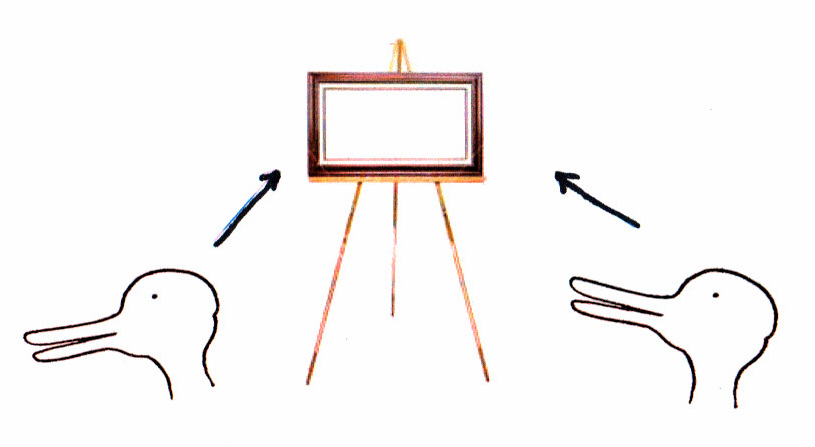
Throughout years of journaling, as I’ve grown to understand how deeply I desire “intimacy” (which I suppose I would describe as “shared personhood” or “met experience”?  Co-events?) I have repeatedly diagramed what seems to me an only possible means between humans:

             Using Wittgenstein’s duck-rabbits to represent whatever we happen to perceive ourselves as, and “Art” on an easel representing anything as a mediated format outside of our “selves” (themselves, I surmise, also likely a constructed medium for experiencing world), to or in which multiple human persons might invest all they experience themselves to be, without necessary personal organism-survival fears, and, possibly, perhaps, occasionally MEET via that medium in toto (or as nearly as possible): experience intimacy, mutuality.  No longer isolated as a being, alone, but finding a common, a sharing-realm, co-perceiving, co-experiencing.

If it be so, that, in fact, as human organisms, all of our entity-type experience is, truly, mediated – through various organizations of mobile and voluble matter and energy – never identifiable as a stasis or final form, if we might begin to see it (us) as such – might we become able to experience direct, person-to-person (experientially) intimacy?  Co-being?  This is where I have turned effort (driven by desire) with my wife, my children.  What if we became safe mediums for one another to experience through?

That would be another entry altogether.

2 Exhibitions

I’m excited about 2 exhibitions occurring this month with which I am involved one way or another…

ReMades will bring multiple local artists together, hauling sundry objects and materials  to their homes and studios to begin remaking, recombining and incorporating these items into lasting objects and artifacts, which will then be exhibited throughout the Fall and Winter at Fisch Haus Studios’ tremendous gallery space, thus preserving their potential to enliven and enlighten our communities.

Opening Reception on Final Friday, November 30, from 7-10pm

Fisch Haus, 524 S. Commerce, Wichita

An exhibition of work by local artists using materials fromThe LUX renovation process that would have otherwise been lost.


And also my lovely amazing wife’s exhibition currently available at Mead’s Corner in Wichita KS

Friday evening, November 23, 6-9 pm there will be an artist’s reception with an artist’s talk by Holly Suzanne at 7:30!

Hope to see you there!

Address: 430 E. Douglas
Wichita,KS 67202
Hours: 8am-11pm Sun
7am-11pm Mon-Thu
7am-1am Fri
7am-1am Sat

HOPE TO SEE YOU HERE, THERE, EVERYWHERE!

(and support art and artists! – BUY IT!)

Chaos Pieces : Election Day

Election Day

The way things that seem to need doing impose mayhem on those things we were wanting to do (vice-versa).

A sort of ratcheting of oddly shaped pieces tumbling down towards one another on an inclined plane.  Necessary bits and fragments of desire rattling against, around and into one another, oppositely directed, apparently, and all with force or momentum (time, change, survival).  They clatter.  They clatter and clutter, like there’s a microcosm of chaos in us, the spillage of some enormous container of Legos.

Is this unfamiliar?

Something, always, functioning as noise in the wavering systems of our message(s)?

I want.  I  need to….  A hunch, an intuition.  A concrete demand.  An idea spawns.  And tasks arise.

That kind of oscillation is what I’m talking about.  And it goes both ways.  All ways.

I set about a chore and am derailed by an idea.  I dream and the over timer intrudes.  I breath and it hitches to a cough.

Not that it’s always that way.  Sometimes the texts come right on time, just when I was getting up anyway.  Sometimes the activities that need the doing, also fuel the dreams.  Think of such a time.

No wonder it’s called “flow.”

Yet it hardly seems “reality,” or “daily life.”  Perhaps that’s only me, that the pieces that construct me are preiteratively cross-purposed?  Maybe my fragments’ forces are centripetal (or centrifugal), either way multi-directional and simultaneous?  ADD?  ADHD?  “Life?”  Speaking animal?

Like Election Day.

N Filbert 2012

Reminded of things…

arbitrary views of aging posts on my site somehow meandered me into this…

and I like it!

Ronald Sukenick

http://bweal474.files.wordpress.com/2011/02/postmodern-fiction-paper-21.pdf

(I still can’t find that masterful essay “The New Tradition in Fiction” by him I so want to share with all of you)

you can find it in here!

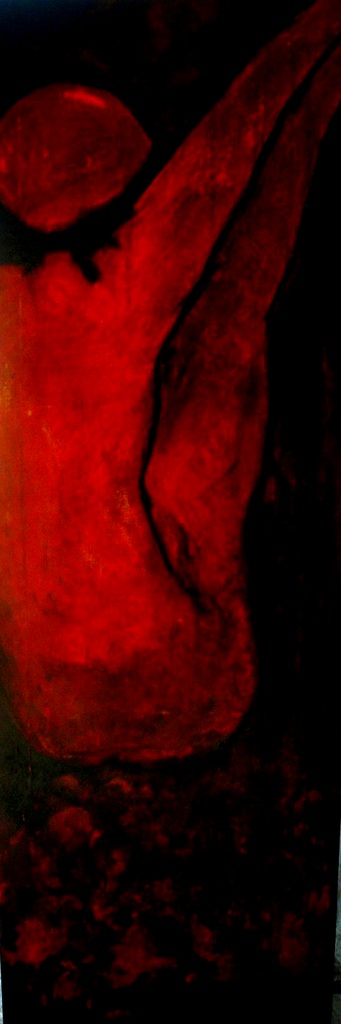
Waterplay – a triptych by Holly Suzanne


Waterplay – a triptych by Holly Suzanne

Waterplay – a triptych by Holly Suzanne


What we know for certain is the steady stream of life, the flood, the flow, replete with bits and currents.  Immersion.

What is less clear is whether we are rising or falling, whether paradoxes hold true, what that might look like.

And if we’re swimming together, how that alters the land, changes the buoyancy, rearranges our standards of measure.

We – individuals – no longer a fixed point of reference.

Now “I” that formerly looked oh-so-much like a “1,” is just a needle in a flurry of dried whirling pines.

Rising up, rising down, in relation.

The self, the other, the flood.

In certain light, it shimmers.  In little light it bleeds dark.

It’s not as if we’re provided decoders, infra-red goggles, enlightenment.

I’m as much in the sea of life as you.

We share, in this sense, an equal, fluid, ground.

And not as something to step up or out of.


The self, the other, surround – weighted flotation devices.

I’m in, at a kind of “over here.”  So are you.

There is no escape.  We sink.  We rise.

N Filbert 2012

(My apologies – these pieces have proven very difficult to photograph in a way that presents the depth of layering and colors truly present.  These are fairly large oil paintings created of Autumnal colorings and glow, many more greens and yellows, oranges and hues filling out the originals.  It is painstaking to present them here struggling with glares and digitalia in a way representative.  Forgive me, and if you are able come see the originals through the month of November at Mead’s Coffee House in Wichita, KS – they are rich to behold!)


What Happens (with a semblance of truth): A True Story (that is never true)

Many things might have happened, indeed, could have happened.  It is impossible to tell until it happens.  Whatever happens.  And so it goes.

Recollection subjects what happens to interpretation, a puzzling assemblage of memory (embodied brains in changing circumstances) and occurrences (embodied brains in specific situations), making it impossible to tell what happens, when it happens, or after it happened, save from a very particularized attention and intention, point-of-view, disposition and enmeshment (the factors being relatively endless).

And so we call histories, scientific observations, statistical reports, etc. al., “stories;” journalism, research, theories or assays (essays), “fictions;” and personal memoirs, dialogue, descriptions or statements – “fantasy.”

Everything that happens or happened is what might have happened.

Let’s theorize that an author or reader, group or individual, has a concern for “truth” – something being what it seems to be – who or what has total and essential access?  The only truth in human expression that I can surmise is that it is truly “made up.”

An individual may have something approximating total and essential access to a thought or feeling, personal experience or idea, but insofar as it actually occurred according to an experiencer, there are already multiple points of view, ranging from molecular to cosmic, matter/energy to cultural.  To say nothing of the complicating fabrics incumbent on expression – whether a grimace or a novel, a shriek of pain or a tally mark on a chart – it has entered uncertain and collaborative interpreted ground.

All to say “experience” is utterly specific and solipsistic (non-transferable “truly”) and is an enabled product of embedded participation in significant (if identifiable as an “event” or “occasion,” “moment” or “intuition” – any feeling, sensation or awareness) surroundings, expanding niches of existing things with variant points of view.

This is how I can guarantee that nothing I show you or tell you is “true.”

It may be more or less accurate to my experience or understanding of it (depending also on your experience/understanding of my presentation of it) but it will in no wise be what it is or was, in truth.  I assume truth to be as impossible as god.  It would require omnipresence, omniscience, boundary less experience (which could not accord with our experience, or a grain of sand, or an ocean) and would be immediately foiled by the omni-ability (omnipotence?) those other necessary qualities would demand.  One could not be absolutely enmeshed or identical-with and entirely and completely objectively separate or alien-from at once.  At always.  That is not a paradox but a contradiction.  If imaginable, incommunicable.

So we speak of a “semblance of truth” or a “truth-seeming” quality to account for our realities and desires (our want for security, to grow order in chaos, to know, to choose or act with less fear or uncertainty).  Things like our ages, census reports, laws and principles (grammar, mathematics, semantics, processes and methods, etc.) a creepage over toward what we think of as “facts” – majority-mutually-agreed-upon-interpretations/perceptions/hypotheses.  These can hold for a long time because they’re held by so many, so widely.  But they most assuredly change over time, again, from atomic behaviors to the shape of the earth and its relation to elsewhere, from what constitutes pain to what gets moniker’d “god.”

What counts as fact does so by being open and shared.  Semblance of truth comes by corroboration, conversation and multiplying points-of-views and expressions of experience.

Perhaps this is one reason we blog.  To try “it” out on everyone, potentially.  If our expressions resonate with others, perhaps they have a semblance of truth, or contribute toward creating it.  Enough “I know, right?’s” and we’re on our way to a fact.  But no amount of data or language, materials or activity makes it so…it rests on agreement and compromise, observation and interaction shared most widely, coagulations of interpretations, accretions of experiencing – fabrication.

Make then, express.  Hypothesize and share your experience – we ask for your two-cents worth – we’re accumulating a fund.

Writing Whys Wherefores


I notice that there has been a recent spate (probably not all that) of authors of blogs I follow and enjoy, reflecting on why it is that they write, and what they think they might be doing by writing…in the current upheaval of things I needed to make some additions to my “About” page and provide a brief bio for another project and in that process stumbled across an earlier writing of mine that seemed to accord or converse with you other creators, so I’m reposting it here in case it adds anything…

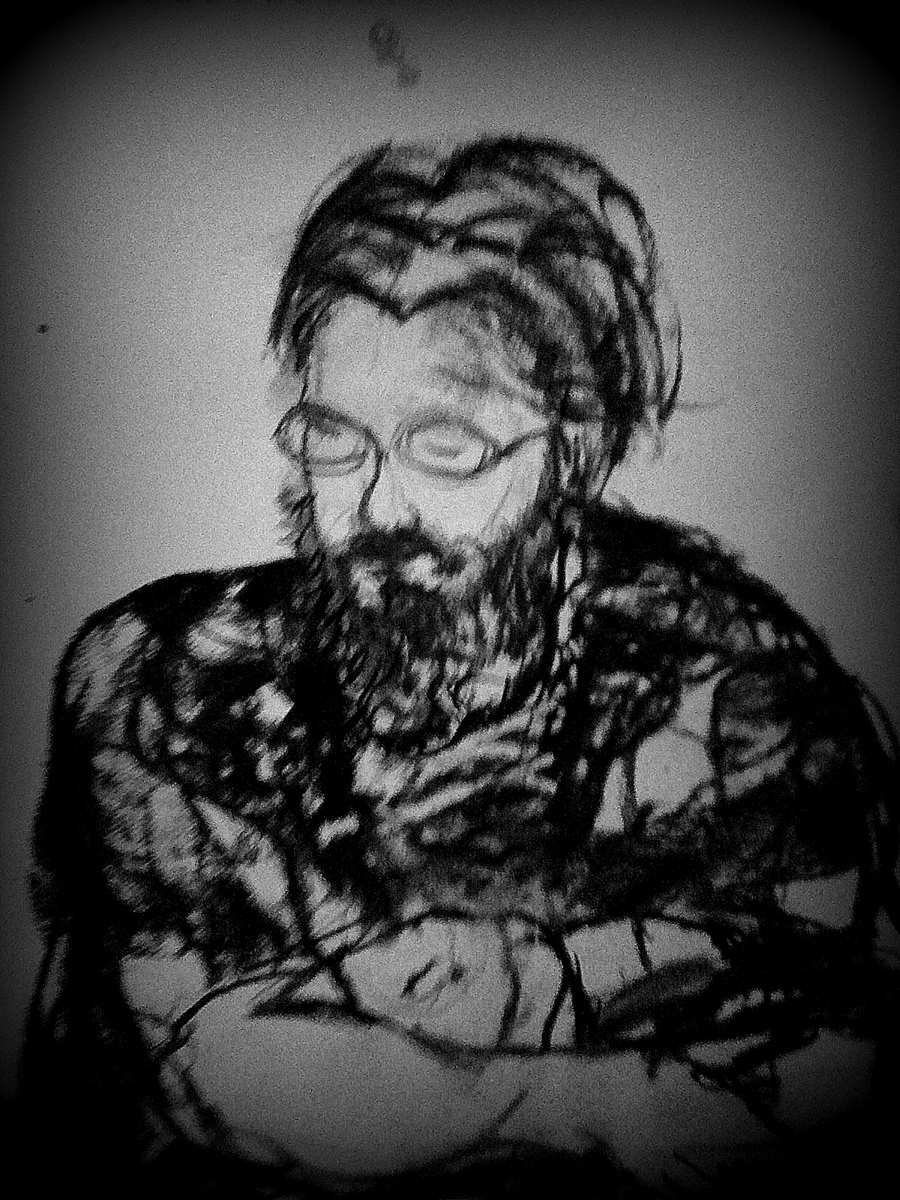
Quick sketch of me by Holly Suzanne

Living is a kind of madness (a prose text)

in reference to

Christian Mihai

Brainsnorts

Boy with a Hat

Adventures in American Writing

and others, thanks!