1. Family
2. School
3. Prioritization of Personal Pursuits
Structural Prioritization of Readings: Fall 2013
(please click on image for display)



Structural Prioritization of Readings: Fall 2013
(please click on image for display)

After a glorious week smushed together in an old log cabin without running water and an outhouse on the slopes of Pikes Peak Colorado, we have returned. It was wonderful family time – hiking, kayaking, playing, reading, climbing and performing the necessary tasks of cabin-living. Irreplacable. One of our sons was reading “How to Read Literature like a Professor” for his summer reading assignments in the wee hours and pointed out that this type of vacation shared many qualifications of the Quest in literary themes. That feels so right. Life lived in relation to others always seems a quest – to know one another better, love one another better, hear one another better, express and differentiate and develop as persons-in-relation. I have been immensely blessed with a mixed and quirky collective of children from whom I learn so much, and a spouse who cracks and opens me. It is a particular pleasure when the world around us is also so splendid and obviously large as it is in the Rockies of Colorado, and when so many distractions are replaced with shared attentions – mushrooms, critters, rock formations, streams, decrepit mines, wild donkeys, and so on. Priceless time.
Upon return it is easy to see how the quest goes on…kiddos heading back to school…classes starting again…and these packages opened in the pile of mail:
the quest always beginning…
In our realm, Summer busies – schedules, rituals and rhythms deconstruct and a verve of freedom and compulsion arises in our children. And there are vacations and visitors and spontaneous events. The weather withers me, people are drawn to the outside, in all – Summer discomforts me.
And yet…this week expect the visits of my wife’s twin, her aunt, and a long-time friend and his family, AND we’ll celebrate these dear twins birthday with wild national hoopla (July 4 – precious to me because she entered the world, but I’m happy to have help in the celebrating at this level!).
What gathers and whispers…or shouts and plays…runs and claps…talks and snuggles…HOME…those precious to us, invaluable, incalculable,
Yesterday eve we were enjoying a particularly (abnormal) gentle, cool Kansas Summer eve on our porch and listening to the music of Keith Kenniff – placed here as a celebration of Summer’s affordances – dislocated time, gatherings, visitations and travels – favorites – family, friends, nests…
Recently, I have received several queries into either how I read as much as I read, or how I find or know what to read. As I respond to these inquiries, it has interested me how in fact, I account for my reading history. “E.L. Doctorow explained he rarely knew what he believed until he had written about it. Dostoevsky would start authoring a given scene, assuming he understood precisely what he believed about the issue discussed in it, only to have one of his characters convince him otherwise. Frequently it is only through the actual act of creation that we locate what we really feel and think about a subject.” (Olsen, architectures of possibility). That, coupled with “Authors frequently say things they are unaware of; only after they have gotten the reactions of their readers do they discover what they have said” – Umberto Eco…resulted in these self-observations:
Even from persons I deem much more knowledgeable than myself I often hear “you’ve read more than anyone I know…” and I have spent many hours a day for many decades – reading. I was raised in a fundamentalist Christian home, so the concern for truth, authority and canon were socio-culturally inculcated in me from an early age. When I began exploring music, philosophy and literature I found this concern ruling my approach: what is deemed canonical (attested by authorities), what came first?, and what rings true? I remember beginning with anthologies of classical poets, then ancient scriptures, Homer and so forth. Beginning with Plato/Aristotle then forward through those who claimed their influence. Beginning with Bach, Brahms, Beethoven and then forward and back to origins and influences. That has been my habit in exploring cultural artifacts. Find references. Correspondence. Claims. Follow them out. And follow those out. And follow those. And….so on.
As to achieving the absorption of piles of books at a time – when pushed to claim a process – I was surprised at the simple methodologies. I have referred to “transductive reading” from time to time in these posts – the interaction and co-constitutive commentaries that work provides to work. So I read large amounts of materials over large amounts of time (though my wife insists I read speedily) – I find I read sections / chapters / pages from a multitude of books and let them interact in me forming tissues and connections, rather than singular voices or ideas straight through. I read for differences – turns of phrase, terminologies, rhythms, in persons approaches to subjects, rather than reading for topical content or idea-information as data. Where a voice, approach, or technique is unique is often what particular works have to offer, I have come to think. And, depending on genre or reason for reading – as overlaps increase as the volume of “have-read” grows – one can often browse for summarizing sections to find the nuances each thinker or creator proffers.

Then there’s my personal history and approach to things. Hard-pressed to learning from youth=26 straight years of education + 17 years working in or managing retail bookstores – in an effort to be an “excellent” bookseller – implying to me I had to know something of everything a reader might desire (first hand). Publisher’s catalogs, reviews, recommendations, lists, histories, from the development of language to its variation in forms and contents. And always that uncanny recognition of Grenzsituationen – or “Limit Texts.”
“It might be helpful to conceive of certain texts as Limit Texts – a variety of writing disturbance that carries various elements of narrativity to their brink so the reader can never quite think of them in the same terms again. To the brink, and then (for most readers, at least) over. Karl Jaspers coined the word Grenzsituationen (border/limit situations) to describe existential moments accompanied by anxiety in which the human mind is forced to confront the restrictions of its existing forms – moments, in other words, that make us abandon, fleetingly, the securities of our limitedness and enter new realms of self-consciousness. Death, for example.”
“If we carry this notion of Grenzsituationen into the literary domain, we find ourselves thinking about the sorts of books that, once you’ve taken them down from the shelf, you’ll never be able to put back up again. They won’t leave you alone. They will continue to work on your imagination long after you’ve read them. Merely by being in the world, Limit Texts ask us to embrace possibility spaces, difficulty, freedom, radical skepticism. Which writings make up the category will, naturally, vary from reader to reader, depending on what the reader has already encountered by way of innovative projects, his or her background, assumptions and so on…but the more Limit Texts one reads, the less one tends to feel the impulse to return to more conventional narrativity…”
-Lance Olsen, architectures of possibility
These situations are tattooed on my body (literally)…and include:
Samuel Beckett – Macedonio Fernandez – Paul Celan – Fyodor Dostoevsky – Ludwig Wittgenstein – Maurice Blanchot – Helene Cixous – Clarice Lispector – Franz Kafka – Fernando Pessoa – David Foster Wallace – Mikhail Bakhtin – Rainer Maria Rilke – Edmond Jabes – Federico Garcia Lorca – William Stafford – Egon Schiele – Vincent van Gogh – Johannes Brahms – Alberto Giacometti – Robert Musil – Friedrich Nietzsche – C.F. Peirce…
as you uncover these (your own personal) writers – your pantheon
of those who change your view of the possibilities of language and who you can return to again and again
without really feeling you’ve been there before – they become coordinates – network nodes – whereby you
evaluate and expand, extend and engage new writings you are exposed to – forever altering your patience and expectations of literature or whatever cultural artifact-type you crave and are pleasured by…thus making your reading more efficient and your selections increasingly more challenging and compelling to you – as long as you continue to leap out and expose yourself to things that might be unexpected
Ben Marcus – Ronald Sukenick – Laurie Sheck – Mei-Mei Berssenbrugge – Lyn Hejinian – Denis Johnson – Laurence Sterne – William James – C.F. Peirce – Michel Serres – Bruno Latour – Jorge Luis Borges – Cervantes – Immanuel Kant –
your lists will spawn as you follow their correspondences, admirations, criticisms, references, citations,
and you develop your literary canon
more on that another time
**More than a decade on, to update my Grenzsituationen, I’d need to add:
the Philokalia – John Moriarty – St. Isaac the Syrian – George MacDonald’s Sermons – Martin Heidegger – St. John Cassian – Sayings of the Desert Fathers & Mothers – Arkadii Dragomoschenko – Elder Aimilianos – Optina Elders – Haida Myths & Songs – Jim Harrison – St. Ephrem the Syrian – I Ching – Dreamsongs from Australia – St. Theophan the Recluse – Jan Zwicky – Martin Shaw – St. John Climacus – Marguerite Duras, and more…
 To all of you out there loving, protecting, nurturing, listening, comforting, engaging and delighting in your children:
which, as my wife’s card to me pointed out, cannot be incoincidentally unjumbled into:

oh the gifts and joys a good father offers!
and the unmeasurable joy and delight brought a man by fathering.
Greetings readers. I have spent the past few days to-and-froing from my son in the hospital undergoing a corrective surgery related to pectus carinatum, and full-family summer and researching the pros and cons of PDA (patron- or demand-driven acquisitions). I am very happy to say that after a nearly 5-hour surgery, in which we allowed “experts” to cut our son’s chest nipple to nipple, lay back the muscle, chip-scrape “excise” the cartilage out of his ribcage, crack his sternum, reshape him and insert a flexible metal bar…he is recovering smashingly, already walking about, playing card-games, and humorously retorting. This is the first “major” operation, injury, break, accident or otherwise that has occurred to my genetic offspring, and, although I’ve endured much trauma with the injuries and surgeries of my spouse, I was unsure what to anticipate going through in allowing invasive slicings and breakings to my precious son’s body.
Needless to say, it is affective.
At night I slept as if in a dark void.
I felt shamefully unattentive to my other children, lacking energy and focus.
I let deadline stressors and ongoing responsibilities take their places in my tissues and veins, deep recesses of my cortex, and let my eyes drift repeatedly into mid-point aether.
I don’t know.
Something like this went on in my son.
it was pretty foggy in me.
So now we enter “recovery.” Realignment. Exercise. Recall. Precision. Strengthening. Focus. Effort. Rest.
and facing the stack of avoidances.
Recall looks like this (for me):
My Medicine(s):
– regaining presence of mind –
“You could try to express what bliss it was in those days to be alive. Of course there were bothersome things here or there. Terrible things, if you looked too closely. There was the dreadful burden of everything that’s too much alive, all that mingles with air, earth and water in an attempt to destroy you. There was the malice of men, the voracity of beasts, and the indifference of objects. There were all the sounds and sights and smells like continual dagger-thrusts in the flesh. It wasn’t easy to live with all those things; no, no one could have said it was easy. But all the same it was funny in a way, touching and funny, a splendid adventure complete with emotion, language, consciousness, and perhaps, in some recess of the memory, a kind of nostalgia for silence and peace…Yes, what was happening to you was an unforgettable and unique adventure…”
-J.M.G. Le Clezio, Terra Amata–
HERE’S TO YOU SON
Fathers Day gifts arriving early….
already ecstatic…
trusting always that these might inform…
all of us
for my wife on Valentine’s
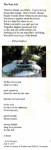
The Way It Is
There’s a thread you follow. It goes among
things that change. But it doesn’t change.
People wonder about what you are pursuing.
You have to explain about the thread.
But it is hard for others to see.
While you hold it you can’t get lost.
Tragedies happen; people get hurt
or die; and you suffer and get old.
Nothing you do can stop time’s unfolding.
You don’t ever let go of the thread
–William Stafford
“Was there ever a period when my words weren’t already headed?”
-R.M. Berry-
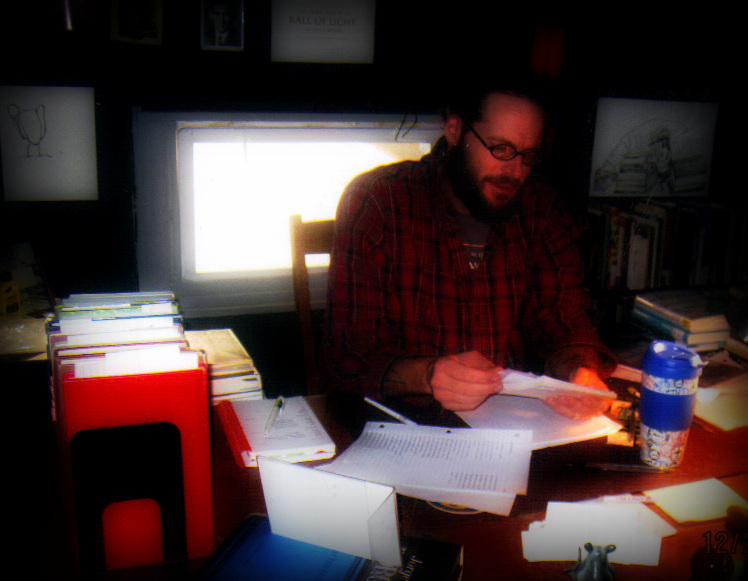
the Superstitious Naked Ape had the great idea of each of you offering a photo of your workspaces – see comment below – would be intriguing – feel free to provide
Student Magazine of IISER Mohali
Music, Musicology, and related Matters
a photographic pilgrimage to Orthodox Christian monasteries across the continent
Meandering Through a Literary Life
Orthodox Christianity, Culture and Religion, Making the Journey of Faith
Erik Kwakkel blogging about medieval manuscripts
"That's the big what happened."
Networking the complexity community since 1999
 All my Words are Silent