Family is Fiction, part two

FAMILY: A FICTION, PT. 1

Family 1

2

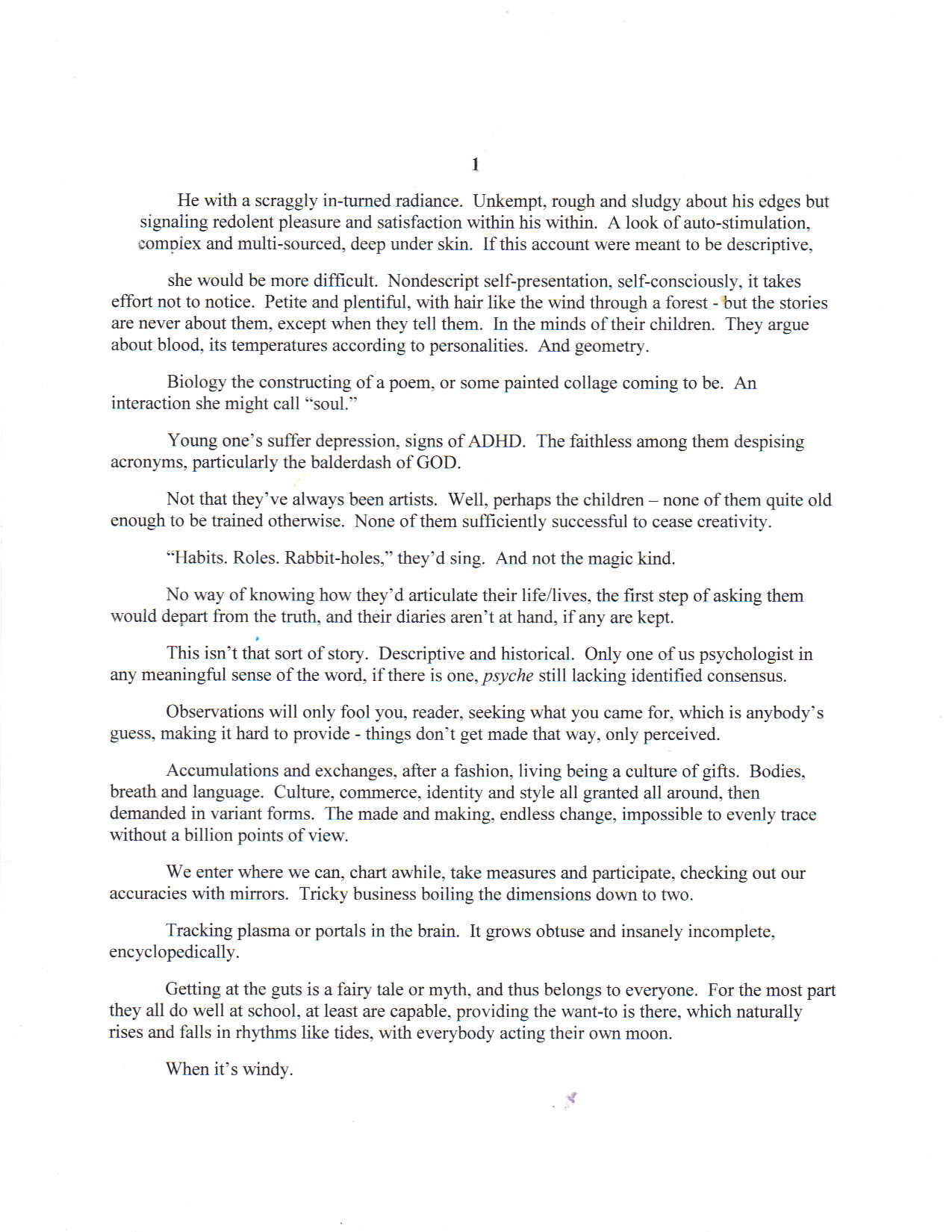
            Quick to give up, or in, to description.  Sidelong glances, or enough periphery, and it’s known – they are there.  Are here.  Which is firstly what needs be established.  Shaggy in-turned male and self-consciously-nondescript-as-a-waged-war-within-herself – are here – whether explicitly denoted or not, for that is not what this story’s about.  And all of their children – as if we’re in shadows – near presences felt.

If the man were currently reading (he is reading now), and is sitting at his desk, surrounded by more words, words bound up to burst and licking the chops of their leafy lips, prepared to murmur and shout.  It seems to him.

And she would be (read “is”) pushing a broken body into limited stress-inducing motions purposed to loosen and tighten.  Laying on a mat on a floor watching women on a screen count and stretch and breathe, mimicking them with her own limbs and torso. Accentuating her “core,” strengthening her “self” for this losing battle.

The children are learning and eating, playing and working – whatever it is youth do to fend for themselves and their futures – their shadow-dance with age.

Unable to say it as is – the is too complete and far from attainable – in segments and particles, or a falsified whole from great distance.  Oh nature.  Oh being.  Because of the facts, we have to just enter, and being recursive it matters only slightly where or when – inception/conclusion are unrecognizable to a decentralized everywhere, connective and mobile.

Some are known by their doings, some by their fathers’ or mums’; others according to their works or the times.  Some hardly known of at all.  To speak of them is to personally encounter –  as if face-to-face – an intersubjectivity of optimal expressivity.

Or not.  Language gets carried away.  When we search for a meaning or some explanation is it not because we already believe it is there?  Something already imagined?  What remains is a tying together in  idealized systems like logic – building a case or crafting a theory, replete with supporting cast of regulatory theorems.  Which demonstrates little but our ability to make science out of anything.  Exercise in closing the systems.  While all remain open.

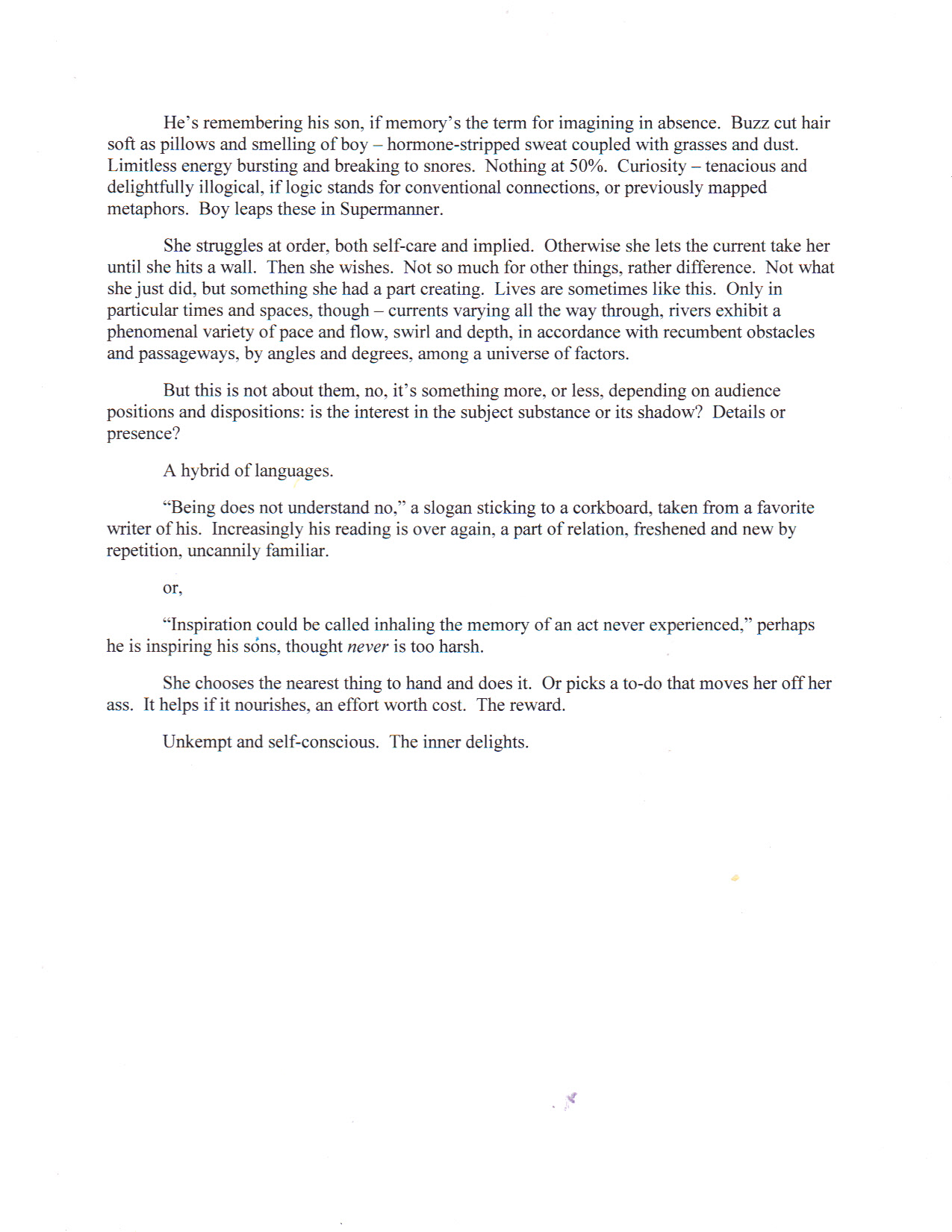
The rugged male shifts from his papers, given possibilities, which it turns out rhymes everything.  She teases her hair nonchalantly (she hopes) and attempts to forget her over-calculations by delving into them – representing them – externalizing image and textures.  Viewed askance not head-on, but in outlines and shades or peered at and through, as we’d envision a form from behind.  Anything to remove the scrutiny of mere appearance – incorporate more and defraggle illusions of skin.

She scribbles it onto used papers,  ready surfaces already marred, turning scarrings and blots into figures and wounds; while he accentuates the peculiar, alarmed by specifics and seeking connective similitude.  If a thought comes queer, he tattoos it with ink until it sounds available.

Both, in a way, finding commerce, a transaction with others engaging/avoiding themselves.  Feeling so like and unlike.  A pestilence of the species, er, human condition – overwhelming similarities of form with infinite intricacies of difference.  Everything related – never one without another – a closed system of incalculable possibilities.  They labor in.

Male smells sour in just a few days, not accustomed to shouldering public, perhaps what allows for his mess.  Adapting  to the threat of her attention, though in the absence of comprehension.  She allows him his comforts till they confront and offend.  Peaceable enough – this arrangement – and duly provocative:  they enhance and combine, stimulate and remind one another in a struggling intimacy – they love.  Not without precedents or fear, but they love.

And in their sleep, the gears will turn.

He writes off stuck places – the uncanny processes of dreams.

The children behave like loosely arranged magnets, at times slamming close, or sullenly repelled.  Usually vibrating, tensely, between.  The volatility of past and a future reacts in young bodies as now.

Viewed collectively – it’s an inter-&-co-dependent mechanism, sketchy and atomically diagrammed – similarly potent (at least potentially) in its splittings and pressures.

Live things best metaphor themselves.

Fumbling toward FICTION

Okay, here goes.  I’ve been diddling my way into another attempt at a longer go of writing, and today have decided, (largely by the courage of company – Tocksin has also begun posting portions of a novelistic go) to post a few rudimentary fragments.  Up until yesterday  the working title was simply FICTION.  I’ve written 3-5 chapters over the past month or two and in seeking an orientation for the work certain symbols and recurrences have led to an inquiry.  “Write about what you want to know” Lance Olsen says, and I can see I’m searching after something in these words.  The epigraphs that shoot me on are the following…

“Reality is the motif”

-Wallace Stevens-

“The universe was the glue that held him together”

-Jonathan Lethem-

“I only care about fiction that raises the question of what fiction is…”

-R. M. Berry-

“The line is only a shadow cast by one (memory or fiction) over the other (fiction or memory).  Once I place memory into language, memory becomes a rumor that makes room for uncertainty.  Memory slips into fiction but then fiction becomes memory once again in an/other way…It is difficult to separate fiction from memory, which is different from separating truth from lying.”

-Doug Rice-

and so it begins…

Family 1

Family 12Family 13

Emissions from the Helmet of Horror, novel mythology-cognitive-science-literature-art

“no one realised that the book and the labyrinth were one and the same…”

-Borges, The Garden of Forking Paths-

[as leaked from the skull stuck to Victor Pelevin]

“…progress is a propulsion technique where we have to constantly push ourselves away from the point we occupied a moment ago…the funny thing is that the concept of progress has been around for so long that now it has all the qualities of a myth.  It is a traditional story that pretends to explain all natural and social phenomena.  It is also a belief that is widespread and false.”
“If a mind is like a computer, perhaps myths are its shell programs: sets of rules that we follow in our world processing, mental matrices we project onto complex events to endow them with meaning.  People who work in computer programming say that to write code you have to be young.  It seems that the same rule applies to the cultural code.  Our programs were written when the human race was young – at a stage so remote and obscure that we don’t understand the programming language any more.  Or, even worse, we understand it in so many different ways and on so many levels that the question ‘what does it mean?’ simply loses sense.”

Ariadne:  “…The diagram was called ‘the helmet of horror’ — it was written in big letters above the drawing.  The main body of the machine was shaped like a helmet.  And there was an identical helmet standing on the demonstration table — an ancient bronze headpiece, and underneath it a visor with holes in it curving back inside…Its lower section ran back inside the helmet through a slit in the middle of the face.  And there were some kind of side plates too — everything was very old, green with age.  It looked like a Roman gladiator’s helmet — like a bronze hat with a visor.  Only this one had horns as well.  They came out of the upper section of the helmet and curved backwards…the helmet of horror consisted of several major parts and a lot of secondary ones.  The parts had strange names: the frontal net, the now grid, the separator labyrinth, the horns of plenty, Tarkovsky’s mirror and so forth.  The largest element consisted of the now grid and the frontal net.  It had two parts that were sometimes fused into a single unit.  Its external part, the net, looked like a visor with holes in it, and its internal part, the grid, divided the helmet into an upper section and a lower one, so there was no way you could squeeze even the smallest head into it…the now grid separates the past from the present, because it is the only place where what we call ‘now’ exists.  The past is located in the upper section of the helmet, and the future in the lower section…The helmet’s operating cycle had no beginning, so it can be explained starting from any phase.

“…start by imagining the gentle glow of a summer day caressing your face.  That’s precisely how the frontal net, heated by the action of the stream of impressions falling on it, transmits heat to the now grid.  The grid sublimates the past contained in the upper section of the helmet, transforming it into vapour, which is driven up into the horns of plenty by the force of circumstances.  The horns of plenty emerge from the forehead, curve around the sides of the helmet and intertwine to form the occipital braid, which descends into the base of the helmet.  There, below the now grid, the bubbles of hope that arise in the occipital braid are ejected into the region of the future.  As they rise, these bubbles burst against the now grid, generating the force of circumstances, which induces the stream of impressions in the separator labyrinth.  And the stream of impressions, in turn, is shattered against the frontal net, heating the now grid and renewing the energy of the cycle.

“It’s not always hope at all, it’s more likely to be fear and apprehension, suspicion and hate, all sorts of nonsense, in fact any of the cud that is chewed with such habitual stupidity…technically speaking it is correct to call them bubbles of the past.  They are called bubbles because their constant tendency is to expand and occupy the entire volume of the helmet, preventing anything else from appearing in it and leaving no space or opportunity for the recognition of what is actually happening…since past is enriched exclusively with more past, the bubbles of hope consist entirely of past, they are simply past in a different state…

“The separator labyrinth is the most important part of the helmet of horror.  It’s the place where everything else is produced out of nothing, that is, the place where the stream of impressions arises.  And it’s also the place where the past, present and the future are separated.  The past moves upwards, the future moves downwards, and the present, in the form of the stream of impressions, falls on to the outer surface of the frontal net, generating the cycle’s passionate desire to recur, so that it becomes a kind of perpetuum mobile…”

“That means that it’s past that decomposes into past, present and future?  In actual fact the whole cycle is simply the circulation of now in various states of mind, in the same way that water can be ice, or the sea, or thirst.”

“…the ‘inside’ and ‘outside’ have no existence in themselves.  They are generated by the separator labyrinth by the force of circumstances and from there they enter the horns of plenty, where they enrich the past, transforming it into the state of bubbles of hope.  But since there is no ‘inside’ or ‘outside’ anywhere except in the horns of plenty, the stream of impressions can quite easily arise inside the helmet and fall on to it from the outside.  And the same applies to everything else as well…never under any circumstances regard anything as real.  The entire phenomenon is induced, like the electromagnetic field in a transformer…as far as I could understand it, the horns of plenty operate like enrichment units in a chemical plant.  When it’s driven through them by the force of circumstances, past gets mixed up with everything else, becoming richer and acquiring value, with the result that bubbles of hope are produced in the occipital braid, go gurgling through the region of the future, are reflected in Tarkovsky’s mirror and perceived as the novel freshness of a brand new day.”
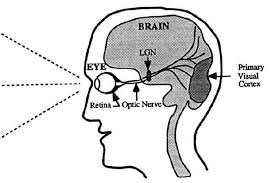
“In real life what you see depends on where you look…the word ‘change’ has no meaning…where you’re looking depends on what you see.  Is that clear?”

“The future is produced from the past, so the further we go into the future, the more past is required to produce it.”

“Free will.  Life’s like falling off a roof.  Can you stop on the way?  No.  Can you turn back?  No.  Can you fly off sideways?  Only in an advertisement for underpants specially made for jumping off roofs.  All free will means is you can choose whether to fart in mid-flight or wait till you hit the ground.  And that’s what all the philosopher’s argue about.”

“Always the way when you feel you’re just about to understand something important.  It’s like the whistle of a bullet or the roar of an aeroplane.  If you can hear them, it means they’re already zooming past you.”
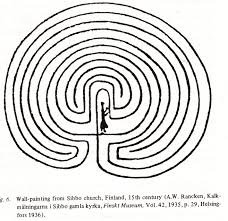
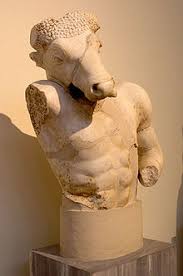
“…a labyrinth comes into being in the course of any discussion with yourself or others, and for that period of time each of us becomes either the Minotaur or his victim.  Although there is nothing we can do with this…there’s nothing we can do without it either…even the discourse itself can only come into being within the discourse.  But the paradox is that, although the entirety of nature arises within it, the discourse itself is not encountered anywhere in nature and was only developed quite recently…Basically a labyrinth comes into being when you have to choose between several alternatives, and the alternatives are a set of our possible preferences, conditioned by the nature of language, the structure of the moment and the specific features of the sponsor.”

“Perhaps that’s the whole point.  Not to think about where the way out is, but to realise that life is the crossroads where you’re standing at this precise moment.  Then the labyrinth will disappear as well.  After all it only exists as a complete whole in our  minds, and in reality there is nothing but a simple choice — which way to go next…We’ve all got dead-ends.  Only it’s not obvious straightaway, it just takes a little while.”

“The helmet of horror fractionates the one thing that is, into the multitude of things that are not.  But since the helmet of horror is in no way the one thing that is, it is also one of the multitude of things that are not.  And the things that are not may enter into every possible conceivable and inconceivable kind of relationship, since these relationships do not in any case exist anywhere except in the helmet of horror, which does not actually exist itself…An individual by the name of A may be a part of the helmet of horror worn by B, and an individual by the name of B may at the same time be a part of the helmet of horror worn by A.  This is the final infinity in both directions, and often both of them are quite nice people.”

“The means by which for many millennia he has attempted to make himself real are terrible and foolish, like all the mysteries of his world.”

A remarkable new mythology from Victor Pelevin

(all above quotations arise from!)

Aspect of Architecture

“A well-crafted sentence overturns the notion that thought is distinct from thinking.  A well-crafted sentence enacts the sense it makes rather than representing it.  The result of writing well-crafted sentences is that your reader will have the most vivid sense that something is happening to him or her and with the irresistible urgency of their own dreams.”

“Dedicate yourselves to reading most energetically that which you don’t immediately understand.  Read with a special attention to the prospect that what doesn’t appear to make sense matters most because of the possibilities of sense-making that are portended in it.”

author Alan Singer

taken from:

A strong mid-section

OCTOBER 2011

POSTMODERNISM AS LIBERTY VALANCE: NOTES ON AN EXECUTION

THE RITUAL KILLING OF POSTMODERN LITERATURE IS A THREE-MAN GUNFIGHT AT THE O.K. CORRAL (ALLEGORICALLY SPEAKING)

Finding a lot of resonances and curiosities in this collection that I’d like to recommend – a fruitful pattering of words to engage – I especially have liked the introduction (can’t find pdf of online) and then I thought the midsection of the essay linked above (click anywhere on the opening titles to read) was strong and productive.

“It’s always a question of beginnings”

Another year.  The title of this post comes from Helene Cixous’ introduction to Clarice Lispector’s The Stream of Life, both books being part of the tight reliable necessities of each of my own repeated beginnings.  No matter how I try otherwise, when the first of a calendrical year comes around with its socio-cultural aura-like atmospheric influence of the idea of new beginnings…I find myself tracking to the shelves for these few cellular texts like the body seeks to breathe.  This has been my inalterable habit for so many years now, that I can not avoid recommending them (with the highest deepest forms of  loving attachment), to all of you.

“evoking the incommunicable realms of the spirit,

where dream becomes thought,

where trace becomes existence…

I write you because I do not understand myself…

it is always a question of beginnings.”

“And for many years I have been writing,

borne by writing,

this book that book;

and now, suddenly, I sense it:

among all these books is the book I haven’t written;

haven’t ceased not to write.”

and additionally, today:

“What I mean is, if you have ink in your blood it’s hard to get it out of your hands…

Our reputation for excellence is unexcelled, in every part of the world.

And will be maintained until the destruction of our art in some other art which is just as good but which,

I am happy to say, has not yet been invented.”

“Samuel Beckett: Try again.  Fail again.  Fail better…

to conceive of writing as a possibility space where everything can and should be considered, attempted, and troubled.”

May your 2013 be filled with incredible texts and integral growth and development!

The Gift that Explodes, 5 : Whispered Leavings

Notebook 5

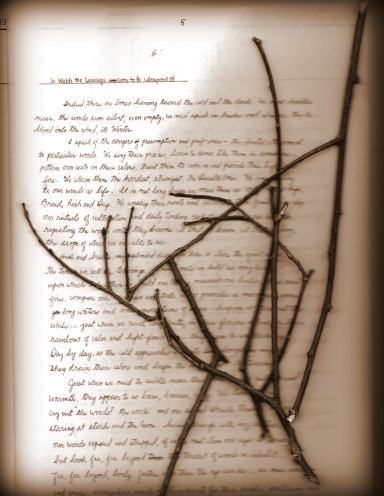
This constitutes the 5th page of the Notebook given me by my daughter…here it is in typescript:

5

In Which the Leavings Whisper

Indeed there are times of leaning toward cold and the dark.  We huddle close, our woods seem silent, even emptied, so we hush and sound our whispers, to blend them into wind, its Winter.

I speak of the dangers – presumption and preference – too-devoted attachments to our particular woods.  You hear us sing their praises, we dance like them in breezing sunlight, pattern our coats according their colors, entrust them to shelter and shade us, providing our true light and fire.  We claim them the hardest and strongest, the Durable Ones.  We come to cling to our woods as life.  Dear child, it is not long before we view them as the “only.”  The Most and Highest, the Broadest, Richest, Rooted Deep.  We worship their hold, celebrating their fruit.  Develop our rituals of cultivation by tending them daily, each of us making our rounds, repeating the woods until they are all that we know, all that we love, the scope of which we are able to see.

Hush and beware, my splendid dear, for here is where the quiet comes.  The times we call The Leavings.  These very woods to which we cling, within and upon which we build our homes, nourish our bodies and fuel our fires, compose our messages and texts, which provide us with movement over long waters and vast mountains of snow – keeping us warm all the while – just when we revel most confidently in their glorious splendor, their rainbows of color and light-glowing hue…they begin their wandering away.  Day by day, as the cold is approaching with its elongating nights, they drain of their colors and begin letting-go.  These, my child, are The Leavings.

As we cuddle near their time-trusted fullness and warmth, they appear to us bare, barren, and grey.  We look up, we cry out “the woods!  the woods!” and our sound shrieks right through, we are staring at stark and the Gone.  Seeing past in icy clarity, our woods exposed and stripped – if we do not close our eyes in terror, but look far, far beyond our own tangled thicket of woods…far, far beyond, my lovely, farther even than the eye can see…are more woods, and more, everywhere woods making scents for their peoples, sheltering and shading them, burning and abandoning them as well.  If we hush and refuse ourselves despair as we see our woods give out, in turn setting ourselves silently to listening and keenly looking out – we can know the lessons of the Leavings.  That there are further woods than ours, many woods and other, only farther out.

We grow easily impatient of our woods in our discomforts and our panics and our fears.  Yes there are countlessly many Leavings – you can count on them, and by them, but my tender one, if you will persist and endure, if you are open to their lessons and their silence, the woods will come back to you, freshly and new.  There will be young woods you never knew before, and the old ones return too.

Our woods are never so much lost as that they undergo strange changes.  They break and wither, shrivel and drop – they must shed themselves of their embellishments and gathering continually – so they might produce themselves again, altered and renewed.  Their many uses over untold years are logged within their roots and cores, marked and divited, scarred and sapped – it is for us to remember and adapt, let go with them and wait, wait, enduring the Leavings with all that we have, slogging onward toward new growth.

Oh yes it is frightening to feel all is lost, sweet child of wonder, but our woods never fail us finally, they leave us to be born.

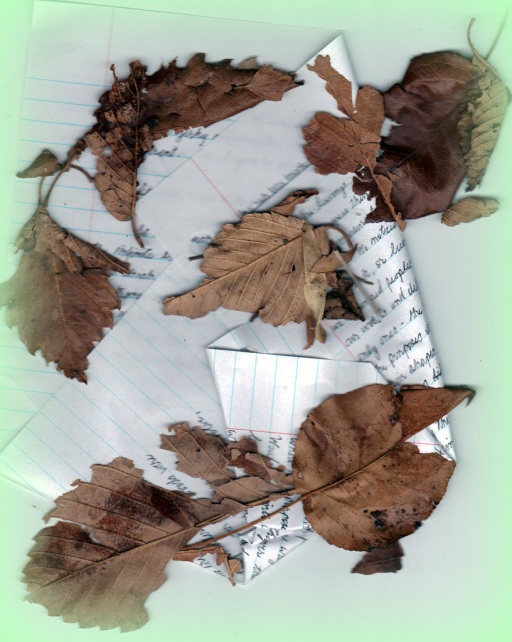
And this is why I gather samples wherever I happen to go – fruits and nuts, leaves and needles, parts of any woods I chance to see or hear – in order to remember and remind in times of Leaving that somewhere, and at any time, we will live again in woods that will be full and bright, returning the woods that we’ve known toward our unknown need.

Now rest, child, rest…the night is quiet and cold, let the woods hush and whisper through your dreams…

click this image for the document in its current entirety:

Notebook - Ida

The Gift that Explodes : 4 : a Loose Leaf

Here is page 4 of the Notebook from my daughter, which was a loose piece of notebook paper inserted into the stapled set.  Here is what’s become of it thusfar:

Page 4
Page 4

and the typewritten text

4

In Which Is Inserted a Loose Leaf

Becoming aware of the change.  My little one, as we let (or made) our woods carry us far, we discovered beings everywhere – and all using woods.  Having named our woods and defining ourselves by their usage – we had thought ourselves the only ones – the People of the Woods – and were surprised and astonished at the purposes others would put them to, at the sounds they were able to emit, at their shapes.  Even the structures they built could seem odd, and their burning came from strange fires.

Everywhere we ventured we found the woods relating to life.  Its giving and taking.  Beings used them for weapons and tools, they used them for shelter and warmth.  As our knowledge of woods grew enormous – the kinds and environments, uses and names – the Mysteries of the Trees began to grow.

In places they were pulped to a gum and let dry, then marked with a rock or hot iron.  Other places they were chopped into boards and large planes and smeared with designs from animal blood.  It came to seem the whole world was made of beings and woods, each defining themselves by particular use.  Battles were waged over woods, clans and families splitting apart, even lovers argued over true uses of woods – what they purposed, how they worked, why they mattered, which ones, what was proper to do with your woods.  Little one, woods came into conflict, everywhere.  People fought over which woods were best, or which had more power or weight, which cores were pure and which garbage, what woods should serve for what.

We wanted our woods to do everything.  To solve and evolve, to stand and retain.  But our woods continued to change as we lived them.  Some grew smooth and slipped from our hands.  Some hardened like rock and got to heavy to carry.  Some simply crumbled to dust.  As their variety grew, so our experiences – we encountered moments when we could not find the woods that we needed.  It distressed us and we cast about in clumsy silences and jerky motions.  We grew hungry for new woods that were different.  We began to play with the roots and the seeds, combining and grafting or trying new soils.

In times like these, there was speech of The Leavings, of infinite limits of life.  The old among us would point out the woods where we no longer dwelt or visited, had let rot or decay, and would question our strange new graftings.  The woods were always changing, dear child, there are always new things to learn.

It is time, then, to speak of these Leavings…draw near…it is our custom to address them in whispers and cold…

the Notebook as it is filled as of now, can be read here:

The Gift that Explodes: A Notebook


Continuation of the Gift that Explodes: In Which the Wood is Entered, Entering

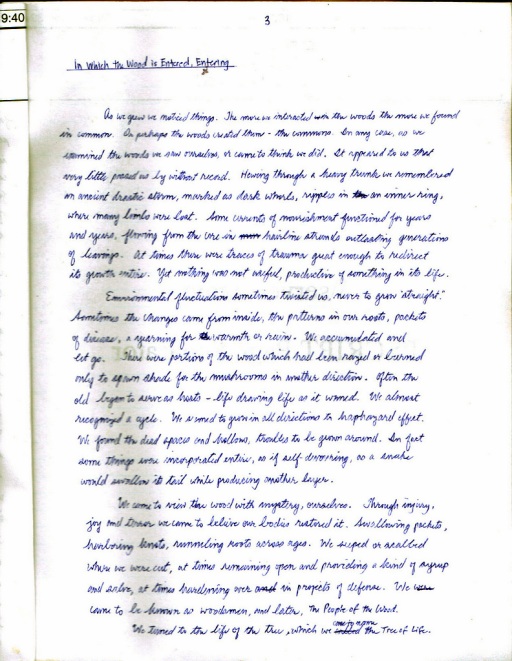
Here is page 3 of my blank-book daughter-gift “The Notebook” (click here for parts 1 and 2)

Notebook - Ida


Notebook 3

and the typewritten text:

3

In Which the Wood is Entered, Entering

As we grew we noticed things.  The more we interacted in the woods, the more we found in common.  Or perhaps the woods created them – our commons.  In any case, as we examined the woods we came to see ourselves, or began to think we did.  It appeared to us that very little passed us by without record.  Hewing through a heavy trunk we remembered an ancient drastic storm, here marked as darkened whorls, ripples in an inner ring, where many limbs were lost.  Currents of nourishment functioned over years and years, flowing from the core in hairline strands, outlasting generations of leaving.  At times there were traces of trauma strong enough to redirect the growth entire.  Yet nothing was not useful, productive of something in its life.

Environmental fluctuation sometimes twisted us, never to grow “straight.”  Sometimes the changes came from inside – the patterns of our roots, or pockets of dis-ease, a particular yearning for warmth or rain.  We accumulated, and let go.  There were portions of the wood which had been razed or burned, only to spawn shade for mushrooms and ferns in some other direction.  Often the old laid down to serve as hosts – life drawing life as it waned.  We almost recognized a cycle.  We seemed to grow in all directions at once, to haphazard effect.  We found dead spaces and hollows, troubles to be grown around.  In fact some things were incorporated entire, as if a self-devouring, like a snake would swallow its tail if it could, all the while producing another layer.

We came to view the wood with mystery, ourselves.  Through injury, joy and terror we believed our bodies re-stored it.  Swallowing pockets, harboring knots, runneling roots across ages.  We seeped or scabbed where we were cut, at times remaining open and leaking a kind of syrup or salve, at times hardening over in projects of defense.  We began to be known as “the woodsmen,” and, later, The People of the Wood.

We were tuned to the life of the tree, which we revered as The Tree of Life.


Read “The Balloon” by Donald Barthelme

“The Balloon” by Donald Barthelme