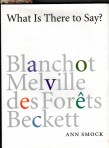

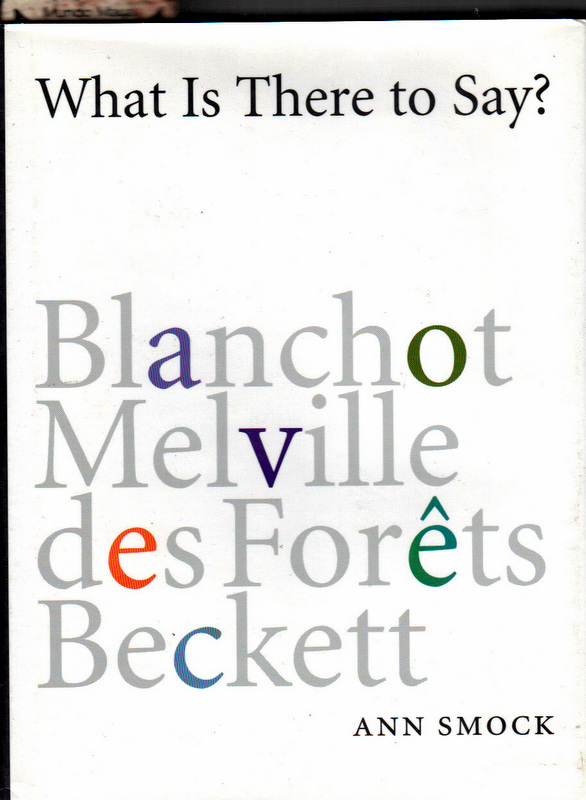
A book I am reading asks, in its title, What is there to say? Another, next to it on its anticipating shelf, states “very little…almost nothing.” Are they in conversation?
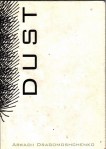
In completing Dust by Arkadii Dragomoshchenko for perhaps the ninth time, I come across a phrase I’ve starred and underlined in three colors: “We talk only because of a persistent desire to understand what is it that we are saying.”
If someone took the time to calculate how many times the word “other,” used to refer to a subjective entity, occurs in philosophical texts post-Heidegger.
What is being?
I often experience the anomalous reality of hoping wildly in the midst of despair, a fervent belief in oxymorons – things like “Poetic Influence” and “Romantic Love.”
How music crafts melancholy and joy.
Perhaps someday we will concoct a system of chaos.
The weather is large enough.
I say “I love you” because I’d like to understand it.
Edmond Jabes has it that “the words of the book were trying, in vain, to say Nothing” (writing of sacred texts) or, in other words, some persistent and extravagant Babeling into Derrida’s vast abysme of origins and effects. What is impossible. “Our persistent desire.” So Jabes asks “Is our relation to the world first of all a relation…to an expectation, a hope of world pregnant with all possible beginnings?”
I ask myself, then, what is it I have to say? The echoing answer “very little…almost nothing.” Persistent desire.

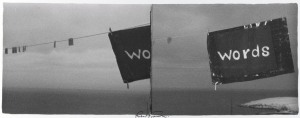



 All my Words are Silent