
Remarking Mark…Part the Second

Mark Marking Questions

“Man is a riddle.  Our complex relation to others may also be affected by our fascination with this riddle…Origin means, perhaps, question”

Edmond Jabes


“Writing as the ‘talking cure

he thought, thinking in language what he thought language might do.  Be doing.  To him.

He heard “why?,” a term learned early in order to learn, and thenceforward laid over nearly everything he read, encountered, overheard or stumbled across, as if it were his placeholding destiny in some infinitely progressing equation simplified “world.”

He’d read he needed other persons and things, places and times to know his own.  – “Why?”

He’d heard “until others acknowledge or teach you your shape, your ideas, what you see what you feel what you taste or speak or hear, your perceptions and scope, you won’t be aware of a thing.  You’ll have no ideas or sensations per se, you’re essentially Nothing without Them.”

Arching his back and shrieking a sound at an absence of breast: “why?”

“I guess I’m just punctuated that way,” he came to think, as he adapted vocabulary.  “My role in a sequence is: – ?”

“And God said ‘Let there be light,’ and there was…” well, maybe – ?

“The Tao that can be named is not the eternal Tao…” well, maybe –  ?

“1 + 1 = 2,” well….maybe – ?

“You are Mark, a male form of a human animal, replete with these working organs, the English language, and certain beliefs.  These are your parents, your sibling, your probable friends.  Here are some feelings, some expressions and thoughts.  Here are your words.”  Well.  Maybe – ?

Shaped with letters and numbers and sounds.  Voices and touchings and feels, he became, slowly, surely, puttied toward a recognizable form – perceptible to others, acknowledged, even affirmed or engaged from time to time.

“Why?” propelled the lengthening problem of life but never grew toward solutions.

He read elaborate explanations and descriptions as he borrowed more languages.  Spiritual terms, medical terms, words scientific, political, philosophical and intimate.  Thick reams of median symbols asking to be joined or embraced, understood or imbibed.

Mark enjoyed these fabrics, and found a belonging among them.  Layers and theories, emotions and dreams – he simply need append his simple gesture – ?


Trouble, in the form of discomfort or pain, of disjunction, arose when agreement was desired.  Explicitly or implicitly, this undermined his form.  In situations where reciprocation or statement, some firm relation was called out for, his questioning mark failed to serve.  Choices, commitments, integrities or beliefs turned to drizzle around his definitive (self-identified) symbol.

“I love you,” she wooed.  “-?-“ he replied.  “I cannot know what you mean, what your language portends, I am unable to verify why?” he’d respond.  To collapse and retreat.

Even thoughts and decisions were questioned and split open on his sharp weapon of a mark.  He was not trusted or deemed trustworthy as doubt was perceived an anomaly.

He remained uncertain.

Self-perceivably, he reliably questioned, he’d respond and then take it away with his mark, his “signature move” as it were, his undoing.  “Yes I will…” “This I think…” “I am…” always followed by his -?- (which sounded like “why?” in the air) and found no rationale that could not be further put to query.

The world was unstable as well as a “self” for him.  All under the branding shadow of “why?”  This Mark never outgrew in all his adaptations, acquisitions, mutations and metamorphoses.  His certain core of uncertainty.  His permanent doubt.  His oxymoronic reality of being, not-being -?-

They perceive him – they really do – but as full of content with no substance; as possible and capable yet a great risk; as veritably human but unnamed from within.  Without “identity.”  This is true even of his wife and his children, parents and friends, all unsure who or what they are relating to, marked with the sign of the -?-  The indeterminate one, the questionable and uncertain, the duplicitous and vague, are various ways he is read and conceived – standing there as he does on his tiny spot of here, long-legged and stooped as in prayer, or inquiry – ? –
Telling Our Stories

This slideshow requires JavaScript.

Telling Our Stories

After all, it is language, this story.  This telling of you, of me, of our feelings and years, whatever we’ve done.  We are just speaking, really, creating from language our world and our children, our works and our actions as if we remembered.

I can’t see the harm in it.

I say I remember, here looking at you, that first time in your eyes, whether 18 or 40, when we may have sat facing each other or entwined, as if we’d first met and must absorb everything.  How large they seemed, how blue and soft as rain, how far I could swim there as if building a nest.

I don’t see the danger in using our language to say so.  In making up stories, alone or together, about us; our world and our selves, what we think.

After all, it is language we share.  As you bend at your work, your collar reveals a fresh sentence, your skirt a painting of terms, in your flesh all these stories I study to learn.  Of your breast and your elbow and hair.  The nape of your neck exclaims and your scars everywhere.  What the poet said, also with words, combining verbs and adverbs and nouns: “Your body is a book of thoughts that cannot be read in its entirety.”  Just words, but I keep them and sing them again, I can’t see the harm in the trying.

I love you with terms of my body.  I sign them to you when it’s dark.  It is language, oh yes, and you hear me.  We read with our skin.  Typography refers to impressions.  You impress me, even as I Braille what I need.  How else might we weave what is we without terms and strokes or gestures?

Only language, after all, that we borrow, I get it.

But where is the frailty in trying?

I read and I read and I read what you tell, ever growing a Talmud of comment.  I notate, I argue, I vent.  Then repeat.  I praise and I question and soothe.  You likewise make of my verbiage a stream; a spring from far peaks that dissolves to a delta.  What should we call what we do?  Relat-ivity?  Our capacity to engage and to meet – to relate?  Communication?  Always co-, ever with, filling munitions and messaging, our vocation?

To say, to listen, to hearken, to spell.  Here we tumble and thicken and age.  Her we interpret, reply and enrage.  Here we bind ourselves, it is language we keep using, keep finding, continue to tell…

“………………..Even in sleep

our bodies seek each other, your face the moon

lighting my dreams.  And by day, scenes beyond

untanglement.  Tell me my story, love;

how could I know it, we are such knotted things?

-Philip White, from Aubade

A resonance in technical difficulties

“Writing is for me a means of modulating and organizing phenomenal and circumstantial information from all points of experience, a process I refer to as ‘tuning’ myself.  As I grow older and seemingly remove myself from unity with any singular, or even plural, socio-cultural environment, I seem more ‘on my own’ in a vast environment of internalized experience.  My approach to poetics has become the search for responses and behavioral modes relative to this experience, to surviving it as well as conditioning myself to it.  Constantly the effort seems to be away from any formalization of ideas or structure or definitive process and towards a rejuvenating line of ‘basics’, that mythical point where each process is fresh and new and wholly responsive to indigenous conditions…

“In a sense, I am trying to cope with the urge of poetry as opposed to the structure of it.  This urge seems to lie within the rooted and individual beginnings of the activity, centered on a meditative, self-encoded embrace of those issues and inclinations I find within my own humanness.  The intention therefore becomes the opening of experience toward a continual address of the self”

-Craig Watson-

in

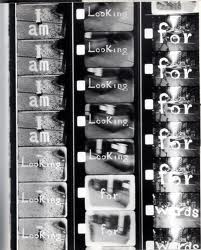
I am Looking for Words

I Am Looking for Words

(click above for full text)

Decompression Addendum: Redefining Terminologies: Finding Words

“The variety of words is another error…I believe words must be conquered, lived, and that the apparent publicity they receive from the dictionary is a falsehood…I now recognize among the thousands the nine or ten words that get along with my soul; I have already written more than one book in order to write, perhaps, one page.”

-Jorge Luis Borges-

Rudiments: Places of Operation

Redefining Core Existence Terminology


Family: those with whom one “belongs,” chosen and not, like it or not, one’s “tribe” – born into and/or evolved and developed.

Home:  states of being or locations, settings in which one IS.  Settings in which one is freest to be.

Love:    shared and mutual, reciprocal regard, respect, desire and preference.  Those with whom one thrives and incites the thriving of.  Intention and attention ( a relation between not inhering in beings)

Friendship:  unmitigated affirmation, reciprocal and intentional.  Native complementarity of being.

World:  internal and external context at any given moment

Self:  whom one is or shows up as in one’s world – at any given moment: individual weave or presentation in circumstantial contexts and settings.

Language:  whatever serves as communique betwixt individual and others and world (internal/ external)

I:  utterer of language, behaver of behaviors, actor of actions, feeler of feelings – as regards the “self”

Other:  any and all beings not the self-regarding individual

Vocation:  that which one IS and DOES; self-perpetuating passion – that which drives and rewards, fulfills and seduces, nourishes and excites desire for an individual…one’s propulsion, desire and satisfaction in being.

Leisure:  rest, reprieve, de-stressification

Fun/Play:  light enjoyment, carbonated experience

Sex:  whole-cloth woven world of contexts of one or more individuals

Art:  combinatory effect of an individual’s self, world, vocation and play; any “otherwise-not” creation of a living being’s given and concocted whole

Thought:  a self’s languaging of “world”

Habits:  automatic or instinctual activities of an individual, supposedly self-soothing or self-managing

Perception:  individual sifting of “world” and “self” (see also: interpretation)

Reading:  engaging the language of others or world or self-as-other

Intepretation:  an individual or group of individual’s “spin” on “universe”

Universe:  arbitrary boundary comprehending all that can be perceived/conceived by an individual or group at a given moment

Conception:  consideration and invention of possibilities of “universe”

Writing:  an effort to live, to exist

2 Sources

Breathlessly discovering these treasure troves of inspiration and encouragement (and great thinking!):

M/E/A/N/I/N/G (particularly examine the essay by Lucio Pozzi – 12 Questions of Art – amazing!)

L=A=N=G=U=A=G=E

“Art, to me, is nothing but a testimony of a flow where order and disorder are interchangeable

and where the darkness of inspiration and desire fulfill unknown purposes within the appearance of space and time”

-Lucio Pozzi-

For Communal Delight

If you enjoy, wish to, revel in, feel ecstasy toward, crave and are intoxicated by

the glories of language

I fervently recommend


for your enjoyment!