
Tag: love
You
Me. We are that we are, how we are, when we are, who.
What has gurgled in me throughout this week, and made it somewhat difficult to post much, is that I ran into these burls. Grief, change, adaptation, struggle – they all push us up against, or cause us to deny or flee from, these knots, these boundaries, these fabrications of how things ARE, how we’d wish they were, or could be. In myself, these evidence as anxieties, fears, verges of hopelessness. With the help of others – my children and their presentness, their being-into (ecstasy), being-out, unique ways of being-with – my therapist, and many other well-intentioned voices and persons who want good for me… I come to see that MOSTLY it’s ME and these burls, these knots, these imagined borders and boundaries in myself – MY IDEAS OF HOW IT WOULD BE NICE FOR THINGS TO BE, my ideas of my “self/ves,” my organismic survival instincts and ancestral tactics – that dislodge me, silence me, THAT I UTILIZE (choose or select) to withhold and diminish and undo my opportunities to be-in, be-with, be-out, be-for the rest of you – the world, my children, my work, my self/ves.
So I’ve been termiting around in these burls. Wondering how do I undo habit, instinct, ancient patterns of stanching, stoppering, limiting a potential flow of the world and my surround and my relationships and my knowledge and my emotions and my beliefs and my feelings and my thoughts and my dreams and my fears and my anger and my sorrow and my regret and my terror and my joy – work WITH those facts… and begin to erode my selections and choices of UNDOING and LIMITING and FEARING and DIMINISHING and instead tear or leap off these quantitative scales of evaluation, these assessments, these CVs and criteria – and JOIN. JOIN. OFFER. GIVE. BRING. SHOW UP. BE.
CHOOSE – slowly, granularly, deliberately, carefully, wildly – to INVITE the world (as it is) THROUGH, and OFFER the world (as it is) THROUGH…
ME
for…to…with…
YOU
…and All.
I don’t even have to reflect to be able to say that Synechdoche, NY – a film by Charlie Kaufman – is my favoritest made movie of my lifetime, or even of all time for my lifetime. And as I burrow in these burls of grinding away at the resistances, the terrors, the wishes, and the ecstasies of being a human alive, stumbling across this short lecture of his has been an invaluable gift. I do not know how to improve on it, so I let it pass THROUGH me… to you…
“Acceptance is nothing less
than the complete transformation
of what one has believed to be one’s self
and one’s reality.”
– Cheri Huber –
The Idea of Maturity (continued) – “Have a ‘good enough’ day”
“Since early years I have been cursed or blessed with a habit of mind – a character defect it may be – that likes to turn over problems that have no solution, or at least no solution that can be provided outside of thought itself (if there).”
– John Deely, Four Ages of Understanding –
This concept of “maturity” as I encountered it in John Armstrong’s Conditions of Love is caught like a burl in my system. Maturity as “not the idea, but the actual reduction of expectation.” Maturity is reductive. Is that so? Is the process of human living a progress of delimitation, scoping the range of experience to our actual organismic potentials? Process, progress, growth not expansive, extending operations, but boundarying and restraining limitations to our hopes?
I take my “problems” to my therapist. They always come back to me changed. “And what are the sources of expectation?” he asked. “Expectation is sourced in the past / oriented toward the future,” he answered. “If you reduce it – “YOU. ARE. HERE.”

Whenever I “get” something like that, I noticed I want to take off with it. Like a skipping stone, I feel inspired and start leaping the surface of things – making connections with this concept and that image, this thinker and that artist, that idea and this experience… activating PATTERNS from my past and projecting POSSIBILITIES toward the future… LEAVING THE PRESENT.
My therapist/guru(?) has been investigating the neuroscience of enlightenment – or being awake to reality / the actual…
…and working with the brain and body to (perhaps) soak or sink there
rather than skip along the surface from PAST toward FUTURE
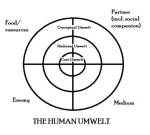
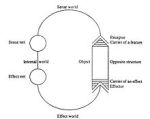
My helpmeet described this as an interesting and fascinating capacity of brains excited by the ineffable to apply TOP-DOWN (or metacognitive, reflective, intentional attention, interpretive) strategies to BOTTOM-UP (automatic, subconscious, pattern-oriented, limbic or reactionary, survival-based) strategies in order to, in a way, burl them – mesh them – unite them with WHAT IS – the Umwelt – our actual EXPERIENCE of BEING a living organism PRESENTLY.
We NEED both strategies to survive, and thrive. Much of our life-world is uncertain and unknown to us – much we will never KNOW in any sense like “understand” or “comprehend.” Life constantly HAPPENS. We are quite limited, reduced, in our capacity to TAKE-IN, ABSORB, “com-prehend” (apprehend-with) all that our life-bubbles afford us and confront us with each moment… We NEED the emotive, reactive, pattern-based knee-jerk reactions to navigate much that could be life threatening (thought not much IS these days – WHAT IF something IS?)…no time to reflect or discourse or meta-cognize it if a car or snake or fire is about to strike you… but we also NEED the reflective, metacognitive capacities to distinguish between what is ACTUALLY life-threatening and what is ONGOING EXPERIENCE – opportunity – potential to comprehend, learn, understand, adapt, adjust, in-corporate, BE WITH.
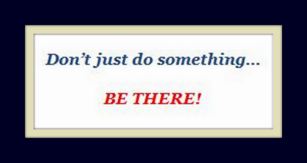
That middle-point : tension-place : meeting-space (“like the appropriate tension of a string on a violin” he said) is perhaps where Armstrong’s maturity IS. Reduced to the present, what’s happening, our actualizing experience – NOT skipping the surface of automated connections drawn from past experience and projected toward possible futures…
In other words (again, in his words)
On Change, Perception and the Idea of Maturity
John Armstrong’s The Conditions of Love is obviously far from through with me, and I with it. My encounter with this writing has challenged me in so many ways. Principally, I think, in querying my bases of knowledge in neuroscience, literature, philosophy, psychology and art – and struggling what is known (or supposed, or observed) in these disciplines toward our lived experience of love, of loss, of change, of survival. Our brains, our stories, our bodies are all so very highly attuned to patterns in our world, perception, experience…how does that work itself out in our lives of loving and losing, changing and adapting? What is difficult, what is beautiful in such behavior and practice? What do domain-specific, developed human disciplines offer us in our mind/body organismic goings-on?
Enormous changes…you could say…REQUIRE all sorts of perspectival changes.
If only, simply, to adapt to the new WORLDS initiated by the universe-altering adjustments that major life changes (positive, negative, or, usually, BOTH) introduce: couplings and separations / relocations / employment, vocation, education / grief, loss, birth, reduction, addition / success and failure and so on…
Our experiential/perceptual “worlds” have been aptly described and ascribed as Umwelten (see also – Paul Bains, Primacy of Semiosis). In drastically simplified form: the concept that we are (each sort of organism) evolved in such a way as to perceive and engage with that in our environments that pertains to our survival and flourishing, our continuance of existence. Those elements or that structuring and interacting with what we select out of our replete environments and surroundings – including ourselves – constitutes our Umwelt – our little “life-world” – species-specific bubble of “reality” (what is real to us, for us).
The sorts of change(s) that provoke potential for maturity tend (I think) to be changes that evince larger (or larger-scaled) patterns of experience and events (although all the minute alterations ever occurring – to the attentive and aware – also constitute mature adaptations for the human – the meditator recognizes the flux in each moment and works to adapt to this flux with openness and acceptance) – in other words, such things as by their very occurrence create/disrupt/introduce significant and substantial structural alterations – profoundly unavoidable – changes to the content AND context of the individual organisms perceptual/experiential SURROUND.
Changes (like those listed above) that, if NOT adapted or adjusted to, evidence a socially recognizable UNreality – a person clearly maladapted to the realities of their situations. An example would be CHANGE or DIE; ADAPT or FAIL in some socially undeniable sense.
ADAPTING – in a “to-obvious-Umwelt-alteration-sense” is what I comprehend as an instance of maturity (a la Armstrong).
The loss of a child or spouse or health or limb. New employment, habitat, geography. Freshly developed abilities, knowledge, or lost capacities or income. New love, memory, trauma – and so on – all represent an altered human Umwelt – adaptation to the ever-changing “reality” would be an instance of maturity – while maladaptation/denial/resistance would be a kind of instantiation of insanity – dis- or mis-alignment/-integration/-accordance to the altered Umwelt/environment/world-circumstance/perceivable “reality.”
Maturity then is our relatively accurate adjustment and adaptation to – our expectations and perceptions – to the “realities” of our ALWAYS-changing life-world.
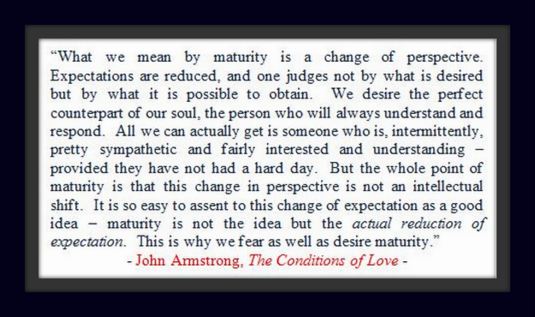
I think Armstrong is right that we have a love/hate relationship to maturity. It is something I (we?) HATE and HOPE for – the changes in our personal and public worlds so mostly beyond our control – air quality, abandonment, accident, reward, attention, ignor-ance, and so on. As he puts it: “maturity is not the idea but the actual reduction of expectation. That is why we fear as well as desire maturity.” I question whether the adaptation is always “reductive” – in some cases, where we tend to be ruled by “patterns” (our past, our available information, our individual perceptions, our nature/culture development, etc.) maturity would constitute expanding, extending and opening our perceptions to the wider, complex and dynamic possibilities of an ever-changing life-world (I think).
For myself: I HATE it (the death and loss implied in honest, authentic reductive maturity – mapping my individuality to my actual surroundings and situations) – I often resent and resist the ongoing change – erosion and eruptions – of the world I’m embedded in. AND I WELCOME it – the reality-check of it, the alteration, breath, fresh potentials of “new worlding” that constant change instigates and offers.
As if our “realities” were 1000 plateaus – layered, indistinct, overlapping, vague and enmeshed. As if “reality” were only (for me) what is perceivable (to me) and a dramatically altered Umwelt STRIKES into me whole new wild conceptions of what the world might be. Reduction / Expansion. Every change offers this. The death (amputation, loss, etc.) and birth (regeneration, appendices, new growth). Every vacancy corresponds with potential and unknown occupancy and vice-versa…
Or so I’m thinking…at this moment in this circumstance…
“Questioning places us in relation with what evades every question and exceeds all power of questioning…it seems that we question more than we are able to question”
-Maurice Blanchot-
…and so it goes…
On Love
I will be up front with you: this post is a failure. If I were able to comprehend, understand or express what it is I have been struggling with myself to grasp and communicate – I would also have the expressive powers to irresistibly beckon my love.
Like many poets and artists, I am not a stranger to great expressions of love. Tales of romance, of idealism, of sacrifice and charity. Of endurance, persistence, obstacles and joy. Of passion, beauty, devotion and charm. Many of us spend the bulk of our lives searching it, attempting to become both loving and lovable, generous and worthy.
What I have wrestled with this past week is how I might convince all of you who have an interest in its meaning, its practice, its enjoyment and its pain that a book I have spent much time reading and reflecting over the past two weeks is worth your full attention. It is entitled The Conditions of Love: the philosophy of intimacy and is written by John Armstrong.
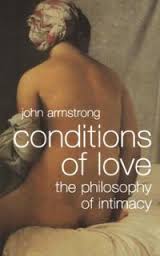
For a while now I have been making effort at examining the “intolerable vulnerabilities” that intimacy evokes in us. Armstrong addresses these in a deep variety of ways, such as “love craves closeness, and closeness always brings us face to face with something other than we expected.” Upon meditating my way through his profound expository book, I have added “incalculable equation” to my sense of love. “Most people are, it goes without saying, sometimes pathetic and sometimes quite competent…reciprocity requires us to hold in mind a complex image of our own nature.” My felt sense upon concluding his words (and those of so many others he includes ever so skillfully) – was a strange sense that love combines the profound gravity of grief and the profound levity of hope.
It is instructive to understand what Armstrong intends by a philosophical account of intimacy: “One of the things which philosophy can do is to try to flesh out, with as much precision as the case allows, just what is at stake in the concepts we use.” And he performs this so deftly. “Hence the more subtle our thinking about love, the more intelligently we discriminate ideals from reality, the more interesting our autobiography becomes.” His is the thinking of the ‘pandoxist.’ “A pandoxist doesn’t locate all the important insights and truths about life in a single system, but tries to seize upon the multitude of truths and insights which are located in many distinct – and often antagonistic – positions…most great systems of thought are founded upon lasting insights…but we generally don’t need to be completely consistent in our thinking…we are attempting to enrich our repertoire of ideas…thoughts which will be helpful at different times and in different situations.” The Conditions of Love satisfies this expertly.
The book has been written. I cannot possibly improve on it, and, although I’d dream of trying – what I most desire is that more humans will engage it toward the extension and enrichment of their lives and the relations they involve . With that in mind I will simply copy some of my underscored passages from Armstrong’s writing – hopefully to successfully convince you that it could benefit you, too.
“The suggestion that love is deep carries the implication that it emerges from deep within us and that it reaches something deep within us. It carries with it an image of the personality as layered.”
“Love isn’t a single thing but a complex of different concerns gives rise to a vision of some of the problems of love. When we try to love we are not actually trying to undertake a single endeavour; rather, we are trying to do a whole range of different, and sometimes not very compatible, things simultaneously.”
“We need love, we have an inbuilt need to love and be loved, yet the two sexes have divergent evolutionary and genetic notions of how love works. The unhappiness of love is the fault of the evolution of the species…which undertakes to show how extremely complex emotions and thoughts are enacted in material processes.”
“to show that love is natural is not in fact to show anything very important…what is given by nature is not necessarily good, and what is achieved by artifice is not necessarily worthless…the experience of love is open to change, but only in some ways.”
“Compatibility is an achievement of love, not a precondition for love…there is no such thing as perfect compatibility, therefore all loving relationships must accomodate some degree of incompatibility.”
“Perhaps the most fundamental fact of human experience is that the experience of being oneself differs radically from the experience we have of others…no other person can complete us…this is something we have to do for ourselves, even if we are lucky enough to find another person who is helpful and supportive and whose character tends to bring out the best in us.”
“friendship is a species of love…there is something about their mode of being, about the texture of their inner life, which seems familiar…it is when we discover, or suspect, some intimate correspondence between our own secret self and that of the other that we begin to move from liking to loving.”
“the very needs which take us into love play a role in the souring of love.”
“love involves a reorientation of our concerns. We are in the habit of being immensely preoccupied by what immediately concerns our own well-being…yet caring for something, or someone, other than oneself can be immensely liberating.”
“the irony is that the more we invest in love, the harder it can be to love successfully. To love another person often requires that we have further and independent sources of satisfaction and security in our lives.”
“of course it can be disturbing, even terrifying, to admit insufficiency to ourselves. ‘Why do I need another person? Because I cannot be happy on my own?’ For some people at least, that is too painful an admission. We sometimes avoid our need for love because it casts us in a vulnerable role…It suggests how deep the need for love goes in us, how hard it sometimes is for us to recognize what it is we are looking for, and how hard it is going to be for someone else to satisfy those needs.”
“infatuation – can be driven not just by a mistake about the other person (thinking they are nicer than they really are) but by a mistake about oneself (wanting to be other than one is)…in infatuation, we use another person as a prop in a fantasy about ourselves.”
“many persons imagine that it is the quality of current feeling that matters; in fact, current feeling is no guide for behaviour under multiple strains and stresses. What infatuation does is to consecrate the present feeling and protect it from serious investigation. Imagination paints a charming view of the future, conveniently adapted to the demands of our current situation.”
“Cupid is the name of whatever it is in us which, without our consent or recognition, provokes the intense longing for attachment which we call falling in love…the fear of love as irrational is not simply the fear that love is in its genesis outside of our control, but that it is not amenable to reason once it is up and running.”
“the forces which make us long for another person to love – loneliness, the need for warmth and tenderness – can be so great that we behave as if we were starving…desperation overrides discrimination…the process of falling in love may be governed not by the intelligent sense of what is good for us but by unconscious forces which cause us to get attached to someone with whom we can – like an addict – repeat a self-harming pleasure – ‘this person is for me’ may be, ironically, true and yet true only in that we have identified a potential source of our preferred misery…a relationship does not start the day two people meet; it starts in the childhood of each partner. for it is long before they meet that the template of their relationship is established. We learn to love as children. Or, more accurately, we learn a style of relating which governs our adult behaviour when it comes to love.”
“much depends on the way in which we find in them someone with whom we can continue the unfinished business of childhood…there is something about this person which coheres with an earlier pattern…Falling in love, then, is a result of two thing coming together: the longings which we have and the workings of our imagination.”
“Our sense of who another person really is is massively inflected by our own concerns…what it is to understand a person – involves having a clear conception of what that person’s real needs and qualities are – a conception which can be radically at variance with the self-image of that person.”
“Love alone can’t make another adult intelligent, generous, courageous, persistent and sociable – unless they are very close to possessing these qualities in the first place…it is axiomatic that people can be wrong about what is good for them; that is, they can be wrong about what will make them happy. This is one of the key reasons why there is so much unhappiness in the world.”
“To love is to interpret another person with charity…of course we habitually go beyond the facts when we find fault with or condemn another…Anger and resentment are frequently founded upon what we suppose another person has intended, rather than on what we actually know about their motives. Charity, therefore, need not ascribe benign motives, but keeps open the possibility that one doesn’t know what really goes on in another’s heart of hearts…to step aside is human…a charitable interpretation seeks out good qualities underneath evident failings and inadequacies – and take a sympathetic view of those failings..requiring a complex image of our own nature.”
“Most accounts of existence place love at the centre of life. We live in order to grow in love – that is the meaning and purpose of each individual life.”
“Love requires the integration of all our powers: we have to be sensual, but also understanding; we need to be able to relax with our beloved, but must equally exercise self-control; we have to mix spontaneity with foresight; passionate, devouring sexual desire has to be tempered with respect…”
“What is wrong with capitalism is not so much that it fosters an unjust distribution of wealth but rather that it damages the personalities of all those who live within it, cutting each individual off from the realization of the true nature, giving rise to internal – as well as external – obstacles to love…If we have to devote our best energies, almost all of our time, to making a living, and if in doing so we have to become competitive, or ruthless, we don’t have much of ourselves left over for love. We can only love on the margins of our lives and with the residue of our capacities…Love, which stands as the natural goal of living, is massively subordinated to the pursuit of the means of living.”
“the reality, here, is that we invest the people we encounter – particularly those we get close to – with characteristics which are not really their own but which derive from our own earlier relationships…construction and transference is an unconscious process – one which we are not only unaware of but which we positively resist becoming aware of.”
“Love, then, can never be the coming together of two perfectly compatible creatures. We are not like jigsaw pieces which can, if only we find the correct piece, lock together in perfect accord. It is as if each person actually belongs to several jigsaws at once and hence fits perfectly into none.”
“Much of the resulting pain of adult life can be traced back to the ways in which the child deals with ambivalence…it is impossible to have a loving relationship which does not involve negative aspects…because a perfectly right partner will still evoke fears and anxieties in us, will still – because of connections back to the roots of love and fear in childhood – become an object of envy or jealousy, will still be the privileged object of our aggression and disappointment…”
“Sex is direct, whereas love is diffuse. Sometimes we need love to be made obvious – and sex is one of the most powerful ways in which this can happen…the troubling fact is that two positions are correct: we are inherently jealous and sexual desire is distinct from love. To accept both claims is to admit a degree of incoherence in human nature…this is an invitation to be more imaginative about dignity.”
“Recuperation is essential to the survival of love because it is inevitable that love will come up against serious difficulties…the point is that even within a good relationship there are continual sources of hurt and disappointment which have to be overcome if love is to survive…their overcoming is actually the growth and development of loving…it is, therefore, extremely important that we work with a vision of love which sees problems not as the end of love, not as a sign that love is over, but as the ground upon which love operates.“
“This is the internal tragedy of love. If love is successful, if our love is returned and develops into a relationship, the person we are with must turn out to be other than we imagined them to be…security can put us off our guard…the notion of maturity is humanity’s attempt to retain an optimistic picture of love in the face of disappointment and difficulty.”
“Maturity is our name for the hopeful strategy which is open to us when faced with something which is both an object of high value (a source of happiness) and, at the same time, threatening, difficult, disturbing..the very things which draw us into love and enable us to invest so highly in another person, to wish to bind our lives together, themselves give rise to disillusionment, frustration, disappointment, and evoke some of our deepest fears and most primitive defences. What we mean by maturity is a change of perspective.”
“In this book I have tried to argue two things…Firstly, the need to love and be loved is deeply placed in human nature – we long to be understood, to be close to another person, to matter in another’s life…the factors which draw us into love also constitute the roots of love’s difficulties. We long to be understood, but it is often awkward to have another see too much of one’s inner troubles…we do not go through life with a coherent set of desires, and anyone who charms us in one frame of mind may be annoying or threatening in another. Secondly, love is an achievement, it is something we create, individually, not something which we just find…and yet it cannot be forced simply by effort…it is dependent on many other achievements – kindness of interpretations, sympathy and understanding, a sense of our own needs, and terrible vulnerability…each requires patient cultivation – we have to take whatever fragile presence each has in our lives and build upon that…in order to unlock our passions, recognize our need for another, and see our present loneliness…”
and so on – i simply took a quote or two from each chapter – hopefully you can imagine the depth of the whole…and will enjoy it for yourselves….!
see also: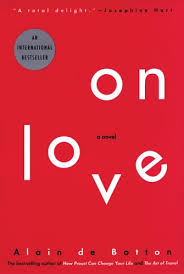
The Intolerable Vulnerability of beginnings…
I am desperately vulnerable to being unable to move beyond beginnings….as witnessed by the following attempts…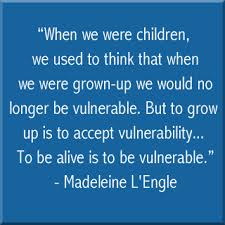 INTOLERABLE VULNERABILITIES
I.
When we begin – anything – we begin with. We start out already always somewhere as some one, some thing. Some entity or element among others. There are no, is no, such thing as a ‘fresh start,’ as a living organism.
From our particular inceptions we are loaded and formed with genetic baggage – our cells and context shaped by conditions far beyond and external to ourselves. And nary a freedom is advanced. Sure we participate in the shaping and construction and continuance of us, but we are never extricated, abstracted, or independent from an environment, a shared and shaping surround – it’s the contingency for existing: Other(s).
A world not formed by us. A plural existence, NEVER a solitary, isolated or uniform one.
Many find these ever-initiating constraints intolerable. That one is unable EVER, to start from scratch, re-invent, re-formulate, or create ex nihilo. Nothing, absence, void, simply – is not.
Therefore, ever existing in the already-established, already formulating, already-begun, we come together and transform.
Cells and genes, energy, matter and air conscribe to carry on in ripples and subject/objects of being. Including, colluding us – we, you, me, I.
Wholly integrated (smoothly or with great difficulty) into the ongoing flux and flow of languages, practices, thoughts and behaviors of a very large and intricate, complex and dynamic world – we arise – conditioned, constrained and subject to our sort of organization – make-up, culture, circumstance, arrangement, perception, emotion, body, reason, available resources, types, renditions of being A being in this possible world. A world, impossibly, that is just this way.
And the task is (always has) already begun – how will/does this particular, unique combination and configuration of elementary particles (a living, bounded, active, exchanging system/organism) adapt, effect, adjust, infect, evolve with its environment?
An environment of people, places, activities and things ALWAYS ALREADY begun, and also always already NOT-YET…awaiting, accepting, adapting, adjusting with US.
Our configurations, energy, activities and behaviors. Nothing the same with us. Nothing without.
Incalculable.
You, me, we make all the difference – along with EVERYthing else.
Some call this a paradox. If you did not begin, it would make no difference. If you do, it makes all difference. Both, always, true.
Nothing is the same with you. Nothing would be the same without you.
The world is a situation = both / and / more. A complex and indiscernible system that just seems to work this way. Call it “Butterfly Effect,” “Creation” or “Evolution,” “Chaos,” “Order,” “Life” – it all makes NO difference AND ALL the difference to actual experience.
And it is so.
Thus we begin – embedded, embodied, and extended – in an environment always long established, ongoing and begun: constrained, constructed, collaborated, and free.
I begin. I beg – “let me start over”, fully incorporated, already begun – I: in.
“Leaning into the sharp points”
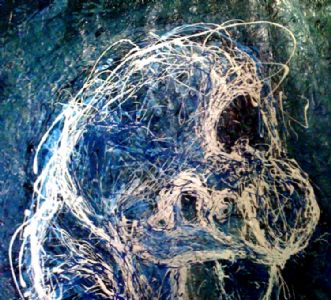
painting by Holly Suzanne
“Fear is a natural reaction to moving closer to the truth” – Pema Chodron
I modeled for the painting above. It is propped beside the bed as I write. A large painting, and heavy, maybe 4.5 feet long and 3.5 feet tall, loaded with layers of paint. She called it “Praying Man,” but I wasn’t praying – the way it turned out I felt like a longshoreman, a hauler, tensed with the energy of pulling things out from the deeps. I see why she called it that.
We’re reorganizing the house, and in that process I notice what’s gone, and discover things forgotten. Today it was When Things Fall Apart by Pema Chodron, “heart advice for difficult times.” I’ve depended on this one before. It’s written with the situation in mind in which a human feels there is nowhere to escape. Suffering floods in weights that compress one toward no option. Chodron says that “No one ever tells us to stop running away from fear…the advice we usually get is to sweeten it up, smooth it over, take a pill, or distract ourselves…but by all means make it go away.” “We don’t need that kind of encouragement, because dissociating from fear is what we do naturally.” “Cheating ourselves of the present moment” according to Chodron.
Instead, she suggests, “we could step into uncharted territory and relax with the groundlessness of our situation…by inviting in what we usually avoid…adopting a fearlessly compassionate attitude toward our own pain and that of others.” I am taking this on as the work of the “praying man.” The longshoreman and hauler, reeling hand over hand over heart over hurt into the tumult of the pain of being. “…getting to know fear, becoming familiar with fear, looking it right in the eye – not as a way to solve problems, but as a complete undoing of old ways of seeing, hearing, smelling, tasting and thinking…having the courage to die, the courage to die continually.” The traditions align. “He who saves his life will lose it.” The terror that drives the boundaries, isolates the organism. Protectiveness cuts the supply chain. Security stanches generative flow.
What happens when we stay? Nailed to the present misery. Chodron suggests that when we move into rather than away from our life-threatening pain a kind of catharsis can occur – an acceptance that we are “precious beyond measure – wise AND foolish, rich AND poor, good AND bad…and totally unfathomable.”

another painting by Holly Suzanne, emptied of me
“The trick is to keep exploring and not bail out, even when we find out that something is not what we thought. That’s what we’re going to discover again and again and again. Nothing is what we thought. I can say that with great confidence. Emptiness is not what we thought. Neither is mindfulness or fear. Compassion – not what we thought. Love. Buddha nature. Courage. These are code words for things we don’t know in our minds, but any of us could experience them. These are words that point to what life really is when we let things fall apart and let ourselves be nailed to the present moment.”
Preying Man then, hunched over and hauling it out, rhythmically breathing into the present, a turbulent pain fueled by fear…searching into what I usually avoid. Hopefully not so much as a way to solve problems, but an undoing of native ways of seeing and hearing, smelling and tasting and thinking…along with the courage to die.
-all quotations Pema Chodron, When Things Fall Apart
Intimacy
Greetings, in an effort I am making to “make sense”… I have been encouraged to chronicle the benefits of my experiences to investigate personal meanings. That might not make sense. Suffice it to say that I am plunging into the world of my recent past in an attempt to discover how it has changed me. A working title might be “Intolerable Vulnerabilities,” (a phrase lent me by my mental physician) and its subject is yet to be defined…but here are the beginnings of an intro…
The hesitant beginning…
” Most all of us have been caught up in the proverbial “throes of love.” The ecstasy and heartache of opening oneself to another, being enraptured, plagued with doubt and hope, captive to longing and the myopia of the significance of the beloved. But perhaps less of us experience intimacy. Intimacy may be something quite different from love. Although usually initiated in its atmosphere, intimacy reaches beyond the experience of love and journeys toward closeness. Intimacy is about the intertwining of lives, the multiform intricacies of barely-boundaried involvement. What occurs when lives are meshed and melded – shaped with and around one another – physically and immaterially, actually and theoretically, imaginatively and really. Where histories are remade and revamped together in a present. Where hopes are remade and reshaped as a couple. Where the unit and body that counts as an “I” extends to a “we,” and sensation, perception and thought happen always with an external mirror.
Where intimacy takes us is awesome. I mean this in the most fearsome and incredible ways. Human closeness is fraught with archetypal danger. When exposed in such nearness, our lives seem at stake. It goes to the “heart of us.” Within the weathers of love, the wedded experience that intimacy brings seems to make us or break us – our futures and fortunes, significance and meaning rise or fall in accord with an Other. We, in ways, “are not our own” but become something new, something larger and fresh. Something open, extended and possible. Something at risk, distended, and vulnerable. Our lives shared in the hands of another. Our minds shaped with the mind of another. Our purposes, intentions and behavior ever effecting conjoined scenarios. The world is different. Intimate. Involved. Precious and fragile.
There are (at least) two sides to the story…a territory of doubled strength and minimal safety. Of terrifying exposure and (possibly) multiplied protection. Of enhanced security and absolute danger. This is the province of love. This is the prospect of intimacy.”
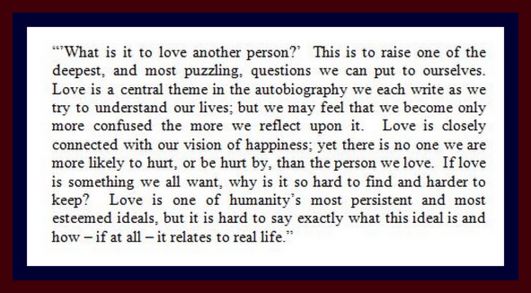
-John Armstrong, The Conditions of Love–
Over the Atlantic
I apologize in advance and beggar your patience regarding the length of the following post. It is not often that I have over 10 hours straight of anonymity and limited distractions to read, study and write. I spent yesterday and last night flying from Wichita to London for a week-long course examining over 10 specialty libraries there. For the course I must keep a diary online, and while not about “library business” per se, this is about the journey…

Over the Atlantic
I have no idea what time it is. I have been airborne for perhaps four hours, having left Houston around 7:35 PM after an hour of mechanical fix-its, preceded by departure from Wichita at 3:36 PM earlier this same afternoon. We seem to be flying fast enough that my electronics are scrambled and I haven’t worn a wristwatch since high school. I’ve been lucky enough to have booked onto an half-full flight, allowing me the pleasure and benefit of a two-seated section all to myself. Almost a work-cubby – two tray tables stacked with books and an empty seat for sundry supplies.
At all times I pursue readings that might deepen and expand both my abstract and subjective life – I’m certain that could be stated better – perhaps that challenge and enhance my lived experience. Most honestly: that cause me to think, help me make sense, prompt change and give me pleasure. Writings that move me, would be another way of saying it. In the cabin I have arranged Focusing by Eugene Gendlin, Elegy Owed by Bob Hicok, Impenetrable Screen of Purest Sky and Wonderful Investigations by Dan Beachy-Quick, Light Everywhere – Cees Nooteboom, Buddha’s Brain and Just One Thing by Rick Hanson, Infinite Jest by David Foster Wallace, A Thousand Plateaus by Gilles Deleuze and Felix Guattari, and Art as Therapy with A Week at the Airport by Alain de Botton. Which could be explained in so many ways.
Traveling internationally, one is limited for selection – in fact it’s by far the most difficult portion of packing – which books will I need – not knowing how the movement and context will affect me? So I choose:
- fresh books by authors that have earned my confidence (my top choice for this trip was Leaving the Sea by Ben Marcus – missed in the mail by a day);
- books that I know meet my needs on departure (many my third or fourth reading); and
- books I long to swim in but rarely have time with the insistent daily needs and benefits of home.
Whenever I’m struggling with depression, I reach for Wallace and books of wisdom – on staying present, taking steps, coping skills, the breath and body. Reality therapy, as it were. Poetry helps as well, with its attention to detail and sensual triggers. Books that remind me that I’m alive, regardless of felt experiences or circumstance.
I will finish A Week at the Airport on this flight, I’m almost there – or maybe I won’t, saving the “Arrivals” chapter for that moment in my journey. It is the account of de Botton’s stint as writer-in-residence at London’s Heathrow Airport (my immediate destination), and in his inimitable and typical fashion – exposing those human universals embedded in the familiar, or overlooked, or hardly spoken. What he asks from other writers, he provides (and I quote): “I was looking for the sort of books in which a genial voice expresses emotions that the reader has long felt but never before really understood; those that convey the secret, everyday things that society at large prefers to leave unsaid; those that make one feel somehow less alone and strange.” Maybe that is my true criteria – “those that make one feel somehow less alone and strange” – for the books I end up digesting do just that.
Here are some of the portions I have highlighted:
Departures
- “Entry into the vast space of the departures hall heralded the opportunity, characteristic in the transport nodes of the modern world, to observe people with discretion, to forget oneself in a sea of otherness and to let the imagination loose on the limitless supply of fragmentary stories provided by the eye and ear…to sense viscerally, rather than just grasp intellectually, the vastness and diversity of humanity”
- on the parting of lovers: “We might have been ready to offer sympathy, but in actuality there were stronger reasons to want to congratulate her for having such a powerful motive to feel sad. We should have envied her for having located someone without whom she so firmly felt she could not survive, beyond the gate let alone in a bare student bedroom in a suburb of Rio. If she had been able to view her situation from a sufficient distance, she might have been able to recognize this as one of the high points in her life.” – (I know this feeling and need this distance)
- on taking ourselves with us: “There is a painful contrast between the enormous objective projects that we set in train, at incalculable financial and environmental cost – the construction of terminals, of runways and of wide-bodied aircraft – and the subjective psychological knots that undermine their use. How quickly all the advantages of technological civilization are wiped out by a domestic squabble. At the beginning of human history, as we struggled to light fires and to chisel fallen trees into rudimentary canoes, who could have predicted that long after we had managed to send men to the moon and aeroplanes to Australasia, we would still have such trouble knowing how to tolerate ourselves, forgive our loved ones, and apologize for our tantrums?”
- on unfamiliar workspaces: “Objectively good places to work rarely end up being so; in their faultlessness, quiet and well-equipped studies have a habit of rendering the fear of failure overwhelming. Original thoughts are like shy animals. We sometimes have to look the other way – towards a busy street or terminal – before they run out of their burrows.”
Airside
- “Despite the many achievements of aeronautical engineers over the last few decades, the period before boarding an aircraft is still statistically more likely to be the prelude to a catastrophe than a quiet day in front of the television at home. It therefore tends to raise questions about how we might best spend the last moments before our disintegration, in what frame of mind we might wish to fall back down to earth…”
- Or, as a “Terminal Priest” expressed to him: “The thought of death should usher us towards whatever happens to matter most to us; it should lend us the courage to pursue the way of life we value in our hearts.”
need I go on?
Yet on I fly…listening to and “Gustavo” from the new Sun Kil Moon album Benji on repeat; performing breathing exercises while silently repeating blessings on those I love to the quivering thrum of this airborne albatross; catching glimpses of “Before Midnight” on face-sized screens where perhaps mirrors should be; and reading and reading and reading and trying to conceive…
stories imagined and rejected
in which the yachtsman drowns
in a remembered winter
and exists as a poem,
.
but the last thought is of
her, the woman who disappeared,
who everything was about, the yachtsman, the bay,
the poet. The air it all breathed
is the loftiest fabrication, a life
possible now it’s no longer
possible.
-from Cees Nooteboom’s poem penobscot
and worrying about “how modest and static a thing a book would always be next to the chaotic, living entity that was a terminal,” our relationships, our lives.
14 February 2014
“telling a story means tracing your finger through the ashes left by the fires of experience” – alvaro enrigue
I love drawing from the world – almost anything, almost everything – ingesting, sensing, feeling, digesting (transforming, processing) into me to pass it on again.
I love the encounter of humans – frightening, fragile things – the desire and revulsion our fullness brings.
Hope. Dread.
I hope to be loved and wanted.
I dread the opposite.
As if it were about me.
As if there were a thousand suns
And we were one of them
Time doesn’t work that way.
It’s been called an arrow
but it’s likely not –
likely wrinkled, warped and bent –
just like us
giving life to it.
Love is like this.
Like our memories.
I remember clearly what is incorrect –
if anything’s erected so.
I doubt it,
along with me and you and everything else…
just enough to believe.
 All my Words are Silent