Erosion, take two

II.

This is the story of how I began telling the truth.  The truth I defined as “two truths and at least one lie.”  The truth of my experience.

Poets often carry sorrow in their sockets – some underlying angst influencing attention.  There’s sclera, iris, pupil, and a deepening mirror of perceived pain…or seared “ego.”  Grief or grudge – and difficult to distinguish.

As much as there is to learn or to know, some simple patterns give the slip.  Once you figure a composing context, the information is derived.  Look out for what might constitute survival for each respective entity.  Aim your inquiry there.

Parents hurt as much as heal.  As do love and risk and wisdom (or well-being).  All that is given in life is also taken away – exactly when it is given.

Everyone canvasses sorrow.  The surgeons in their trembling hands, the librarians in their order.  The therapist’s reflective stance, architect’s angles, businessman’s mettle.  We all know that we’re going to die.  Celebrities in their acclaim, the athletes in their strength, and whores in their affection.  Everything is risk.

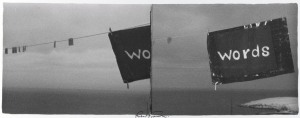
truthlies

What = Now

EROSION

“to change patterns…expose the wounds…”

– Charlie Kaufman – 

1.  Truth is…truth was…truth is… 

And this was the daily game of Reality-Telling…two truths with at least one lie.  A morning-midday-evening list-assembling of continuous is-was-ises.  Spilled coffee, set aright, sopped with towel.  Triples.  Thing – thing – relation.  So many relations revising so many “things.”  Complicating, co-creating, is-was-is.

“Change is never lossless,” it was written.  Once comforted by the is of experience – that no matter the grief or anguish, no matter the disaster or rift, the poverty or destruction – experience kept accruing.  “Experience is additive even in reduction.”  Even deletion adds to experience.  Isn’t it nice to know that regardless of what or who or how – for every living thing – at least something accumulates?  Grows richer, more varied, expands?

But how calculate that every addition is reductive?  That the raw fact of everything adding up = losing?  At least this is one way of working the figures.  An instant added is an instant taken away.  “The Lord giveth…”

The very momentariness, unquantifiability of what happens seems to attest to this.  Two precisely equal processes, or hands.  The one inviting and offering, delivering; the other letting-go, sweeping aside, and waving goodbye.  Moment in, moment past.  Experience added, one less experience to have.

Life as a riverbank – new deposits and constant erosion.

            The truth is: experience

            The truth was: experience brought exactly what it took away

            The truth is: experience

(therefore): NOW =

            And thus it is known that living is equal to dying and “He who would save his life will lose it” is just a simple fact.  Dying is equal to living.  It all happens in the same instant.  One step further = one step nearer to something else.

Sometimes people smile when they’re together.  Sometimes they don’t.  And sometimes other things happen.

You

Me.  We are that we are, how we are, when we are, who.  

What has gurgled in me throughout this week, and made it somewhat difficult to post much, is that I ran into these burls.  Grief, change, adaptation, struggle – they all push us up against, or cause us to deny or flee from, these knots, these boundaries, these fabrications of how things ARE, how we’d wish they were, or could be.  In myself, these evidence as anxieties, fears, verges of hopelessness.  With the help of others – my children and their presentness, their being-into (ecstasy), being-out, unique ways of being-with – my therapist, and many other well-intentioned voices and persons who want good for me… I come to see that MOSTLY it’s ME and these burls, these knots, these imagined borders and boundaries in myself – MY IDEAS OF HOW IT WOULD BE NICE FOR THINGS TO BE, my ideas of my “self/ves,” my organismic survival instincts and ancestral tactics – that dislodge me, silence me, THAT I UTILIZE (choose or select) to withhold and diminish and undo my opportunities to be-in, be-with, be-out, be-for the rest of you – the world, my children, my work, my self/ves.

So I’ve been termiting around in these burls.  Wondering how do I undo habit, instinct, ancient patterns of stanching, stoppering, limiting a potential flow of the world and my surround and my relationships and my knowledge and my emotions and my beliefs and my feelings and my thoughts and my dreams and my fears and my anger and my sorrow and my regret and my terror and my joy – work WITH those facts… and begin to erode my selections and choices of UNDOING and LIMITING and FEARING and DIMINISHING and instead tear or leap off these quantitative scales of evaluation, these assessments, these CVs and criteria – and JOIN.  JOIN.  OFFER.  GIVE.  BRING.  SHOW UP.  BE.

CHOOSE – slowly, granularly, deliberately, carefully, wildly – to INVITE the world (as it is) THROUGH, and OFFER the world (as it is) THROUGH…

ME

for…to…with…

YOU

…and All.

I don’t even have to reflect to be able to say that Synechdoche, NY – a film by Charlie Kaufman – is my favoritest made movie of my lifetime, or even of all time for my lifetime.  And as I burrow in these burls of grinding away at the resistances, the terrors, the wishes, and the ecstasies of being a human alive, stumbling across this short lecture of his has been an invaluable gift.  I do not know how to improve on it, so I let it pass THROUGH me… to you…

“Acceptance is nothing less

than the complete transformation

of what one has believed to be one’s self

and one’s reality.”

– Cheri Huber –

The Idea of Maturity (continued) – “Have a ‘good enough’ day”

“Since early years I have been cursed or blessed with a habit of mind – a character defect it may be – that likes to turn over problems that have no solution, or at least no solution that can be provided outside of thought itself (if there).”

– John Deely, Four Ages of Understanding

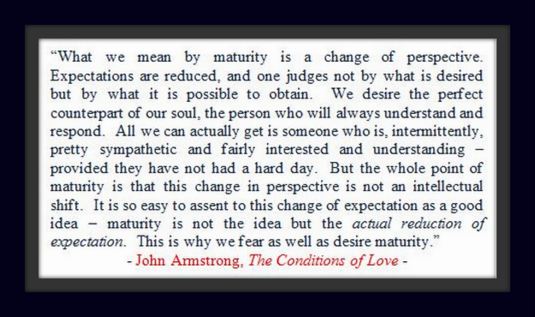
This concept of “maturity” as I encountered it in John Armstrong’s Conditions of Love is caught like a burl in my system.  Maturity as “not the idea, but the actual reduction of expectation.”  Maturity is reductive.  Is that so?  Is the process of human living a progress of delimitation, scoping the range of experience to our actual organismic potentials?  Process, progress, growth not expansive, extending operations, but boundarying and restraining limitations to our hopes?

I take my “problems” to my therapist.  They always come back to me changed.  “And what are the sources of expectation?” he asked.  “Expectation is sourced in the past / oriented toward the future,” he answered.  “If you reduce it – “YOU. ARE. HERE.”

YOU ARE HERE


Whenever I “get” something like that, I noticed I want to take off with it.  Like a skipping stone, I feel inspired and start leaping the surface of things – making connections with this concept and that image, this thinker and that artist, that idea and this experience… activating PATTERNS from my past and projecting POSSIBILITIES toward the future… LEAVING THE PRESENT.

My therapist/guru(?) has been investigating the neuroscience of enlightenment – or being awake to reality / the actual…


…and working with the brain and body to (perhaps) soak or sink there

rather than skip along the surface from PAST toward FUTURE

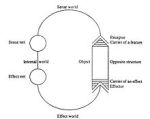
My helpmeet described this as an interesting and fascinating capacity of brains excited by the ineffable to apply TOP-DOWN (or metacognitive, reflective, intentional attention, interpretive) strategies to BOTTOM-UP (automatic, subconscious, pattern-oriented, limbic or reactionary, survival-based) strategies in order to, in a way, burl them – mesh them – unite them with WHAT IS – the Umwelt – our actual EXPERIENCE of BEING a living organism PRESENTLY.

We NEED both strategies to survive, and thrive.  Much of our life-world is uncertain and unknown to us – much we will never KNOW in any sense like “understand” or “comprehend.”  Life constantly HAPPENS.  We are quite limited, reduced, in our capacity to TAKE-IN, ABSORB, “com-prehend” (apprehend-with) all that our life-bubbles afford us and confront us with each moment… We NEED the emotive, reactive, pattern-based knee-jerk reactions to navigate much that could be life threatening (thought not much IS these days – WHAT IF something IS?)…no time to reflect or discourse or meta-cognize it if a car or snake or fire is about to strike you… but we also NEED the reflective, metacognitive capacities to distinguish between what is ACTUALLY life-threatening and what is ONGOING EXPERIENCE – opportunity – potential to comprehend, learn, understand, adapt, adjust, in-corporate, BE WITH.

That middle-point : tension-place : meeting-space (“like the appropriate tension of a string on a violin” he said) is perhaps where Armstrong’s maturity IS.  Reduced to the present, what’s happening, our actualizing experience – NOT skipping the surface of automated connections drawn from past experience and projected toward possible futures…

In other words (again, in his words)

Lord - Motto

On Change, Perception and the Idea of Maturity

John Armstrong’s The Conditions of Love is obviously far from through with me, and I with it.  My encounter with this writing has challenged me in so many ways.  Principally, I think, in querying my bases of knowledge in neuroscience, literature, philosophy, psychology and art – and struggling what is known (or supposed, or observed) in these disciplines toward our lived experience of love, of loss, of change, of survival.  Our brains, our stories, our bodies are all so very highly attuned to patterns in our world, perception, experience…how does that work itself out in our lives of loving and losing, changing and adapting?  What is difficult, what is beautiful in such behavior and practice?  What do domain-specific, developed human disciplines offer us in our mind/body organismic goings-on?

Maturity - John Armstrong

Enormous changes…you could say…REQUIRE all sorts of perspectival changes.

If only, simply, to adapt to the new WORLDS initiated by the universe-altering adjustments that major life changes (positive, negative, or, usually, BOTH) introduce:  couplings and separations / relocations / employment, vocation, education / grief, loss, birth, reduction, addition / success and failure and so on…

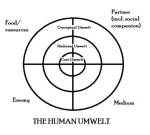
Our experiential/perceptual “worlds” have been aptly described and ascribed as Umwelten (see also – Paul Bains, Primacy of Semiosis).  In drastically simplified form: the concept that we are (each sort of organism) evolved in such a way as to perceive and engage with that in our environments that pertains to our survival and flourishing, our continuance of existence.  Those elements or that structuring and interacting with what we select out of our replete environments and surroundings – including ourselves – constitutes our Umwelt – our little “life-world” – species-specific bubble of “reality” (what is real to us, for us).

The sorts of change(s) that provoke potential for maturity tend (I think) to be changes that evince larger (or larger-scaled) patterns of experience and events (although all the minute alterations ever occurring – to the attentive and aware – also constitute mature adaptations for the human – the meditator recognizes the flux in each moment and works to adapt to this flux with openness and acceptance) – in other words, such things as by their very occurrence create/disrupt/introduce significant and substantial structural alterations – profoundly unavoidable – changes to the content AND context of the individual organisms perceptual/experiential SURROUND.

Changes (like those listed above) that, if NOT adapted or adjusted to, evidence a socially recognizable UNreality – a person clearly maladapted to the realities of their situations.  An example would be CHANGE or DIE; ADAPT or FAIL in some socially undeniable sense.

ADAPTING – in a “to-obvious-Umwelt-alteration-sense” is what I comprehend as an instance of maturity (a la Armstrong).

The loss of a child or spouse or health or limb.  New employment, habitat, geography.  Freshly developed abilities, knowledge, or lost capacities or income.  New love, memory, trauma – and so on – all represent an altered human Umwelt – adaptation to the ever-changing “reality” would be an instance of maturity – while maladaptation/denial/resistance would be a kind of instantiation of insanity – dis- or mis-alignment/-integration/-accordance to the altered Umwelt/environment/world-circumstance/perceivable “reality.”

Maturity then is our relatively accurate adjustment and adaptation to – our expectations and perceptions – to the “realities” of our ALWAYS-changing life-world.

I think Armstrong is right that we have a love/hate relationship to maturity.  It is something I (we?) HATE and HOPE for – the changes in our personal and public worlds so mostly beyond our control – air quality, abandonment, accident, reward, attention, ignor-ance, and so on.  As he puts it: “maturity is not the idea but the actual reduction of expectation.  That is why we fear as well as desire maturity.”  I question whether the adaptation is always “reductive” – in some cases, where we tend to be ruled by “patterns” (our past, our available information, our individual perceptions, our nature/culture development, etc.) maturity would constitute expanding, extending and opening our perceptions to the wider, complex and dynamic possibilities of an ever-changing life-world (I think).

For myself:  I HATE it (the death and loss implied in honest, authentic reductive maturity – mapping my individuality to my actual surroundings and situations) – I often resent and resist the ongoing change – erosion and eruptions – of the world I’m embedded in.  AND I WELCOME it – the reality-check of it, the alteration, breath, fresh potentials of “new worlding” that constant change instigates and offers.

As if our “realities” were 1000 plateaus – layered, indistinct, overlapping, vague and enmeshed.  As if “reality” were only (for me) what is perceivable (to me) and a dramatically altered Umwelt STRIKES into me whole new wild conceptions of what the world might be.  Reduction / Expansion.  Every change offers this.  The death (amputation, loss, etc.) and birth (regeneration, appendices, new growth).  Every vacancy corresponds with potential and unknown occupancy and vice-versa…

Or so I’m thinking…at this moment in this circumstance…

“Questioning places us in relation with what evades every question and exceeds all power of questioning…it seems that we question more than we are able to question”

-Maurice Blanchot-

…and so it goes…

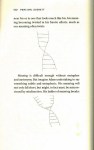
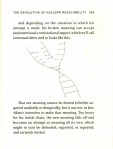
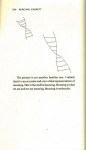
Meaning is Molecular…

compliments of Percival Everett

From Another Hand – “Folksonomies” & “Controlled Vocabularies”

Here follows a rambling response to a course discussion post relating to social-media-tagging and authority-derived-taxonomies in information resources (pros/cons, advantages/disadvantages, issues, etc.)…from my unedited perspective.  Perhaps it will interest some.

Option 2: Discuss issues surrounding social vs. professionally created metadata, citing examples from the readings. What are the problems and challenges as you see them?

“Naming entities in the world is a tricky business” (Mai, 2011, p. 116).  Socially-created metadata is a fascinating approach and response to the inherent ambiguity, flexibility and complexity of the human use of language and the co-ordination of communicating the range of contextual usages of information resources / objects in contemporary life.  I particularly appreciated Mai’s attention to the plurality and “heterogenous settings” (settings where there are “no unified contexts, goals, or objectives against which objects can be named and ordered…” p. 116) of networked global information resources.  “Naming, indexing, has its limits – it can only be done within a given context” (Mai, p. 116), and as George W. Trow pointed out long ago – we are in the “Context of No Context” once we’ve embarked on a world-wide web engagement.  The stimulating idea is that if you have those who are interacting with the resources “tagging” their meaningful engagement with those resources “in their own terms” – you are replicating the range and breadth and depth of ACTUAL human use and inference and representation of interaction with information.  Now THAT is FASCINATING!

On the other hand.  By now we are all mostly aware of the extreme subjectivity involved in perception, acquisition, attention, selection, and utilization or effecting of data-available-to-us (individually) in the experiences that afford us, expose us, enable us to actuate and in-form whatever available reality that resource represents for us.  This means that each individual organisms experience of a given interaction with an available resource is intensely situation-specific.  Which also implies that their report, account, or “tricky naming” of said interaction is apt to be highly idiosyncratic.  Which (OBVIOUSLY) presents an enormous problem for the stability or repeatability or findability or accessibility of the potential import of said resource for any other organism.  This, it seems to me, is where even collective or massive social input still engenders community-and-individual-sized gaps in findability and usability of digital information resources.

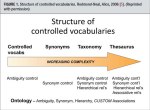
As I see it, the concept of “folksonomy” and social democratic tagging is a practical response to Wittgenstein, Heidegger, Uexkull, et. al.’s realization that any and all conscious human individuals will seek, access, perceive and select elements of their environment FOR THEMSELVES – limited by every aspect of their own physiobiology, neurobiology, social contextualization and environmental situation – if a WHOLE BUNDLE, an aggregate, a swath of humans “tag,” “name,” “label” a resource according to the meaning it gave rise to in them – we might get an approximately adequate representation of the (at least human) RANGE of meaning or import that resource might have for our species – the uses to which it might be put, the ideas it might give rise to, the practical effects it may indeed effect.  HOWEVER – it will by no means have overcome the inherent ambiguity, openness and possibility of said entity/resource/ordination of “information” for any further context / individual / situated need going forward, unknown.  This is where things like mathematical language, artistic form/contents, agreed-upon languages, domain-specific terminologies, “controlled vocabularies” SERVE our species – they give us COMMUNAL resources by which to evaluate and organize our experiences – and COMMUNICATE.  Private languages, really, tell us no more than the barking of a dog.  We infer and intuit, but then, that is OUR language imposing order on someone else’s expression.  Standardized, collectively agreed-upon terminologies and languages allow us to participate, interact and coordinate our experiences and understandings, while “folksonomies,” “tagging” and so forth allow us to nuance and extend or specify aspects of the agreed-upon discourse.  At least these are the uses I find compelling around both Controlled Vocabularies AND individual or privatized labeling.

It’s fascinating because it allows a democratic voicing which accounts for many more human facets to ANY and all resources, while “social” in a “societal” sense – domain-oriented, authoritative and agreed-upon terminologies allow us a way to flesh out, fuel and invigorate COORDINATED meanings – something accessible to us more like our own bodies – a corporate interaction – avoiding both solipsism (isolation) and equivalence (anonymity).  All sources seemed to agree that all things “con-” (con-sensus, co-llaboration, co-rrespondence and so on) are ESSENTIAL for our worlds to be useful and meaningful to us.

We have work to do in finding the dynamic balance in agreed-upon vocabularies as touchstones maybe not necessarily rules and the open source of additive description to equal something perhaps more in accord with human “reality.”  I sense that this is the dream of the Semantic Web…and of all communities worldwide.  I appreciate how the internet re-invigorates this ancient human process.


“Leaning into the sharp points”

Suzanne(Beckman-Filbert)Holly-suzanne-prayingman.jpeg


painting by Holly Suzanne

“Fear is a natural reaction to moving closer to the truth” – Pema Chodron

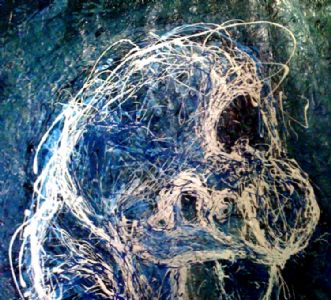
I modeled for the painting above.  It is propped beside the bed as I write.  A large painting, and heavy, maybe 4.5 feet long and 3.5 feet tall, loaded with layers of paint.  She called it “Praying Man,” but I wasn’t praying – the way it turned out I felt like a longshoreman, a hauler, tensed with the energy of pulling things out from the deeps.  I see why she called it that.

We’re reorganizing the house, and in that process I notice what’s gone, and discover things forgotten.  Today it was When Things Fall Apart by Pema Chodron, “heart advice for difficult times.”  I’ve depended on this one before.  It’s written with the situation in mind in which a human feels there is nowhere to escape.  Suffering floods in weights that compress one toward no option.  Chodron says that “No one ever tells us to stop running away from fear…the advice we usually get is to sweeten it up, smooth it over, take a pill, or distract ourselves…but by all means make it go away.”  “We don’t need that kind of encouragement, because dissociating from fear is what we do naturally.”  “Cheating ourselves of the present moment” according to Chodron.

Instead, she suggests, “we could step into uncharted territory and relax with the groundlessness of our situation…by inviting in what we usually avoid…adopting a fearlessly compassionate attitude toward our own pain and that of others.”  I am taking this on as the work of the “praying man.”  The longshoreman and hauler, reeling hand over hand over heart over hurt into the tumult of the pain of being.  “…getting to know fear, becoming familiar with fear, looking it right in the eye – not as a way to solve problems, but as a complete undoing of old ways of seeing, hearing, smelling, tasting and thinking…having the courage to die, the courage to die continually.”  The traditions align.  “He who saves his life will lose it.”  The terror that drives the boundaries, isolates the organism.  Protectiveness cuts the supply chain.  Security stanches generative flow.

What happens when we stay?  Nailed to the present misery.  Chodron suggests that when we move into rather than away from our life-threatening pain a kind of catharsis can occur – an acceptance that we are “precious beyond measure – wise AND foolish, rich AND poor, good AND bad…and totally unfathomable.”

2013-01-22 14.36.20

another painting by Holly Suzanne, emptied of me

The trick is to keep exploring and not bail out, even when we find out that something is not what we thought.  That’s what we’re going to discover again and again and again.  Nothing is what we thought.  I can say that with great confidence.  Emptiness is not what we thought.  Neither is mindfulness or fear.  Compassion – not what we thought.  Love.  Buddha nature.  Courage.  These are code words for things we don’t know in our minds, but any of us could experience them.  These are words that point to what life really is when we let things fall apart and let ourselves be nailed to the present moment.”

Preying Man then, hunched over and hauling it out, rhythmically breathing into the present, a turbulent pain fueled by fear…searching into what I usually avoid.  Hopefully not so much as a way to solve problems, but an undoing of native ways of seeing and hearing, smelling and tasting and thinking…along with the courage to die.

-all quotations Pema Chodron, When Things Fall Apart

Intimacy

Greetings, in an effort I am making to “make sense”… I have been encouraged to chronicle the benefits of my experiences to investigate personal meanings.  That might not make sense.  Suffice it to say that I am plunging into the world of my recent past in an attempt to discover how it has changed me.  A working title might be “Intolerable Vulnerabilities,” (a phrase lent me by my mental physician) and its subject is yet to be defined…but here are the beginnings of an intro…

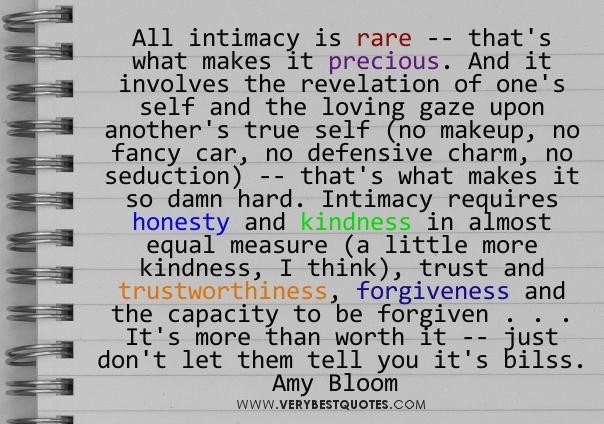
Intimacy - Amy Bloom


The hesitant beginning…

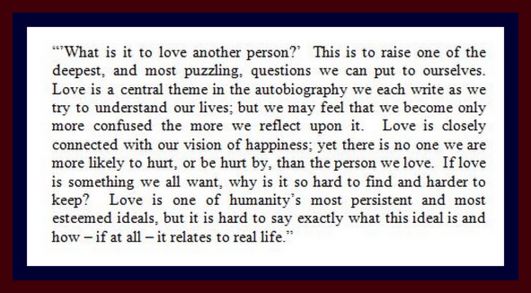
” Most all of us have been caught up in the proverbial “throes of love.”  The ecstasy and heartache of opening oneself to another, being enraptured, plagued with doubt and hope, captive to longing and the myopia of the significance of the beloved.  But perhaps less of us experience intimacy.  Intimacy may be something quite different from love.  Although usually initiated in its atmosphere, intimacy reaches beyond the experience of love and journeys toward closeness.  Intimacy is about the intertwining of lives, the multiform intricacies of barely-boundaried involvement.  What occurs when lives are meshed and melded – shaped with and around one another – physically and immaterially, actually and theoretically, imaginatively and really.  Where histories are remade and revamped together in a present.  Where hopes are remade and reshaped as a couple.  Where the unit and body that counts as an “I” extends to a “we,” and sensation, perception and thought happen always with an external mirror.

Where intimacy takes us is awesome.  I mean this in the most fearsome and incredible ways.  Human closeness is fraught with archetypal danger.  When exposed in such nearness, our lives seem at stake.   It goes to the “heart of us.”  Within the weathers of love, the wedded experience that intimacy brings seems to make us or break us – our futures and fortunes, significance and meaning rise or fall in accord with an Other.  We, in ways, “are not our own” but become something new, something larger and fresh.  Something open, extended and possible.  Something at risk, distended, and vulnerable.  Our lives shared in the hands of another.  Our minds shaped with the mind of another.  Our purposes, intentions and behavior ever effecting conjoined scenarios.  The world is different.  Intimate.  Involved.  Precious and fragile.

There are (at least) two sides to the story…a territory of doubled strength and minimal safety.  Of terrifying exposure and (possibly) multiplied protection.  Of enhanced security and absolute danger.  This is the province of love.  This is the prospect of intimacy.”

Love - John Armstrong


-John Armstrong, The Conditions of Love

In the Sea above the Sea: transitory reflections from above the Atlantic

P5151753-001

Look at things, see them exposed

in their metaphysical innocence

unsure of their existence.

When do paintings shrug off

the painter, when will this same material

become a new idea?  The evening mist crept over

the lawn, drowning the avenue, the fountain,

the house.

.

Music, the splash of oars.

Someone turns on the light, someone

doesn’t believe in dusk.

The unanswerable question drifts

past the window.

-Cees Nooteboom, Cauda

Heathrow Airport

As I make my way back over the Atlantic from the nominally United Kingdom to the (equally nominally) United States, I am considering what things most prominently infected me.  Partly “I think I wanted to get lost to see what happens next” (Deborah Levy, Things I Don’t Want to Know) and partly I wanted to know what to do – my coursework and library visitations – to anchor my lostness while providing anonymity and foreignness in which to search for peace and move through grief.

 nobody

More and more the invisible was named,

the blind man grew mightier.

How he wandered and called out to his echo!

.

which called back with the screech of gulls.

He is still searching among flags and vistas

for that same statue.

.

Sounds blow to the far side of the river.

Nobody is standing there.

.

Nothing takes shape.  Newspapers melt,

photos fade.  The stone is made of wax,

the notebook of ash, time takes itself

and repeats the appearance

.

until his life becomes a mirror

in which he disappears and appears,

but nobody looks at himself,

because nobody can see himself.

-Cees Nooteboom
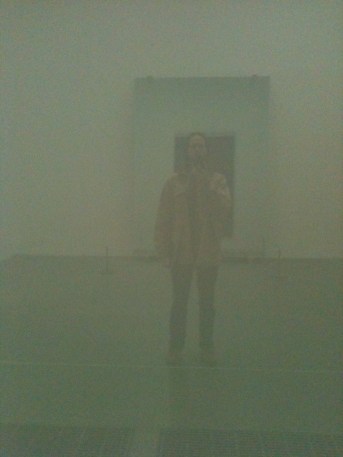
IMG_0280my “self” photographed in front of Gerhard Richter’s “painting” Grey Mirror

-Tate Modern, London-

I noted how clear the signage.  Clear and direct with no soft-pedaling of consequences stated.   Mind the gap, way out        (and way in), “moving through these doors may result in death or injury” (on the Underground), smoking kills.  The ubiquity of concern for mental health – that Bibliotherapy is not just a bookseller’s or librarians metaphor of expertise – but is in fact a prescriptive cure – scripts are written by doctors for BOOKS! (hundreds a week, one library reported).  Along the same culture-historic lines, perhaps influenced by the longevity and prevalence of hundreds to thousands year-old architecture and artefacts, traditions, and tangible evidence of time and identities – the apparent insistence on QUALITY – of life, of drink, of service – of literature and art and purposes.  So while everything costs about twice as much as the USA, the options often doubled the quality.  A local pub on every corner, small grocers, fresh markets – in the miles I walked I only spotted a handful of McDonald’s, Krispy Kremes or other international chains (and only in heavily touristed areas) – aside from Starbucks.  I saw 3 gas stations.

And the bookstores!!!  Sometimes 3 or 4 in a block, flush to the gills – but hardly a bestseller, a romance, or fluff!  Amazing – perhaps the most profound difference between the USA and UK that I noticed: their stores FEATURED literary quality, and only sometimes provided mass appeal items that could be had anywhere online – in many stores 80% of the stock I encountered did not have an eBook format – the books were books meant to be books in the purpose of books – to be engaged with the body and mind and retained and gone back to – like the architecture, museums and galleries – not disposable pleasures – but necessary cultural artifacts made from the human condition and accessed repeatedly for its benefit.

Of course there are the “places”: Trafalgar Square and the National Gallery, the British Library and British Museum, the Tate, Houses of Parliament, Westminster Abbey, St. Paul’s Cathedral, Buckingham Palace, Shakespeare’s Globe, the Tower of London and on and on…walking over 15 miles a day, finding “oldest churches” in every nook and alley, colleges and universities every other block, London is a place swamped with culture and continuity, the high and the low, and great gaps to mind in between.

So with those great anchors securing me, I tried to see myself.  In the reflections of great art and architecture, thousands of years of history and culture, thousands of languages in cosmopolitan streets, thousands of unknown faces and voices, habits and practices and sayings…my “life became a mirror in which he disappears and appears,” but, of course, “nobody looks at himself, because nobody can see himself.”

What did I see?  Well by looking through others that I could see, I found “I wasn’t sure my skeletal system had found a way of walking freely in the Societal System” and the need “to find a language that is in part to do with learning how to become a subject rather than a delusion, and in part to do with unknotting the ways in which I have been put together by the Societal System in the first place” including the “many delusions of my own”…”it’s exhausting to learn how to become a subject – it’s hard enough learning how to become a writer” (Deborah Levy).

And I thought of how, like the forest and the trees – it often seems we are unable to see reality for our experiences.  So many of us semi-automatically equate our experience with reality – rather than note how small our perceptual bubble really is.  Just try using the “Powers of 10” idea – start anywhere – with your pain, your fingernail, your happiness.  Now imagine IN a power of 10 – you’re into the cells, into one strand of what’s causing you pain, into a moment eliciting joy.  10x more and you’ve gone beyond atoms and quarks – matter and energy ill-defined and inexplicable and ALWAYS dynamic.  Imagine OUT a power of 10 – you’re viewing a street full of private perceptual experiences very different from your own – and trees and birds and squirrels and buildings.  X 10 and you see miles and miles of earth – filled up with all kinds of creatures and systems, connectors and wonders and weathers and mountains and rivers – x 10! and you’re out in the galaxy of planets much larger than our own, stars much bigger than our sun, and still more galaxies to go…

Either way you go there is gargantuan forest – and our experience, our body – barely a branch…yet we evaluate so often from that individual outlook – incredibly distorting bubble of lens – with a minimal scope – not engaging the forest, absorbing the forest, wandering and listening and looking and opening – so that “the unanswerable question drifts by” and “unsure of its existence” can “become a new idea…” the beginnings of subject-ivity – a particle in relation from within and without – from mattering energy to butterflied effects…an individual instancing of human.

Be mindful.  Be curious.  Be patient.  Don’t know, and enjoy your hands.  Be generous, take refuge, find strength.  Be grateful, keep going, be glad.  Respond, don’t react.  Slow down and forgive.  Let go, accept limits, and do what you can.  Take in the good, relax, have compassion.  Feel safer, fill holes, and love.

-all chapter titles from Rick Hanson’s just one thing

It’s okay.  Be human – the extremely hard, most natural thing.

cheers!

an added and unexpected catharsis – on the night I tried British telly due to trouble falling asleep – Synechdoche, NY – a remarkable example of how complex and generative our perceptive bubble can be…and yet how barrier’d from the world outside of that bubble…forests and trees / reality and personal experiences – beautiful drops in the sea… (and perhaps my favorite movie to date)..

February 23, 2014