On “waking depressed,” or, Human Clear-sightedness

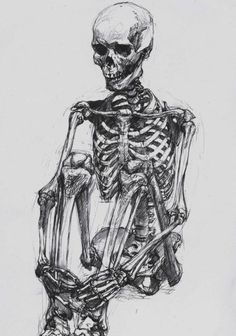
skeleton

We say that we “wake up depressed” wonder why and conjure up reasons.  What is this “hollow” or “indentation” in relation to?  Depression versus delusion?

Squirming up out of dream or slumber into wakefulness, awareness – illusions and solipsism scattered by light of day, by alertness – what would be the “norm” ‘depression’ dips under?

Say we consider “normal” as the state or condition of being aligned with what is.  The only certain trajectory of living is dying.  Dying the condition of life.  The only permanent outcome of breathing, saying, doing, being…are their cessation.  In confirmation or conformation to this “reality” – what should be the normal living response?  Depression, I should say, full awareness and wakeful understanding that my promise, potential, outcome and fortune are to end.

Decay, departure and death are the certain “norms” ruling human existence.  What occurs, forgets; what merges, diverges; what events, unravels; what happens, undoes; what is made, erodes.  Assuredly, they are strange loops, ambiguous and temporal – more wave/particled than 0/1 – and yet as “fate” or “doom” would have it (definite futures) we know of no other.

Therefore it should seem “depression” would be the normal human state of life, and all forms of happiness or joy come about due to some compromise or delusion – an abnormality – some neuroses or failure to accord or conform to what is.  How might we have come to classify conformity to what is as a “disorder” or diagnosable swerve?

“Certifiable depression” is marked as a disability, a failure to thrive, a condition incapacitating function.  Yet does that not most assuredly accord with the certitude of demise, destitution, eradication?  To terminate activity, halt health, conclude creativity, finish folly and destroy delight would all seem to indisputably align with the necessary phenomenon of obliteration.

Thoroughgoing comprehension of what is – that birth has a single objective – that all roads lead to one – that all effort leads to naught – that entropy – is not lunatic, demented, deranged or unhinged – but rather most enlightened and balanced, intelligent and lucid, perspicacious and well-advised.

Being pressed down, a lowering of quality, vigour or amount, feelings of severe despondency and dejection are surely the most accurately normal experiences – regulated, coordinated and adjusted to what is versus what is imagined or desired – indications of astute apprehension and capacities of apperception to the real.

Do not be flummoxed by “waking depressed” – do not seek for treatments or reasonings ‘why’! – do not be baffled that a heaviness descends, or a ‘pressing down’ is felt or occurs – we emerge into life and descend into matter…the cradle and grave a continuous process.

everyone dies

Short essay on Venice Biennale experience – Summer 2015

Glimpse of Lightness : Venice Biennale 2015
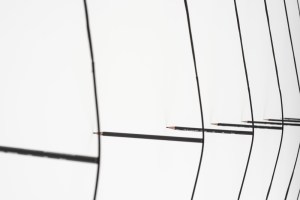
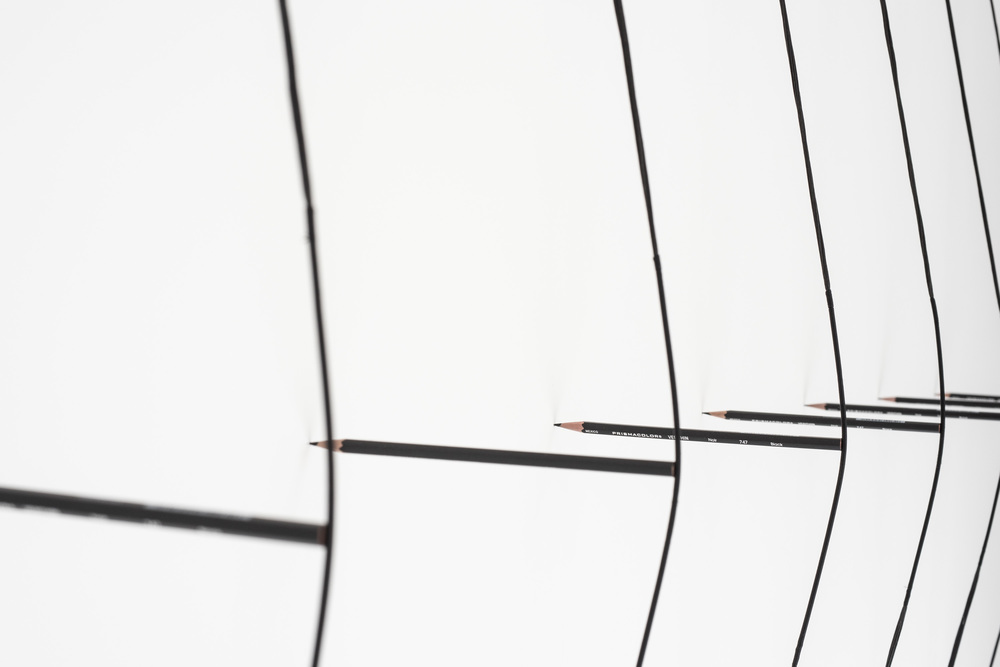
Maggi - Drawing Machine

Marco Maggi – “Drawing Machine” – Uruguay Pavilion, Venice 2015

            How does art “happen”?  What is a work of art in an age of reproduction?  Who, where, what, and how are we in relation to composition, construction, collage, creation, craft… encountering “art” as a strange “zone of indistinction”, an “undecidable”[1], perhaps an interference, or intervention – at the renowned Venice Biennale 2015?  What lightness might we glimpse in such immersion, inundation, veritable floundering and bewilderment among “works of art” – the touted greats within the most prestigious cultural institution in the world.[2]

In a deep cleft of Agamben and Heidegger, physical and mental exhaustion, a set of European Graduate School students (which gratefully included myself) set out to engage “art” in the context of the famed Venice Biennale Exposition, assigned to look for “glimpses of lightness” – something “having little weight…alleviating…demonstrating ease or agility…mirth, levity…and a graceful slenderness”[3] OR – “lit brightly, illuminated, illuminating”.[4]  The day began hefty and hot with prospects of 89 national participations, 44 collateral events in the Giardina della Biennale plus an additional “more than 136 artists from 53 countries” at the Arsenale.[5]  We set out.

The 2015 Biennale was filled with many ambiguous / ambivalent / open works that, depending on the perspective of the observer, might be engaged with levity, mirth and playfulness or burdened by art-extraneous political, moral and conceptual communiqués and paraphernalia.  I found myself wondering if art was happening in such a context – a deluge and glut of politics, morality and economy.  I began looking at things curious if messages could be untangled, read past and through, passed by: emotional, commercial, personal, national, site-specific – querying – “what here is ‘being raised, set forth, set up’? (Heidegger).  ARTing: can we come to art through artists and artworks and exhibitions?[6]

Considering art as Riss – rift – an outline, sketch, drawing and marking setting into relief a “moment” or “space,” a new relation hard to distinguish, perhaps undecidable, opportunities of encounter with encountering-itself, being – itself – being, in relation to.  A passage.  Something beyond good and evil (ethics); beyond division, calculation and measure of perception (subject/object, this/that, here/there) (ontology); beyond narcissism (me/you, us/them, him/her) (epistemology); beyond laws and institutions and individuality (ours/theirs, who/what, when/where) and so on… Toward activation – activity + occurrence, an awareness, a-tension at/of/with/in NOW? [ultimate zone of indistinction and undecidability].  Play?  Lightness?  Resisting the urge to pronounce, proclaim, propose; swerving past strife, through strife – holding open? – Art…as Being…an open question?  Some undoing in its doing, some common toggling call to a present, re-present, encounter?  Are we able to tear up a world in an activity of mending, assembling and combining it (rift)?  To set up a world in an activity of revealing (veiling/unveiling) as a poet might do (oscillating signs) with a semiotic semantic, ex-hibit-ing, exposing, en-light-ening – making lines instead of following them, opening spaces rather than closing, becoming in difference to became?  I wondered what might result if we scrambled the sites/sights on some randomizing algorithm of names/nations/pavilions or scrambled the labels and ‘statements’ according to same.  To undo in order to Art.

So what rends?  What can tear through the amalgams and overlays we bring to each encounter with one another, with the world?  What might cause a rift to occur in my own perceptions, predispositions, cares, concerns, propensities?  Where do the potentialities lie?  What will bring me to the open?  Below are a few works I encountered in the heat and dust and exhaustion of 2015’s 56th La Biennale di Venezia that re-oriented me, turned me into at least two sides of a chasm, illuminated a seeing-space, a being-space for me – provided me with glimpses of lightness.

Blind Spot.”[7] The first work that woke me, intervened, destabilized and shifted my course was Blind Spot by Mykola Ridnyi (Ukraine) located in the Arsenale.  Working from the ophthalmologic  analysis of scotomas – areas of partial alterations or degenerated acuity in our normal fields of vision that are surrounded by normative and well-preserved views.  We all have them, aspects we never see clearly – biologically, culturally, psychologically and personally.  Scotoma is not a condition to be overcome, but to be aware of.  As I engaged the Biennale, I recognized that artists, nations, participants and audiences all live their existences with “Blind Spots.”  The effortful work to account for them only serves to expose further areas where “things disappear on us.”[8]  Accompanied by C-prints painted with various exemplars of scotomic affect, Ridnyi’s installation ripped an awareness into me that opened my emotional reactivity to nation-state pavilions and exhibits, artists compromises to culture and fame, my own dear lack of self-critique and clear-sightedness, and the ever open question of how and what we engage in our being-alive, relating, and “reading”/”seeing” the world.

Not far beyond “Blind Spot” resided Ricardo Brey’s “Every life is a fire (2009-ongoing,.”[9] intricate, redolent boxes opening out in glass cases – the layers, complex details and labyrinthine qualities of our coagulating, webbing construction of idiosyncratic interpretations of the world.  “The box is our head,” he notes, “the box is the cave… is the attic… is the memory and the world.” The boxes are an attempt to represent the intensifications of internal modes and their relationships in spatial terms; and what results is a “hermeneutics of the soul” that creates “a topography of the mind.” Articulated like a labyrinth or mandala, Brey considers the box-mind compound the “most metaphysical project” he has attempted, nothing less than “a workshop to produce the invisible” or “the countless” that is also “the way out and the jail.”[10]  The attempt to articulate the inarticulable, visualize the unseen, expose blind spots through elaborate archiving and representation and obsessive care and attention also ripped into my own desperate strivings for self-awareness, knowledge and authenticity.

And finally, yet in retrospect to my Biennale’d day, an early return…Marco Maggi’s Global Myopia (Pencil + Paper) (Uruguay Pavilion) and, particularly, his piece at the entrance to the show: “Drawing Machine (nine possible starting points)” (image above).  Options.  Beginnings.  Openings.  In what direction will the “drawing” move?  From what emphases and characteristics?  What intricacies of our histories and culture, memories and desires, experiences and imaginations will direct the ensuing mark of us in relation to our world, ourselves, our perception, one another?  Maggi reports, powerfully, that “ the only subject of Global Myopia is drawing.”[11]  Lines begun – a movement, a glance, a word, a new distinction.  Rifts and rendings, gaps and site-specificities, we inscribe – blindly, collectively, collaboratively, actively and in elaborate idiosyncratic ways both laden and illuminating – glimpses of lightness outlining our crossings, traversals and conduct through All the World’s Futures.[12]

References

Agamben, G. (1993). The coming community. Minneapolis : Minneapolis :

Agamben, G. (1998). Homo sacer. Sovereign power and bare life. Stanford, Calif. : Stanford, Calif. :

Agamben, G. (1999a). Potentialities : collected essays in philosophy. Stanford, Calif. : Stanford, Calif. :

Agamben, G. (1999b). The man without content. Stanford, Calif. : Stanford University Press, 1999.

Agamben, G. (2004). The open man and animal. Stanford, Calif. : Stanford, Calif. :

Blind spot – Mykola Ridnyi. (2015). Retrieved August 30, 2015, from http://www.mykolaridnyi.com/works/blind-spot

Every life is a fire. (2015). Retrieved August 30, 2015, from http://www.ricardobrey.com/every-life-is-a-fire.html

Every life is a fire. (n.d.). Retrieved August 30, 2015, from http://www.ricardobrey.com/every-life-is-a-fire.html

Heidegger, M., & Heidegger, M. (1977). Basic writings from Being and time (1927) to The task of thinking (1964) (1st ed). New York: Harper & Row.

Heimo Zobernig at the Austrian Pavilion, Venice Biennale / MOUSSE CONTEMPORARY ART MAGAZINE. (2015, May 13). Retrieved August 30, 2015, from http://moussemagazine.it/zobernig-austrian-venice-2015/

La Biennale di Venezia – Biennale Arte 2015: All The World’s Futures. (2015). Retrieved August 30, 2015, from http://www.labiennale.org/en/art/news/05-03.html

La Biennale di Venezia – History of the Venice Biennale. (2015). Retrieved August 30, 2015, from http://www.labiennale.org/en/biennale/history/

La Biennale di Venezia – Home. (2015). Retrieved August 30, 2015, from http://www.labiennale.org/en/Home.html

lightness, n.1. (2015). OED Online. Oxford University Press. Retrieved from http://www.oed.com.proxy.wichita.edu/view/Entry/108230

lightness, n.2. (2015). OED Online. Oxford University Press. Retrieved from http://www.oed.com.proxy.wichita.edu/view/Entry/108231

Welcome. (2015). Retrieved August 30, 2015, from http://www.marcomaggi.org/welcome/


[1] (Agamben, 1993, 1999a, 1999b)

[2] (“La Biennale di Venezia – History of the Venice Biennale,” 2015)

[3] (“lightness, n.1,” 2015)

[4] (“lightness, n.2,” 2015)

[5] (“La Biennale di Venezia – Biennale Arte 2015: All The World’s Futures,” 2015)

[6] (Heidegger & Heidegger, 1977)

[7] (“Blind spot – Mykola Ridnyi,” 2015)

[8] (“Blind spot – Mykola Ridnyi,” 2015)

[9] (“Welcome,” 2015)

[10] (“Every life is a fire,” 2015)

[11] (“Welcome,” 2015)

[12] (“La Biennale di Venezia – Biennale Arte 2015: All The World’s Futures,” 2015)
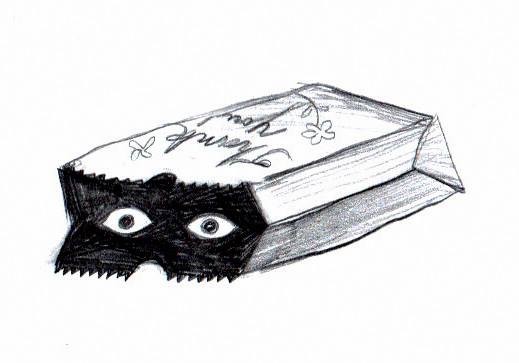
There, Thank You

sketch by Hallie Linnebur

There’s this first thing.  And then the side of it.  The underside.  Maybe a knot.

My shirt looks like a dress.

A darkness that comes open.  A light controlled by dimmer switch.

It’s just work.  Effort.  The cost of paying attention.  No end of account.

Start with what you might call a “feeling.”  Continue that way.  And move on.  Navigable hunch.

The roles are flipped.

And flipped again.

Flip-flop, padding along.

Topside.

I don’t remember much, but it all comes with.  Sometimes called “effects.”

Affect.  I perceive.

I watch her move, and move, and move again.  I listen.  I smell.  I wish to touch.  I like to learn.  I don’t know what.  Just find out.  It doesn’t happen.  Well, sometimes.  But not as often as I wish.

I don’t know what the wishes are.

If that’s not true, then I don’t understand.

Over.  Under.  Stand.  Other sides.

When most accurate, I breathe.  Just that, and staying there, I follow.

Staying as a sort of plodding.  A moving.  A padding along.

It seems that sounds compete.  But they collapse, constructing more.

If sights and sounds were all.  Or,

If there was a difference.

A word was used – was “murky.”

I touch the curves.  I’m searching edges.

The switch dims and brightens, dims again, brightens.

Something.  And then the side of it.  Another side.  A knot.

Outside being inside, dims and brightens, inside-out again.  Staying there.

An old and thankful argument.  To whom?  For what?  To what?  For whom?  And so on.

Or just affect.  And staying there, I move along.  And I am thankful.

The Costume

Bill Jacobsen - Untitled 1999

The Costume

            When there is dialogue, or perception.  When he’s awake.  But what to name it?  How describe?  Perhaps even while sleeping.

The lag.

At checkout counter, clerk addresses: to absorption, numbness, mumble.  Other.

Strikes Alfonse as he’s driving toward home:  there are trees bending, being present in their way.  Cars, pedestrians, small animals scurrying.  A school bus.  Neighborhoods – definite yards and homes.  A mail-delivery-person.  A filmy mist.  A fall-behind in his perception.  Gap.  Perhaps.

He initially considered it a veil.  A tremulous fog.  A curious “vagueness to things.”  Like long, cold Winter.  Haphazard inceptions:  tree, bus, children; cat, dog, car.  No attachment.  A muffling and delay.  A foreigner.  Driver inside steel mechanism, separate by seconds, very nearly removed – a skein, a skin, a veil.  An organism with apparatus.  The slow calculator.

The smeary light when she speaks:  lover, mother, friend.  Overlaps, palimpsests, a smudging feedback, a decay.  The children crying.  Vocalization evokes.  Indicates.  Needs.  Response.  Remembers he is human.  Particular understandings, expectations.  Affirmations and acknowledgments.  Times for saying yes.  Attentional assent.

Alfonse disbursed.  Pernicious regress.  As if he’d be immediate.  As if the others were.  As if it all were touching, interspersed and in exchange.  This thing and another.  He is embodied.  The body seems slow, or surprisingly fast, almost anticipatory (unbeckoned, unmeditated erections).  He can’t make sense from it.  Body makes sense he knows not of.  Who knows not of?  Of what?  Even how might be accurate here.  Alfonse cannot seem to know, this is his costume, a glassy shroud, the sluggishness between the here and now.  Without a zipper or a tag.

Inside a bottle within distorted frame, but without an image described so clearly.  Costumes are alive – expose the motions of the wearer.  Notions.  Reveal, conceal, but variant things.  Who dressed him this occasion?  This dismantled undoing and random erasure, perpetual hiatuses of interpretation?  His hesitant reality – a retardation, sensational slag, both slow-soaking sponge and absorbency-abdicator.

“I got nothing,” he murmurs, “didn’t catch a word you said…” as if in some other language of different rhythm and tune.  Not understood.  Multiple things unrelated, cannot tell, cannot smell, is uncertain where he is in his motions.  Not quick enough, just out of joint, who what where why when never equals now for him, nor how.  He is Alfonse and he seems costumed.

Making love – a metaphor for intimacy – those direct invasive actions – and yet he’s steps away, slow to the uptake, uncertain who is doing where and when.  That comes later and looks like smudges that he estimates with guessing.

Is this uncommon? – is what he wonders.  Am I the only one who cannot tell?  Does she know what she is doing, feeling it as it happens?  He’s asking something far away he cannot measure.  He wakes each morning, to himself, inside this costume, and dons the heavy cloak of it for sleep.  Asynchronous, distant, accidental and traumatic, but postponed – perpetual flush of shut-down, shock, bewilder.

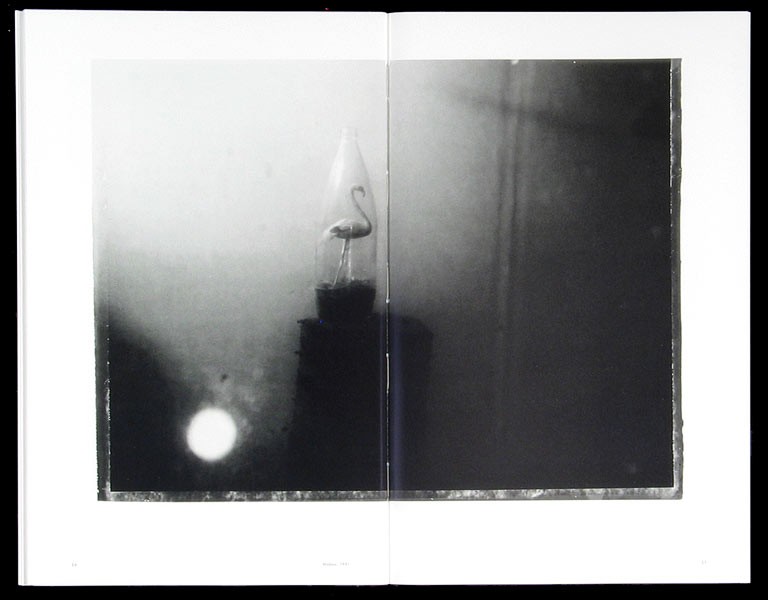
He thinks “flamingo” inside a jar of unfocused space in alternate materials in artificial frame and anesthetic wall in analagesic scheme, so far, far, far, far… the clock is slipping.  The span from here from now, from him from there, from this to happening, happens.

And so it goes.  Costume he can’t remember wearing that encases and engulfs.  Awareness too long after to affect.  A lostness in the makeup or makeover, the becoming and become.  Too late.  Ineffective.  Ever after and begone.

Echoes.  Surely something must be said, something addressed to him, something interjected, interacted and applied – only ever now arriving quite beyond a sensibility toward response – apposite, inappropriate, out of line and time and sense.  Unsettled and uncouth.  A threatening out-of-sorts, off-color and unfelt.  Feeling suffocated, unrelating.

Alfonse swimming being, non-concurrent, unawares.  Ineffably indistinct.  Imperceptibly misinterpreted.  Not.  Never.  Was. But.  Here.  Where.  No.  Not.  Now.  It slides away.  He heard something (her mouth, lips, the child-in-walkway, bird, tree bent to breeze) – no, not yet, before, never always, when?  How?

Soughing in a muddy river, ice overhead shifting, yesterday.  Forever.  There is no today in the mix, the undertow, a disconnected untoward, who where when – not he – can’t remember, a caesura of consequence – plugging, plunging him far from present, dark and drear.

So far between the now and when – not-knowing.

Invisible costume.  Alfonse’s weight.  Indistinguishably unable – uncommonly common, this viscous opaque coating – no known axis or location – simply not.  Not.  Not.

Knots of not…not-knowing, not-quite-hearing, not-feeling, not-tasting, ever too late.  Undone for undoing.

Alfonse within costume, a muzzling muffle of indigestive guzzle, of life.  A weather and reprove, a restrictive deconstruction, a not-quite-absence in the presence of the everywhereabouts and everywhen of… of… everything.

Flamingo Robert Frank

Invisible Man Chronicles, cont’d

Click HERE for parts 1 and 2

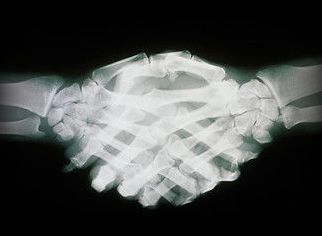
2-xray handshake

III.


            Rattling bones, deep-falling diaphragm – through continuous sightings and encounters with “H” (“her”) these consistently occur – even over hours, days, and months.

            I might say that what characterizes our particular version of intimacy are curiosity and wonder and the ecstasy of discovery and finding – imbuing apparently abandoned spaces with vitality and imagination.


            A week later was a potluck for the visiting artist.  Small-talking with “her” in the kitchen – I felt inadequate to be occupying her time and “let her go” to mingle with the many I was certain were desirous of her indomitable and imaginative company.  I spoke with her partner, the farm-inhabiting-best-friend-artist-lady, and H sidled in.  There was much laughter (their minds are contagious and entertaining – as if the structures of adulthood and professional culture never quite ‘took’ or corralled possibilities)…around “her” my breath dissipates.  We’d both been hired as rural mail carrier associates with joint training to occur the week following; both commissioned to respond to this artist’s intimately relational performance work; both in love with abandoned places and their loss and decay – both committed to discovering lost or overlooked things. 

            There we were.

            I in poverty. 

            Day one of training sat us next to one another, her length and beauty, doodles and read-alouds from the training manual enthralling.  I worked to breathe and lived through my peripheral perception – registering her movements, hair, wrist, knee, hands, mouth pronouncing acronyms, quirky nervous habits, footwear, scent and clothing…

            She suggested (did she?) lunch together.  I’m quite certain that converged through a clumsy stumbling and fragmented semblance of conversation.  I had planned only banana and peanut butter on my budget – yet each day we went – for that amazing hour – somewhere I’d never been before in a city I’d spent over three decades in and around.  An abandoned hotel, a nature trail, small chain restaurants, of which one, perhaps, constituted a first “date,” as, after placing our orders, she removed to the restroom and I was left to pay the bill!  (Delightful things like that).


            Blessings.  I was gaining practice in “soaking in the good” – a strategy instructed through my therapy, and H was much better than I ever imagined, a remarkable alchemy of behaviors and body parts – co-constituting an unknown ‘ideal’ to my mind, sensations, experience and history.  I was dumbstruck, amazed, bewildered, befuddled – in other words – alive and in hope.


            I’d been asking her coterie of creator-friends to visit my home for fire or food or an art-making party – to no response or avail.  Everyone taking a read.  She agreed, then doubted, then declared she thought she might appear via an internet message.  Thus she arrived, of a Sunday afternoon in April, to my home.

             We parlayed and exchanged – art, family, friends, lives, plans, hopes, strategies, likes and dislikes, ideas and tears, meanings and lies and other truths.  I ached toward her – finding romance and desire and a periscope of loving peeking out, looking round, checking for safety.  It isn’t safe.  It’s unlikely, bizarre, fantastical : sixteen years between us and four marriages – her blossoming while I fade to grey, her popping with –larity, my struggling for place.  She asked me to sit next to her.

            The sides of our arms.  Legs.  Eventually fingers becoming entangled.  We talked staring straight ahead, caught in some astronaut training module machine, no gravity, no reference, dizzied and desirous, disbelieving and desirous, frightened and desirous, with just the right amount of belonging and estrangement, novelty to craft courage and excitement throughout our neural nets.

             We concocted funnel cakes of cinnamon and sugar, mustard, jalapenos and sausage.  They flopped and sickened, we laughed and she left.  I think perhaps we loved, even then, that day.  She left behind a bevy of hands from a book she created, by extraction.  Our hands were open, our minds and hearts, a letting-go, with patterns and a freeing, a dance: in common, in Kansas, in history, in hope, in commitments, in fears and neuroses.

             Letting-go.

This slideshow requires JavaScript.

Our 80/20 Vision and Rememory

“Nothing’s like anything else in the long run.

Nothing you write down is ever as true as you think it was.”

-Charles Wright, “Lost Souls”-

Rememory is just a thing we do when we “need” it – or, for reasons that aren’t really rational at all – we seem to feel we do.  In other words, our experience (what our organism, our little assemblage of cells, lives through) works in us like nutrients that our neuronally connected organs (even smaller collectives of cellular functional troupes) select predictively – as probable perhapses – to aid our survival in each moment.

That it’s always subject to change, often flatly incoherent, or dreadfully inappropriate to any given situation proffers no guilt or dishonor – could we really expect accurate predictions of unforeseen and total novelty with infinite contingencies each next moment is?

We do the best with what we have.  After all, we’re not even able to use our tools intentionally – they work on automatic algorithms we are not aware of unless there is a problem.  Scientists might use machines and fabricated contraptions or instruments to measure and calculate “experiences/experiments” – something semi-controlled, devised and arranged in a lab.  We, on the other hand (scientists included), do not have access to our controls (of which there really aren’t any – just meticulously interconnected and recursively interactive meshworks) – our controls (or rather, effects) result in their humming along.

Ah, rememory, refraction – there whenever we need it (or think/feel we do, or hadn’t even sensed it) – and never to the point but that we make it so – experiencing piecemeal fragments the system spits out in relation to itself and its environment, and puzzling them together as if encountered in the world – using them like stencils or frames through which to assess our surrounds.

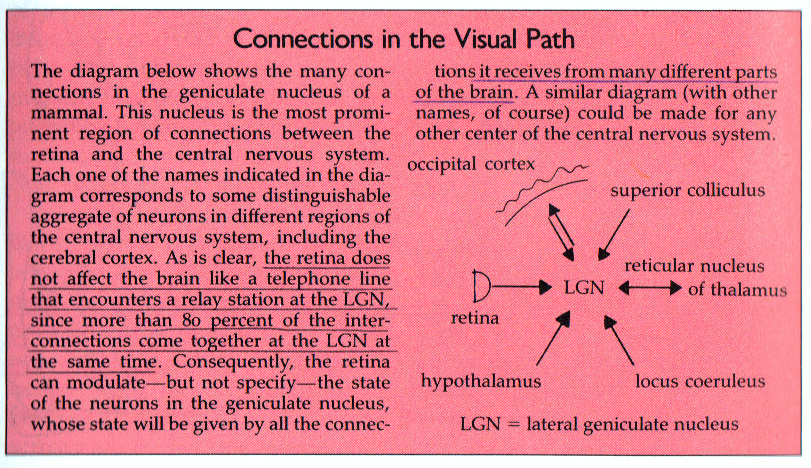
What a tricky treat!  Phantasms of deconstructed digestions floating a stream, plucked willy-nilly by impulsory triggers and collaged onto a canvas called Perception.  Howdy-do!  When 80% of the show is our relation to ourselves, it’s no wonder we feel criticized!  (for a sensory example – here’s a breakdown of what influences what we see….):

Vis Path 3

– from Maturana and Varela, The Tree of Knowledge

Each of us with our 80/20 view on the realms between – the worlds we share – it’s no wonder we’re ill at ease arguing agreements.  I’d have to ask my sons to calculate the potentials, but even from my 80+20 it’s infinitesimal – our shot at “sharing a moment” as we say.

Hanson brain

-from Rick Hanson, Buddha’s Brain

Perhaps to some Turing machine, or deep-distance galaxy view we’d look like a calibrated system, but the contingencies and unknown variables all changing with each changing change surpass even the weather…

So go on rememoring and adapting your stories, just keep in mind the bric-a-brac you’re rummaging in and it’s exponentially altering situation and experiencing states (by the millisecond), and consider offering those with and around you something in the neighborhood of 80% benefit of your doubt (your self-generated POV)!?

“I give you mine [dreams] for the same reason,

To summon the spirits up and set the body to music.”

-Charles Wright, Lost Souls-


Experience, anyway. sector 4


The following being part 4 of the growing mycelium that happens when I’m alone…

if interested, to-date is accreted here
Escher

4


Relatively speaking, it will all be over soon.  For some sooner than others, but soon all the same.


I’ve seen a lake filled with upright sticks and trees.


What’s written on the body dies with it.


There are reasons to stay alive.


A mysterious pressure arrives with “real.”


To think of recounting, embellishment.  A pressure to remain “true.”  Wherefrom do these come?  If I transcribe only facts as they are agreed to – collaborated – I do not accord with “real,” for imagination is always active and participant.  It would be like deleting affect.

Emotion.

And yet.  To consciously create a re-telling – devise a version – something’s different from experiencing’s bricolage.  The positing of author, I-collage, selection of pieces.  The pieces also selecting – opportunities for perception.

Only another experience.  Another form of framing.  A novel utility.


I write – construct a world – at times aiming for mimesis, but, as it happens, the interaction required between resources and agency = experience anyway.


Telling of my son is never writing him, it’s composing MY.  Which in no way obviates the Other off whom I riff.  Only keeps him discrete from my perception and activates subjectivities for us.  Unless I seek to define or contain – to account for him – ab-straction, object-ify.  Caesura of love: to falsify.


Whatever one takes as “real” exerts pressures of false.


Demands one set one’s course for “proof” as opposed to “truth” – a demonstration.


It’s experience, either way, and a variant sort – the staking-of-real or searching-for-proof sort – joining a demonstration – no less fabric of experiencing than any other, no less interactive or “real,” ever unique.


Categories falsify.  And enable.  No matter, still they matter.  I relate to them as things.  As limits and opportunities.  It equals changes.  Equaling experience, anyway.


To look toward wife and perceive.  To co-orient agreements.  Perchance to be/have experience to-gether (to gather).  Align what we share in kind.


“Real” being what we organize of reality, changing each moment’s notice (before-during-aft each the moment itself) – unlocatable present.  As I collage it (now past tense).


I listen to your story, constructed-on-the-run, as it were.  Me too.  Co-being.  I agree as I edit and reform.  Agreements forming knots, not points or solid nodes.  Tangles of perceptions, cast, re-cast, and still wet clay.  The surface never hardens.  When it “seems” there are still seams – a thoroughfare.


How we know that we’re alive, or better, “living” – curse the verbal nouns.  There are no steady states – but constructed patterns.  Sane inventions.  At times.  Experience, anyway, “experiencING” – seamingly changeless change.


The urge, in writing, to stay.  To thwart or channel flow.  Progression of narrative – a pressure.  Another experience:  the tension of process and now.


Why inscribing haunts us with false.  Telling or speaking too.  Even in song, something occurs.  The fluidity cripples and hardens.  We strive to trick it loose.  Account for dangling threads at every touch, but even the threads are intangible.  Change is a force of form.


I recall.  To vocalize back or again.  The loop a seductive model.  And I fragment.  The attempt to be impartially partial (or “real”) winds its way through every act.  Acts don’t start and finish, English-infernal-nouning.  To name is to kill it is said.  To stop up beING.  But it seams another example of change, going-on, the ever-activity experiencing.  Why fight back (wards)?


Recall: back words?  Assembling experience anew?  Only different (our noticing change) – i.e., experience, anyway.


To loop is false, such lovely model.


Experience, anyway. Empty, the space of life. (page 3)

“To reach, not the point where one no longer says I, but the point where it is no longer of any importance whether one says I…

…A book has neither object nor subject; it is made of variously formed matters, and very different dates and speeds…

…There is no difference between what a book talks about and how it is made…

…A book exists only through the outside and on the outside.”

gilles deleuze & felix guattari –

3

“My relation to others is staggered all the way to the infinite;

from the bottom up, never horizontally, the distance from here to there…

…what you call ‘distance’ is but the time of breathing in, of breathing out.

All the oxygen man needs is in his lungs.

Empty, the space of life.”

-Edmond Jabes-

            Passage to and fro.  Fore and aft.  Passing through.  So many streams of signs and symbols, sounds, referents – in some pores and out from others.  A long and endless middle.

If photons, neither particles or waves (or both) – packs of energized events.  Here, then there, everything on its way.  As if life (the verb) is journey.  Booking passage in a network of traces.  Slug-lines.  Marking, evaporate, recombinant maps.

Convergences – sense/perception/neurons and quanta.  Convergences – weather and molecules and thises and thats (write “I” and “you”) and light and air, ground and other conjoining disjunctive matters.  Convergences – roving planets in orbital trajectories, distances sustained by what is near, all the kinds and classifications.

Descriptions and errors.  Adapt, adjust, revise.  And err.  Trial err trial err, survive.  For now.  Temporarily.  This way.  The always-conditioning clause: Now.  If.

A stone Buddha, or just its head, being drawn by an artist.  A trace, remark, a transcription – transformation – another form.  For now.  And then…

Tracing convergences – our qualia – as events describe – the meeting and meshwork of lines, of motions, of pathways and bendings in travel, of stars and their dust.  Refraction, reflection, sharing directions, constraints.  Opportunities for pulse, for pattern, for wave.

To journey then, to map.  Now, if.  The long and ever-ending middle always already begun.  Trajectories and knots, unravel.

Experience, anyway.  Breathe in, breathe out, the trace.  The empty plenitude, the pregnant space, and timing’s distance.  We join.

Experience, anyway. cont’d

2

            Like before, but never exactly.  That’s why similar and memory, and that’s why it’s new.  Begins.  Never not change.  If only pennies.  It works.  It goes on.

So that what seems a chasing, a tracing, a spy-archaeology-sci/fi-breathless-fragile-safebreak (i.e. “creative writing”) is also dirgy dredging, slurry stirring, re-invention redone renewing some old search.  If he wrote “to get it right” it would be wrong.

Standard unlocatable with too many variations depending on, all boundaries shift with each decision – though it feels less freedom of choice than compulsion to find – where there’s nothing to find that’s not making (constructed – what’s there getting too little credit in general) – what’s done with what’s attended.

Not meant to be confusing – but from quark or qualia, wave-particle to universes full of looming holes, it plainly is.  At least what we’re able to tell of it – representamen – hingey symbols we careen from like units of mobiles in wind or gyring pirate swings.

There is that.  Is, is, is, is : handy set of markings and concepts “to be” the seeking and the sought – condition and conclusion – of begin.

Listening now – the statue the only Other besides the dogs – well, and whomever all conjoined to craft these scribblings to serve as silent sounds filled with elastic contents over meticulously-constructed time.  The billions.  And infinite (as far as he’s concerned or capable of “counting”) quanta of wave/particle/atom/molecule/element – dithering thoroughfares making up ginormous pervasive systems within systems in which he depends and participates toward is.

– To music, quiet head of Buddha lurked behind, no longer staring with the eyes as much as ears – sense shift and collusion – never one without another – it goes on.

Or perhaps correspondence…(Asking after the Nature of Nobody, pt. 3)

from pt. 2:

This is a portion of a map that does not represent the territory.  There are, perhaps, moments – instances – in which I fit with my surround – but usually it is organizing a mapping conference of sensation, affect, percept and infinite inputs coupling to pre-formed acquired categories and classes, fuzzy generalizations to stencil lines and rivers, mounds and fissures with very little correspondence to the world.

It writes this as “my world,” or “the world that I in-habit.”

Or perhaps correspondence…

(Asking after the Nature of Nobody, pt. 3)

…is precisely what is occurring.

“Each biological life-form, by reason of its distinctive bodily constitution (its ‘biological heritage,’ as we might say), is suited only to certain parts and aspects of the vast physical universe.  And when this ‘suitedness to’ takes the bodily form of cognitive organs, such as our own senses, or the often quite different sensory modalities discovered in other lifeforms, then those aspects and only those aspects of the physical environment which are proportioned to those modalities become ‘objectified,’ that is to say, made present not merely physically but cognitively as well…the difference between objects of experience and elements of sensation is determined primarily not by anything in the physical environment as such but by the relation or, rather, network and set of relations that obtains between whatever may be ‘in fact’ present physically in the surroundings and the cognitive constitution of the biological organism interacting with those surrounding here and now.”

-John Deely, Umwelt

Given the apparent disjunction of its maps to the potential largesse and intricacy (unknowns) of the territory, it reconsiders.

It thinks it may be inextricably related to the territory.  In no way accurately or exhaustively (in relation to the territory) yet constitutively via what kind of co-respondence pertains (in relation to the species of which it is an example).

In other words, by inter-relation to the territory, and by nature of its dynamic organismal systems of sensation-perception-cognition and communication (+ language – the capacity to model the above relational systems): it is I.

It co-evolves personhood.  The capacity to refer to an I among Is.  An individual personality among a We.

Map and territory, co-respondent.  The map being a model of that correspondence and correlation.  Therefore, of course it is idiosyncratic and fraught with misperceptions, disjunctions and erroneously organized interpretations and representations of the networked environments…yet the map = correspondence with the territory in species-specific experience.

Perhaps?

Correspondences of one to many and many to one, and to a very delimited aspect of the territory, but still constructed by real linkages (reciprocal relations and responses) to that “Territory.”

Bees’ links look different.  If a lion were to speak we would not understand.  Every organism its own relations to the territory, selecting and responding, sensing and processing various aspects of the territory into species-specific lifeworlds, but correlated and corresponding particular to their kind.

Or…our maps are our maps.  Ever changing, adapting, responding to our environments and experiences, genuinely related to the territory, representations of our habits of being in the world (in-habit-ing it as humans).

I can’t lay claim to truth about the territory, but my maps derive from it and shape my forays within it, can be shared and examined, evaluated and adjusted with other mapmakers, and trusted as the experience of a peculiar entity of a particular species modeled in reciprocal relation to specific environs of the territory.

“The map is not the territory” but a model, a depiction, a fragment co-evolved in and with that territory, a specific kind of rendering and representation, and valuable for the explorer-species of the sign.

Umwelt by John Deely