THANK YOU AND AWARDS FOR ALL – it’s long, but please read – it’s directed at YOU!

Acknowledgement and Re-cognition

Lately there’s been a rash of occasions in which I’ve been requested to tell things about myself (my wife would immediately note the choice of nouns as descriptor and tack on “well, that’s one way to look at it” i.e. as irritant, possible disease, discomfort – a “rash”).

I’ve noticed that discomfort.  Say I’m elated to have a poem accepted somewhere, or receive these lovely and encouraging blogging awards in WordPress, each joy arriving along with these little nettles: “please provide two paragraphs of biography,” or “tell us about yourself,” “list seven things about yourself your readers probably don’t know” and so on.

And I desire to tackle it all poetically, as fiction, an invention (which perhaps I think it actually is : “self-perspective” blah blah blah)…

…and yet…

Why are we writing or sharing recipes or art in the first place?  What is that urge?

To express, perhaps – we feel aburst with something and want relief, to press it out…into where?  why viewable?  readable?  hearable? physical?  For whom?

For ourselves, we might say, some more objective, ab-stracted processing of what goes on in us as we struggle to live?  Okay.  But, again, why do we share it?  Click the keys and hit “send” or “publish” or “post”?  Why not leave it all on our desks, in our journals, our notebooks, as undeveloped film and private files?


Maybe we write to discover, to create, pass along information, simply verbalize…I agree.  But also – why not just read?  We’ll never compass it all, even without adding another jot or image.  And if we’re paraphrasing experience as an exercise in knowing – echo – why share it?  Why book?  Why picture?  Why avail?

My guess is that, whether I like it or not (about myself, about being a social human critter, about existing) we all of us make/use signs, marks and gestures in order to engage.  In fact we must and we need to.  To acknowledge and be acknowledged; to process and join the process;  to have our being validated, even to ourselves, which still requires another.

I find that many of the blogs and their creators I have come so much to value are likewise reticent, withdrawn, coiled in a very unique, particular and special veil of language and machinery, cybernetic cyberspace…a safety of at least felt and imagined control over what re-presents us in our world, an edited voice, or bodiless pattern of thought.  Where we feel some level of risk-management and damage-control.

My wife was recently bullied in a small claims court case.  Last year one of my children was bullied on a walk home from school.  In both cases, I was enraged.  Almost uncontrollably vehement at what I perceived as injustice, depersonalization, predatory victimization, intimidation and abuse of power (etc.) I quickly activate into activist, I do things, strike back, strike out, and defend.  As she talked me down through this recent event, my beloved spouse asked me what it might feel like to come to my own defense in that way?  To be incensed at being ignored as a person, a voice, a being?  To say “no, you don’t get to do that to me” as if I were just as valuable as her, as our children?

WHAM.

I could hardly imagine such a scenario.  My instincts have defended me in fright or danger.  I’ve escaped, avoided or saved myself in andrenalin-rushed bravado or terror, but never really exhibited courage for myself, or because of my personally estimated worth.  Billions of graves, agnosticism, “life-happens-and-then-you-die” awareness along with saturations of accounts of wars and their rumors, poverty, destitution, abuse, genocide and all the etceteras have left me pretty humble around complaint, as if “first-world problems” didn’t count as “problems,” after all.

I haven’t figured all that out, but I’m willing to say that in whatever world, we all of us actually matter, and would do well to respect ourselves at least as much as we must all these others we care about, visit or “like,” protect or take the time to read.

I may never know any of you in a fully personal way, that is, embodied and face-to-face or voice-to-voice, but I am learning that whatever we do is personal, for the simple fact that we are persons doing whatever however whyever whenever we do.

So thank you – EVERYONE.  Whether you’re disguised behind an invented gravatar, code-name or handle, some fictional aspect of yourselves – it doesn’t matter – I believe it’s originating with a person, that’s important to me, and so are you.  Thank you each for whatever it is you provide to this vast and wriggling system of signs.

A “Person Award” to you all – as in recognition, not as bestowal.

THANK YOU


Day Dreamer Award!

Day Dreamer Award

I’m back from my five minute, coffee-laden, brain-reprieve.

Thanks to Lotus Ohms for awarding me this badge/honor/advice?

It is an honor to be read, thought of, and chosen.

Award works like this:

Upon receipt of this award, you are to take a mental vacation for 5 minutes. (Gaze off into space, look out of the window, have yourself a wonderful daydream….)

When you have returned from you daydream, you are required to take another one tomorrow.

Lather, Rinse, Repeat.

Award this to 3 other people. You can only pass this award on to three (3) people.

And me own nominees for this self-loving reprieve include:

the Self Appointed Life Counselor at http://unwantedadvice.wordpress.com/

lots of thought and reading go into these blogs

Jean-Paul Galibert and his “philosophy of non-existence”

(philosophizing can always use some aimless gazing for fuel)

and

Careful for Isa

some hefty poetry-writing happening there

You guys take five and refuel…dive in…do it again…dive in.

Thanks for working!

manoftheword

So Rich and Rewarding in their Own Unique Ways!

Favorite sourcings of mine

and pleasures

both INTENSELY recommended for readers and thinkers alike

(are those one and the same?)

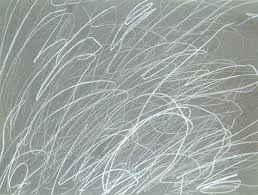
Mark Marking Marks

Cy Twombly

Mark Marking Marks

“oh it’s working, it’s magic, each word lifts me up, takes me away from here,

from this nothing; I feel…I am…speak always, Maybegenius.”

Macedonio Fernandez

Writing as the ‘Talking Cure’

As long as I keep speaking, Mark thinks, – ?

WHAT IS REAL?

            As long as I keep talking to myself, even better the inscribing, using matter somewhat foreign to myself, like this plastic pen, this sheet of paper, this blue ink…I am providing myself with evidence.  A humming continuity, a series of marks, a silent sounding breathed into air.

But when unable?

As long as I keep telling myself these stories, Mark thinks, – ?  then what – ?  why – ?

There is evidence that I am here, he says to himself, marking it down.  Marks make Marks, he supposes, I am, at least as far as the reach of this pen, and I stay, at least longer than my thoughts, he thinks.

Mark got tattoo’d.  He did so for evidence, a permanence.  They said it could not be undone.  So he had them spit into his skin the names of those who had changed him, affected.  As if to say, to go on and on saying, these, these existed for me, in and on me, these folks made impressions that made impressions on me, therefore I must, yes, it logically follows, here – you can see them can you not – ?, it logically follows that I must exist – to have these names, these titled and organized and permanent woundings of names, of those who existed (it’s attested by many), so it follows, it must, with them pierced in my arms, that I, too…

If it all keeps on talking, these whispering names, the sound of my voice, the terms in my head, and if I work to make it real, as an object, if I chisel or stencil or ink it to the world, then surely it must testify on my behalf – I was here!  I am here!  I’ve left my Mark!  Mark marking Mark – a declare!

Or so he is thinking through his days, through his life or lives, through his odd and self-imposing tormenting sort of fear, of worry.

Am I?

To no effect?  he wonders – ?

Mark often fears he’s interchangeable.  Or worse.  Perhaps another boy would have been a better son, left a fuller name, a more remarkable mark than – ?.  Another man a truer spouse and more sensitive or empathetic, more evolved or more mature than his straggly droopy heavy brain of a – ?.  A more substantial father with clearer love and direction, firmer hands, readier tears – ?.  Mark was aware they were out there.  They’d been fellow students, inhabited stories and novels and other people’s lives.  Why were his people stuck with the – ?.  His nagging mark, so often read right over as innocuously as a comma or period.  Weren’t they looking for content not a pause or an absence?  A man marked by inquiry?

But if I leave here some trail strewn round my desk, this floor all these cupboards, perhaps at some point they will see I was here!  I am!  And I was watching and listening, loving and feeling them all.  Spending myself and my worries in this strange attempting to trace and to hold, to keep and remember their details, their effects, my responding.

Someday shuffling through or perhaps clearing out, maybe they’ll stop, pause, question and wonder.  Who was this man?  Where was he?  When?  How?  Why?

What did he do think make say?  And perhaps they’ll find these markings.  Perhaps they won’t have burned or mouldered away, and all these messaging reports, all these processings and accounts will come to mean, to have significance, these bird-routes of scratches and marks, dashes dots lines, this pouring forth of constructing an identity against with the world…

As long as I keep speaking, Mark thinks, possibly –

– ? –

Passing Thoughts

Passing Thoughts

“People don’t always understand what they see…it’s always better with a few verses”

-Henri Rousseau-

“I don’t understand it.  The injustice of it, the random, unpatternable thing life is, feels like guilt, at first, and then matures (thought the verb is obscene in the context) into sorrow.”

-Larry Levis-

            I often feel something that must be near sorrow when I pretend for a moment that I am able to reflect or observe my own life.

Usually this occurs a few minutes after everyone that inhabits the home in which I live have tottered off to their beds or their dreams or wherever it is that they go when they’re alone.  I pour myself a cup of coffee, take on cigarette out of its case, and swing gently on the porch in the night’s dark.

At first, I simply listen.  For the trees, the breeze, my breath.  Then I let my eyes  gaze.  Neither here nor there but some middle-distance that never asks to focus.  Three or four puffs in, two or three sips of day-old reheated coffee, and I begin to feel.  My body reports its day.  How long it has been awake, what muscles have been used, what nutrients processed (or wasted).  I start to find emotions.  Perhaps lodged in the elbows or neck, gut or temples or knees.  Places they sneak off to in the day’s demands.  I gain what feels like a sense of things.  A “this is what you’ve enjoyed, endured, has transpired in your waking.”

And I breathe.  The smoke, exhaling, tells me so.  And the knowing the days that remain are smaller.  And that the days that compose me stretch out.  And I wonder.  “I don’t understand it.”  It baffles me so.

I have the impression throughout my aging frame, that so many places, engagements, and events that require all of me should not feel so dangerous, such threatening.  That the places we spill for one another, on one another – where we come forth – why do we fear so deeply? and try so hard? – why don’t they give rise to elation rather than wound?

I see moments, occasions, and encounters that have scared me to my silent howls – but from here, now, look like people in love giving themselves or trying to – declaring, expressing, vulnerably opening.  Why the fullness of human persons should overwhelm and frighten us so, when we are also one of them – why is this?

Why do I not feel I can hold my own in another’s anger or grief, sorrow or fear?  What is so uncomfortable about difficulty and complexity and unknowns?

The haunting guilt of finitude, of insufficiency, eventually levels out toward a universe of conundrum peopled with questions, and a kind of sorrow and grace seeps in.

By now my smoke has gone out, the coffee has cooled, and it is high time I join my spouse in our final accord.  The waves rise, they wash out.  They rise again.  There is a passing, and some passage, it is ephemeral and sure, and it goes on.

All these passing thoughts, and days.

I don’t understand what I see, but it’s usually better with a few verses…

I have the suspicion that the meaning of things

will never be sorted out

-Denis Johnson-


(click image for musical accompaniment to the text:

“Broken” by S. Carey)

(it’s worth listening to even if not reading all the text)

Remarking Mark…Part the Second

Mark Marking Questions

“Man is a riddle.  Our complex relation to others may also be affected by our fascination with this riddle…Origin means, perhaps, question”

Edmond Jabes


“Writing as the ‘talking cure

he thought, thinking in language what he thought language might do.  Be doing.  To him.

He heard “why?,” a term learned early in order to learn, and thenceforward laid over nearly everything he read, encountered, overheard or stumbled across, as if it were his placeholding destiny in some infinitely progressing equation simplified “world.”

He’d read he needed other persons and things, places and times to know his own.  – “Why?”

He’d heard “until others acknowledge or teach you your shape, your ideas, what you see what you feel what you taste or speak or hear, your perceptions and scope, you won’t be aware of a thing.  You’ll have no ideas or sensations per se, you’re essentially Nothing without Them.”

Arching his back and shrieking a sound at an absence of breast: “why?”

“I guess I’m just punctuated that way,” he came to think, as he adapted vocabulary.  “My role in a sequence is: – ?”

“And God said ‘Let there be light,’ and there was…” well, maybe – ?

“The Tao that can be named is not the eternal Tao…” well, maybe –  ?

“1 + 1 = 2,” well….maybe – ?

“You are Mark, a male form of a human animal, replete with these working organs, the English language, and certain beliefs.  These are your parents, your sibling, your probable friends.  Here are some feelings, some expressions and thoughts.  Here are your words.”  Well.  Maybe – ?

Shaped with letters and numbers and sounds.  Voices and touchings and feels, he became, slowly, surely, puttied toward a recognizable form – perceptible to others, acknowledged, even affirmed or engaged from time to time.

“Why?” propelled the lengthening problem of life but never grew toward solutions.

He read elaborate explanations and descriptions as he borrowed more languages.  Spiritual terms, medical terms, words scientific, political, philosophical and intimate.  Thick reams of median symbols asking to be joined or embraced, understood or imbibed.

Mark enjoyed these fabrics, and found a belonging among them.  Layers and theories, emotions and dreams – he simply need append his simple gesture – ?


Trouble, in the form of discomfort or pain, of disjunction, arose when agreement was desired.  Explicitly or implicitly, this undermined his form.  In situations where reciprocation or statement, some firm relation was called out for, his questioning mark failed to serve.  Choices, commitments, integrities or beliefs turned to drizzle around his definitive (self-identified) symbol.

“I love you,” she wooed.  “-?-“ he replied.  “I cannot know what you mean, what your language portends, I am unable to verify why?” he’d respond.  To collapse and retreat.

Even thoughts and decisions were questioned and split open on his sharp weapon of a mark.  He was not trusted or deemed trustworthy as doubt was perceived an anomaly.

He remained uncertain.

Self-perceivably, he reliably questioned, he’d respond and then take it away with his mark, his “signature move” as it were, his undoing.  “Yes I will…” “This I think…” “I am…” always followed by his -?- (which sounded like “why?” in the air) and found no rationale that could not be further put to query.

The world was unstable as well as a “self” for him.  All under the branding shadow of “why?”  This Mark never outgrew in all his adaptations, acquisitions, mutations and metamorphoses.  His certain core of uncertainty.  His permanent doubt.  His oxymoronic reality of being, not-being -?-

They perceive him – they really do – but as full of content with no substance; as possible and capable yet a great risk; as veritably human but unnamed from within.  Without “identity.”  This is true even of his wife and his children, parents and friends, all unsure who or what they are relating to, marked with the sign of the -?-  The indeterminate one, the questionable and uncertain, the duplicitous and vague, are various ways he is read and conceived – standing there as he does on his tiny spot of here, long-legged and stooped as in prayer, or inquiry – ? –

Telling Our Stories

This slideshow requires JavaScript.

Telling Our Stories

After all, it is language, this story.  This telling of you, of me, of our feelings and years, whatever we’ve done.  We are just speaking, really, creating from language our world and our children, our works and our actions as if we remembered.

I can’t see the harm in it.

I say I remember, here looking at you, that first time in your eyes, whether 18 or 40, when we may have sat facing each other or entwined, as if we’d first met and must absorb everything.  How large they seemed, how blue and soft as rain, how far I could swim there as if building a nest.

I don’t see the danger in using our language to say so.  In making up stories, alone or together, about us; our world and our selves, what we think.

After all, it is language we share.  As you bend at your work, your collar reveals a fresh sentence, your skirt a painting of terms, in your flesh all these stories I study to learn.  Of your breast and your elbow and hair.  The nape of your neck exclaims and your scars everywhere.  What the poet said, also with words, combining verbs and adverbs and nouns: “Your body is a book of thoughts that cannot be read in its entirety.”  Just words, but I keep them and sing them again, I can’t see the harm in the trying.

I love you with terms of my body.  I sign them to you when it’s dark.  It is language, oh yes, and you hear me.  We read with our skin.  Typography refers to impressions.  You impress me, even as I Braille what I need.  How else might we weave what is we without terms and strokes or gestures?

Only language, after all, that we borrow, I get it.

But where is the frailty in trying?

I read and I read and I read what you tell, ever growing a Talmud of comment.  I notate, I argue, I vent.  Then repeat.  I praise and I question and soothe.  You likewise make of my verbiage a stream; a spring from far peaks that dissolves to a delta.  What should we call what we do?  Relat-ivity?  Our capacity to engage and to meet – to relate?  Communication?  Always co-, ever with, filling munitions and messaging, our vocation?

To say, to listen, to hearken, to spell.  Here we tumble and thicken and age.  Her we interpret, reply and enrage.  Here we bind ourselves, it is language we keep using, keep finding, continue to tell…

“………………..Even in sleep

our bodies seek each other, your face the moon

lighting my dreams.  And by day, scenes beyond

untanglement.  Tell me my story, love;

how could I know it, we are such knotted things?

-Philip White, from Aubade

The Cleaving

“Connection is the recognition of the  intimacy of a division…

to make a division is to give substance form”

Madeline Gins

“Therefore shall a person leave his father and mother and shall cleave unto another

and they shall be as one flesh”

Genesis 2:24

The Cleaving


How do we come to know, believe or accept this ancient concept?  It has mited its way to the deepest reaches of Being (Dasein): Heidegger’s rift, linguistics address, each individual body’s pulse or breath or tremor.  That only the separateness may truly join.  Only the differences are recognized as similar.  Only the rifts require a bridge.

I do not know.  It is a reality I feel with as much pain as hope or joy.  That cleaving is both the splitting apart, the splintering wood and severing rope, AND their clinging together, their sealing and sealant.  It undoes me.  As a metaphor, concept or signification it rings true and carried dark howls and bright screams out of the depths of me.

And yet it comes so naturally.  Fight or flight.  Attack, retreat.  The extremities of the urges to join and drive to cease.  In the utterly intimate action of cleaving, we expose and unite – right in the most susceptible, vulnerable, life-threatening places.


The “cutting out,” “cutting off” – to cleave – you know what I’m referring to – when that which is most important to you becomes unreachable.  That impression that you are being “given up on,” that someone is “letting go,” even actively removing themselves or casting you away, chopping the cord – the umbilical torn, gushing, pulsing, the infant left writhing and wailing in the dumpster or thorny woods, a closet or dark alley.  Cleft.

In truth:  that severing of relationship, whether momentary or fatal, is a life-threatening, death-dealing blow.  Abandonment.  The dawning that you are at the front and there will be no reinforcements, you are cut from the supply train.  There is shock, there is scream and then a canyon of void with no other side.  It is we at our most disastrous, mortally dependent state.

We in the face of absence.  We without response – no face in a mirror, no echo of sound, NO THING.  Cleft.

Individual, alone, solitary entity.  Facing the reality:  we are insufficient to our needs, incompetent to our existence, impossible to self-sustain.  We in our fragility.  Our valid, appropriate, ontological FEAR.

Whack!  In anger, in grief, in silence, in bruise, we are severed, ultimately exposed, whether through small offense or enormous rejection – we have been cut.  Past the bone.  The reverberations tumble and crumble out far and wide, seemingly ubiquitously, regardless of the specific instant’s severity.  This is “the cleaving” done as much to us as by us in our madness to survive, to be real, to be verified and validated.


In the “drawing near,” in the “clinging” of to cleft, on the other hand, we are born.  We become.  As another reflects or responds to our raw broken mortally wounded finitude and fragility, we get glued to the vitality of these limited lives we have in us.  As these fearsome exposures are clasped, bonded, covered by another – transfused and salved, bandaged and wrapped or dressed by another – we know we are possible, we feel we exist and we matter, we join toward world and its being, brief though it is.

These are our chances and capacities: to effect, to mean, to act, create or be.  It is in the drawing near that what life there may be is acknowledged, fostered, affirmed.  Con-firmed.  Cleft – grafted into the ongoing reality of things, parting through wholes, participating and enhancing of semiotic systems.  As if life does not really belong to us, but we must belong to it, by belonging with one another.

“Leaving,” “cleaving.”  The leaf cleft from its branch will not survive, but cleft or grafted to another stem or soil or root may for awhile yet, live on, grow, produce, change and become.

We continuously leave and cleave to varying extents, and these just may be the principal elements of our thriving.  Cleft we perish, shrivel, die away.  Cleft we heal, nourish and grow life.  Both options/realities occurring in the cuts, the core places, the sources.

Here we panic, here we rejoice.  Here we suffer, here we love.  Here we become, and here we cease to be.


This mysterious activity necessitates both significations, counter-intuitive though it seem.  The need to be cleft exposes the places needing cleft.  Awareness of the sources for supply determines the crucial treasure, dependency, and gifts of supply.

We are chopped to the truth of death

and joined to the reality of life

Cleft.

A resonance in technical difficulties

“Writing is for me a means of modulating and organizing phenomenal and circumstantial information from all points of experience, a process I refer to as ‘tuning’ myself.  As I grow older and seemingly remove myself from unity with any singular, or even plural, socio-cultural environment, I seem more ‘on my own’ in a vast environment of internalized experience.  My approach to poetics has become the search for responses and behavioral modes relative to this experience, to surviving it as well as conditioning myself to it.  Constantly the effort seems to be away from any formalization of ideas or structure or definitive process and towards a rejuvenating line of ‘basics’, that mythical point where each process is fresh and new and wholly responsive to indigenous conditions…

“In a sense, I am trying to cope with the urge of poetry as opposed to the structure of it.  This urge seems to lie within the rooted and individual beginnings of the activity, centered on a meditative, self-encoded embrace of those issues and inclinations I find within my own humanness.  The intention therefore becomes the opening of experience toward a continual address of the self”

-Craig Watson-

in