The Scribbled Line Portraits of illustrator Ayaka Ito and programmer Randy Church began as a class assignment before the stunning digital photography innovation came to public attention at a Toronto FITC workshop.
The series showing shredded human bodies integrated 3D and programming for a project with a three-day deadline while the two were at the College of Imaging Arts & Sciences at Rochester Institute of Technology.
Ito and Church “put their models through the shredder” using a custom Flash drawing tool, HDR lighting, Cinema4D and Photoshop.
The project began as a class assignment and grew into a fully realized series which won an Adobe Design Achievement Award and has been featured in 3D World Magazine and Communication Arts Magazine.
A post from DesignBoom with more technical detail on the process, here.
“”I write.” This statement is the one and only real “datum” a writer can start from. “At this moment I am writing.” Which is also the same as saying: “You who are reading are obliged to believe only one thing: that what you are reading is something that at some previous time someone has written; what you are reading takes place in one particular world, that of the written word. It may be that likenesses can be established between the world of the written word and other worlds of experience, and that you will be called upon to judge upon these likenesses, but your judgment would in any case be wrong if while reading you hoped to enter into a direct relationship with the experience of worlds other than that of the written word.” I have spoken of “worlds of experience,’ not of “levels of reality,” because within the world of the written word one can discern many levels of reality, as in any other world of experience.”
-Italo Calvino-
p.s….
“A work of literature might be defined as an operation carried out in the written language and involving several layers of reality at the same time”
“The preliminary condition of any work of literature is that the person who is writing has to invent that first character, who is the author of the work”
To be, so they tell me, at least mostly fluid. How to be that, too, in the other kind of way? Beyond “fact”?
Water (or blood), being good for that, because it can be inside and outside at once, leaving and filling a vessel. That is, it can be spilling out while going in.
As if ‘the other kind of way’ were metaphor. But it’s unlike. In fact, for us, it’s exactly the same, just different.
Therefore, rigid as I might “seem,” this is not actual-factual, I am mostly liminal.
Which could (factually) explain the constancy of change, or, how we identify effects of wind, e.g. fluctuation; i.e. the rippling of emotions or mood.
My faith in these “facts” alters, like my beliefs about most everything else, including my self.
That would be “natural” then, if by “natural” we meant “according to widely accepted notions of facts.” (For example.)
Be that as it may, I’ve heard talk about a collusion between professed “facts” and perpetually mystifying “reality” as some instance of joinder (called, perhaps “knowledge”? or “wisdom”? – an alignment of facts with reality – a “truth”?). What some might describe “accord” or “harmony”? A sort of “peace.” Akin to the “angle of repose”?
Would that be being in multiple ways? At once, of course.
To synthesize: the purveyors of fact inform me that I am mostly fluid (even as my knee pops when I rise, and I’ve a hard time rotating my neck). If, in fact, I am fluid (mostly) I am asking how it is that I am being fluid in another way (from another perspective, i.e. do humans multiply being?).
A viscous question.
“And how is the riddle of thinking to be solved? – Like that of flame?”
-Ludwig Wittgenstein-
In other words.
Find a liquid view. For instance – rolling in a bathtub or sharktank in heavy rain. Feel water, see through watery eyes, taste saliva, breathe liquid in (mostly). What else do you think you are? Grab a bone, a lock of hair and some of your own flesh. Hold. If you’ve a mind or soul, thoughts or theories – liquefy them, put them through a juicer until they’re at least 70% fluid – pour them in.
What does he mean “the mind is the great slayer of the real” (Benjamin Lee Whorf)?
Or the poet – “there is nothing in life except what one thinks of it”… and “I am what is around me” (Wallace Stevens)?
So, mostly fluid, with watery eyes, drenched or submerged – logically, like a porpoise or whale – we would be bringing “fact” and our “reality” to a closer accord in the “actual.” 60-80% fluid inside, 60-80% immersed outside, working our imaginations and thoughts, self-perceptions and beliefs toward a more indivisible, continuous flow…
What sorts of things do we wring from such “harmony”? “That reality is continuous, not separable, and unable to be objectified. We cannot stand aside to see it” (Robert Creeley). We cannot be submerged in water and watching ourselves swim at the same time, we would (presumably) have to exit the flow and look at a still or moving picture of ourselves (doubling time?) while “reality” and “facts” kept flowing, moving, going on (including the “unreal” activity of watching ourselves swim).
The trees blur into the sky as if they share a surface, as road to carlights, to earthen shoulder, grass, flower, again to tree: “reality is something transitory, it is flow, an eternal continuation without beginning or end; it is denied authentic conclusiveness and consequently lacks an essence as well…it is not evaluable” (Mikhail Bakhtin). Abstracting and division put us in the realm of the unreal, while the activity (of abstracting and perceiving difference) is, in fact, really occurring.
Submerged, blurry, inseparable and flowing…constantly and continuously…
“This is how we originate and how we are formed: a slapdash piece of work, subject to the vagaries of time and the blunders of brief opportunities”
-Michel Serres-
What I really want to ask, is where I am? Implying already the question of an “I” to locate, whether or not there’s a who that could be. I really DO wake into questions.
Pop over to my “currently reading” page/list. It hasn’t changed a lot, perhaps gained a few pounds. I set in this tribal circle, stacks of books like temple pillars, and feel like I’m made of shavings and fragments. Some strange conglomeration of paper-thin shreds, filled with phrases and songs, floating in air. Like using dust as a puzzle.
What sits in that center, bathed in blaring desk-light, really?
“a slapdash piece of [sometimes very hard] work, subject to the vagaries of time [its growth and its wear] and the [sometimes brilliant] blunders of brief opportunities”
That feels pretty accurate. My parents, my sister, my Kansas. My musical training. Education, educators, friends. Marriages and children, travel and work. These words, this blogsite. How “I” originates and am formed. And thousands upon thousands of books, hours and hours of movies and song.
Then the dust and the shavings keep collecting: mountain climbs and ocean views, orchestras and art museums, foreign countries and people. Slapdash, subject to vagaries, blunders of opportunities.
I’ve an urge to look closer (a terminal “illness” of mine). For “slapdash” I find ‘things done hastily, carelessly,’ but I’ve often taken great pains over much time with fervent investment – yet, yes, the results have definitely been ‘roughcast’ and ‘haphazard.’
And “vagaries” – ‘erratic, extravagant, or outlandish’ occurrences, ‘unexpected and inexplicable change.’ Admitted, time works this way, as (the dictionary suggests) the ‘variations of weather’ – a ‘wandering’ ‘fluctuation.’ I accept.
And what of ‘blunders,’ of blundering? ‘Mistakes, usually serious, caused by ignorance and confusion.’ ‘Clumsily or blindly’ mannering forth. However else could I proceed with this limited mind and body, space and shape, this miniscule duration (recalling ‘hastily’ – how much time, relatively, do we really have in a larger scheme?). Yes, I am always walking into an unknown next, ‘blindly’ as it were, piecing together a ‘haphazard’ and ‘erratic’ assemblage of imagined/remembered experiences, ‘clumsily’ hauling them forward breath-by-breath. Fair enough, ‘extravagant’ or ‘serious mistakes,’ I blunder.
Remains the “opportunities” to set it all aright. These are described as ‘favorable or advantageous circumstances, or combinations of circumstances.’ ‘Suitable chances for progress or advancement.’ Possibles. And this scattered smattered hollow or vortex, opens out again.
So – I’m here, and this – a clumsy blind wanderer stumbling through unexpected and inexplicable changes to haphazard and outlandish results; a con-fused combination of circumstances ever entering favorable and advantageous, suitable chances to progress and keep going…into the ever-possibles…
When I think of you, think about us, I want to. That’s exactly what I want to do: be done with mysteries, be one in fact.
But when I look at you, when I touch, taste, smell and listen you, I cannot conceive it. Can’t even imagine comprehending all that’s unknown, inexplicable. And I’m afraid to. That too, I’m frightened of some unfathomable overwhelm.
Yet from a distance, I mean, from here, now, it feels plausible. To declare all mysteries, one to another, in song or verse or gesture. Enaction. To enact our mysteries and imperceivables all at once in some enormous chaotic unison, unashamed. What is there to be ashamed of? Secrets are not mysteries, only their private signs. What forges them is larger and unclear. Diversity and variation – these we celebrate – no?
Step out of your houses and enact your whole selves!
We will bewilder one another – not such a bad catharsis!
Running, perhaps amok, perhaps silenced to a shuddering ball – who knows? It’s a mystery!
Perhaps we’d shout in brand new languages – delighting everyone’s ears! Perhaps we’d alter the surface of the earth, its environments?
Would that we were one expressive impressive cacophonous voice!
Would that we were?
I’d split into a willow tree dropping language-boulders from my fragile limbs. I’d erupt a perfect mountain steaming as a cold clear lake. I’d mud. I’d sprout as a milky pasture of weeds.
You’d Sousaphone in primary colors woven as a world-shawl. You’d be all the quiet stars, glimmering in their conflagration. You’d whisper through grain and aspen, moving through air like helium.
We’d crash without injury, fomenting monuments of grandeur. Melding our mysteries. You-topia. Humana-topia. “Other”-worldly.
Perhaps.
Perhaps a universal dancing, a carnival of beauty so trouncing our balancing globe as to shatter it, sitting afloat or casting about – some atmospheric inferno. Perhaps a gaseous stench would burst forth, a deadly poison. Perhaps disaster. Apocalypse of invisible revealed.
We could surely say “we know not what we do” living mysteries, eh?
“Off the hook” even as it gores us.
Earthquaking order in riotous glee.
The maniac’s laugh.
A universe of blindness and flare.
Breaking the eggs, precarious shells.
No wonder veneers. Elaborate mechanisms.
Flexible and porous, rigid and finely tuned.
It wears out, the strain and stress: containing, defending.
What if we went right on ahead?
Plunged up out of deep waters, rocketing down from our skies?
Going through with our propensities: explosion/implosion?
What do you imagine? The beginning? The end?
A flood, a conflagration? Some perfect balance?
We hardly know ourselves, one another…
secrets give way to hiding, large blank territories blocking the unseen, from ourselves, one another…
equilibrium-fear
we call eco-system, survival, “life.”
Undoing?
From here, right now, I want to release, to channel and broadcast – to expose without imposition, sing that I might hear, dance that I might see, enact in order to know…become some inward/outward thing, supernova and black hole at once…
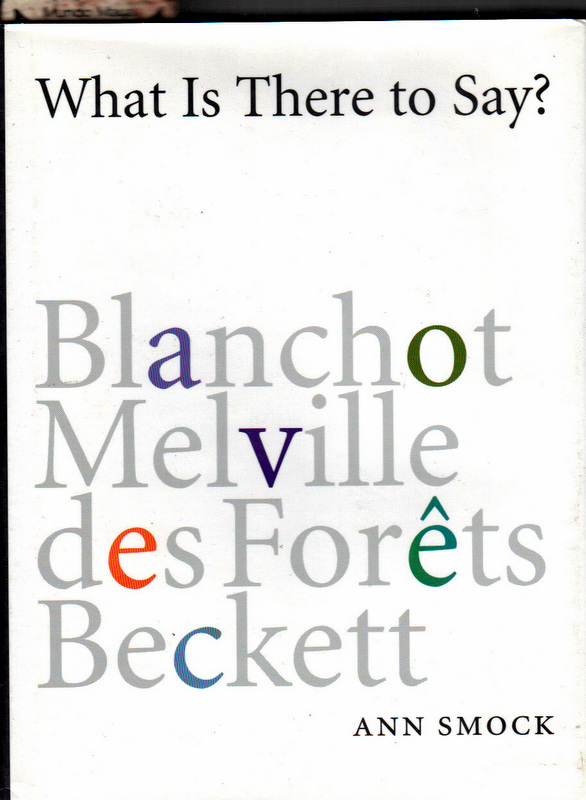
A book I am reading asks, in its title, What is there to say? Another, next to it on its anticipating shelf, states “very little…almost nothing.” Are they in conversation?
In completing Dust by Arkadii Dragomoshchenko for perhaps the ninth time, I come across a phrase I’ve starred and underlined in three colors: “We talk only because of a persistent desire to understand what is it that we are saying.”
If someone took the time to calculate how many times the word “other,” used to refer to a subjective entity, occurs in philosophical texts post-Heidegger.
What is being?
I often experience the anomalous reality of hoping wildly in the midst of despair, a fervent belief in oxymorons – things like “Poetic Influence” and “Romantic Love.”
How music crafts melancholy and joy.
Perhaps someday we will concoct a system of chaos.
The weather is large enough.
I say “I love you” because I’d like to understand it.
Edmond Jabes has it that “the words of the book were trying, in vain, to say Nothing” (writing of sacred texts) or, in other words, some persistent and extravagant Babeling into Derrida’s vast abysme of origins and effects. What is impossible. “Our persistent desire.” So Jabes asks “Is our relation to the world first of all a relation…to an expectation, a hope of world pregnant with all possible beginnings?”
I ask myself, then, what is it I have to say? The echoing answer “very little…almost nothing.” Persistent desire.
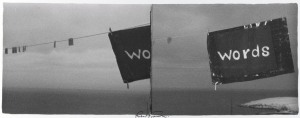


 The Scribbled Line Portraits of illustrator Ayaka Ito and programmer Randy Church began as a class assignment before the stunning digital photography innovation came to public attention at a Toronto FITC workshop.
 Ito and Church “put their models through the shredder” using a custom Flash drawing tool, HDR lighting, Cinema4D and Photoshop.
 The project began as a class assignment and grew into a fully realized series which won an Adobe Design Achievement Award and has been featured in 3D World Magazine and Communication Arts Magazine.





 All my Words are Silent