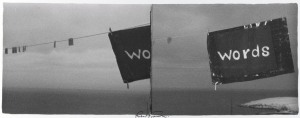
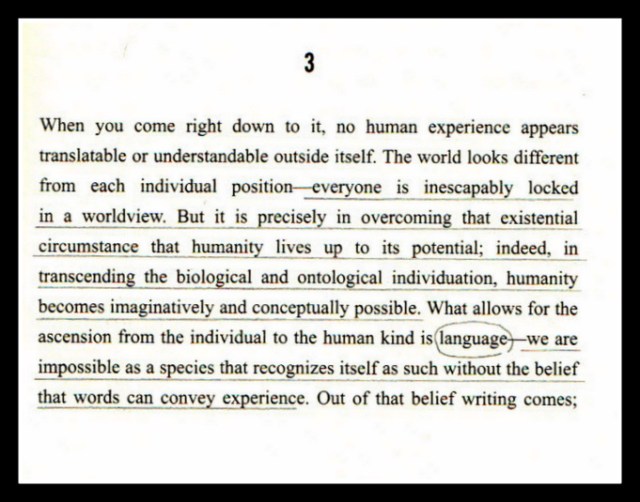
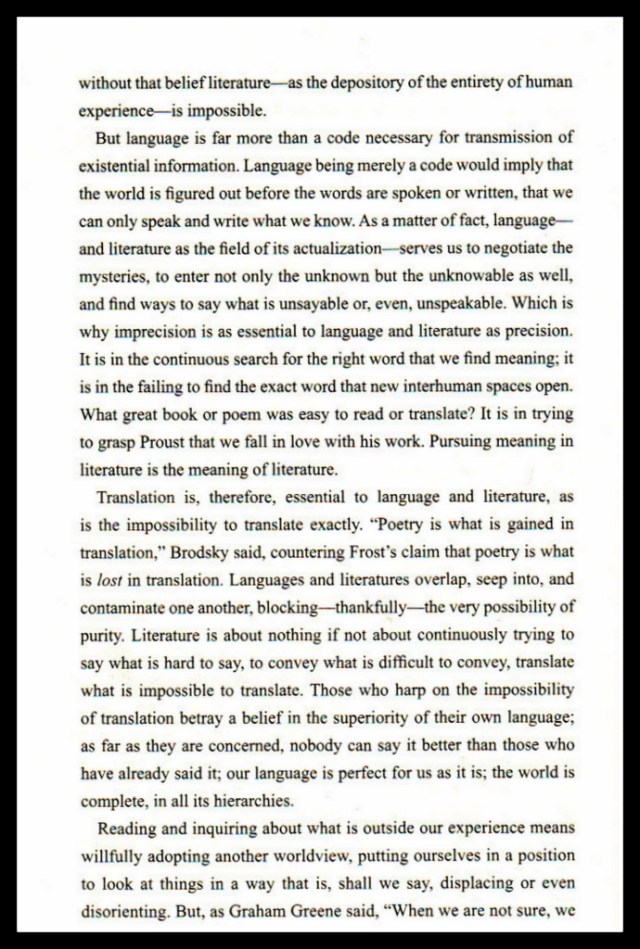
“When we are not sure, we are most alive”
-Graham Greene-

“When we are not sure, we are most alive”
-Graham Greene-
“I am someone who tries to write, who right now more and more seems to need to write, daily; and who hopes less that the products of that need are lucrative or even liked than simply received, read, seen…why I’m starting to think most people who somehow must write must write. The need to indite, inscribe – be its fulfillment exhilerating or palliative or, as is more usual, neither – springs from the doubly-bound panic felt by most persons who spend a lot of time up in their own personal heads. On one side – the side a philosopher’d call ‘radically skeptical’ or ‘solipsistic’ – there’s the feeling that one’s head is, in some sense, the whole world, when the imagination becomes not just a more congenial but a realer environment than the big Exterior of life on earth…The need to get words & voices not only out – outside the sixteen-inch diameter of bone that both births & imprisons them – but also down, trusting them neither to the insusbstantial country of the mind nor to the transient venue of cords & air & ear – a necessary affirmation of an outside, some Exterior one’s written record can not only communicate with but inhabit…the textual urge, the emotional urgency of text as both sign and thing. The other side of the prenominate 2-bind – … – is why people who write need to do so as a mode of communication. It’s what an abstractor like Laing calls ‘ontological insecurity’ – why we sign our stuff, impose it on friends, mail it out in brown manila trying to get it printed. “I EXIST” is the signal that throbs under most voluntary writing – & all good writing…
what must the world be like if language is even to be possible?”

got it, David. Thank you.
I have just entered in to another remarkable whorl and world of Lyn Hejinian‘s language. From the blurbs…”For Lyn Hejinian the concept of ‘everything’ or ‘everything living’ is the greatest seduction. In this book of tales, poems, polemics, lullabies, treatises, asides…’everything’ is captive to life and continuation is queen…Lyn Hejinian knows that ‘familiarity breeds the predictable’ but she knows as well that – and how – ‘contact produces uncertainty.’ This is a brilliantly uncertain book, a book of fantastic connection, connection as multiple and as hopeless as love might be, connection as big and leggy as the night is long”
And I quote:
“Who can be trusted? / One tells / but cannot recognize.”
“the yearning inherent in the use of any sentence makes it mean far more / than ‘we are here’…
shows with utter clarity how sentences in saying something make something”
“My sentence is garbling grammar to the inside as phenomena change / concentration”
“since the future, like fortune, is to be found not in events but in their / meanings /
The future is fortune’s form /
But it lacks familiarity, the criterion for belief /
But it is real by definition, being unaffected by what we think of it /
…
The future is an accuracy requiring patience, presence /
We can’t predict if we don’t watch /
Watching makes what comes to be watched”
“It’s not the length of a life but the tension of its parts that lets / resound all that it feels”
“There is nothing unconditional – there is always room – “
and so on…333 pages of dreams and wisdom, language and possible meanings…I recommend
“I would stop celebrating loss, if I could figure out what replaces it”
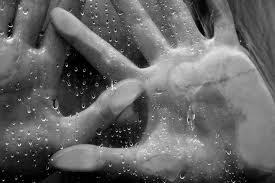
In the way I describe the barn, can you feel it? The barn is rugged and old but stays dry. Light would find its way in if sun ever broke through. But the world here is moist and grey. A totaling overcast with a ground and a sky making one thickened thing. The green of the trees turned so dark that the world peers back black and white. That austere, filled with that many increments.
A perhaps melancholy is more like a humidy cold. You can perceive it in your clothes. They cling, they hang, they weigh. And saturate skin, that feels parched with age, like wax in its melting, still and gone down. You slow there. Drudge, trudge, move (if you move) like a worm at its creep – that claustrophobic a wriggling.
Almost struggle, but lacking the fight.
A zeroing out – the observance of something undoing, with the added false pretense of fate.
Resemblance: tectonic. Some slow, massive shifts, imperceptible morphing, glacial advances – a grind without wounding, pulverized and smothered with a winter wool blanket, a lowering lid made of iron. And you sit there: gaze through the cracks at the drips from the eaves, life runneling away and absorbed. Inconsequent with only replenishing leakage. A purgatory.
As the greying deepens to charcoal. Vision unhinges, becomes soft streaky fades, you were never looking at or out, your eyes simply open. Somewhat. Toward nowhere.
In full dissolution. Not staring, not gazing, not perceiving – what to call it? The mechanics are working, if asked. There is a park, there are trees, there are children, playing in rain like a sprinkler. The bars of equipment are red, green and blue, but really they’re grey, just not actually.
A world made of asphalt. The windows, your flesh, the skein on your eyes. Grey-gravelly sky without markings, just mottled. Movement has slowed to match outlines of concrete, the grasses are cracks, and the trees, the trees and the trucks, buildings and cars – simply humps, objects unleveling the vastness of road. The endless. The nowhere. A world made of asphalt – surely some ass’s fault.
And that’s where you are, granite soldier. Sculpted in the belly of earth, steady to the line, so much of you crumbled to time, and yet faithful. You take up the spaces you’re supposed to, supposing…what? That there must be a reason you sat down. Feel this way. With capability only to stare. Without seeing.
You wonder if something has come or has gone, like a season – expected but oft overlooked as it passes – until another takes place. Like that. Like waiting, without anticipation, there being there for which to wait. Is that really waiting?
Endurance as endlessly patient. But patience expects changes as well. No change occurs here. Here just continues, inconsecutively and vague.
The owl at its nightly watch. The worm at work in its tunnels. The mayfly at its twenty-third hour. The one that never ends. It goes on.
“In my room on 32nd Street…
…words dissolve as they’re spoken…”
with all that drizzle
and no intent.
If it were loss, you’d have lost something or had something to gain, but that is not so. It continues. Everything here, nothing to replace = now. You bow your head slightly, just off to the left. Your hand curls about the armrest. At one point you swallowed a drink. Your legs have crossed and uncrossed. And that is all. You wait without waiting. The barn is so old but stays dry. You probably just sit in your room, the barn imagined like memories. Still you seem dry to the touch, though you feel drowned in a heavying damp. You sit, you go on. You look, it’s unclear. It is dim. It goes on.
N Filbert 2012
conversations with my wife (www.lifeinrelationtoart.wordpress.com & www.ekphrastixarts.com)
and all accompanied by:
Sigur Ros’ relatively new “Valtari” album
hope your day is great!
Resonance: Reverberations: The Nature of Quotation
“Awake O sleeper!…”
(Ephesians 5)
“…life is but a dream”
(children’s rhyme)
“The Tao that can be spoken…”
(Tao te Ching)
“From the way I say your name I always know…”
(???)
“In the beginning was the Word…”
(John 1)
“To be or not to be”
(Hamlet)
“Try again. Fail again. Try again. Fail better.”
(Sam Beckett)
“I went to the word to make it my gesture. I went, and I am going”
(Edmond Jabes)
Color stained into fabric woven into rug. Of a piece, as they say, indistinguishable from the object itself. So the words flow into us, saturate and stain us, are absorbed and resurface as we ourselves. Like echoes in the cranium, or instinctual responses of the body. Resonant reverberations.
“And so it was…” (A.A. Milne?)
“Once upon a time..” “In the beginning…”
Countless appearances, an abyss of sources, the word lives on.
Who first used “love” or “light”? “To be” or “not”? “Hello,” “yes,” “a”?
Our life is quotation, interpretation, paraphrase.
We shelter in a common blanket.
We’re covered with a shared snow.
We drink of one great water.
Languages one to another, stained and woven rug.
N Filbert 2012
“Writing is for me a means of modulating and organizing phenomenal and circumstantial information from all points of experience, a process I refer to as ‘tuning’ myself. As I grow older and seemingly remove myself from unity with any singular, or even plural, socio-cultural environment, I seem more ‘on my own’ in a vast environment of internalized experience. My approach to poetics has become the search for responses and behavioral modes relative to this experience, to surviving it as well as conditioning myself to it. Constantly the effort seems to be away from any formalization of ideas or structure or definitive process and towards a rejuvenating line of ‘basics’, that mythical point where each process is fresh and new and wholly responsive to indigenous conditions…
“In a sense, I am trying to cope with the urge of poetry as opposed to the structure of it. This urge seems to lie within the rooted and individual beginnings of the activity, centered on a meditative, self-encoded embrace of those issues and inclinations I find within my own humanness. The intention therefore becomes the opening of experience toward a continual address of the self”
-Craig Watson-
in
“meant to detect just how slushed our insides were from too much speech, how blighted we’d become from the language toxin…
The know-it-alls are always the last to know. Everyone’s a diagnostician, and everyone’s wrong…”
-Ben Marcus-
“As is usual with me I would not go on with the rest of the story and come back to the difficult sentence later. With others it may be different – but when I am that far in a work the story must exist in each word or I cannot go on…”
-Louis Zukofsky-
-Lukas Felzmann-
I know….there’s a LOT of envy fuming out of you readers eyes!
(use your local library!)
“No useless chatter, but a word of necessity face to face with itself.
With this word, I have written my books.
Word of sand. Word of eternity.
Thoughts of shipwreck, but also of haven.”
“To approach silence before the silent sign.
To approach the book before the page.
To wait for words that wake our thoughts as they write us.”
-Edmond Jabes-
“When a sparrow feels the freezing cold air, he puffs up his feathers and gathers his feet under his body;
he bears the surrounding cold by countering it with his inner warmth.
The writer, who is also warm-blooded, fights even harder”
-Viktor Shklovsky-
“The bow’s harmony arises from the strained stick forced by the bow-string.
Subsequently, harmony resides in unity and contradiction.
It is kinetic energy that’s about to become dynamic energy.”
“And those of us, never angels, who are verbal, who ‘on this low, relative ground’ write, those of us who lowly imagine that ascending into print is the maximum reality of experiences? May resignation – the virtue to which we must resign ourselves – be with us. It will be our destiny to mold ourselves to syntax, to its treacherous chain of events, to the imprecision, the maybes, the too many emphases, the buts, the hemisphere of lies and of darkness in our speech.”
-Jorge Luis Borges-
Student Magazine of IISER Mohali
Music, Musicology, and related Matters
a photographic pilgrimage to Orthodox Christian monasteries across the continent
Meandering Through a Literary Life
Orthodox Christianity, Culture and Religion, Making the Journey of Faith
Erik Kwakkel blogging about medieval manuscripts
"That's the big what happened."
Networking the complexity community since 1999
 All my Words are Silent