
It promises to be a very good day!
Tag: recommended reading
Enough about Writing…
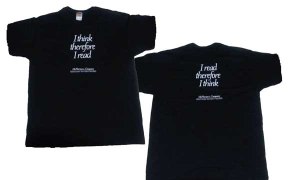
Came across this article…seems to jibe with many blog discussions/posts floating about out there just now…thought I’d like to share it. It’s a bit dated in places, but the overall concept seems worth your ruminations….
Introduction:
Why Books?
LIBRARIES 2000
Libraries 2000, a seminar to re-examine the function and future
development of libraries in Alberta, was held in 1983. A committee
consisting of representatives of Alberta Culture, the Alberta Library
Board, the Alberta Library Trustees Association, the Library Association
of Alberta and the Learning Resources Council of the Alberta
Teachers Association was set up to look into ways of following
up on the suggestions arising out of the seminar. This is the second
booklet commissioned as a result of these discussions.
Public libraries have long attempted to fulfil many functions and
roles in our society. As financial and human resources have become
harder to obtain, librarians and library trustees have had to give
more attention to examining these roles and assessing their relative
worth. In recent years, there has been increasing discussion of the
public library as an information provider, but less discussion of the
more traditional view of library service.
Sam Neill is a professor at the School of Library and Information
Science at the University of Western Ontario, London, Ontario.
This booklet is based on a speech delivered at the Ontario Library
Association Conference, Ottawa, 1984, entitled “The Role of a
Traditional Library in an Age Bludgeoned by Information.” The
opinions and ideas expressed are those of the author and do not
necessarily represent the view of Albe11a Culture, or the Alberta
Library Board. The assistance of the Alberta Library Board in editing
and printing this booklet is gratefully acknowledged .
(click for full article, please)
dove-tailing ever-so-nicely with another book I stumbled across in the library (which also contains a fine consideration of David Foster Wallace in one of the chapters), and considers, I think, the same sorts of issues of humaneness and being alive meaninfully:
Due Emulation
open now. on my desk.
feeding from it like a leech.
truly a living master.
if ever there was one.

see also…The Big Other
Masterful Hejinian on Language
“Language discovers what one might know, which in turn is always less than what language might say.
We encounter some limitations of this relationship early, as children. Anything with limits can be imagined (correctly or incorrectly) as an object, by analogy with other objects – balls and rivers. Children objectify language when they render it their plaything, in jokes, puns, and riddles, or in glossolaliac chants and rhymes.
They discover the words are not equal to the world, that a blur of displacement, a type of parallax, exists in the relation between things (events, ideas, objects) and the words for them – a displacement producing a gap.
Because we have language we find ourselves in a special and peculiar relationship to the objects, events, and situations which constitute what we imagine of the world.
Language generates its own characteristics in the human psychological and spiritual conditions.
Indeed, it nearly is our psychological condition.
This psychology is generated by the struggle between language and that which it claims to depict or express, by our overwhelming experience of the vastness and uncertainty of the world, and by what often seems to be the inadequacy of the imagination that longs to know it –
Language is one of the principal forms our curiosity takes.
It makes us restless.
As Francis Ponge puts it, ‘Man is a curious body whose center of gravity is not in himself.’
Instead that center of gravity seems to be located in language, by virtue of which we negotiate our mentalities and the world; off-balance, heavy at the mouth, we are pulled forward.
Language itself is never in a state of rest.
Its syntax can be as complex as thought. And the experience of using it, which includes the experience of understanding it, either as speech or as writing, is inevitably active – both intellectually and emotionally.
The ‘rage to know’ is one expression of the restlessness engendered by language. ‘As long as man keeps hearing words / He’s sure that there’s a meaning somewhere,’ as Mephistopheles points out in Goethe’s Faust…”
–Lyn Hejinian, The Language of Inquiry–

Reminded of things…
arbitrary views of aging posts on my site somehow meandered me into this…
and I like it!
http://bweal474.files.wordpress.com/2011/02/postmodern-fiction-paper-21.pdf
(I still can’t find that masterful essay “The New Tradition in Fiction” by him I so want to share with all of you)
you can find it in here!
Question: What Makes a Masterpiece?
“A masterpiece isn’t a masterpiece until it is well known and has absorbed all the interpretations to which it has given rise, which in turn make it what it is. An unknown masterpiece hasn’t had enough readers, or readings, or interpretations…A work of art isn’t created a masterpiece, it becomes one…the authority, the familiarity and the relevance of a great work of literature: we open it, and it speaks to us of ourselves…naturally every reading affects the book, in the same way as the events we experience effect us…”
–Umberto Eco & Jean-Claude Carriere, This is Not the End of the Book–
Your thoughts…? Any “unknown” masterpieces possible?
A trip to the library
– a sampling of the results…






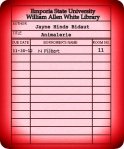


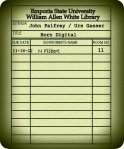

Seasonal Survival: Autumn Reading
Survival Supplies – Seasonal Semester
The way I go about selecting what I “need” to be reading ends up functioning by the time the list competes its way out to also be a “Recommended Reading” list, as if the titles that capture my attention withstand engagement and require careful full attention clearly I’ve decided (for me) that these books are worth adding to my internal world. So the purpose of periodically posting the books I spend time in each week (usually for a few months), is both a bibliography to the thought that comes out in my writings, as well as an “I think these books are worth anyone’s time” should you share some of my interests. That being said, it is August, and I’m in a full week of graduate school (full-time) after over 15 years of private personal schooling within my home and 16 years of marriages, parenting and retail employment. Reentry is daunting, particularly as technologies of education have changed radically, so all my moments are being rearranged and reallotted, but I need books and literary languages for so many things in my life (indeed, for quality of life itself), that my body demands I make moments for all it craves throughout every process. The following is what lines my desk as “essential” as I enter this Fall semester (many are repeats – not quite finished from the busy Summer):
This time, from left to right around the perimeter:
Christoph Niemann: Abstract City
Jonathan Safran Foer: Extremely Loud & Incredibly Close
Michael Chorost: World Wide Mind: The Coming Integration of Humanity, Machines, and the Internet
Gerald Edelman: second nature: brain science and human knowledge
Antonio Damasio: Self Comes to Mind: Constructing the Conscious Brain
Norman Doidge: The Brain that Changes Itself
Mengert & Wilkinson, eds.: 12×12: Conversations in 21st Century Poetry and Poetics
Michael Holquist: Dialogism: Bakhtin and His World
Michael Chabon: Manhood for Amateurs
Viktor Shklovsky: Bowstring: On the Dissimilarity of the Similar
Lyn Hejinian: The Language of Inquiry
Octavio Paz: Convergences: Essays on Art & Literature
Ronald Sukenick: narralogues
Fiction:
Ben Marcus: The Flame Alphabet
Lance Olsen: Girl Imagined by Chance
G. Gospodinov: And Other Stories
John Gardner: The Wreckage of Agathon
Lynne Tillman: This is Not It
David Foster Wallace: The Pale King
Poetry:
Wallace Stevens: Opus Posthumous
William Bronk: Life Supports
Larry Levis: The Selected Levis
William Stafford: The Way It Is
Edmond Jabes: From the Book to the Book
Arkadii Dragomoschenko: Xenia
Rosmarie Waldrop: Curves to the Apple
Miscellaneous:
Edward Sapir: Language
J.R. Firth: Speech
Ann Smock: What is There to Say?
V.N. Volosinov: Marxism and the Philosophy of Language
H.L. Hix: Spirits Hovering Over the Ashes
M.M. Bakhtin: The Dialogic Imagination
Maurice Blanchot: The Infinite Conversation
Richard Rubin: Foundations of Library and Information Science
Cassell / Hiremath: Reference and Information Services in the 21st Century
Carol Kuhlthau: Seeking Meaning: A Process Approach to Library & Information Services
 All my Words are Silent