It’s complicated

“In a complex relationship with the environment, very similar substances with the same chemical structure can become quite different in their reality and form”

-Michael Gazzaniga-

“On the evolutionary tree, we humans are sitting at the tip of our lonely branch…We have the same roots as all living organisms.  All those similarities are there.  Our cellular processes depend upon the same biology, and we are subject to the same properties of physics and chemistry.  We are all carbon-based creatures.  Yet ever species is unique, and we are too.  Every species has answered the problem of survival with a different solution, filling a different niche…Homo sapiens entered a cognitive niche…

…in one sentence Garrison Keillor captures humanness…such a simple sentiment, yet so full of human complexity…

BE WELL.  DO GOOD WORK.  KEEP IN TOUCH.

-Michael Gazzaniga-

Another strong recommendation from me for those interested in the what’s and how’s and some where’s and when’s of being a particular we.

Our Propensities

“identifying a function for dreams or pretend play or fiction doesn’t mean that we’ve identified the function”

-Jonathan Gottschall-

I am enjoying this book more than I expected.  Often overview-type books of aspects of human phenomena leave me with a touch of “yeah, we all know that (i.e. we experience that), but tell us something new, give us opportunities to create knowledge from new data!”  Gottschall’s book is a well-written tour (akin to the work of de Botton on aspects of human life) – representative of current knowledge, suggestive rather than pedantic, and fluidly engaging.

“Consider the following information:

Todd rushed to the store for flowers.

Greg walked her dog.

Sally stayed in bed all day.

Quick, what were you thinking?…

In the same way that your mind sees an abstract pattern and resolves it into a face, your imagination sees a pattern of events and resolves it into a story…studies show that if you give people random, unpatterned information, they have a very limited ability not to weave it into a story…the storytelling mind is a factory that churns out true stories when it can, but will manufacture lies when it can’t…it’s usual method is to fabricate the most confident and complete explanatory stories from the most ambiguous clues…the Sherlock Holmes in our brains job is to ‘reason backwards’ from what we can observe in the present and show what orderly series of causes led to particular effects…we will always rather fabulate a story than leave experience unexplained.”

And so on.  In fact, the sentences he writes above are on-the-fly conjured random fact-statements unrelated.  Most of us probably had already begun to fit it into something ‘meaningful to us’ before we finished the third one.  Does this help you see how your view and perspective on reality – your ‘automatic’ or instinctual or deferral mode comprehension ALWAYS needs sorted out with CONTEXT and the empirical world?  Our minds are amazing and unbelievable in their functions and operations (literally), factories of fictions based on ancient genetic messages qua homo sapien, empirical experiences from our own individual lifespans, and an untangleable web of socio-cultural input and in-formation.  We’re fascinating…and utterly unreliable.  Thus we have each other, and our senses and myths and science and all sorts of other-world perspectives to adjust and possibilize our own stories.  Perhaps there are moments our thoughts align with facts, but those will be rare in our lives.

Taken in a context of Nelson Goodman’s Ways of Worldmaking, John Canfield’s Becoming Human and Alan Singer’s The Self-Deceiving Muse, Gottschall’s delightful foray into the impulsivity of fiction-like brain behavior makes for a savory meal. I’m concocting stories about it even now (it’s sure).

Going Back, Going Forward

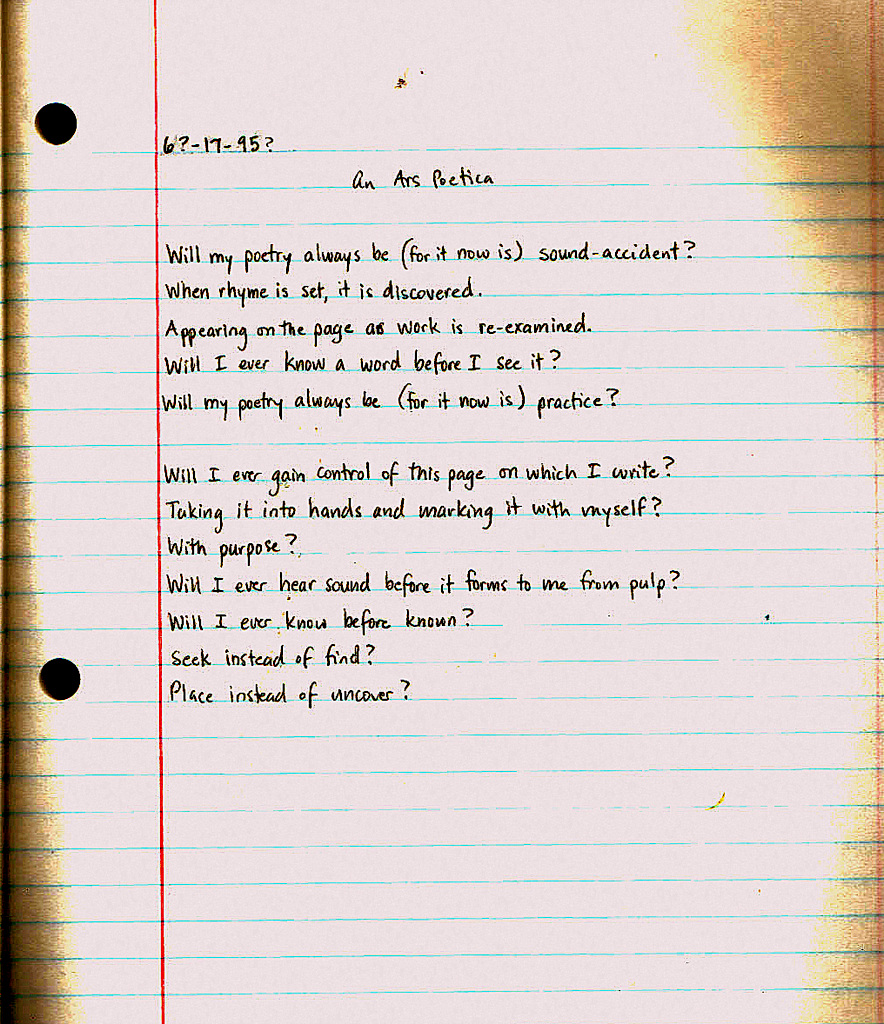
I hastily grabbed a notebook of primarily blank pages as I whooshed the children off for a swim.  I needed to study and make notes while they splashed about and played and require pen & paper for the process.  It turned out that the pages containing my writing dated some 15 years ago – journaling from a 4-day solo hike I had made in the Colorado mountains.  Included was this me-of-20-something’s poem:

Ars Poetica 1995

The whole notebook was nostalgic for me – my youthful vibrant concerns for solitude and justice, freedom and nature and virtue.  What struck me about this little number was how consistent (or persistent) the concerns and interests worded here have been (obviously) throughout most of my life.  Seeking purpose, expression, control – recognizing somehow that once language is entered, is invoked, everything changes.  Our purposes, searches, availabilities, capacities, expressions, knowledge, – all gets reworked and revised as we engage in the broader activity of language.

If, as John Canfield theorizes, “in language we never leave the sphere of the social” and that “language is a vague concept with unclear boundaries,” in part because it “grows as more language-games are added to the mix, and as existing ones are enriched in various ways,”  that, fundamentally “language is a set of customs in which words play a role, a set of patterned, culturally determined modes of interaction..” so that with “increasing cultural complexity come increasing complexity of our patterns of interaction” then my lifelong hunches that I’ll never get a handle on it, or master its use, or turn it explicitly to my purposes are a matter of course.

M. A. K. Halliday’s Triangle

Which is also what fascinates, compels and rewards its use.  Again, with such a limited arsenal of units – (take a look at your keyboard and consider for a moment to what gargantuan and variable use we put those 100 keys or so) – every engagement with the tool is interactive, reciprocally shaping and shaped by us, and unfailingly externalizing for our organism – the medium thrusts and immerses us into our society and culture and history and possible futures, as well as all the “thinks you can think” and more!

On the right day, then, my bewilderment in the face of language as my vocational practice gets to be an adventure of constant discovery, novelty, and learning – immersing me in some infinite-like context, warping and woofing my organism into a universe of threads…

all quotations from John Canfield’s Becoming Human: The Development of Language, Self and Self-Consciousness

Fiction. Fractals. Filosophy.

The WHYs of them:

“semiotics is not about the ‘real’ world at all, but about complementary or alternative actual models of it… an infinite number of anthropologically conceivable possible worlds.  Thus semiotics never reveals what the world is, but circumscribes what we can know about it; in other words, what a semiotic model depicts is not ‘reality’ as such, but nature as unveiled by our method of questioning.  It is the interplay between ‘the book of nature’ and its human decipherer that is at issue.”

-Thomas Sebeok-

“the forms and laws in our worlds do not lie ready-made to be discovered but are imposed by world-versions we contrive – in the sciences, the arts, perception, and everyday practice.  How the earth moves, whether a world is composed of particles or waves of phenomena, are matters determined not by passive observation but by painstaking fabrication…Constable urged that painting is a science, and I suggest that science is a humanity.”

-Nelson Goodman-

“a mobile unsteady structure…with all the bits always moving about, fitting together in different ways, adding new bits to themselves with flourishes of adornment as though consulting a mirror, giving the whole arrangement something like the unpredictability and unreliability of living flesh…The endeavor is not, as is sometimes thought, a way of building a solid, indestructible body of immutable truth, fact laid precisely upon fact…Science is not like this at all.”

-Lewis Thomas-

“Perhaps the best way to think about post-modern self-referentiality is not as a denial of language and literature’s connection to the world but as their self-consciously pointing to themselves trying to point to the world.”

-Robert McLaughlin-

Nathan Portrait

This slideshow requires JavaScript.

Today’s Nonlinear Equations

   +  +  + 

=

Question

The Family of Fiction – 6

The story to now…

Family 1

and part the sixth…

6

“I propose description as a method of invention and of composition.  Description…is phenomenal rather than epiphenomenal, original, with a marked tendency toward effecting isolation and displacement, that is toward objectifying all that’s described and making it strange…Description then is apprehension, ‘the act or power of perceiving or comprehending’ and a motivating anticipatory anxiety, expectant knowledge…the very writing down seems to constitute the act of discovering it…but also and problematically an act of interpreting it.”

-Lyn Hejinian-

            Hybrids.

What is “normal” or “traditional,” what forms remain (for long) in a universe of chaos ever emerging and expending?  Convergences, then.  Bloodline here, bloodline there, cross it through and pull it taut.  Cultural collage.

The parents lead the way, though not as masters, more experiments – of brother linked to sister linked to brother step toward brothers veined by half with sister same as brother.  Not personal or by choice until fixed in the same installation.  Could be called art, called family.

Other halves and steps by three with partners of their own yet bleeding half their blood.  Where are they?  A sitcom cast of lesbians and addicts, the wealthy and the poor, the liberal, constrained.  Kaleidoscoping styles and beliefs – “it takes a village” – and they’ve settled one.

Working well enough – a jalopy needing constant tinkers.  It most assuredly breaks down.  Imagine society.  Or the size of it, extended.  How many grandparents can a child acquire?  Its fine for rituals like births and holidays – multiplying spoils – but where does one belong?  With whom?  Family-by-affinity?  Reunions become a game of pick-up-sticks or jacks and marbles (except with persons).  Arbitrary circles depending on usable space.

The family tree she drew for therapy’s a forest.  Cottonwoods and pines, baobab, bonsai.  An oak thrown in for measure, and barely identified shrubs.  What base is there to touch?

Parliament versus monarchy, troubling the court of appeals.  With manager-types and generals, gurus, debaters and clowns.  Stir in deconstruction and some faith for emotive stew.  It’s a kinky chain of command, yet all are bound by it.  Children vying a vote.

And if infected by the peacemaker-pleaser-gene, the torsion becomes a complicated interpretive dance.  A surplus of baggage with all the due fees.  A lot to saddle on young.

They’re resilient.  Navigating democracy and other octagonal squares -awkward parallelograms – never quite losing site of Atlantis.  Lost kingdom, utopian, buried deep under vast emotional sea, at times nearly glimpsing a spire.  At least some strange stirring.  Dreams of a large enough house.  Solving nonsymmetrical fusion equations.  These children are smart.

If an artist paints the picture she performs mixed-media collage with inks and clay and dozens of paints, incorporates cloth and wire and found objects with hopes enough resin or wax will contain it.  Hold it all fast.  And still let everything – everyone – be seen.   The composer creates an erratic symphony – arrhythmic with regular dissonance, whelming moments dramatic with harmony and occasional measures of quiet resolutions.  The scientist keeps figuring on emergent chaos, open-ended systems like weather and complexly variable algorithms.  Author writes it down and edits, erases as much as inscribes, constantly losing track.

Each makes their own scribbled lines, overlaid.  Its sketchy and messy and thick.  Kids jumping ropes, fingering string figures, string theory, Spiderman-webs.  It gets made.

Family is Fiction, part two

FAMILY: A FICTION, PT. 1
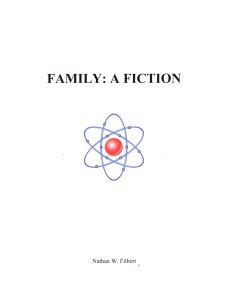
Family 1

2

            Quick to give up, or in, to description.  Sidelong glances, or enough periphery, and it’s known – they are there.  Are here.  Which is firstly what needs be established.  Shaggy in-turned male and self-consciously-nondescript-as-a-waged-war-within-herself – are here – whether explicitly denoted or not, for that is not what this story’s about.  And all of their children – as if we’re in shadows – near presences felt.

If the man were currently reading (he is reading now), and is sitting at his desk, surrounded by more words, words bound up to burst and licking the chops of their leafy lips, prepared to murmur and shout.  It seems to him.

And she would be (read “is”) pushing a broken body into limited stress-inducing motions purposed to loosen and tighten.  Laying on a mat on a floor watching women on a screen count and stretch and breathe, mimicking them with her own limbs and torso. Accentuating her “core,” strengthening her “self” for this losing battle.

The children are learning and eating, playing and working – whatever it is youth do to fend for themselves and their futures – their shadow-dance with age.

Unable to say it as is – the is too complete and far from attainable – in segments and particles, or a falsified whole from great distance.  Oh nature.  Oh being.  Because of the facts, we have to just enter, and being recursive it matters only slightly where or when – inception/conclusion are unrecognizable to a decentralized everywhere, connective and mobile.

Some are known by their doings, some by their fathers’ or mums’; others according to their works or the times.  Some hardly known of at all.  To speak of them is to personally encounter –  as if face-to-face – an intersubjectivity of optimal expressivity.

Or not.  Language gets carried away.  When we search for a meaning or some explanation is it not because we already believe it is there?  Something already imagined?  What remains is a tying together in  idealized systems like logic – building a case or crafting a theory, replete with supporting cast of regulatory theorems.  Which demonstrates little but our ability to make science out of anything.  Exercise in closing the systems.  While all remain open.

The rugged male shifts from his papers, given possibilities, which it turns out rhymes everything.  She teases her hair nonchalantly (she hopes) and attempts to forget her over-calculations by delving into them – representing them – externalizing image and textures.  Viewed askance not head-on, but in outlines and shades or peered at and through, as we’d envision a form from behind.  Anything to remove the scrutiny of mere appearance – incorporate more and defraggle illusions of skin.

She scribbles it onto used papers,  ready surfaces already marred, turning scarrings and blots into figures and wounds; while he accentuates the peculiar, alarmed by specifics and seeking connective similitude.  If a thought comes queer, he tattoos it with ink until it sounds available.

Both, in a way, finding commerce, a transaction with others engaging/avoiding themselves.  Feeling so like and unlike.  A pestilence of the species, er, human condition – overwhelming similarities of form with infinite intricacies of difference.  Everything related – never one without another – a closed system of incalculable possibilities.  They labor in.

Male smells sour in just a few days, not accustomed to shouldering public, perhaps what allows for his mess.  Adapting  to the threat of her attention, though in the absence of comprehension.  She allows him his comforts till they confront and offend.  Peaceable enough – this arrangement – and duly provocative:  they enhance and combine, stimulate and remind one another in a struggling intimacy – they love.  Not without precedents or fear, but they love.

And in their sleep, the gears will turn.

He writes off stuck places – the uncanny processes of dreams.

The children behave like loosely arranged magnets, at times slamming close, or sullenly repelled.  Usually vibrating, tensely, between.  The volatility of past and a future reacts in young bodies as now.

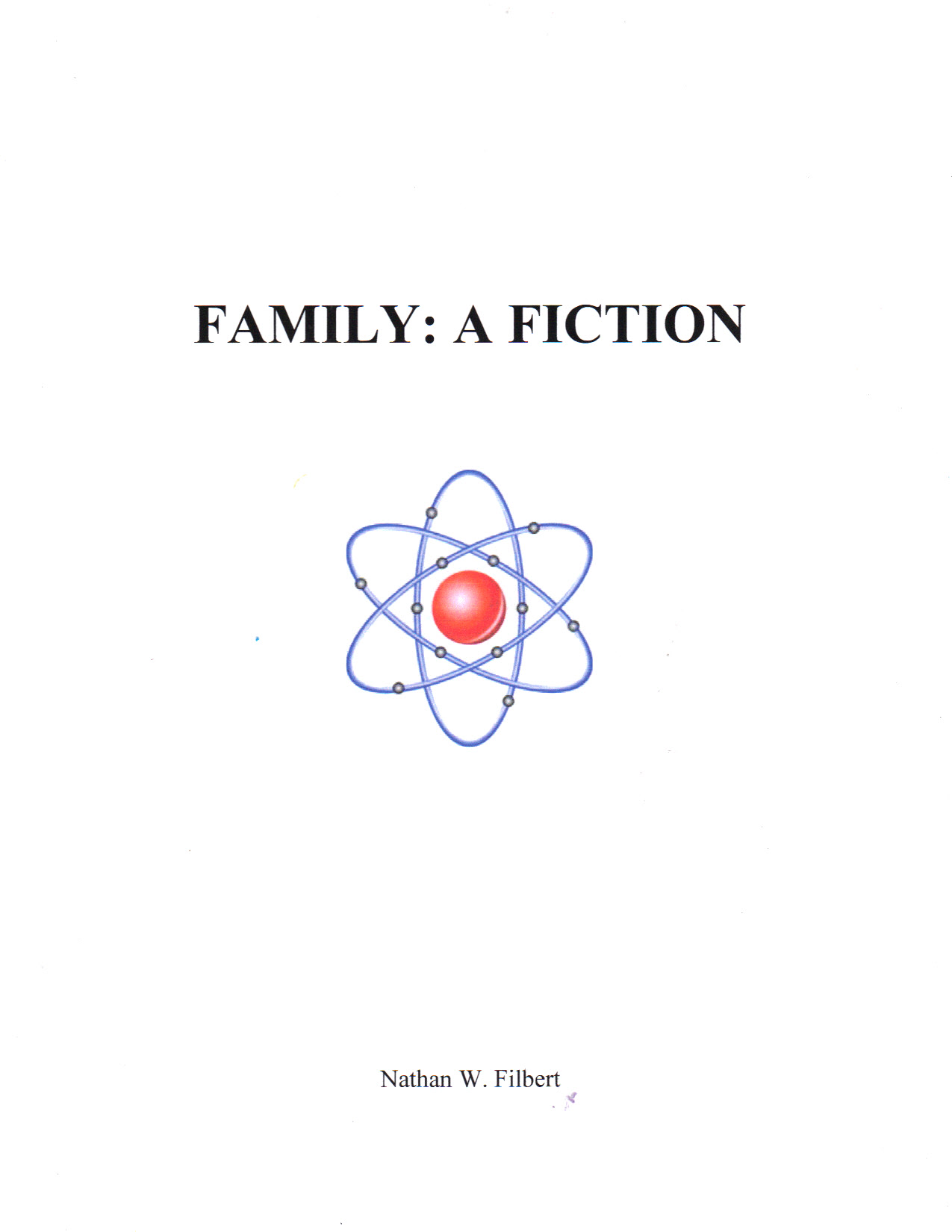
Viewed collectively – it’s an inter-&-co-dependent mechanism, sketchy and atomically diagrammed – similarly potent (at least potentially) in its splittings and pressures.

Live things best metaphor themselves.
Back to School Preparation: “Gleicked”


Fumbling toward FICTION

Okay, here goes.  I’ve been diddling my way into another attempt at a longer go of writing, and today have decided, (largely by the courage of company – Tocksin has also begun posting portions of a novelistic go) to post a few rudimentary fragments.  Up until yesterday  the working title was simply FICTION.  I’ve written 3-5 chapters over the past month or two and in seeking an orientation for the work certain symbols and recurrences have led to an inquiry.  “Write about what you want to know” Lance Olsen says, and I can see I’m searching after something in these words.  The epigraphs that shoot me on are the following…

“Reality is the motif”

-Wallace Stevens-

“The universe was the glue that held him together”

-Jonathan Lethem-

“I only care about fiction that raises the question of what fiction is…”

-R. M. Berry-

“The line is only a shadow cast by one (memory or fiction) over the other (fiction or memory).  Once I place memory into language, memory becomes a rumor that makes room for uncertainty.  Memory slips into fiction but then fiction becomes memory once again in an/other way…It is difficult to separate fiction from memory, which is different from separating truth from lying.”

-Doug Rice-

and so it begins…

Family 1

Family 12Family 13

Congruency: Of Delight in It

Thank you Superstitious Naked Ape for such a spot-on condensed rendition of (I think) what Pelevin’s Helmet of Horror evoked for me as well!  Really readers – check these out together – incredible lucky spontaneous occurrences of “synchronicity”?  Almost?

brain-in-hands1

“The God Machine”

by The Superstitious Naked Ape

with the personal caveat that it may as well be named “The Self Machine,” “The Reality Machine” and so forth…

The Helmet of Horror (selected emissions)

by Victor Pelevin