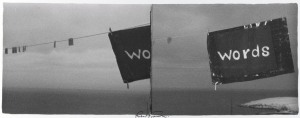
Writing: the Subjects

Writing: the Subjects

A lot can be read about what it takes, means, requires, or qualifies a person as a writer.

From “someone who inscribes a text,” (akin to walking or speaking), to publication and critical acclaim (akin to fame and riches).

As I see it

it must begin with a facility with language.  Any language.  An awareness of words and their implications.  The intention to utter.

Uttering tends to search a subject, (what words are “about” is as various as the universe) and a style or voice (how it will inscribe).

From there it’s simply performance: arranging or placing the selected words in a medium with a measure of physicality, sense-ability, somewhere capable of being perceived.

As far as I can think it, when these few elements are satisfied what we are engaging is “writing” as a product of “writer.”

He chooses a form of English he has acquired through hunting and gathering, a language institutionalized and socially invested in him with measures both beyond and within his control.

He searches a subject to say.  Already subjective (as he is the one searching with what language he has or is able to acquire or create) his utterance will always contain an “I” – both shaped and formed by his responses and politically constructed by his social milieu.  In other words, there are always more than one “subject” in every utterance.  At base, at least three: the language, the user, the construction and arrangement.

He’s already overwhelmed with the largeness of the simple subjects inescapable to human languaging, and he’d thought to write about rocks (geology) or time (epistemology); romance (psychology) or events (history; ontology).

Subject-fields are vast, you understand.

Having sought to describe an object (desk or stone) in space (again scientific theories / epistemology) each signal latent in language subjectivized: using language creates subjects, no objects remain but are subjectively engaged.  Language is an invisible bridging, a liminal skin, connective absorbent tissue, subjectively creating subjects-in-relation.

This, apparently, its object.

Thus uttered…a story.

N Filbert 2012


Untitled Prose

It wouldn’t be that way, not now, not conventional.  It would start itself, become, begone.  It would be something words couldn’t take aim for.

But it would not be absence, or if there was no escaping it, it would pressurize presence in such a way.  The idea of presence.  Feeling of it.  The desire for presence.

Where all the answers are the instant, but without trauma or utopia.  Not to exist, but to insist.  There’d be no describing it, it would lack presentation.

Knowing this is how it must be, fervently believing so, of course the questions come – doubt, the presence of absence.  Mortality.  The limitations of finitude.  These are not to rule.  Not to matter in the moment.

It would be no place to go, neither flight nor pursuit, homing nor escape.  It might scramble the senses, melt the categories.  Be without difference.

Not like that.  Not resemble.  Not the satisfaction of unknown longing.  Not quite immersion nor awareness exactly.  Not singular.

It might resemble flight, for a bird, without metaphor, without referent.  It will not resemble flight, for a bird.

Imagines a cloud.  It would not be various layers of sky, a gathering of imperceptible boundaries, no erasure or revision.  Or vision, as opposed to sight.  Sensorium replete without overwhelm, this sort of thing, perhaps.

Not identifiable but actual.  Not understood but occurring.  Without fear or hesitancy or remove.  Without expectation or excitement or joy.  It would not be saturation, then, nor separate.

It might be that it will be just what it is, yet without concept.  Without spectrum or speculation.  Unscaled, unmeasured.

What would be written after?

It would not be relief or knowledge.  Not revelatory, not banal.  Unnarrativized.  Without distinction, yet not indistinct.  Not like a circle of a circle or the warmth of sunlight.

It would not be written, informed inscription, not verbalized or sung.  Space, shape (time would lack duration?) would be difficult to reckon.  It would not “occur” then, without plottable end.  Unrecollected.

Not quite expressive, possibly impressive minus attention exactly.  Not like color fields or blankets.

There it would be without “it.”  And not “there” as another.  The questions would be undone without conclusion or solution.  Not like water as a solvent for dead things.  Repeat: unlike without unique.  Not vague or opaque: no into, out of, within.  No almost or already.  Not fulfillment or exclusion.

Neither all, every, nor of, nothing.  Not between.  Not point line or plane.  Not subject.  Without object.  Without lack, gap, distance.  Cognized without recognition maybe.  No reflection.  Embodied.  Not the same, though, without difference.

“one constantly attempts to say something that does not, and can never, touch the essence of the matter…But the tendency, the running up against, points to something”

Ludwig Wittgenstein

N Filbert

Writing: the Margins

This slideshow requires JavaScript.

Writing: the Margins

“All words run along the margins of their secrets”

– Susan Howe –


Now we are getting somewhere.  Now we can go ahead and believe in telling and in being told.  If “every word runs along the margins of its secrets.”  If so, (and it feels truthful, even if untrue) then…

there might be other margins, or perhaps every margin limns its contents and its secrets?  Perhaps, then, our senses, and every limit of our perceptions “run along the margins of their secrets,” like our cells and bodies do.

That “perhaps” means here “possible” – an enormous margin full of stuff and secrets.  I.e. seen and unseen, known and unknown, believed and unbelievable, etc.

And if “Limits/are what any of us/are inside of” is truthful of Charles Olsen to utter, then we might be everywhere up against the margins of the limitless.

Speaking practically, a margin is variable, and bodies and language (synonyms of a sort) are more variable than variables.

So to say, we may indeed (in our actions of doing and making, saying and thinking – signing and gesturing) be communicating.  That is, it is possible.  Words running along their margins of secrets, senses apprehending along their own secret margins, the boundaries porous and variable: something might be meeting there, might be weaving, might be, as it were, com-prehended (apprehended together in some so-called secret way)…co-mmunication?

If language, in its way, defines the social, our context, like skin, for participation in world…connectivity, sharing in common, is not only possible, but necessary, and the secrets, the ineffables, the private, what we thought of as incommunicable, is clinging there, infused with the margins, the borders where we interact, transact, have (as it were) our being.

Therefore

“it is not infinite.  Even infinite is a term”

-Louis Zukofsky-

by which I mean all our words signifying –lessness: limitless, timeless, meaningless, objectless, and so forth, limn their mysteries as much as the constant traction we enact with our names.

Lines wide enough for all of us to traffic in, and obviously very thin, perhaps transparent – we are dancing here.

Feet and minds, hands and mouths ever each right where they seem to be and also where they’re not…marginal movements…co-here-ence, always presently together, secret and exposed.

Perhaps and possibly.

N Filbert 2012