Making Trouble….er…Making Meaning (via Jay Lemke)

I personally attempt to read every writing I am able to obtain by my favorites.  Some of my blog entries may therefore be redundant, as redundancy is a way that I am able to sense patterns and make connections and thereby forge what I experience as meaning.  The following is one of the summary writings (nah, that’s not quite right – even with redundancies and retellings I rarely find a summary-type writing by my favorites – there’s always difference – and that is what snags me!)… Okay, for your interaction, pleasure, and engagement, without further ado…

Making Meaning, Making Trouble

by Jay Lemke (1995)

The Human in Humans (accd’g to Edgar Morin)

“Man fulfills himself as a thoroughly human being only in and by culture.  There is no culture in the human brain (biological apparatus able to act, perceive, know, learn), but there is no mind, no spirit, no capacity for consciousness and thought, without culture.  The human mind is an emergence, created and affirmed in the brain/culture relationship.  Once the mind has emerged it intervenes in cerebral function and retroacts with it.  This gives us interdependent and indispensable triads:

brain – mind – culture loop

reason – emotion – impulse loop

individual – society – species loop”

Edgar MorinSeven Complex Lessons in Education for the Future


Systems Everywhere

On the Dissimilarity of the Similar (excerpt) – Viktor Shklovsky

An Effective Procedure for Computing “Uncomputable” Functions

this is what i’m talking about! Yippee! Couple it with:

Questionable

Spinning in a bit of ineffectual conundrum…what reaches the paper expands…

Does remarking constitute remarkable?

Do I discover value only when change causes difference?

Is recognition of closeness a result of disjunction?

What engineers a ‘train of thought’ – who lays the track?

Which is more creative – reading or writing?

When are thoughts and feelings the same?

Is language a metaphor?

Who asked you?

Does the talking stop at conversation’s end?

What does skin separate?

When does beginning begin?

Why is death?

What is meant by ‘same’?

Is there anything as dangerous as freedom?  Anything as certain as risk?

What  are the ingredients of making?

How do we identify?

Do emotions signify?  If so, what?  If not, why?

When?

What is gained by loss?

Are these questions rhetorical?  Essential?  Trivial?  For whom?

Who answers how and what kind of who does that make?

What?!?

Please feel free to respond to any or all of the above – wisdom/insight/hypotheses are warmly welcomed!

Enough about Writing…


Came across this article…seems to jibe with many blog discussions/posts floating about out there just now…thought I’d like to share it.  It’s a bit dated in places, but the overall concept seems worth your ruminations….

Introduction:
Why Books?
LIBRARIES 2000
Libraries 2000, a seminar to re-examine the function and future
development of libraries in Alberta, was held in 1983. A committee
consisting of representatives of Alberta Culture, the Alberta Library
Board, the Alberta Library Trustees Association, the Library Association
of Alberta and the Learning Resources Council of the Alberta
Teachers Association was set up to look into ways of following
up on the suggestions arising out of the seminar. This is the second
booklet commissioned as a result of these discussions.
Public libraries have long attempted to fulfil many functions and
roles in our society. As financial and human resources have become
harder to obtain, librarians and library trustees have had to give
more attention to examining these roles and assessing their relative
worth. In recent years, there has been increasing discussion of the
public library as an information provider, but less discussion of the
more traditional view of library service.
Sam Neill is a professor at the School of Library and Information
Science at the University of Western Ontario, London, Ontario.
This booklet is based on a speech delivered at the Ontario Library
Association Conference, Ottawa, 1984, entitled “The Role of a
Traditional Library in an Age Bludgeoned by Information.” The
opinions and ideas expressed are those of the author and do not
necessarily represent the view of Albe11a Culture, or the Alberta
Library Board. The assistance of the Alberta Library Board in editing
and printing this booklet is gratefully acknowledged .

Why Books? by Sam Neill

(click for full article, please)

dove-tailing ever-so-nicely with another book I stumbled across in the library (which also contains a fine consideration of David Foster Wallace in one of the chapters), and considers, I think, the same sorts of issues of humaneness and being alive meaninfully:

Random Idea


something like…while i’m doing a bit of this

you can just hit “random post” up under “manoftheword”

and visit stuff i can’t remember

something new will (hopefully) arise

in my journeys

and hopefully

you will find it interesting

but for now…

you guys keep working

so i stay inspired

upon return

Scribbling chapters that don’t belong…(2)

2.  The Chorus

“As for we who ‘love to be astonished’…

…A pause, a rose, something on paper implicit in the fragmentary text”

(Lyn Hejinian)

            Explicitly.

I.e. “the loss was always implicit as the longing” (Alain de Botton).  And I quote, quoting from someone else’s quotation, but I forget which (or whose).  For.

I’m certain for various reasons.  Which beggar the certainty.

A pause, arose, and fragmented this text.

Because I don’t

know

what I’m

doing

I am writing,

and it questions.

            As if we could get intimate with our process, so near it as to join.  In other words, if our action, breathing, effort, language, thinking, senses and the uncountable inborn “blind spots” that a human system circulates were, well…coterminus.

Is that a question lacking its mark?

It would seem so.  About.

Either too large or too small, perceptively, I suspect.

Causing a pause to rise,

as I search for something implicit.

            Explicitly.

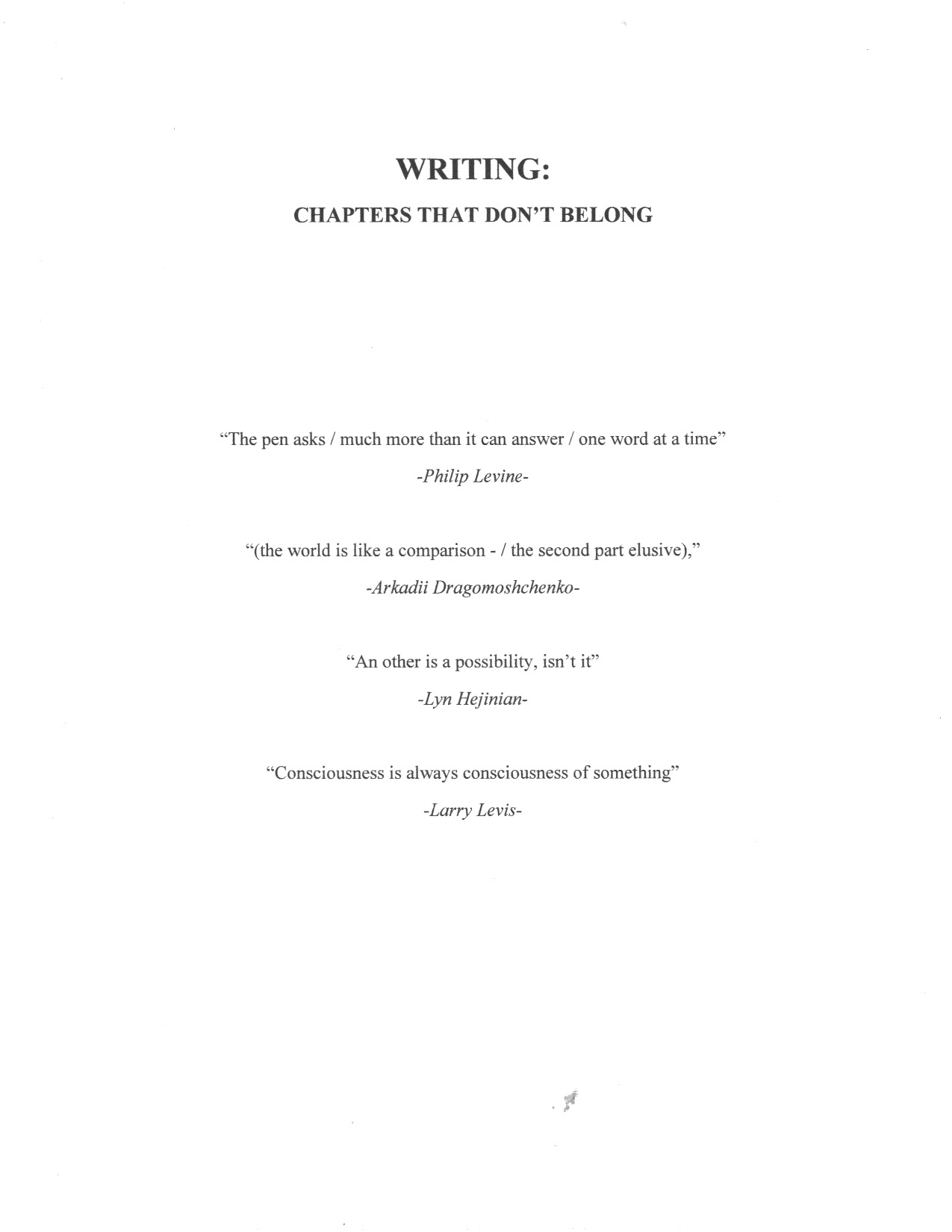
Given the fragmentary text(s) (you agree?) I have to ask:  might writing be possibling an other?  “Consciousness is always consciousness of something” (he said).

That is a possibility, isn’t it?  (the second part’s elusive),

Blatantly – I feel caught in a snare I am setting, as spacious as I imagine chance to be, (having no other name I can call it), ensnared as I seem – some web, some matrix, some universe and beyond – too large or too small to perceive (I am guessing)

which always gives rise to a pause, implicitly.

What I had hoped to make explicit.

What I call “wanting actually resonate,” some loss implicit as longing.

I write, asking more than it answers, or “the closer the look one takes at a word, the greater the distance from which it looks back” (Karl Kraus, which I quote off someone else, who knows who – yet I hope someone does!)

“But of any material, the first thing to make is an ash-tray”

(Lyn Hejinian, I quote this text from its source,

apparently).
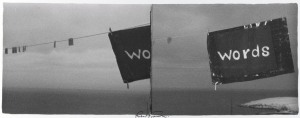
Scribbling chapters that do not belong…

1.  “wake up, snare-setter, / in the snare / spacious, like chance” (Arkadii Dragomoshchenko)


And sometimes I do, wake up.  St. Sebastian pinned as a still-life with crystal lances, a clarity.  But that is catching too, and refracts.  “I think that what I thought when I was thinking that, at least in thinking of it now, I am thinking that I thought it…” and so on.  Crystal lances.  Thoughts refracting.  The occasional conviction.  (Which we call certitude).

The margins within margins, windows in reflection.

Every image being an entrance through which we exit.  From.


I call this “letting actually resonate.”  This being, activity, thinging we do.

If I stand still, so to speak, I form a spiraling vortex, an enormous vacuum.  What is: portal and Black hole every now.  With.

Prepositions being ever-so-important, say “sign-ificant,” that they deserve their own sentencing.


I’ll never know what it is “to write.”  If only because it questions.  Every word.  In.

I can think of it as a working, out, but that is far from any truth I can conceive.  “the second part elusive” with each toggle of a term.


Gravity enforcing force, to fly.

I’ve never been fond of violence, but how else might we change?  Or even move?  On.


A recent well-organized text I perused and then ate, mentioned dialetheia as a two-way truth; or, “true contradictions,” that is, in one.  Word.  Split with a twin.  Comparison as congenital doubling.  Of difference.  Equals such same.


We look toward what can be seen.  Compromised and concealed by a frame.  Otherwise unseen.  Learn, therefore, (through your senses), in-visibility.  Dialetheia.

We do (many of us) love to be astonished, after all.  With.


If there are more parts to this I haven’t found them.  They’re either too large or too small.  I’ll have to wait.  I’m unable.  Nothing living waits.  Patience is pretense, pretend.  Waiting, is searching; patience, is longing.  Loss is implicit.


Metaphors of Mind

Metaphors of Mind


I thought about the East like sunrise, or, the bright shadow of sun as it sets on the sea.  Opening out, up, growing wider from a perceptive center.


I thought of my own like a spider rushing to complete its web and attachments to structures while the prey already wriggles in its core.  Spinning quickly, creating patterns, finding foundations so one might approach, carefully, and engage.


And of the wise, “responding with the submissiveness of a mirror to a completely unthinkable array of things where there’s no space or time” (Arkadii Dragomoshchenko, Xenia).  “And which I can’t accept” (he adds immediately afterwords).


My wife like a field of slender grasses made out of senses waving in rain.  It touches everywhere and then is guided and drawn into the veins and roots in a natural process.


An ecstatic: the moon hovering above, without details, yet influencing tides.


Fundamentalists jackhammering surfaces to shape; drilling from the riggings a far cylindrical bore.


The verbavore – translating, translating, translating…signs, digits, numbers.


Intuitionists: winds situationally directed by unseen prompts or hidden obstacles.


Perhaps the thing itself – sensual and complex machine – absorbing, recording, repeating and combining – crafting temperaments at the switchboard?

N Filbert 2012