“The Creators Curse” – a raw deal – and everything is practice

When I stood up from the couch I thought.  I’m tired of everything being practice.  Each character sketch, each poetic fragment, each novel attempt, each theory, each relationship, each parenting moment, each breath.  All participated in as if the engagement might provide benefit, as if the pain will promote healing, as if the mistakes will prove corrective, as if fitness might improve health.  “Lifelong learning” – how nice it sounds, how endless.

But learning for what – ?  There’s just more life until… and then it’s probably simply (well, complexly) variantly continued – one situation hardly informs another – for the next now the context has changed, as well the elements, the matter, the flow.

So then I think again – perhaps it’s fear.  That lifelong learning, or anything meta- entails a splitting off – a doing WITH the observation; and thinking WITH  reflection; the subject’s objectification.  A remove.  And so it feels like practice rather than NOW.  

Earlier today (apologies – I’m really just rambling this post – no pre-write, no consideration or filtering) my son shared this with me:
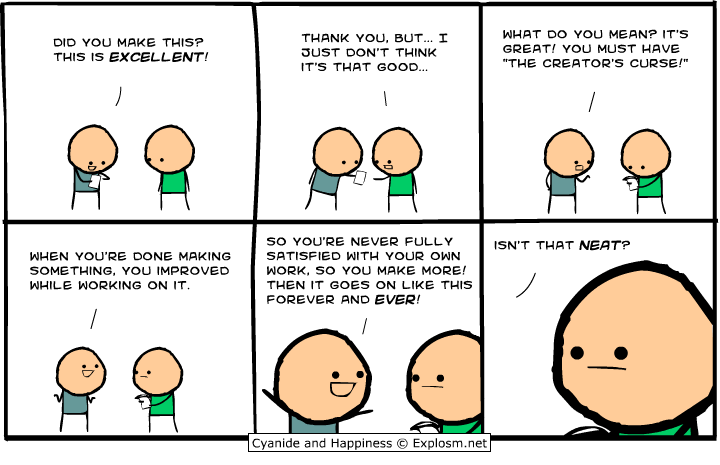
Cyanide Happiness Creators Curse


– The “Creators Curse” from Cyanide & Happiness.  In our making we extend and become in the risking required to attempt…to craft… to work… so it cannot end, for if we grow or move or change (which we will) the work will need to go farther, be finer, account for those fluctuations… ever stepping into new, fresh, dynamic, complex realities… PRACTICE IS IMPOSSIBLE.

But if we turn and try to bring the effort up to speed, in that turning, that editing, that effort, nothing stops.  Nothing stops moving into that next moment, next ream of realities, heart-beat’s context, juggling atoms and muscles and breath…  “Improvement”?  Who knows.  But different for sure.  And even if we reach and stretch toward the work we imagine versus the work we are capable of…it all changes in kind…as change.

In optimistic moments this is cause for hope.  The possibility that something might improve, benefit may come, a temporary health could be achieved.  But not achieved only altered.  And not altered only changing.  I’ve argued before that we must lose our tenses to be honest to living – everything must become verb.

But I don’t want anything to be practice anymore…rather maybe process – doing, making, saying thinking in or with … everything.

I’m very tired of the hesitation, illusory gap, the pretend-vision of seeing our seeing, or feeling our feeling; loving our loving, writing our writing, thinking our thinking our  thinking…

I want to be : living, writing, parenting, loving, doing, making, saying, thinking NOW and HERE as IS.  
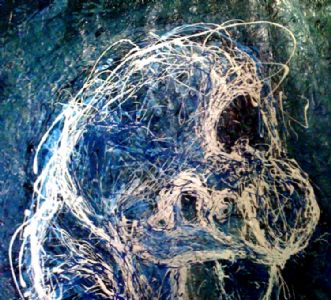
“Leaning into the sharp points”

Suzanne(Beckman-Filbert)Holly-suzanne-prayingman.jpeg


painting by Holly Suzanne

“Fear is a natural reaction to moving closer to the truth” – Pema Chodron

I modeled for the painting above.  It is propped beside the bed as I write.  A large painting, and heavy, maybe 4.5 feet long and 3.5 feet tall, loaded with layers of paint.  She called it “Praying Man,” but I wasn’t praying – the way it turned out I felt like a longshoreman, a hauler, tensed with the energy of pulling things out from the deeps.  I see why she called it that.

We’re reorganizing the house, and in that process I notice what’s gone, and discover things forgotten.  Today it was When Things Fall Apart by Pema Chodron, “heart advice for difficult times.”  I’ve depended on this one before.  It’s written with the situation in mind in which a human feels there is nowhere to escape.  Suffering floods in weights that compress one toward no option.  Chodron says that “No one ever tells us to stop running away from fear…the advice we usually get is to sweeten it up, smooth it over, take a pill, or distract ourselves…but by all means make it go away.”  “We don’t need that kind of encouragement, because dissociating from fear is what we do naturally.”  “Cheating ourselves of the present moment” according to Chodron.

Instead, she suggests, “we could step into uncharted territory and relax with the groundlessness of our situation…by inviting in what we usually avoid…adopting a fearlessly compassionate attitude toward our own pain and that of others.”  I am taking this on as the work of the “praying man.”  The longshoreman and hauler, reeling hand over hand over heart over hurt into the tumult of the pain of being.  “…getting to know fear, becoming familiar with fear, looking it right in the eye – not as a way to solve problems, but as a complete undoing of old ways of seeing, hearing, smelling, tasting and thinking…having the courage to die, the courage to die continually.”  The traditions align.  “He who saves his life will lose it.”  The terror that drives the boundaries, isolates the organism.  Protectiveness cuts the supply chain.  Security stanches generative flow.

What happens when we stay?  Nailed to the present misery.  Chodron suggests that when we move into rather than away from our life-threatening pain a kind of catharsis can occur – an acceptance that we are “precious beyond measure – wise AND foolish, rich AND poor, good AND bad…and totally unfathomable.”

2013-01-22 14.36.20

another painting by Holly Suzanne, emptied of me

The trick is to keep exploring and not bail out, even when we find out that something is not what we thought.  That’s what we’re going to discover again and again and again.  Nothing is what we thought.  I can say that with great confidence.  Emptiness is not what we thought.  Neither is mindfulness or fear.  Compassion – not what we thought.  Love.  Buddha nature.  Courage.  These are code words for things we don’t know in our minds, but any of us could experience them.  These are words that point to what life really is when we let things fall apart and let ourselves be nailed to the present moment.”

Preying Man then, hunched over and hauling it out, rhythmically breathing into the present, a turbulent pain fueled by fear…searching into what I usually avoid.  Hopefully not so much as a way to solve problems, but an undoing of native ways of seeing and hearing, smelling and tasting and thinking…along with the courage to die.

-all quotations Pema Chodron, When Things Fall Apart

Arrivals (cont’d, crossed over the Atlantic)

Isles from the air

Arrivals

“We may ask of our destinations, ‘Help me to feel more generous, less afraid, always curious.  Put a gap between me and my confusion; the whole of the Atlantic between me and my shame.’ Travel agents would be wiser to ask us what we hope to change about our lives rather than simply where we wish to go.”

-Alain de Botton, A Week at the Airport

I must have slumbered, unattractively and fitfully, for the plane windows were open and it was very very bright in the sky.  My glasses had fallen, my head scrunched under an arm rest, legs tightly angled and restrained from the aisle by the arm rest just one seat away.  And below, there were moments of Ireland.

I finished the book, thinking de Botton’s observations might make the arrival more profound.  But Rick Hanson’s Just One Thing helped me more.  “Find beauty, take in the good, be compassionately for yourself.  Breathe out long and the intentions (little by little) will seep out around you” (a paraphrase).  As we circled London, having skewed our arrival from delay, the clouds thickened and soon we were scuttling through the wet and the grey.

I thought: ‘Experience is like this’ (of course it is, it is my experience!) – most of it a thickened ambiguity – the swirl and swoon of our passing – when the winds are right you can make something out – particles of cloud, the edge of the wing, sometimes even a reflection.  That was the moment – clouds surrounding the wing, the wing itself, and the reflection of the scumbling clouds on the wing:  world, ourselves, and occasions where we catch our perception – our experience.

And then we touched down, wet splashing the plane, 21 hours and 41 minutes (by the clock) since I’d set out on this journey.  Customs went smoothly, my luggage arrived, and I tunneled by train to my host.  Now I’m in place at my window as the city becomes squares of lights.  de Botton states it thus: “I returned to my room at three in the morning, struck by a sense of our race as a peculiar, combustible mixture of the beast and the angel.” Assessing out from myself and this view of the city, I agree.

“We forget everything: the books we read, the temples of Japan, the tombs of Luxor, the airline queues, our own foolishness.  And so we gradually return to identifying happiness with elsewhere:  twin rooms overlooking a harbor, a hilltop church boasting the remains of the Sicilian martyr St Agatha, a palm-fringed bungalow with complimentary evening buffet service.  We recover an appetite for packing, hoping and screaming.  We will need to go back and learn the important lessons of the airport all over again soon…”

It’s good to have help on the way.  Thanks to Alain de Botton, Rick Hanson, Cees Nooteboom and David Foster Wallace for “a kind of writing that could report on the world while still remaining irresponsible, subjective, and a bit peculiar” – moving me (little by little) from a here to a there.

view from hotel window

view from hotel window

15 February 2014


Potent Selections from Vacation Reading

“I wondered what indeed it meant about me that I was so set against the notion of convention that I should attack it.  So, I replaced the dream with the novel, stripping the stories of my dreams of any real meaning, but causing the form of them to mean everything.”

“…the gap between the subject of enunciation and the subject of enunciating not only failed to appear to me as a place of entry, but also failed to register as something I might elide.  For me, there was no gap, as there is no gap for anyone.”

P Everett 1

“…generally, people are only inclined to speak of the past with those they believe will somehow not only share some commonality, but who will also be disposed to exhibiting sympathy.”

“Is a photograph always present tense?  I described them so…better, let the question be, is what is in the photograph always in the present, without a before, without an after?  Of course, it is.  And isn’t that actually you in the picture?”

ennuyeux

“On Ludwig Boltzman’s tombstone is carved: S=k. LogW.  S is the entropy of a system, k represents Boltzman’s Constant, and W is a measure of the chaos of a system, essentially the extent to which energy is dispersed in the world.  This equation meant little to me as I read of it the first time, but as I considered it I grew excited.  The space between S and W is the space between the living thing in front of me and stuff hidden inside beyond my observation and comprehension.  It raises the question:  How many ways can the parts of a thing be rearranged before I can see a difference?  How many ways can the atoms and molecules of my hand move and recombine before I realize that something is wrong?  Thinking about it scared me.  Certainly, I understood that natural events symbolize collapse into chaos and that events are motivated by dissolution, but the idea of such subversive and invisible change moved me.  I likened it to observing the minds of others.”

P Everett 2

ootheca

“Ezra Pound said, ‘Every word must be charged with meaning to the utmost possible degree.’  Let it be the case then.  But words need no help from anyone.  Bet thew ords kneeknow hellip freeum heinywon.  Context, story, time, place – don’t these work like Bekins men, packing the words like so many trunks?  But finally, words are not cases to be packed at all, but solid bricks (and, of course, like a brick, even a word’s atoms are not motionless).”

“We do not give the creature reality enough credit, choosing to see it sitting out there as either a construct of ours or an infinitely regressing cause for the trickery of our senses.  But I claim here that the most important thing I have learned is that reality has a soul, reality is conscious of itself and of us, and further is not impressed by us or our attempts to see it.  In fact, we see it all the time and don’t know it, perhaps can’t.  It is like love in that way.”

-all quotes by Percival Everett

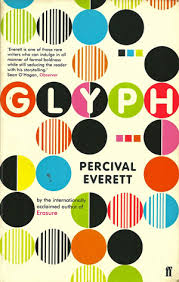
from his novel, Glyph

Glyph - Everett

Writing Wisdom

This turns out to be the best thing I read this week on the art of writing…

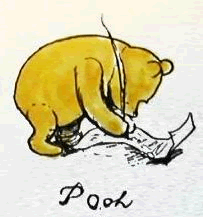
Pooh writing 2

“The friends could not agree which way to go.  Pooh looked for answers.

“Perhaps if we tell a story, the story will tell us how to get there…”

– Winnie the Pooh

struck me solidly as the way so very many of us who write

go about looking for answers.

Pooh writing

Write on…

Synchronous Display – Serendipity

The books I first encountered today – and in such intriguing titular order….

and when is additional engagement with Olafur Arnald’s work not welcome

“Acquiring an open rationality”

The best that I can do on this trip is to share some of the inputs coming my way… aside from the gorgeous lush thick greens of Oregon and Washington, there are also these gorgeous, lush, thick growths…

Edgar Morin – Paradigm of Complexity

Le Moigne – Intelligence of Complexity

“A meaning only reveals its depths once it has encountered and come into contact with another, foreign meaning…” – M. M. Bakhtin

Response to a Question from Novy Mir

– M. M. Bakhtin –

The Heart and its Branches

“I do not want to know about the human heart.  I do not desire to speak at all about those indwelling, intimate reaches of the heart in which anguish is an undiminishing personal interrogation, much less to analytically enfetter those reaches.

I have the sense, the good sense, the decency, to have nothing to say.”

“Sick of all the you be’s?  Well, what do you say, you be you and I’ll be me?  What do you say?  We can fall asleep in a room full of the snoring dead.  We can sleep while an old woman twangs away on a bad piano while rain keeps time in the empty street.  We can listen to and count the closings of a child’s fist as he tries to catch a fruit fly.  We can listen to the whistling of the bombs.  We can listen to each other.

I do not want to know about the human heart.”

“I am not a man of science.  I am not proficient in any branch of nature study.  I do not know the difference between an amphibian and a reptile.  I have no yearning for hard knowledge about the hard world.  And yet I have no affinity for anything spiritual.  In fact, I have a pronounced, conspicuous, and striking absence of an affinity for anything spiritual.

I know but one hard thing about the hard world and it is this:  from the sum of all theories, as arranged in accordance with ascertained facts, we make a few assumptions, that we have actually ascertained facts, that we are actually here to ascertain them, and that there is actually a here.”

-Percival Everett-

“It is only meaningful to speak of originality where there is a tradition” – Robert Musil

“thus one could probably ‘dissect’ any writer whatever (formally, or according to subject matter, or even according to the intended meaning), and would find in him nothing but bits and pieces of his predecessors; by no means completely ‘taken apart’ and ‘newly assimilated,’ but preserved in broken shards”

“Thus in serious literature the peculiar situation emerges that the general ongoing tradition and the personal contribution of the individual cannot be separated from each other.  In this process the continuum does not grow in any dimension other than extent, nor does the personal element gain a solid position.  The whole consists of variations that randomly come to rest on each other.”

-Robert Musil, “Literati & Literature”-