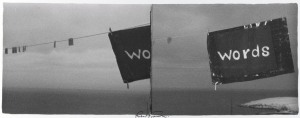
ah how I relish in his mind and language…
Deciderization 2007 – A Special Report
from

The Pleasure of Reading
In other words (than what? than which?) we all of us are readers, all of us writers.
That is a pleasure.
And all of us, always, doing both. Simultaneously.
Speaking of my textbooks (were we?) – information sciences, developmental and behavioral psychology, reference services, librarianship / and the research to the side – physics, evolutionary biology, neuro- and cognitive sciences / my pleasures – novels, poems, stories, others’ blogs, visual, aural, literary artifacts / my relational – wife, children, family, friends, society, culture – gestures and vibes and dialogues and signs / my “self” – sensations, perceptions, formulations of these, reformulations, adjustments and maneuvers.
In other words, at all times, I am reading, even if only my lack of memorable dreams, or pulses and breaths. And writing it all in actions, movements, responses, adjustments of speaking and writing and making.
It is a metaphor, obviously. Perhaps.
Roman Jakobsen purported that “all meaning is a form of translation, and multiple translation (polysemy) is the rule rather than the exception.” (I am translating his text just now into another con-text).
Wolfgang Iser’s (perhaps, anyway insofar as I am translating it here) concept of actual text (text as it is recorded by an author) and virtual text (actual text as read by a reader).
This is an aspect of the deep living pleasures of reading/writing for me.
An author/speaker/artist/scientist/mother/etc. has an urge or sensation – a possibility of action/behavior/message/idea (a virtual text) and translates it through multiple processes and levels of activity through some medium into an actual text/painting/utterance/experiment/recorded idea/sound, etc. There it is in the real world – a physical artifact in time and space – added – if only for a moment. Transforming (simultaneously) its maker into a recipient (translating a now existent text/sound/behavior/gesture/sculpture/experience for him or herself) and if any witness/participant/auditor/recipient or reader is in his or her environment they are simultaneously interacting (via translation through their own tools, language, perceptions, sensations, mood, etc) with the actual text, writing a virtual text (translating) of their own.
And it goes on. And can be done innumerable times, this process, whether using an identical actual text over and over, or simply writing/reading life as it occurs, making it occur.
Paul Ricouer: “stories are models for the redescription of the world.” Possibly. Or at least redescriptions (translations) of models for redescription.
Iser: “the relative indeterminacy of a text allows a spectrum of actualizations…literary texts initiate ‘performances’ of meaning rather than actually formulating meanings themselves…the reader receives it by composing it.”
Language, action, behavior as possibilities rather than certainties.
So that I can encounter with all I’ve encountered/experienced an actual text by psychologist Jerome Bruner translating these very quotes and contents with all he has experienced and translate it with the multiple translations of family life and being a human organism and novels and pains, poems and stories, paintings and laws, translated with data and education, emotions and animals, translating with you and a computer, internet, digits and bits, translating into…
a great pleasure of reading is writing reading
or, “a writer’s (reader’s) greatest gift to a reader (writer) is to help him become a better writer (reader)”
– Jerome Bruner (parentheses mine).
literary texts as “epiphanies of the ordinary”
-James Joyce-
This week’s feeblish attempt at Friday Fictioneers 100-word stories…

It was never difficult to see the way, it’s the getting there that problems. The paths unique to our movements. We tend to think it’s the setting out – that getting going presents the obstacle – but we’re always going somewhere. The millions of streets and alleys, those are what throw us, what keep us from the end. How do we know, in constant diversion? Oh I see a way, but not the destination. I’ll move as I see fit. As will you.
Consider, then choose. But always keep moving. There’s no other way. Keep your eye on the opening.
N Filbert 2012
For those of us with children.
How different the meaning of “precious.” Also “alive.” What the self rearranges.
There was a time.
In the beginning, the excitement of puppies. That generosity. The concept of dependence revised.
A dawning recognition involving hope and helplessness – their power. Sheer organism. Complexity. Alive, mobile, emerging. What wears away, gets broken. What heals, what hardens. Your part in it.
The changing nature of survival, and terms like “health,” “okay,” and “wellness.”
An awareness of trajectories: expansion versus maintenance, collage versus carve, assembling as opposed to mending. The children, the parent.
What persons are. Attachments. Difference. Freedom. Control.
The blowing snow left in their absence. The ways they vanish, into themselves, their people, cracks in the world, airstreams and oceans.
How control rarely changes hands, nearly always remains invisible, what no one grasps.
The erratics of growth, the scale of unexpected development, of motives, of attention.
Intention and the noise inherent in communication. The stage of sighs – their nuances.
We age. Our eyes grow joy and sorrow, and both look like pride coupled to grief.
Randomness of adulthood. Vagaries of time and consequence. Learning curves like tangled thread.
Inevitable dismissal.
N Filbert 2012
try driving through the Flint Hills in Kansas
with accompaniment
“The same urge that leads us to mistake idiom for Word leads us to create a philosophical unconscious by repressing the origins of our concepts.”
-H. L. Hix-
For over a month I have faced the following on my desk:

created for me and delivered with a a sheaf of empty pages and a stapled complete story by my precious daughter Ida, aged 8:

I am passing it along to each of you…as I struggle with the task…
“One needs to have wandered a lot, to have taken many paths, to realize, when all is said and done,
that at no moment one has left one’s own…
…To forget in order to know; to know in order to fill up the forgotten, in its own time.”
-Edmond Jabes-
Nothing is the force / that renovates the world.
-Emily Dickinson-
Please read the following conversation between poets Christine Hume and Rosmarie Waldrop (pp.76-88, click on image for text)
Waldrop has always been a heroine of mine, and I’ve been struggling again with “Who am I?” “What do I do?” “How am I?” – questions of identity and difference that come up in times where we are suffused in roles – students, parents, spouses, artists, employees, gendered, and so on…In insular places where I feel safe I am able to theoretically conjure a kind of flow, that these aren’t choices but movements, that things and actions do not exist, only ‘occasions”, “relations,” but under stress I quickly find myself wishing I knew who/what/where/when/how I am. Today I received this book through inter-library loan, and kept opening to the Waldrop chapter… apparently for good reason. I share many of her points of view, and would like to share them with whomever finds themselves interested.
I think of the ‘between’ more in terms of both, and of extending the gray zone between the black/white in the direction of multivalence. ‘The yes and no in everything.’
-Rosmarie Waldrop-
Rereading. Had forgotten how good.
Or maybe things get better – different – time.
Recommended.
Student Magazine of IISER Mohali
Music, Musicology, and related Matters
a photographic pilgrimage to Orthodox Christian monasteries across the continent
Meandering Through a Literary Life
Orthodox Christianity, Culture and Religion, Making the Journey of Faith
Erik Kwakkel blogging about medieval manuscripts
"That's the big what happened."
Networking the complexity community since 1999
 All my Words are Silent